Wednesday, October 01, 2008

Who are the debtors?

PRE-POSTSCRIPT: Drowning in the firehose of commentary about the crisis and "bailout," I can only recommend my favorites, Instapundit (Glenn Reynolds) and Megan McArdle's joint. Reynolds' entries are terse but frequent; McArdle's less frequent and sometimes a bit long-winded (like I'm one to talk). Both have good links to other places. Megan has a funny screed against bad metaphors for the crisis here. Glenn correctly nudges people to use "rescue" instead of "bailout."*

An idea definitely worth supporting is replacing Pelosi and Reid as House Speaker and Senate leader, respectively. Both have been embarrassments to their party and country. Bush's popularity oscillates between 30 and 40%. This Congress' ratings have never been higher than low 20s and have sunk, at times, into single digits. With good reason, it's the most unpopular Congress since World War Two. Assuming the Democrats maintain control of the House (which they probably will, with a smaller majority), the best choice is Clintonista Rahm Emanuel. Politics makes strange bedfellows: weird as I feel typing these words, everyone's disgusted with Reid-elosi, and the Dems desperately need a counter to the cultish children's crusade that is their presidential campaign.


The credit market and housing debt crisis continues to gyrate. Strangely, it seems to have boosted the prospects of the party that bears much of the blame for it. Remember: government is now involved in backing about 40% of home mortgages.

While I would have voted for the bailout bill if no alternative were available, I completely understand the motives of the House members who voted against. They got an earful from their constituents and only weak pressure from the House leadership. It's essential to decouple the credit-liquidity crunch from the longer-term asset-decline problem. It's too early to seriously discuss responding to the latter. The former needs a response now.

Finance/economics blogger Fabius Maximus (F.M. from this point) recently published a fascinating and frightening look at American debt trends since World War Two. While his views are always loaded with doom and gloom, this argument is worth a look; he's backed it up with hard numbers ultimately based on what the Federal Reserve tracks. F.M.'s debt ratio charts show various categories of debt from 1952 until now, as a fraction of GDP. (The GDP is gross domestic product, the annual output of the American economy, the world's largest, at a little more than a quarter of the global total). I'll admit: my jaw dropped too.

Such high debt ratios are the deep fact now spooking credit markets and foreign investors, deeper than the immediate credit crisis or falling housing prices. No society can get into as much debt as we're in and not create a huge crisis of confidence among lenders. With no sign that the debt accumulation will stop, they've cut back their lending, even to the creditworthy. We've been lucky that this debt is denominated in our own currency, allowing the Fed to massage the money supply and keep credit crises at bay in the past. But, still, there is a limit. Evidently, we've reached it.


From these charts, both the numbers and their trends, we can draw some conclusions at some variance with received wisdom.

Government itself, far from being the main debt culprit, is the least. Its ratio reached an absolute peak in 1945 and has not approached it since.

A large federal debt does seem to be a permanent feature of modern America. The period of the 1960s and 1970s, when the federal debt ratio dropped, is misleading in one respect. In that era, government policy was to print money rather than borrow it. The tendency to borrow, established in the 1930s and 40s, returned in the 80s. OTOH, the effect of peace dividends is real: the drop of the federal debt ratio after World War Two and in the late 80s and early 90s reflects the end of one very large and another, less intensive, conflict. Both the 1950s and the 90s were periods of falling federal debt ratios, because the pressure to increase government spending had eased off. The period after 2000 was marked by a smaller, but still significant, surge in federal debt, mostly a result of the Republicans' new eagerness for big government.**

Business enterprises, both financial (banking and insurance, essentially) and non-financial, have developed a large leveraging habit, borrowing in good times -- during economic expansions -- and paying down in bad -- during and just after recessions. They learned to start doing this in the Great Inflation of the 1970s, because inflation makes debt attractive.

But the habit persisted long after high inflation ended in the 80s. The rationale for business debt is simple: borrow now, found or expand a business, and future profits will more than take care of it. While this "leveraging" generally works, it doesn't work consistently enough to prevent major debt crises from hitting poorly performing corporations at every recessionary downturn. It's a risky strategy with extravagant real payoffs, but frequent casualties as well.

Finally, Americans as consumers, individuals and households, have by far the biggest taste for debt -- an extraordinary taste for it, in fact -- much more than corporations and government.

The largest component of this debt consists of mortgages. But it also consists of credit cards, student and home equity loans, and all the rest. Almost 40% of this debt ratio's increase occurred just in the last 15 years or so.

Powerful institutional and social habits reinforce the preference for personal and household debt. Many of our institutions, both public and private, make debt look and feel very attractive. While bankruptcy was made more punitive a few years ago, lending standards have continued to drop (at least, until a few weeks ago). Inevitably, there will soon be a lot of people in a lot of financial pain and legal trouble. It was fine to make bankruptcy more punitive -- but only if borrowing itself had been made more difficult as well.

F.M.'s charts make me wonder something else. Rather than take on too much debt themselves, government (in relation to housing and higher education) and banks (in relation to credit cards, mortgages, and home equity loans) have instead encouraged ordinary people to take on debt, a lot of it. Preaching prudence and probity, but also enticing us with borrowing and spending, often ready to "juice" the economy with cheap credit, these are institutions at war with themselves, sending very mixed messages.
---
* More accurately, Part I (credit crunch) is a "rescue"; Part II (falling house prices) is a "distressed asset collection and fire sale."

But, ah!, a cynical Ann Althouse smirks in the background :)

** An important feature F.M.'s charts is that his current federal debt totals about $6 trillion, not the $9 trillion you usually hear.

The reason is that he doesn't count $3 trillion in past Social Security and Medicare debt, which (as he rightly points out) merely consists of IOUs written by government to itself. It is not part of the federal debt held by bondholders. In any case, present entitlement costs are at this time paid for by present tax revenue. That will start to change in the next decade, however.

Labels: , , , , ,

Saturday, September 27, 2008

What is to be done?

UPDATE: The post below was composed on Friday and Saturday, so the news is a little outdated.

The distinction I made is parallel to the distinction Virginia Postrel makes in her recent post between the "illiquid" (the immediate credit crunch, the unwillingness of lenders to lend) and the "insolvent" (the narrower and longer-term problem of serious restructuring or bankruptcy, caused by mortgage loans not performing or in default). She also makes the wonderful suggestion that any net profit Treasury makes on federal intervention should be rebated directly to taxpayers.
---
The Paulson-Bernanke proposal for a financial sector bailout still seems to be floundering in Washington. The House Republicans, at last report, are still split on the idea, and without a united front from them, the Democrats are not willing to jump in alone.

For a moment, set aside the economics of the proposal and focus on the politics. The Congressional Republicans suffered in the 2006 elections from the perception that they had completely lost it on restraining federal spending. They had also spent six years in partisan lockstep with Bush on spending, expanding government, and the Iraq war. Enough conservative and independent voters got pissed off by the Republican abandonment of anything resembling conservative policies that many just stayed home or, in some cases, voted Democratic. The Republicans lost control of Congress.

That painful lesson floats in the background now as the House Republicans struggle with the question of whether to support the plan. Some support it because they think it's a good idea, and others oppose because they think it's bad. What hangs in the balance is how much Bush can call on simple partisan and personal loyalty. He lacks the automatic Republican support he enjoyed in his first term, and thus we see a political cliffhanger.


Now turn back to the economics of the plan. Paulson and Bernanke got themselves in some trouble because they failed to explain the situation and their proposal completely enough.

Some of the problem is everyone's ignorance about when and where the housing market will bottom. That event will be crucial in determining the final, diminished values of the assets that back the financial paper (bonds and other credit instruments) that many now suddenly mistrust. Those values in turn will determine the ultimate losses that lending institutions, depositors, and bondholders will face. Many will just have a bad day; a subset will suffer large losses; a subset of that subset will go bankrupt. No one knows the full scope yet. Yesterday's Washington Mutual failure threw some more paint on the canvas and filled in another part of the still-incomplete picture.

Paulson and Bernanke are also wrestling with a crisis that has two very distinct parts, subcrises with different origins, time horizons, and consequences. Their plan addresses both at once, which was probably a mistake, and thus evokes a lot of skepticism.

There's a large advantage to separating these two parts. Part two will take a few years to fully work out and make sure that the government is not overpaying for distressed assets. No one can make those judgments now -- it's too early. At the same time, part one can address the credit crisis right away, but through short-term loans, not buying up assets.

Part one, the credit market crisis, is immediate and needs to be confronted quickly. Failure here would cause severe economic problems, as short-term credit acts as quasi-money for businesses, government, and individuals. If banks and other lenders suddenly decide all at once to stop lending, we will have something like the Great Depression on our hands. The Fed is already acting as it should to prevent this, keeping low the interest rates it controls (federal discount and interbank overnight). It also injects cash by buying up Treasury and government agency bonds and exchanges longer-term bonds for shorter-term. All act to keep the money supply flowing, or "liquid," as economists say.*

But it might prove necessary to do more with the credit crisis than the Fed, under its normal rules, can do. The New York Federal Reserve's AIG loan is the model to follow. It's a relatively short loan (twenty-four months) and, during its term, gives the Treasury some say in how AIG is run. The Treasury, by charging AIG interest, is also forcing AIG to pay for the privilege of rescue.** Such an approach is about preventing a short-term credit crisis, nothing else. It should be ad hoc and address serious dangers quickly as they arise with time-limited rescues. It's not about the collapse of underlying asset values (houses, mainly).

Dealing with that collapse is part two of the crisis, where we have to think in terms of a few years or even a decade, not weeks or months. The model should be the Resolution Trust Corporation that dealt with the savings and loan bust of the early 90s. Here's where the RTC-like agency collects distressed assets in a kind of giant fire sale.† It then resells them, not immediately, but over a period of time, to get better prices and not glut the market for those assets all at once. The RTC worked well in the end, costing taxpayers only about $100 billion.†† The initial cost seemed much higher, because the RTC was in buying mode at first. But in resale mode later on, it recouped most of its gross costs. It worked because it spread out the impact of the S&L bust over a number of years, preventing the cost from being felt all at once.
---
* Bernanke has a strong interest in the Great Depression, when banks failed in large numbers, as the Fed kept pursuing the exactly wrong policy. In effect, it hoarded gold (the dollar was backed by gold in those days) and starved its member banks.

The Federal Reserve is actually not part of the government. It's a publicly chartered, non-commercial private entity that regulates the money supply, which includes not just cash, but various forms of credit and foreign exchange. It's a "bank of banks," which federally chartered banks are required to join and contribute to. Other banks can join too, if they want.

Recently, proposals have been floated to allow non-bank entities (insurance companies like AIG, for example) to join. They would get the help the Fed can provide in a crisis, but they would also have to pony up some of their assets in exchange and accept a higher level of regulation.

** From the government and taxpayer point of view, a loan is better than a guarantee. It makes AIG's assets collateral in case of default. The conditions are more spelled out than a guarantee usually is, and the term is limited in time. Someday, people will thank Paulson and Bernanke for this.

† By themselves, assets are not "distressed." They become so when a loan or some other financial obligation is attached to them that assumes a value well above what they can actually be sold for. Selling the asset raises some cash, but not enough to fully cover the attached obligations.

†† I know, I know - "only" :)

Labels: , , , , , , , ,

Monday, September 01, 2008

It's a small world, after all

The distinguished Solomonia blog has invited your humble correspondent to co-blog with them. Being the sort who tries to play well with other children, I've accepted. You'll be seeing my postings in both places.

Labels:

Monday, August 25, 2008

"The death of 1989"

It's the not the return of the Cold War, not by a long shot. But the wave of democratization, market opening, and globalization that began at the end of 1970s is definitely over. It reached its peak in 1989, with the fall of the Soviet bloc, but continued until the end of the 1990s, with the fall of Milosevic in 2000. But the last eight years have seen a strong reversal of the trend, which goes to show: positive trends can draw on powerful forces, but positive outcomes are far from inevitable. They require sound policies, leadership, and persistence. They're not part of some automatic unfolding of history.*

There's no ideology or coherent political system that ties these resurgent anti-liberal countries together. They're simply autocracies that learned to adapt and avoid the fate of, say, the Soviet Union, Serbia, or Iraq. (What's happening now in Georgia is best thought of as a cousin of what happened in Yugoslavia in the 1990s -- except the analogue of Serbia, Russia, is winning.) The most sophisticated of these autocracies have learned to smooth-talk their way with skillful twisting of Western concepts and language. Having nuclear weapons helps. But the main common factor among all of them is state monopoly control of increasingly valuable oil and natural gas resources. Already familiar from the corrupt petro-dictatorships of the Middle East, Venezuela, and west Africa, such countries feature the "strong state, weak society" model. The government frees itself from dependency on tax revenue by seizing control of valuable natural resources sold mainly to foreigners. Most other valuable economic activity is controlled by the state as well, not motivated by socialist ideologies, but by simple cronyism and gangsterism. The rest of society and economy go into sharp decline. Russia, in many respects, is the most advanced case of these trends.

We won't be hearing talk of "World War V," I hope. But the common denominator of energy monopoly in a world of sharply rising demand for energy will, I expect, stimulate energy-consuming countries to develop a common strategy to moderate demand and look for alternatives to fossil fuels exported from the petro-dictatorships. Such a strategy is certainly overdue. We also need to step back from our casually reckless adherence to the globalization paradigm and concentrate on repair and defense of existing democracies.

And one more point: the progress and retreat of political democratization, social and economic liberalization, and globalization go hand in hand, contrary to a certain piece of fashionable claptrap now making the rounds on the left.

POSTSCRIPT: Some fine reporting, as always, from Michael Totten. Also, thoughts from Paul Berman, who has rightly declared the "death of 1989."
---
* The developments of the last decade have discredited not only the naive arguments of economic determinists (prosperity leads automatically to political liberalization), but the European post-historical fantasy of "soft power." The "end of history" has, well, ended. It didn't die all at once, but in stages: the rise of al Qa'eda and the 9/11 attacks, the return of Russia and China as great powers, the sharp rise in commodity prices, and so on.

Labels: , , , , , , ,

Monday, June 30, 2008

Steal this blog

It's a been a long road, two years here at Kavanna. This blog has covered so much stuff, at length - sometimes too much length - that I can't remember everything. That's why we've put labels on all the postings. Click on a label link, and you'll get all the postings categorized under that label.

With all that climate craziness behind us, we'll be downshifting a bit here for the rest of the summer, and Kavanna will be updated about once every other day or so. We'll still be blogging on culture, religion, politics, science, popular culture, and anything else that strikes our fancy.

And be sure to visit our blogroll friends in the list to the right.

Labels:

Tuesday, June 10, 2008

Why did the chicken cross the road?

Some answers, from Upper Left Coast.

Labels: , ,

Tuesday, June 03, 2008

Is the GOP kaput?

Yes and no.

Looking at it from just this year's election perspective, we can see two seemingly contradictory trends. One is in the presidential race, where McCain has a moderate but distinctive advantage, even against Hillary Clinton, the stronger of the two remaining Democratic contenders. The other is in the Congressional elections, where the Republicans are still in real trouble, as much trouble as they were in back in 2006.

The root of the trouble remains what is was then: no political party has so swiftly abandoned what it purported to represent after achieving such dominance. This development certainly alienated the conservative base, a trend already visible as far back as the 1998 elections. But the party's fecklessness with regard to spending and reorientation towards big guvmint has also alienated right-leaning independent voters and conservative Democrats. Even without being conservative purists, they find less and less reason to vote Republican. It's hard to find a comparable example of a party squandering its natural advantages so completely, so quickly.

It may be past time for what remains of the conservative movement to abandon the baggage of traditional conservatism. It once had a reason and a role. But it's becoming clearer every day that the rhetoric of traditional Anglo-American conservatism - appealing to traditional moral and political authority, patriotism, and religion, while opposing the growth of government - is incoherent, at least under modern conditions.

It leads to weird paradoxes, like the revival of respect for governmental and presidential authority under Reagan, who was opposed to the ambitions and pretensions of modern government; or the abuse of governmental authority by Bush, even while he still uses the rhetoric of conservatism. The ultimate upshot is that such a contradiction has to be solved and has been, by moving in a Nixonian direction - traditional authority, patriotism, and morality tied to massive growth of government. The parallel move of conservative and moderate Democrats to the Republican party means the party has a whole new constituency to serve and a new type of right-leaning populist politician. The most striking sign is the rise of Mike Huckabee, the Christian minister and nanny-statist, who came in second overall in the Republican primaries. Such a politician would have been unthinkable in the GOP even as recently as 15 years ago.

A new sort of coalition is needed, perhaps taking a page from "liberal" parties in other countries, using "liberal" for once in its real meaning: smaller government, market-oriented, and individualist - without the traditionalist, moralistic, and populist baggage. The pieces of such a coalition are at hand. But we don't yet have politicians to lead it. Voters thinking that Obama fits the bill are deluding themselves. He's the most left-leaning presidential candidate in American history, although he lacks much political definition. His politics are a throwback. Even Hillary Clinton, as left as she is, is not such an antique. From the present wreckage of the GOP, such a beginning can be made by liberal Republicans and center-right independents. But it will take a lot more to regroup and reassert the limited government message. (May 29)

POSTSCRIPT: Kimberley Strassel has made a similar argument over at the Wall Street Journal: McCain needs to run against Congress. It's not just that it's controlled right now by the Democrats and has the lowest poll ratings ever recorded. The Congressional Republicans need the wake-up call as well. McCain has contributed in his own way to the present debacle, above all with the ridiculous and unconstitutional McCain-Feingold political speech and finance restrictions.* But he does have significant credibility on spending and not falling into the braindead partisan lockstep that led to the Republican losses in 2006. (May 30)

POST-POSTSCRIPT: Jon Henke of the fascinating Web site, The Next Right, concludes about the Republicans in a way very similar to my distinction among liberal, conservative, and big-government-populist (miracles not math!) Republicans. He correctly points to the rise and fall of the third group, the marginalization of the second, and the surprise resurgence of the first. Henke's been guest-blogging over at Megan McArdle's joint. Maybe someone out there is paying attention to me, and I'm not just bloviating into the silence of cyberspace :) (June 1)
---
* Ironically, McCain himself has opted out of public campaign financing, because of its onerous restrictions.

Labels: , , , , , , , , , ,

Friday, May 09, 2008

Now it gets interesting

The coming fall of PCU, triggered by intolerable costs, is preceded by the final stages of rising prices and hemorrhaging subsidies. This bubble is now the subject of more and more active discussion in the blogosphere and the specialized higher ed press.*

Over at the Yeah Right blog, the mysterious Batman refers to this article on the student loan bubble, following the lead started by Instapundit:
... about "the next market bubble" being higher education, where government subsidies (obstensibly, to improve access to higher education) have had the unintended (but certainly foreseeable) consequence of inflating the costs of college: "Over the last 10 years, after adjusting for inflation, tuition is up 48% at public schools and 24% at private schools."

There are several important parallels with the recent housing bubble; policy goals of extending participation (in higher education, in home ownership) led to people with serious credit risks borrowing a lot to pay a lot for something that, it turns out, isn't worth what they paid....

This bubble, like all bubbles, will have its tragic stories, so I don't want to cheer this on. But if there's a silver lining, it's that it may make people rethink the value of those four years that polite society assumes you need.

Discussion ensues.

How much you wanna bet now on a federal plan in 2009 or 2010 to "save" higher education from a government-enabled burst bubble? And, of course, to keep pushing college education on students who don't need or want it? Just like pushing houses on people who don't need or can't afford them ....

POSTSCRIPT: Nice blog, BTW. Although Batman seems even more mysterious than we are :)

Additional thoughts about how the cultural elite skews education spending the wrong way, from Jerry Pournelle.

POST-POSTSCRIPT: Some bloggers caught Megan McArdle's hysterically funny take on HillaryPlan, but not all of us saw it:
What do Americans care most about this election season? The troubled housing market, and the short supply of oil. That's why Hillary is here with a plan. Specifically, a plan to discourage investment in the oil industry through a windfall profits tax, and to destroy the mortgage market by freezing foreclosures and interest rates. That way, no one has to worry about oil or houses, because there won't be any to worry about. That's just the kind of thoughtful, caring politician she is.
Plus Megan has some really cool economics charts that take me back to college days. I guess my public college education is worth something. And it means Megan is way cool.

And that is why my new life goal is to meet and marry Megan McArdle.
---
* Your guides to the academic scene, Inside Higher Ed and the Chronicle of Higher Education.

Labels: , , , , , , , ,

Saturday, May 03, 2008

More on the end of PCU*

One sign of the impending fall of PCU is the aggressive sniffing of state legislatures around college endowments and other academic assets and income streams. States don't have much leeway here, because of federal charitable tax rules. Yet the trend is striking, for example, right here in Massachusetts and Beantown. See also this, about the explosion of non-educational costs in academia. Might this not be like the dissolution of the monasteries and economic assets of the Catholic Church during the Reformation? The comparison is neither new nor unique to me.

The rise of PCU was never enough to provoke a large, direct revolt by alumni, taxpayers, and students, although it has greatly diminished the prestige and influence of academia in the larger society, compared to 30 or 40 years ago.** Rather, it's costs that will stimulate the revolt, and more generally the perception of academia as an island of bloated privilege. It's not a completely correct perception, but there's enough truth in it that political hay can and will be made.

The right solution is not to revoke universities' charitable status (unless the whole concept is changed across the tax code), but to take a hard look at public and private subsidies to universities and their unwillingness or inability to control costs. Profit-making activity by schools should be spun off into taxable regular commercial enterprises that universities own, but which are legally separate. That's what some schools do already, and it's a common approach in other countries. In any case, the financial problem is not for-profit activity, but "cost-plus" activity.

Such academic blogs as those mentioned last time (Althouse, Instapundit, Volokh Conspiracy, as well as so many others: Augean Stables, Cranky Professor, Professor Bainbridge, Daniel Drezner, and ChicagoBoyz) keep a steady track on the bundle of trends that define PCU: costs, endowments and other subsidies, political correctness, censorship, and declining standards. They know the insides as only insiders can.
---
* Politically Correct University, like the movie!

** One major reason for the rise of think tanks, especially conservative and libertarian ones.

Labels: , , ,

Friday, May 02, 2008

The coming fall of PCU*

It is one thing to wish to have truth on our side, and another to wish sincerely to be on the side of truth.

- Richard Whately, Archbishop of Dublin

In the last generation, something terrible has gone wrong with American colleges and universities. They've become grotesquely overpriced, anti-intellectual, and increasingly repressive backwaters. Outsiders looking in can see it, and, remarkably, so can a growing number of insiders. Outsider Michael Barone:
I am old enough to remember when America's colleges and universities seemed to be the most open-minded and intellectually rigorous institutions in our society. Today, something very much like the opposite is true: America's colleges and universities have become, and have been for some decades, the most closed-minded and intellectually dishonest institutions in our society.
Barone points out that there's no reason why taxpayers, trustees, parents, and students have to continue supporting this. It's unlikely they will continue for much longer. And for its insiders, academia has become a gilded cage, locking up its brightest minds in narrow, obscure corners and conditioning them on a steady diet of the Three Cs: conformism, credentialism, and careerism. William Stuntz of Harvard Law School said it a couple years ago, after the Larry Summers fracas, when he declared Harvard the "General Motors of academia":
... rich, bureaucratic, and confident - a deadly combination. Fifty years from now, Larry Summers's resignation will be known as the moment when Harvard embraced GM's fate.
Political correctness isn't the whole problem, but it is a large part of it. Universities, especially the elite ones, no longer know what to do with their undergraduates. They used to have something called "liberal education," but that has disappeared:
The humanities have destroyed themselves over the past 30 years…. Through an obsession with European jargon and a shallow politicization of discourse, the humanities have imploded…. There’s hardly a campus you can name where the most exciting things that are happening on campus are coming from the humanities departments…. I think the entire profession is in withdrawal at the moment. (Camille Paglia)
I hope people don't think P.C. was just some early 90s fad, like grunge. It's institutionalized - that was the whole point: a generation of tenured intellectual corruption. Along the way the P.C. faculty pressured the non-P.C. to leave or retire and made sure younger non-P.C. faculty weren't hired. They continue to use superficially liberal language for profoundly illiberal ends - it's called "postmodernism," and there's nothing liberal about it. As in 1968, they don't believe in truth or reason; they believe in the fist.


The intellectual origins of this debacle lie in the prestigious 19th century German academia, as Allan Bloom tried to communicate in his prickly classic The Closing of the American Mind, published in 1986, just before the rise of P.C. Occasionally, brave thinkers, such as South African Nobel literature laureate Doris Lessing, will press home the same point. Like Bloom, but coming from a different political direction, she put her finger on the origins of "political correctness":
...the pedantries and verbosity of Communism had their roots in German academia. And now that has become a kind of mildew blighting the whole world.
It's a sad legacy for the great German Enlightenment thinkers, Kant and Hegel. Their style set the stage for later mystagogues and obscurantists to peddle banalities or poisonous nonsense with profound-sounding mumbo-jumbo. Their modern avatar is Heidegger.

We're still suffering the consequences, which came about demographically by the rise of the Boomers to positions of authority in academic institutions. Remember this is the generation that 40 years ago rejected facts-as-such and independent truth. Paul Goodman, one of the best of the 60s radical thinkers (anarchist, founder of gestalt therapy, two generations older than the Boomers), discovered the hard truth about America's Worst Generation in a late 1969 graduate seminar on professionalism:
Didn't every society, however just, require experts? ... [No, his students insisted.] ... Suddenly, I realized that they did not really believe that there was a nature of things. Somehow all functions could be reduced to interpersonal relations and power. There was no knowledge, but only the sociology of knowledge .... they did not believe there was such a thing as the simple truth. To be required to learn something was a trap by which the young were put down and co-opted. Then I knew that I could not get through to them. I had imagined that the world-wide student protest had to do with changing political and moral institutions, to which I was sympathetic, but I now saw that we had to do with a religious crisis of the magnitude of the Reformation in the fifteen hundreds, when not only all institutions but all learning had been corrupted by the Whore of Babylon [the Church].
This is not a generation that can "speak truth to power" - quite the contrary. Political correctness is all about speaking power to truth.**

The most blatant abuses of this type occur when particular individuals are targeted by militant faculty out to "make examples" of designated hate objects. The Larry Summers affair was one. (See here and here.) Another, far worse, was the false case against the Duke lacrosse team, where academic intolerance merged with prosecutorial abuse and media hysteria. We've met the abusive prosecutor before in, for example, the "Scooter" Libby case. And the media: it can't run, it seems, on anything but fake "narrative" expressly built to demonize its targets. It's extravagant spectacle, never mind the facts.***


The problem is not faculty tenure, which American universities and colleges have had since the 1920s and 30s. That privilege was originally balanced off of a small set of powerful administrators who could get things done, while letting faculty go about their teaching and research business. Powerful administrator presence also deterred the worst tendencies of the worst faculty. After academic administrators lost their authority in the 1960s and 70s, concentrated power and responsibility were diffused into "faculty self-governance." Since most faculty are busy with teaching and research, a power vacuum opened up, one filled by the small but vocal and aggressive minority of irresponsible faculty who, more and more, wield veto power over departmental and college decisions and are invariably at the center of eruptions of identity politics and P.C. Contrary to an old misimpression left from the 1960s, it's generally not students, who are in any case too transient a population to do sustained damage to universities.


Political correctness blends with other university trends to produce something beyond just simple closed-mindedness and petty dogmatism. Universities are also big businesses, for-profit in all but name, yet not run the way normal businesses are run to keep costs and waste under control. Instead, being heavily subsidized with little oversight, they're run as "cost-plus" institutions that pass on costs to everyone else, because they can get away with it. Much of higher ed is simply a racket.

Curiously, it's generally not faculty who benefit. While older, tenured faculty have done well in the last 40 years, younger faculty hired since the 1980s are doing much more poorly. They are not only less likely to get tenure, they're increasingly hired off the tenure track; instead, they end up as adjunct or part-time faculty.

You then might wonder what is driving costs up. The answer is found in university budgets: it's "other" - everything else not connected with the university's business of knowledge. It includes vastly expanded student services and athletic departments (which, contrary to myth, rarely make money for their schools). Above all, rising costs are driven by massive growth in administration. As once-powerful academic administrators have lost authority, they have compensated by hiring armies of underlings. Top administrators, in any case, no longer do as much administering as they once did; their jobs have been redefined as money-chasing.

Here's Marty Nemko in the Chronicle of Higher Education:

Colleges should be held at least as accountable as tire companies are. When some Firestone tires were believed to be defective, government investigations, combined with news-media scrutiny, led to higher tire-safety standards. Yet year after year, colleges and universities turn out millions of defective products: students who drop out or graduate with far too little benefit for the time and money spent. Not only do colleges escape punishment, but they are rewarded with taxpayer-financed student grants and loans, which allow them to raise their tuitions even more.

I ask colleges to do no more than tire manufacturers are required to do.
The American Association of University Professors (AAUP) has attempted to counter the mounting criticism with a lame and beside-the-point statement that evades the real issue and astonishingly implies a blank check to universities and doctrinal infallibility to their faculties, with everyone else footing the bill. Conservative critics are saying it (see here and here), but remarkably, even liberal academics are too (here and here). Taxpayers, parents, and alumni continue to pay to be abused in this way. But there's no reason for them to, and I predict that postmodern academia has no more than a decade of life left.

Academia was originally granted its special privileges and status, along with bucketloads of money, to serve a bundle of larger purposes connected with knowledge. It has drifted far from that mandate. Until a few years ago, we might have held hope that universities and colleges could be reformed from within. But the Larry Summers case, more than any other, showed that sympathetic liberal insiders can't pull it off. Summers was the last of his kind. Change will come, but the reformers will not be liberal, sympathetic, or insiders. As Harvard's Stuntz put it, academia, and in fact, America's whole liberal elite, including its fake aristocracy of celebrity, feels a lot like the French aristocracy before 1789, although without the latter's powerful residue of taste and refinement. But for now, it's 1786 - say - and life's good.

POSTSCRIPT: Hat tips to the terrific blogs out there kept by academics, especially those of Ann Althouse, Glenn Reynolds (Instapundit), and Eugene Volokh (The Volokh Conspiracy).
---
* Politically Correct University, like the movie :)

** Here's another striking example, one of many, from the crazy anthropology department at Columbia/Barnard, an incorrigible center of the rot of "Middle East studies." After reading this, my first reaction was, why didn't Reinharz and other liberals like her raise these objections to the wave of P.C. and postmodernism when it started 20 years ago? Columbia is the same place Ahmadinejad got his fawning reception.

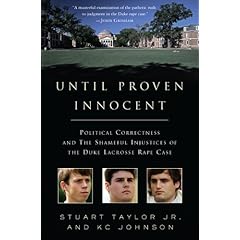
*** There's a rich online and print literature on the Duke travesty, starting with Johnson and Taylor's Until Proven Innocent and the Durham-in-Wonderland blog. Check out these items, from the New Yorker and Harvard's George Borjas, as well this review. (The link above goes to the Economist's review.) The concentrated essence of PCU is all there in one ugly case.

Labels: , , , ,

Thursday, May 01, 2008

Really, it isn't

ANOTHER POST-POST UPDATE: It was +0.6% annualized, not quarterly, but still positive. No 2007-08 recession in sight.
---
PRE-POSTSCRIPT: If the rivers of "narrative trumps fact" bullshit of the news media could be summed up, it would look like this non-news article about the non-recession in the Washington Post: "Employers Cut Fewer Jobs Than Expected."

I just saw another yesterday: Hillary Clinton's strong rebound and Barack Obama's accelerating implosion (the real story) were twisted in headlines into something like, Republicans weaken against Democrats in November (the pseudo-story). The media's candidate (Obama) is fading fast, and the real result is, the Democrats have a somewhat better (but still uphill) chance against McCain in November.
---
It wasn't a recession, whatever it was that happened this past winter. The economy grew by a little under a percent in the first quarter, at an annualized rate of somewhat more than two percent.* The housing sector did take a big hit, however, and it's not over yet. Housing prices will continue to fall.

But, as Ann Althouse puts it, why can't we reporters just "report" what we feel, dammit - plus move on with that Obama guy :)
---
* If I'm interpreting the news story correctly.

Labels: , , , , , , ,

Sunday, April 20, 2008

Chaos, weather, and climate

Nature uses only the longest threads to weave her patterns, so that each small piece of her fabric reveals the organization of the entire tapestry.
- Richard Feynman

In the face of chaos, we might throw up our hands and abandon any attempt to understand climate at a deep level or make any predictions. After all, meteorologists don't try to predict weather beyond 10 days or two weeks. Such humility certainly beats the arrogance of the IPCC and "global warming" fanatics who wrongly believe that the climate problem is in the bag.

It isn't. Contained within it, as a subproblem, is the hardest question in physics, that of chaotic turbulence and turbulent heat convection - itself a problem that not only remains unsolved, but will probably never be solved in complete generality. Add to that the further severe difficulty of discontinuous water transformations (ice, liquid, vapor, and back), and you have a problem like nothing else in science. Soon we'll learn how the misguided idea that this problem is solved ever got started.

The search for the invariant structure of climate. Chaos means that climate can only be understood, crudely speaking, as a range, or climate regime. (Technically, the "range" is really a strange atttractor.) Besides, we're not talking about one thermodynamic variable (pressure, or temperature, say) at one point. We need a set of such variables at every point in space (multiple, spacetime-dependent fields) to specify what we mean by the state of atmosphere.

What's needed is some controlled simplification or approximation that captures this "range," without having to track every variable everywhere within the atmosphere, for all times. The Lorenz attractor, which is defined by only three variables (we need a continuous infinity of them), has an invariant set. "Invariant" means it doesn't change over time as the system does its chaotic thing. What's lacking is a "supershadow" of atmospheric turbulence, an invariant covering set for the whole atmosphere that would allow a simplification of the chaotic part.

On a somewhat different but related tack, it's better to avoid describing the atmosphere using local intensive variables like pressure or temperature. These are local averages and indicate the state of the atmosphere only at one point at a time. The right variables are extensive (meaning, they scale with the size of the system and are additive) and, for an open system, like our atmosphere, not fixed sums over static volumes, but flows. (That is, stop thinking about heat, for example, and start thinking about heat flow.) We already know what the basic flows are: dry air, water vapor and condensed droplets, heat. Their magnitude gives a much better sense of climate globally than beating the dead horse of meaningless temperature averages. (Besides, we need more than just temperature.) Even more compelling is the topology of these flows: their connectivity, regardless of where exactly they are in space or what exactly their magnitudes are.

If we're going to get a grip on "climate change," we'd better get a grip on "climate" and "climate state." Contrary to what everyone assumes, there's no good definition of either at this time, and thus no good definition of "climate change." The question, left unanswered and often unasked, is assumed away. In all branches of science, we get to meat of "what?" questions by looking for invariant or almost-invariant structure. This posting has pointed to some good candidates constituting a starting point for future definitions. And if more quantitative characteristics can also be nailed down, we can start ranking different aspects of atmospheric change in order of importance. At that point, we would have the beginnings of what is so far lacking in climate modeling, controlled approximations.

Why look for answers when you think you already know the answer or, worse, don't even know the question?

POSTSCRIPT: Certainly this past winter has been one of the longest and snowiest in a long time, reinforcing the trend that started in the late 90s. Wisconsin gets it here.

Meanwhile, here's an interesting article in the Wall Street Journal about the non-warming non-crisis in Greenland. It mentions the last warming period in Greenland in the 1950s, not to be confused with larger-scale warming trends mentioned in previous postings. And it makes an interesting and telling point: the warmest post-Ice Age period was the Hypsithermal (or Holocene) Climatic Optimum, about 8000 to 4000 years ago.* For example, Siberia had forests growing all the way up to Arctic Ocean, although the warmth was also worldwide. But the kicker is that Greenland's ice cover was not significantly smaller during the Hypsithermal. Evidently, it's pretty hardy, and there remain some big things that scientists don't understand about it.
---
* In the northern hemisphere. In the southern, it was about 10,000 to 8000 years ago.

Labels: , , , , ,

Saturday, April 12, 2008

The yahoos and snakehandlers strike back

Obama insults the Pennsylvania voters he needs!

Hmm ... this is the end of Obama as blank slate, it is. See here and here for more.

I do believe Mrs. Clinton has this primary in the bag. She did already, but this is more demonstration of how Obama is not really transcending anything. His politics is the usual white upper-middle class elitist liberalism. The fact that he's not "white" is beside the point.

Of course, maybe Obama has a point. I hunted a few times and certainly went fishing plenty of times, all as a kid. But now, as a grown-up, I have put away childish things and have my meat and fish grown for me, at the grocery store, like other civilized people.

(Hat tip to Instapundit.)

POSTSCRIPT: Someone's got Obama's number:
By cracky, it's like the man sees into my very soul!

Thirty years ago, I had a good job in the mill in Pittsburgh. I was bringing in a good income, going to jazz clubs, discussing Proust over white wine and brie, with my gay friends of all colors. I was all for free trade, so that we could sell the steel overseas, and I never bothered to go to church, let alone actually believe in God.

But then, the plant closed down, and I couldn't get another job. I went on unemployment, and found odd jobs here and there, but they barely paid the rent on the loft, and the payment on the Bimmer. I couldn't afford the wine and brie any more, and had to shift over to beer and brats.

Of course, as a result, I started hanging out with the wrong crowd - the beer drinkers.

And it wasn't just the beer. Some of them actually went out in the woods in the fall, and shot animals. And kilt 'em. With real guns!

I was shocked, of course ....

Labels: , , , ,

Friday, April 11, 2008

When will the Obama cult end?

This spring? This summer? This November?

It's clear that Hillary Clinton is the better of the two Democratic candidates for the general election in November, and the primary voters seem to agree with this. She has won all but one of the big states (including her almost-certain victory in Pennsylvania coming up) and all of the swing states the Dems will need in November. Obama's entire primary vote lead came from his home district of Cook County, Illinois. If the Dems had more rational primary rules, like the Republicans, she would already be the nominee. The weird inability of Dem primary voters to make the full weight of their voice heard is what's allowing the media and the left wing of the party to "wag the dog," so to speak. This is likely to be the Democrats' final opportunity for the forseeable future to have a large impact on national politics, and they seem determined to blow it.

Obama has on his side an extraordinary alliance of the left wing of the Democratic party and the media, which seem determined to get him nominated. Let's go over this again: He's the most underqualified candidate to run for President in a long time. His political "movement" smacks more of a cult than anything else. Given his views, which are to the left of Clinton and which he tries hard to hide, he has a poor chance against McCain in November. Without the center and center-left vote Clinton has a better chance of getting, Obama stands no chance of winning the general election. The Democrats, in fact, would have to start thinking about how big the loss will be: not just the White House, but one or both houses of Congress as well. The defections will be fatal and leave the Party in a shape similar to what it was like after 1972 or 1984.

The complaints about Bush, his inexperience and provinciality, were well-founded seven or eight years ago. They hold with much more force for Obama. In spite of his talk of "restoring" America's reputation, he's a foreign-policy lightweight, at best - it's more about restoring some fantasy shared by, say, Ted Turner and George Soros. His obvious ignorance of foreign trade and the Middle East make his noises about these issues laughable. With leadership on trade and other international issues, Bush looks profound by comparison. Obama has in addition the heavy political baggage of the people he's chosen to associate with. All of these problems will become far worse in the general election, no matter how hard to media tries to distract people. That only works for so long.

Of course, the Democrats were always going to have a hard time this year: they're no longer running against Bush. Early on, they eliminated their most qualified candidates and, instead, gave us the spectacle of empty identity politics and exceptionally slick levels of political cynicism - more obviously from Clinton, less obviously but even more disturbingly from Obama - that leave any outside observer with a simple conclusion: the Democratic party is politically and morally bankrupt. Its putative base continues to shrink, and an Obama nomination will accelerate the shrinkage and defections to the point that the Dems may cease to be a viable national party at all. Once a forward-looking optimistic bunch, the Dems have become a strange collection of panicked, self-hating rubes.

The cult of Obama feeds on a number of things, including a surprising amount of misogyny. But more than anything, it is the desperation of liberals that makes them prone to bad choices. Democrats can look back on over fifty years and not see (with one exception) a successful Democratic presidency since Truman left office in 1953. The turning point was undoubtedly the awful day in November 1963 that started the liberal "unhingement." The JFK presidency left an ambiguous legacy; Johnson began with great success and ended as a failure. Carter was just a failure. Clinton's second term, after a failed first term, is the only bright spot for the Democrats in half a century - but it came at the price of Clinton's adopting some of the most conservative Democratic policies since - well - Grover Cleveland. This left liberals in the strange position of being ready to do anything to defend Clinton personally but hating his policies. The consequences were bad for the Dems. In 2000, Gore, instead of sensibly running on Clintonism but keeping Clinton at arm's length, ran a bizarre pseudo-populist campaign spooked by the fringe candidacies of Bradley and Nader to his left. The same logic was at work in the fringe Dean candidacy in 2003, heavily promoted by the media and the left wing of the party, and only ended when the primary voters had their say.

The Democrats need to think long and hard before they continue down the road with the Obama cult, drink the Kool-Aid, walk over the cliff - or whatever other cult metaphors you want to use. Cinnamon Stillwell has this to say: "He's not the Second Coming, you know" - but according to some, he is apparently the First :)

When will the Obama cult end? Maybe when Clinton wins in Pennsylvania ... nah. The cult will end when the media lose interest.

POSTSCRIPT: I missed this column by Robert Samuelson in February, but it's worth reading.

A detailed article on Obama's early career, including more disturbing material about the Reverend Wright (see page 8), from the New Republic.

Labels: , , , , , , ,

Monday, April 07, 2008

Oh god, she's done it again ... :)

Our polar correspondent, Jen of Nunavut, after a long, hard winter, joins the Inuit in doing more un-P.C. things with polar bears.

Labels: , ,

Sunday, April 06, 2008

Inside the biofuels craze

I've been meaning to blog on this topic for a while. Reading the apparently opposing conclusions of Cinnamon Stillwell's blog and Robert Zubrin's book on biofuels, Energy Victory, pushed me over the edge.

The first thing to say is, human-induced global climate change isn't happening, at least not at a level significant enough to distinguish it from anything happening in climate anyway. The facts that biofuels, when burned, produce more carbon dioxide is not important from that angle. OTOH plants currently alive will love it - at least, until they're harvested to feed our fuel hunger.

Ah, the circle of life :)

Anyway, the corn-based ethanol industry does seem to be an unequivocal subsidized boondoggle. It's breathed new life into those ridiculous agricultural supports that Congress actually tried to phase out a decade ago,* but failed to. You pay twice for them: once through your taxes, and then again the grocery store - they indirectly drive up the cost of other commodities, as Cinnamon explains in her post. The craze for ethanol is also causing a lot of environmental damage, much of it government-subsidized: accelerated chopping down of rainforests and other trees, pollution run-off, pressure on water supplies, and so on.

The real argument for biofuels is geopolitical. It's a way for hydrocarbon-burning countries to get alternatives to the monopoly of petroleum. Moderating petroleum demand worldwide is the key, not the obsolete ideal of energy independence. Zubrin argues more in favor of biodiesel and methanol (which can be made from any biomass, and the latter from coal and natural gas as well). But his recent statements have increasingly gone over the cliff in promoting biofuels, and he's thrown away any earlier caution he had about ethanol. He does effectively demolish the claims for hydrogen as a fuel source, something that thankfully you no longer hear much about. He also smartly promotes nuclear power for fixed-site power generation. Virtually every other advanced country in the world has been moving rapidly forward with nuclear power; the US is stuck in the 1970s on this.

But there's still a significant role for conservation. Scandalously, the US vehicle fleet's fuel efficiency, which rose from the mid-1970s until the early 1990s, has been falling for more than a decade, thanks to all those SUVs and monster "light" trucks out there. There's been something of a turn-around recently, but not enough. It has to be larger and sustained for a decade-plus to make a real impact. Since this is a geopolitical problem, it's perfectly reasonable for the Feds to impose a much higher gasoline tax, say enough to pay for a quarter or a third of our military budget, that part tied up with the Middle East. The tax rate should be set up to rise or fall as the price of petroleum falls or rises, so as to maintain a roughly constant and high pump price for gas. The gas price doesn't have to be at European levels, but it does need to remain at a reasonably high, sustained level. A few years of oil price collapse would probably erase whatever progress is made, by removing the pressure to conserve.

There is a good case for methanol and biodiesel. They're derived from partially or completely transformed biowaste, not from plants grown for food, and their negatives are far less than ethanol. Methanol is also economically competitive at the $1.00 to $1.50 per gallon level. It's just then a matter of getting a vehicle fleet that can burn methanol pure or mixed with gas (so-called M-85 fuel and variants). That's what Zubrin's book is about. Unfortunately, there's no big payoff for politicians. Methanol is easier to produce than ethanol and can't be rewarded with targeted subsidies the same way. But selling cars with the right engines is complicated by pollution and fuel efficiency rules. Like many of our problems these days, this is more political than anything else.

POSTSCRIPT: Here are some basic science about ethanol and methanol, both alcohols, and some basics about alcohols as fuels.
---
* Back when Congress still had a significant number of conservatives.

Labels: , , , , , , ,

Friday, April 04, 2008

West Coast Cinnamon

Cinnamon Stillwell is a journalist for the San Francisco Chronicle, but does a lot of her own freelance work as well, especially for an important organization called CampusWatch (linked at right). Kavanna's blogroll now links to her excellent blog, which is part of Pajamas Media, and you can see her Web site here.

Labels: , , ,

Thursday, April 03, 2008

More blogosphere incest

Oh the sheer deliciousness of it .... Solomonia now posts on the Boston blogger meeting I posted on earlier.

And thanks to everyone who stopped by in the last couple days! Read on.

Labels: , ,

Tuesday, April 01, 2008

The bloggers' coven

So there we all were, a generation lost in ... Blogistan, or something. Some decidedly dissident bloggers of the Boston area met tonight in an undisclosed location, and I had the distinct pleasure of meeting the people behind these outstanding sites, whom I now count as friends:
Apologies to bloggers present whom I overlooked!

To start with, we all laughed ourselves silly by reciting out loud Iowahawk's priceless parody (but is it?) of the current Archbishop of Canterbury and his take on the rise of shari'a in Britain. It's a rewrite of Chaucer's Canterbury Tales and not to be missed, especially its surprise ending:

Whan in Februar, withe hise global warmynge
Midst unseasonabyl rain and stormynge
Gaia in hyr heat encourages ....

On a more serious note, we discussed the provocative and controversial short movie Fitna, which has led to death threats for Dutch filmmaker Geert Wilders. We also discussed the larger problem in Europe of developing a consistently non-supremacist approach to opposing the rise of shari'a. There is a wing of the European right with a questionable past and questionable present-day democratic credentials, and who are opposed to Muslim immigration altogether - they were mentioned here last year and denounced perhaps unfairly in overly-sweeping terms. The problem is that serious and difficult issues like this are still often avoided by Europe's mainstream parties, leaving fringe parties to capitalize on them.

Finally, I must mention that the divine Sisu, Mr. Libertarian Leanings, and I had a lengthy discussion on climate. My contribution, besides trying my best to be the evening's instant expert on the subject, was to mention the two most important recent popular books on the subject:
Sisu has an excellent recent posting on temperature and ice trends in Antarctica, which not only continue to track colder and colder, but just this past year, have gone more in that direction than any year recorded. In a rational world, that decisively stop the "global warming" insanity cold, if you'll excuse the expression. Whatever's going on in the Asian/Pacific Arctic, isn't global - it's local.

POSTSCRIPT: Minor updates today - thanks for comments!

Labels: , , , ,

Tuesday, March 18, 2008

The final odyssey

People are just dying too damn fast :(

Now it's Arthur C. Clarke, science and science fiction writer, and the inventor of geosynchronous orbits and communications satellites. Hal will open the pod bay doors no more.

See here for the February and October 1945 issues of Wireless World, with Clarke's articles on space flight and satellites.

POSTSCRIPT: Glenn Reynolds of Instapundit has a fine tribute to Clarke here. Clarke was the last of the Big Three (Asimov and Heinlein being the other two) whose work filled our young minds with curiosity and big questions all those decades ago. "The world is better for his having lived, and worse for his having died."

Labels: , , , ,