Saturday, October 25, 2008

I'm Binah, and I approved this posting


It's a shame, but I have reached the point of no longer having the time to blog as I once did -- life has too many other demands at this point. So I'm quitting the blogging life, perhaps for good, perhaps just for a time.

I don't need to expand much on the depressing political developments probably coming our way -- a large step backwards to about 30 or 40 years ago -- in the form of Barack Obama, his movement, and the flunky journalist class that surrounds and protects him. Falsely sold as an agent of change, Obama in reality is the politics of Boomer nostalgia made flesh and dwelling among us, as well as a false messiah of the panicked establishment now filling his campaign coffers. It's older voters and older Boomers who are his core supporters. He's not the future, but very much the past, nicely scripted and teleprompted.

There will be no more seemingly limitless easy credit from our Asian lenders after the current financial crisis ends. Once discredited, nostalgia-filled "progressive" politics is likely to turn into nasty or even violent reaction. Constitutional and democratic government will be under exceptional stress, with suppression of dissent and free speech very likely. With its voter fraud schemes and bullying of local radio and television stations, the Obama campaign is a foretaste.

Somewhere between cult and hoax, an Obama presidency will probably be one term only. But don't get your hopes up too fast. An enfeebled GOP will take at least a decade to rebuilt an effective opposition, and we don't have a decade to respond to the crisis brought on by a vast credit bubble and a decade and a half of overborrowing. The coming breakdown of the welfare state will only add more woe. The problems created by too much debt cannot be solved by more borrowing. Politicians' new false promises can't undo the damage done by past false promises.

Political opposition is likely to take more bizarre forms. Backward steps in tax and other policies will undoubtedly make the US an even more hostile place than it already is for businesses that produce goods and services -- as opposed to financial institutions and politicians that encourage Americans to pile on more debt to buy from elsewhere. The dollar's long period as the world's main reserve currency enabled much of this excess. Expect the dollar to lose much or all of this status. The terms of borrowing from foreigners will become much tougher.

If we had a free press in America -- ah, but we don't. (See here and here, curiously, both by Democrats.) What we have instead is a class of would-be courtiers and lackeys, all primping themselves to serve as Obamamerica's unpaid Ministry of Popular Enlightenment. The conventional media is a junk-food banquet in which most of the dishes are poisoned. The best thing you can do is the simplest: turn it off. Conservatives, libertarians, and independents need to abandon the media-driven populist posturing that has displaced their older political wisdom in the last 15 years. The conservative movement so successful in the 1970s, 80s, and 90s was a movement of personal experience, thought, conversation, and books, not a movement of televised talking heads, Washington cocktail parties, and pandering.

This is Binah, signing off, till who knows when. To quote a journalist from a different era, when America actually had reporters, good night and good luck. Let's hope the night doesn't last longer than it needs to.


POSTSCRIPT: How could I forget "blogal warming"? :) Good news to report: more and more scientists are publicly rejecting the idea, as the negative evidence keeps piling up. Don't ignore your personal experience: the last two years really have been colder. The polar regions, especially the Antarctic, are cooling. The connection to the Sun's weakening magnetism can no longer be disputed, even if it is not yet understood.

It's refreshing to see scientists responding to evidence and ignoring mistaken computer models. If only Wall Street had taken this to heart earlier ....

Labels: , , , , , ,

Friday, September 05, 2008

The fall of the Kyoto Accord, continued

Here's one more sign of the end of the Kyoto era. No country that signed the Accord a decade-plus ago has met its carbon dioxide emissions targets.

The conventional wisdom was that Britain had come closest and showed that significant reductions in CO2 emissions were possible. But the conventional wisdom is wrong.

The respected Stockholm Environment Institute, in York, has done its own CO2 emissions audit and found that Britain's emissions have been rising along with everyone else's, at a similar pace. The official figures demonstrate how open the entire issue is to manipulation.

Labels: , , ,

Thursday, September 04, 2008

"Climate consensus" continues to unravel

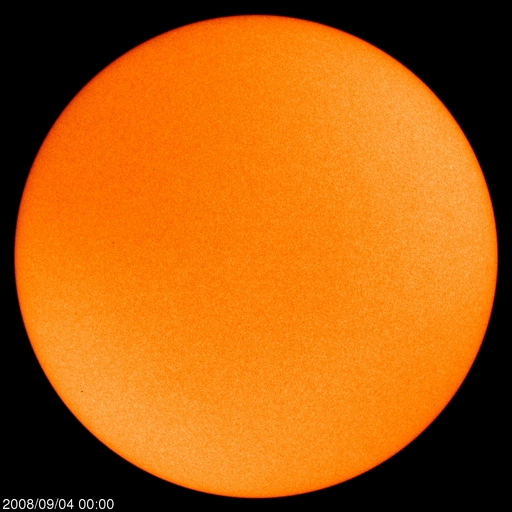
The most curious solar cycle 24 continues its dearth of sunspots. The Sun has now gone more than a month without a spot, the first time in a century (nice roundups here and here).

Why is this important? There is circumstantial but strong evidence that the 11-year solar magnetic cycle and its longer-term modulations are responsible for the Earth's climate variability over decades to centuries to millennia. The stronger that cycle is on the Sun, the warmer it seems to be here; the weaker, the cooler. The best proxy metric for the cycle strength is its exact period, which varies somewhat from just under 10 years to about 11 years. The cycle is stronger when the period is shorter, weaker when longer.

However, other measures of cycle strength are also used. One is total solar surface area covered by spots; another is number of spots. "No spots visible" might mean the new cycle 24 will be weaker. The last four cycles have been fairly strong, with cycle 22 of the late 80s being the strongest of the four. Perhaps not accidentally, temperatures on Earth the last year or so have been ~ 0.6 - 1.0 oC cooler than the decade immediately prior (with annual and daily variations removed).

Meanwhile, some scientific organizations have issued an equally curious call for a lot more money to be spent in climate modeling, because, you see, climate still isn't nailed down. If it means going back to scratch with unanswered basic scientific questions, yes, although I doubt a huge amount will be necessary. If it means continuing down the same deadend path climate modeling has been on for the last 30 years, no, it's a waste. It's more of the same mistakes. But it's not what they said that's really important, it's what's implied: climate is not nailed down scientifically. Indeed.

I think we're within a year or two of laying the manufactured climate crisis to rest for good. Then the science can come out from under its 15-year partial embargo.

POSTSCRIPT: Here's a technical comparison of climate models with observed climate, over weekly-to-century time scales (Koutsoyiannis et al.), with negative conclusions about the reliability of climate models beyond a scale of about a year. That is, conventional climate models are unreliable for "climate" as opposed to "weather." (Hat tip to ClimateAudit.)

Labels: , , , ,

Thursday, August 21, 2008

Basic research and why it's important

Recently, Physics Today, flagship publication of the American Physical Society (but not a refereed journal), published an interesting article on "soft," liquid or liquid-like states of matter (requires subscription). I was struck by how much progress has been made in the last 30 years on the subject and by how much that progress was due to the interaction of applied and basic, or pure, research. Such achievements show better than any abstract argument why science can't function without both.

Basic research is not necessarily theoretical -- it can include experiment -- but it is conducted with no immediate application in mind. It's obvious enough that pure research needs both experimental and applied research. (Ignore this, and you get string theory.) I don't think any successful pure research was ever not a result, direct or indirect, of some attempt to solve an applied problem.*

But applied research needs pure research as well. The reason is that applied research, carried far enough, encounters or poses problems that applied research alone cannot answer. Re-posed as pure research, these problems and their eventual solutions in turn often have unexpected and broad ramifications. There's Fourier analysis, for example; 200 years ago, it was mainly a mathematician's curiosity. But by the late 19th century, it was already very practical. Today, most of the technological gadgets we encounter day to day owe something to Fourier's discovery.

Weather and climate constitute a case where understanding beyond a certain point fails because of large, unanswered basic questions about the definition, nature, and prediction of "climate" over long times. The pressure on scientists to resolve questions that currently lack answers is what has produced the groundless para-science of "global warming." Without the real thing, empty mummery and BS fill the void. A "consensus" is manufactured. Pressure to conform to this consensus overrides scientific standards and critical thinking. Demands for policy-ready conclusions are a major culprit.

POSTSCRIPT: With hurricane season upon us, making climate predictions more useful is becoming topical. But typical weather predictions of a few days or the two-week type are all that's needed to get people out of the way of incoming storms.** There's no point in creating an industry of bogus "long-term forecasting." At the present stage of the science, such an industry can be no better than reading tea leaves, beyond obvious seasonal and other astronomical patterns.

The value of basic research arises from the apparent paradox that, to be useful in the long run, it has to be "useless" in the short.
---
* That's true even of subatomic physics, which has its origins in 19th century theories of electromagnetism and early 20th century attempts to combine electromagnetism and quantum mechanics.

** Even better is finding ways of discouraging people from living in likely storm paths in the first place -- or at least, not encouraging them.

Wealthier countries have early warning systems in case of severe weather. A helpful step would be to make these early warnings more available in poorer countries. But such steps have nothing to do with improving weather forecasting or climate science. They're about making already-known information better disseminated and, in that sense, "more useful."

Labels: , , ,

Sunday, June 29, 2008

Climate and climate change: Envoi

And so we come to the end of the road we began 19 months ago. We've covered almost every aspect of Earth's climate, climate change, the "global warming" craze, basic physics, the nature of scientific theories and science as a culture, and the associated politics, policy, and journalism. Some points were only touched on, others explored at great length, with some tangents here and there. Friends tell me I need to turn the whole production into a book, and maybe I will one day.

On the blog, we'll continue to comment from time to time about climate trends, political trends, and related economic questions, which we haven't talked about much. This blog now has a significant list of climate-related posting labels that you can use to locate postings on particular topics. They include: climate, environment, geoengineering, global warming, polar, radiation, storms, thermodynamics. Some additional technical topics include: chaos, cycles, Fourier, statistics. And don't forget the excellent climate blogs to the right: ClimateAudit, CO2 Science, and World Climate Report.

The one-minute summary. Start with the Earth, its atmosphere and oceans, add the Sun and its heliosphere (solar wind and magnetic field). Add the most distinctive thing about Earth's climate, the presence of water and its astonishing repertory of possibilities. Radiation comes in from the Sun and is absorbed and re-radiated as infrared (IR) at a temperature of about 288 oK (56 oF = 15 oC). Carefully distinguish heat (some "thing" in a volume) from heat flow (some "thing" moving in some direction, with some magnitude). From the thermal point of view, the Earth is an open system; heat doesn't stop, but keeps flowing out, balancing what flows in. It's how it flows that determines the distribution of temperature and humidity.

Radiation (moving at the speed of light)
heat = heat flow

Matter (moving much more slowly): earth, water, air
heat ≠ heat flow

In matter, heat can:
  • Flow through (conduction)
  • Move with (convection)
  • Transform phase (water)
The phases of water are:

Vapor ++evaporation/condensation++ Liquid ++melting/freezing++ Crystal (Ice) ++sublimation/deposition++ Vapor etc. *

From the mechanical and chemical points of view, OTOH, the Earth system is closed, if we draw the boundaries properly and include oceans, crust, air, and living things.

Heat flows upward through the atmosphere and, as radiation, back into space, determining its temperature, humidity, and cloud distribution by a mix of three types of flow: infrared-radiative, evaporation, and convection. The flow is not radiation alone, and the Earth's atmosphere is not a greenhouse, not even approximately.

Radiation is a steady flow, although it is strongly affected by clouds. Heat convection, an aspect of fluid turbulence, is chaotic and makes weather unpredictable beyond about two weeks ahead. On longer times, the weather exhibits fundamentally nonrepetitive patterns, in spite of the many aspects that do repeat. Atmospheric fluid turbulence is additionally complicated by the ceaseless transformations of water: liquid to vapor to condensed droplets (clouds) to heavier, falling droplets or crystals (precipitation), back to liquid or ice again. Fluid turbulence remains the hardest unsolved problem in physics. But not capturing the full nature and effect of clouds is probably the single largest failing in contemporary climate models.

Global warming as barely noticeable. The presence of IR-opaque gases in the clear air (water vapor, carbon dioxide, methane) directly modifies the outflow of radiation and indirectly modifies air and water temperatures, evaporation, clouds, precipitation, and convection. A "globally-warming" world would be one that looks a little more tropical, with the largest relative changes happening in the coldest regions (the poles) and during the coldest times (the winter). There's no evidence that this pattern is under way. The time scale is not decades, but a couple centuries, and on that scale and longer, plant and ocean absorption of carbon dioxide will have a major impact. It's very unlikely that a doubling of carbon dioxide concentration would have much of an effect, except perhaps for enhanced precipitation. A tripling would, but plant and ocean absorption might prevent that from ever happening.

Beyond doing nothing, the only justifiable countermeasure at this time is the easy and benign one of more and better plants, with CO2 emission taxes held in reserve in case of the problem is worse than foreseeable now. Scrap everything else, including cap-and-trade. Ignore Stern, Gore, and the other sanctimonious doom-preachers with wild, costly schemes.

I've never met anyone who hates trees, and there are plenty of places in the world that could use more of them.

Environmentalism, politics, and policy: My two cents. Another approach to the profoundly non-crisis nature of "global warming" is to take the cost and benefit estimates of a previous posting (Nordhaus), combined with the 2.5 kg of CO2 gas emitted for every gallon of gasoline burned. The estimated "global warming" cost (with the IPCC's too-high numbers) is about $8/metric ton CO2. A tax offsetting the cost would then be roughly (0.0025 metric tons CO2/gallon gasoline)*($8/metric ton CO2) = $0.022, or 2 cents per gallon. With a scaled-down estimate of the cost of "do nothing about CO2 emissions," we're below a cent per gallon.

Of course, you might say that such a cheap tax should not be objectionable, and, in a limited sense, you're right. If such a tax ever becomes necessary, our politicians would probably squander the revenue on some stupidity or other. But there's only one right place the money should go: to more trees and other plants. But that misses my larger point, which is the utter triviality of the issue compared to other, much larger, and far more pressing issues.

"Environment" and "energy production" are often lumped together, but they shouldn't be. Our economic and geopolitical need for a change to energy production (especially toward biofuels and nuclear power) is a real problem, right now, that needs addressing in the next few years, not the next couple centuries. The path forward is blocked partly by stupid and obsolete regulation. Pollution of the old-fashioned kind has not been much of a problem in wealthy countries for more than a generation. It is a major problem in "middle-income" countries undergoing rapid development, like China, Brazil, India, and Russia. Gases like carbon dioxide, methane, and water vapor are not exotic poisons from Planet Krypton; they're gases the Earth's oceans and plants have been processing for billions of years.

While I'm optimistic about the power of reason on such issues in the longer term, and especially on ordinary voters, I'm much less sanguine about our decadent political class (politicians, media, environmentalists), with their heavy investment in bad theories, misinformation, and guilt trips. Their unquenchable addiction to pseudo-apocalypses and pseudo-messiahs has become an active danger to our future. At the same time, they ignore real problems, especially ones they helped to create. The scientific case for "climate change" apocalypse, never strong, has disintegrated. The blind juggernaut of bad politics, bad journalism, and hollow Official Science rolls on. It's up to us to shut it down.
---
* The atmospheric pressure is too high on Earth for ice to sublime directly from ice to vapor. But not on low-pressure Mars.

Labels: , , , ,

Saturday, June 28, 2008

The polar bear disaster

A sidelight on the strange world of climate hysteria and what Official Science has done to us ....

The "endangered polar bear" fiasco is an example of the madness of manufactured ignorance. The new Bush administration position, putting forth polar bears as endangered but attempting to not invoke the full regulatory apparatus of the Endangered Species Act, is an incoherent piece of cynical political maneuvering. The decision should be rescinded immediately.

For one thing, the decision puts us in immediate conflict with Canada and other Arctic-bordering countries. Polar bear numbers are healthy, and there are more than a few decades ago. ("Endangered" means populations so small they risk not being able to reproduce themselves.) Instead, the new policy is based on speculative judgments about the Arctic ice shrinking, in spite of the facts: the polar bear population is growing, most of the Arctic ice is not shrinking, the Antarctic is cooling and icing up, and polar bears range mainly along shorelines. There's no scientific basis for considering them endangered.

Here's another case of the authoritarian mummery of Official Science putting science and scientists into conflict with policy. What do they say? What they know (polar bears aren't in danger)? Or, what they're supposed to say? Climate hysteria has loaded a wide range of scientific subjects, journals, scientists, and professional societies with this dilemma. Go with the politics, be a "player" - or stick to the science? As scientists, what do we traffic in: authority, or knowledge?

The Bushies seem to think this will mollify some people, but without giving the environmentalist wackos a powerful new legal lever to start demolishing industrial civilization in the US. Here again, we see a breakdown of governmental sovereignty, how government's power, especially under a weak president, becomes fragmented, taken over by narrow interest groups, and abused at the expense of society as a whole. The situation is frightening, opening up a limitless dictatorship over everyday life by environmentalist and legal fanatics.

Labels: , , , , ,

Friday, June 27, 2008

Climate policy after Kyoto

The first thing to understand about the policy implications of abandoning the Official Science of climate is that we are, indeed, living after the Kyoto era. Many don't understand this yet.

In quick succession, the seeds of the "climate change" hysteria sown in the late 80s sprouted into the 1992 Rio "Earth" summit, followed by the Intergovernmental Panel on Climate Change (IPCC) of the UN, which started issuing regular reports in 1997. A pact committing signatory nations to significant reductions in CO2 emissions (back to 1990 levels) was negotiated in Kyoto, Japan, in 1996. Many countries ratified it. The US gave preliminary presidential approval. But a 95-0 advisory vote in the Senate rejected the treaty, and the Clinton administration didn't even bother to formally submit the treaty for Senate ratification.

The scientific case fails. The years since have seen two basic developments. One is that the case for current and recent warming, never more than ambiguous, underwent the rise and fall of the "hockey stick." For ten years, people were sent running around in circles by a manifestly wrong scientific claim. In the end, in 2007, the IPCC implicitly abandoned the "hockey stick" for the pre-1980s climate and implicitly acknowledged the long-term, four-to-five century warming trend (far too long to have anything to do with human activity), sticking to much more modest claim of post-1980 human-caused warming. Even this claim has fallen in the last decade, however, as mixed trends of the 1990s have been followed by a clear, decade-long cooling trend. The observational case for "global warming" fell apart. There was never any serious theoretical case.*

The Kyoto Accord fails. The other development is that, after a decade-plus of the Kyoto emission limits, the countries that ratified the Kyoto Accord have failed to come anywhere close to their quotas. They never will. The cost is politically unacceptable. In the last two years, the revolt against Kyoto has spread far and wide in the signatory countries, now that they're faced with "put up or shut up." The required reductions in CO2 emissions would inescapably shut down a noticeable chunk of industrial civilization. The people who devised and signed the Accord were, at least to an extent, aware of this. Always pious frauds, the Kyoto agreement and its regulatory system are dead.

Some economic comparisons. I'm fortunate in that Freeman Dyson, the last of those mid-century physics greats, has done most of the policy work for me in his recent and refreshingly honest article in the New York Review of Books. Couched as a review of two recent policy books on climate, Dyson lays out the issue with a scientific simplicity and clarity rare today. He summarizes the conclusions of economist William Nordhaus in considering the one- to two-century results of following various policies, given the IPCC's already exaggerated predictions.

Nordhaus estimates economic benefits and costs, both from climate change and policies designed to combat it and uses constant 2005 US dollars as his unit, with time discounting at 4% yearly. He estimates the absolute cost of "do nothing about CO2 emissions" at $23 trillion over a century, or about $230 billion annually. His figure of merit for comparing policies is a "net benefit," the total benefit relative to the "do nothing about CO2 emissions" baseline. (For comparison, the US annual economic output is about $15 trillion and constitutes about a quarter of the world's production.)

In rank order of "net benefit," the results are:
  • Low-cost with technological breakthrough(s) (Nordhaus), +17
  • Realistic and economically optimal policy (Nordhaus), +3
  • Kyoto Protocol with (without) the US (Kyoto Accord), +1 (+0)
  • Stern (Nicholas Sterna), -15
  • Gore (Al Gore), -21
aStern is a British science advisor and was part of Tony Blair's government.

We must take the exact numbers with a grain of salt, since the inherent unknowns in such estimates are large. (Nordhaus assumes economic growth and inflation at the overall rate of the last century.) But the rank ordering, and the strikingly close results of the second and third policies, and the fact they are close to zero (that is, close to "do nothing about CO2 emissions") are very telling. $230 billion a year is about 1/65th (1.5%) of the annual US output, or 1/260th (0.38%) of global output. It's smaller than current interest rates, which can be taken as an overall social "discounting" rate incorporating risk and uncertainty.

From such results, "climate change" looks like, not non-existent, but still quite marginal. And the policies pushed by Gore and Stern, far more restrictive than Kyoto, are clearly lunatic and should not be considered further.

Dyson's article is also one of the few, outside of narrow technical forums, I've seen that discusses the effect of plants. That alone makes it invaluable, and I strongly recommend that you read the whole thing, as they say. To Dyson's lucid discussion should be added some additional points. The time scale for noticeable climate impact from CO2 emissions is one to two centuries. When we consider the smallness of the effect, scaling the costs of "do nothing about CO2 emissions" and the benefits of "doing something about CO2 emissions" down to account for the IPCC's exaggerations (at least a factor of two, probably three, in temperature change), the case for any but minimal countermeasures vanishes. Indeed, once you step outside the media- and environmentalist-saturated Western world, you run into much stronger skepticism about both the science and policy of "climate change." The reasons are no more than those presented here and in previous postings.**

Some important quibbles. I have only two significant points of disagreement with Dyson. The first concerns his characterization of "climate change consensus" as representing the large majority view of "climate change" among climate and allied scientists. This is simply false. The IPCC's scientific annexes alone, with their broad and large differences with the summary reports, demonstrate this. Consider as well organized protests by climate and other geoscientists against the Official Science of "global warming," such as the Heidelberg Appeal and Leipzig Declarations. The media generally capture the same group of self-appointed "true believers" over and over.

My other point of disagreement is Dyson's overly sanguine view of environmentalism, which he correctly acknowledges as the great secular religion of our time and the latter-day replacement for socialism, the last big secular religion. Disconnecting the "climate change" propaganda machine, starting at the governmental level and in the schools, is an essential step. The "climate change" hysteria has needlessly frightened both adults and children, warped and darkened their view of science, technology, and industrial civilization, and corrupted how science is taught and understood. The rampant runaway bad metaphors alone represent a new level of manufactured ignorance, something our society is getting better and better at.†

Slightly more than nothing. Dyson's article is a sanity tonic in a subject that, 15+ years ago, left scientific standards and protocols behind for the status of religious belief. The smorgasbord of policy alternatives he summarizes from Nordhaus, together with the other considerations presented here, leads to some natural policy conclusions. The phenomenon should be viewed on the time scale of a couple centuries, with at least a guess of cloud enhancement, plant metabolism, and ocean absorption taken into account. The IPCC's reports don't currently do this in a serious way, because the reliable science to do it isn't there.

Based on what we know now and what we don't know, there's no justification for any active countermeasures against CO2 emissions, beyond a mild form of geoengineering, which I've previously and cheerfully denounced as crazy. Here's my one exception: the most important geoengineering scheme, the one with the least risks, is more and better plants. Dyson reaches the same conclusion. The coming century will be one of biotechnology, just as much as the last was one of electronics and information. Superplants with enhanced CO2 metabolism are not at all impossible. Genetically engineered, or simply cultivated by the selective breeding that humans have been doing for millennia, such plants, spread wide enough, put the atmosphere's CO2 level under human influence no less than CO2 emissions form burning fuels do.

If a more aggressive policy toward slowing human emissions of CO2 and CH4 should ever prove necessary, the right approach is to tax them.†† Of course, politicians hate taxes for environmental purposes, because they hate putting the cost of their pet policies up front and visible to all. Complex and obscure regulatory systems are far more attractive to environmentalists, because they hide the real costs of the regulation. In any case, CO2 is not a poison or a pollutant in the classic sense. (Is π=3? Is the Earth flat? Why are courts involved in deciding such issues?) It's a naturally occurring gas respired and metabolized by plants and absorbed by oceans. If anything, it should be treated like water. No one thinks of water as a pollutant, even though people occasionally drown in floods, and clear-air water vapor is the main infrared-active gas at the heart of "global warming." At about 30 billion metric tons (Gt) of CO2 emitted per year and using Nordhaus' estimates, the external costs run to roughly $23,000 billion/100 years/(30 Gt/yr) = (US 2005) $7.80/metric ton.‡ The US is a relatively efficient burner of fossil fuels, by comparison with China, now the world's biggest CO2 emitter, or Russia and India. Their technologies are simply not as efficient or clean as ours: here's the world's real contemporary pollution crisis.

Finally, and always, keep in mind the crucial point made so effectively by Bjørn Lomborg: wealthy and technologically advanced societies have more means and choices at their disposal. There's no problem that we face, have faced, or will ever face made harder by better technology. (Whether we make good use of it is another matter.) Whatever the future holds for humanity and Earth's climate, there's no case for shutting down civilization or significantly impairing it. On the contrary, the better science and technology we have, the better we understand both the climate and the limits of our knowledge, the better decisions we'll make and the better off we and our descendants will be in facing whatever's headed our way.
---
* Anyone who thinks otherwise has been fooled by fuzzy, runaway bad metaphors about "greenhouses" and a climate modeling science still in its early infancy.

** I've never met a Russian scientist who takes the "global warming" hysteria seriously or views the climate problem as anything more than marginal. And the Chinese aren't about to impoverish the next two generations of Chinese for marginal and uncertain benefits.

† It's not the natural ignorance we're all born with. We're an advanced society and have the means to "do" ignorance far better now :)

†† "Cap-and-trade" should be abandoned as soon as possible. It's easily corrupted and subject to confusing manipulation by all parties involved. Also see this by Megan McArdle. Work like that of Nordhaus provides a first answer to the question of "costing" the CO2. But there's no "natural and optimal" level of CO2; all we can do is compare scenarios and ask, "What do we want?" (BTW, it's carbon dioxide gas, not "carbon.")

‡ One gigaton (Gt) of CO2 would fill about 89 million Goodyear blimps. The CO2 emission control schemes of Gore and Stern imply costs of $300-1000/metric ton CO2, which shows in a different way how far out of line with reality their proposals are.

A metric ton of CO2 emitted in the US produces about $1850 of economic value. Compare with the Nordhaus estimate of external cost ($8) and, again, the marginality of the problem is evident. And remember, these Nordhaus numbers assume the IPPC's already exaggerated claims.

Labels: , , , , , , , ,

Thursday, June 26, 2008

Climate science after Kyoto

With the Official Science monkey gone from our backs, what can we do with climate and climate science?

Over the last year, I've outlined on this blog a set of open questions that are frequently ignored and often not even seen correctly as questions, but that need to be answered if we're going to talk sense about "climate" and "climate change." Not able to predict weather beyond about two weeks ahead, we need a simplified and abstracted definition of "climate" whose "state" can be defined, analyzed, and predicted with some confidence. The fallacies of temperature averaging and "climate parameterizations" were a failed attempt to do this. Whatever notions of "climate," "climate state," and "change of climate state" we end up with will have to withstand - as temperature averages and the "hockey stick" cannot - probing criticism and emerge free of the hefty list of fallacies associated with the "global warming" hysteria.

In retrospect, the generational dead-end of climate and allied sciences with "global warming" and general circulation models (GCMs) can be viewed as an attempt to force a premature integration of theory and observation. It would be best for all involved if theory and observation were to remain aware of one another, but go their separate ways until such time as they have sufficient means to meet each other honestly. Until such a synthesis is possible, it's best to maintain a pluralistic and agnostic attitude about the Big Picture, resisting the forces bent on our "salvation" from the "evils" of industrial civilization or plying us with supposed alternatives to "knowing" nature.

What follows is a personal and partial view, informed by this failure to get a grip on these issues and by my own scientific experience along the edges of the problem and in related fields. It should not be taken as definitive or complete.

Theory: It's a really hard problem. The Earth's climate is the most complex scientific problem ever posed and almost certainly unsolvable in its full generality. Any progress we make with this problem will therefore necessarily involve approximations. The essential point is that, if we're going to attempt actual predictions, we need better and controlled approximations at every step. These are currently lacking.

Theory: Science is hypothesis and deduction. That is, it's not just a piling up of facts. Certainty of conclusions requires control of assumptions and reasoning.

There is thus an important role for mathematical deductive modeling, with simplified and controlled approximations applied at every step. The ideal should be to make these mathematically simplified and controlled models closer and closer, with each step, to the real climate. The failure of the "parameterized" GCM approach underscores the need to keep the modeling within controlled approximations at each step and not jump into the deep end of the pool right away.

Theory: Don't BS - simplify and smooth. A revealing way to look at the "climate state" problem is to grasp the motive behind "climate parameterizations": it was to "force closure" on the dynamical-structural equations of climate. In general, there are never enough equations to match the number of unknown variables. "Forcing closure" on the system means guessing or making up extra equations to close the gap.

But the gap could equally well be closed the other way: reduce the number of variables. A simplified "climate state," less complex than "the exact, instantaneous state of the whole atmosphere," is just such a proposal. It's also likely that such a state will not only involve flows and topology in space, but time and space integrals of the basic variables (equivalent to what statisticians call cumulants). Such integrals are usually better-behaved than the original variables.

Theory: Boil, mist, and trouble. Climate is chaotic, in the technical sense: exponential sensitivity to errors in initial conditions. Alternatively, climate is essentially nonperiodic, and not all climate disturbances die away. The atmosphere is a fluid, in the physicist's sense; its chaos is turbulence. Turbulence is the largest unsolved problem in physics. A partial or complete solution would have immediate impact on many areas of science and engineering, pure and applied, theoretical and practical - everything from understanding convection in planetary atmospheres and stars to improving your airplane or boat ride to reducing turbulence losses in your car engine.*

Climate needs new and better techniques for coping with chaos. Many such techniques have been developed in the last 25 years in various areas of science, but they haven't penetrated far into the climate world, partly because of the paralysis induced by Official Science. They include exceptionally relevant techniques like the following.
  • Renormalization. This technique is a powerful generalization of the dimensional analysis we learned in school. (It's sometimes goes under the guise of "homology" or "rescaling.") It relates one mathematical problem posed at one set of space and time scales to a different problem at a different set of scales. Sometimes, impossible problems posed at one scales can be recast into other problems at different scales, and those different problems are solvable, either exactly or by controlled approximation.

    Renormalization for climate means imagining a scale at which decades, centuries, or even millennia seem modest and slow cycles like El Niño, say, wink by in rapid succession. On those scales, we can see more clearly the invariant and almost-invariant structure that must define, at a deeper level than everyday weather, what "climate" is.

  • Dynamical reconstruction of phase space. This requires some contact with observed climate (see below), but the essential technique amounts to isolating the relevant degrees of freedom in the very complex climate system, the ones that operate on scales of tens to thousands of miles. Only a small subset of the possible changes in the climate system are actually important. Isolating them is a big step toward defining "climate" in a simplified sense. It will undoubtedly involve flows of heat, water, etc. (not local temperatures or humidities) and how they're connected in space (their topology).

  • Non-Gaussian statistics, for extreme weather analysis. This is an application of the great progress that has been made in understanding how energy and other conserved physical quantities move through "open" systems, like the climate. Again, the issue straddles both theory and observation. People just have to stop assuming Gaussian (classical central limit or bell-curve) conditions in analyzing weather "events." There's never been any reason to do so.

  • Pattern formation. This is an intersection of renormalization, non-Gaussian statistics, and "complexity," as an earlier posting discussed. The locus classicus for these techniques is understanding the perpetually landsliding sand pile. (There's even a cute book on the subject by Per Bak.) In complex, open systems with "flow-through" of air, water, and heat (or sand grains for that matter), long-range patterns with "almost" (but never quite!) repetitive behavior form and dissipate over and over - just like the weather: cyclones, storms, fronts, and so on.

    Pattern formation is especially germane to understanding clouds - their nature and lifecycle - better. Clouds are the most important feature of climate not easily captured by simplified models; convective turbulence is actually secondary in importance, at least for heat flow, although it's still crucial for the complete picture. And the big, difficult pieces of climate - clouds, turbulence, water transformations - are all linked together. Convection doesn't just transport heat; it lifts water vapor to higher altitudes than it would otherwise go, making clouds form more often and last longer than they would otherwise.

    The presence of clouds in turn transforms the climate by changing how radiation flows into and out of the atmosphere and providing a greatly enhanced form of upward heat convection. The main source of IR-active gas in the clear air is not CO2 or CH4, but the feedback effect of enhanced, clear-air water vapor. But even limited condensation of the enhanced water vapor into clouds changes the radiation flow drastically.
Observation: Go forth and squint hard. In the end, a chaotic system is its own best computer: no model we devise or limited set of observations we make can ever capture every aspect of its behavior. But observation nonetheless remains essential for understanding climate. Modern scientific observation of the atmosphere, increasingly detailed since the 18th century, has a lot to tell us about the repertory of possibilities.

In understanding actual climate, we must always keep in mind the proviso that chaotic systems feature an unending stream of unique events. We also have to face repetitive trends that repeat on time scales longer than the modern scientific record captures. Climate is, in this sense, a unique problem, in that we're inside the system being studied, and we're myopic observers with only hints and partial clues about the long term. Although laboratory experiments are essential for isolating general physical laws, the actual conditions of climate do not constitute a laboratory experiment. It's not controlled, and we're not outside the system in a position to aspire to know and control everything about it.

Observation: The Sun will have its say. It always does. It's the ultimate factor in charge of Earth's climate. Like other stars, the Sun is variable, at a small but measurable level. What limited observations have been made of our Sun already strongly hint at important solar modulations of Earth climate. The more basic solar physics in control here, and how the Earth responds to solar changes, are still poorly understood, and the whole problem remains at the frontier of research. But the base of raw data needed is now available in a way not true 20 or 30 years ago. Studying other planets' response to the Sun's variability will help.

Observation: All things green and blue. Plants and oceans need to be understood better as well. Over scales of decades and longer, they play a critical role in absorbing and recycling carbon dioxide. Current climate models capture the ocean part only imperfectly and plants barely at all. Yet there's a 0.2/0.00038 = 530 ratio of diatomic oxygen (O2) to CO2 in the air, which large ratio is made entirely possible by plant metabolism.** The annual plant-driven variations in atmospheric CO2 concentrations are about eight percent of the total. Since 100/(8/year) ~ 12 years, every CO2 molecule in the atmosphere gets captured by a plant in a little more than a decade.

What's not understood is how plants are responding in their annual cycle of growth and decay to increasing CO2 in the atmosphere. With more "food," there will be more and bigger plants. How much is unknown, although the Ice Age results give a very rough idea. What little research here has been done so far has been strongly tainted by people out to "prove" that plants aren't important - even though they clearly are. It's an obvious place for Gaia-philes to speak up. One of the few geoengineering ideas with any merit involves humans enhancing an already old and thoroughly proven means for removing CO2 from the atmosphere: more plants, bigger plants, maybe even über-plants. More on that next.
---
* Indeed, the wild claims made by the IPCC for GCMs and "climate parametrizations" can be put into sharp relief when we consider that, were these results actually definitive answers for climate, we would also have a solution to fluid turbulence.

In fact, we don't. Over at the Clay Institute web site, you'll see there's a Clay Millennium prize for solving turbulence (Navier-Stokes equations) - and it remains unclaimed. Given the true state of affairs (turbulence remains an unsolved problem in physics and engineering), we can then rightly reason backward and conclude that the climate problem remains unsolved as well, since the turbulence problem is embedded within it.

** Without constant plant replenishment, the O2 would rapidly disappear from the atmosphere by oxidation weathering and water absorption. Animal metabolism would be impossible without plants, although plants can and, long ago, did do fine without us and our animal relatives.

Labels: , , , , , , , , ,

Wednesday, June 25, 2008

Abandoning Official Science

Junk science has several warning signs: It advocates a cause, pays little attention to the investigative process, ignores contrary evidence and advertises a high moral purpose.

- Ron W. Pritchett, "Recognizing Junk Science," The Professional Geologist (December 1997)

For its two-decade history, the "global warming" craze has been an outstanding case - perhaps the supreme one in our time - of something I've called Official Science. It's not quite the same as what some people call "junk science," although it includes a fair amount of that. But it has something else: an authoritarian mummery that looks like science, but isn't. I've called this "para-science." In the case of climate, the key elements - the IPCC and its false "consensus" - are political in nature, not scientific. Blame it on Rio: they were enshrined in the policy world by the 1992 Rio "Earth" summit, a party to which scientists, for the most part, were pointedly not invited. The summit was a jamboree of environmentalist politics and activism, not ecology, climate, or any other science.

The kernels of Official Science are the pet theory and the politically, ideologically, or theologically predetermined conclusion. Science, among other things, is mostly bottom-up and inside-out knowledge. In areas where many open questions remain, it's stimulated by surprise discoveries and unexpected insights. Basic research is especially important here because it tries to frame questions and find answers with potential for wide-ranging impact, both in theory and application. Official Science is the opposite: top-down and outside-in. Non-scientists (politicians, political intellectuals, journalists, activists), often in alliance with ex-scientists either cynical, ambitious, delusional, or all three, apply the pressure from the outside. Blow-ups, dilemmas, and intellectual corruption begin where the two cultures - science and "para-science" - collide.

Cultures in collision. This is origin of the unusual social phenomena associated with the "global warming" craze. They include the misrepresentation of an actually non-existent "consensus" about "climate change," which consensus is then repeatedly invoked to isolate and demonize "deniers," skeptics, and fence-sitters (who, all told, actually make the up the majority of climate and geoscientists). Environmentalists attempt to smear scientists with often false or misleading "reports" detailing alleged "secrets" about funding sources.* Quasi-official institutions (bureaucratic leaders of government and academia, scientific journal editors) create an echo chamber where otherwise normal skepticism and criticism are silenced. Publications once noted for their high standards (like Scientific American) degenerate into politically correct propaganda outlets, with scientific reasoning playing less and less a role in their arguments. In its place are invocations of authority, something having no place in science. In fact, in no other area of science are such non-scientific procedures so routinely made use of. The mere existence of an "official panel" on climate (the IPCC) is far from scientifically kosher.

Follow the (public) money. Scientists in climate and allied areas have protested, repeatedly, against the fake "consensus." The protests are ignored by the IPCC and the non-science media. But the situation is more subtle and disturbing than a simple black-white opposition. Incentives both positive and negative have been applied to reshape the sociology of the field (and don't doubt that this reshaping is a conscious political effort.) Public funding has moved from open-ended basic research, in which questions are paramount, to a situation where the larger answer is assumed and research proposals have to be tailored to "get with the program." Professional societies (American Geophysical Union, American Physical Society, American Statistical Association, etc.) leave the provinces and move to Washington, where their staffs shift gears and become political players in a politically- and journalistically-shaped arena, leaving scientific questions far behind. These societies - or at least their headquarters staff - then join the "consensus," often over the protest of their scientific members.**

The IPCC itself offers a particularly insidious temptation for scientists, the IPCC reports' scientific annexes, which are produced by a large body of "working groups" (a couple thousand scientists) routinely confused in the media and by politicians with the the much smaller IPCC staff (a couple hundred). To compare the working groups' annexes and the IPCC's summary report is to compare two apparently different planets. The couple thousand scientists in the working groups become, in effect, wittingly or not, ventriloquists' dummies.

The folks back home. So why the scientific annexes to the IPCC reports? Essentially, to impress the rubes. Nothing else can explain why the scientific reports keep getting included, yet contradict what the Summary report says. The gap has not closed in 16 years of these reports. The rubes are politicians, journalists, even other scientists, and you and me. It makes the reports look authoritative, while allowing the IPCC and "global warming" fanatics to ignore scientific criticism and demonize and isolate individual critics as "skeptics" or "deniers" (as if skepticism is out of place in science, instead of being its daily bread). Meantime, outside of their respective scientific disciplines, few actually read the scientific reports. (I've read parts of the 2002 and 2007 reports.) Under the baleful influence of Official Science, scientists amongst themselves and individually express one view, but assembled "officially," express a very different view. That's a sure sign of arm-twisting and Official Science overriding of scientific criticism. It's no road to knowledge: science makes more progress through criticism, by demolishing bad ideas and disproving wrong hypotheses, than through converging on correct ideas. Not that these processes are separate: converging on the right conclusion requires a lot of clearing away first.

Official Science equals bad science. Under the usual circumstances of scientific practice, the extravagant claims of the IPCC - being able to predict future weather; denying or selectively "cherry picking" the behavior of the current, recent, and paleoclimate - would be laughed out of the room, so to speak. Specific instances of sloppily done or simply mistaken scientific embarrassments, the "hockey stick" above all, would have been ripped apart through the usual process of criticism, counterproposals, and so on. Without an externally enforced preconceived and dogmatic conclusion, progress would result, as it usually does when scientists work on something in their usual mixture of cooperation and competition.

But with the "boundary conditions" changed, so to speak, and an externally imposed, preconceived conclusion forced on the issue, something very different happens. Badly done science, embarrassing fallacies, and outright fraud start to win, no matter how horrifying, because they fit the dogma. Really good science, superb insights with clear implications (for example, the ice core results), are disallowed, rejected for publication, ridiculed, or otherwise ignored and languish in a narrow specialty in a way that doesn't threaten the dogma. When editors of leadings journals (like the editors of Nature and Science in the 1990s) undergo conversion and baptism in the Cause of "global warming," excellent work contradicting the official line doesn't get published, at least not their journals.† Mistakes that would be marked wrong on a test or homework assignment, or corrected by a graduate research advisor, instead get perpetuated in prestigious venues.

Official Science must go. There's a lot of positive progress that awaits climate and allied sciences, once they're freed from this monkey on their backs. But before anything positive happens, the big negative has to be cleared away first. There's no "reforming" Official Science, or "making it responsive." The spirit animating it and the spirit animating science are in direct conflict and can't be reconciled. The right thing to do with Official Science is to abandon it.

In the case of climate, the IPCC should simply be scrapped. It keeps committing the same crime over and over, providing the fanatics of "global warming" in the political, environmentalist, and journalistic worlds more clubs (or hockey sticks) to beat up their designated targets simply for practicing science in public. The IPCC carries on under the auspices of the UN, but is rooted in a multinational convention that grew out of the 1992 Rio summit. It's true that this convention, the IPCC, and the Kyoto Treaty that resulted are not in America's interests. But they're really not in anyone's interests. The US should withdraw from any official involvement in or funding of the IPCC and strongly encourage other countries to do the same. What private individuals and institutions do on their own time and nickel is their business. It's become everyone else's business just because ways have been found to force it on everyone else.

That's a first big step in the right direction for the science and scientists and frees them to look at positive possibilities. Such a step also has a whole set of separate implications for policy.

SPOT THE FALLACIES! I ran across this item recently in Physics Today, flagship publication of the American Physical Society. It's a not a refereed technical journal, but a magazine at a high level for physicists and scientists in related areas, as well as students and interested outsiders, with the main articles and much else written by scientists. PT has high standards, so the item came as a shock, if not a complete surprise. It commits at least four climate fallacies in two paragraphs. See if you can spot them.†† (Disclaimer: I don't meant to criticize anything about the research article discussed in this news item. I haven't read it.)
---
* Sorry: even if these reports were correct, "funding sources" is not a scientific argument.

** The American Statistical Association, in the past a reputable professional scientific organization, recently announced its endorsement of the already debunked "hockey stick," creating some shock in the scientific world. Important members of the ASA were involved in the earlier debunking and were not consulted in this change of "official" view. Apparently, the ASA is working hard to "get with the program," a political, not a scientific, imperative. The problem is not that the "official" view needs to be changed; the problem is rather that there is an "official" answer to the question at all. This is the essence of what's wrong with Official Science.

Disaster results from such trends: good people leave the field or shut up; good students don't enter, and so on. This has now gone on for almost a generation, and climate and allied scientists are waking up to the cold truth of how much damage this crusade has done to their science, their research, and their teaching. (How do you teach this stuff to students with a straight face, when there are so many things so obviously wrong with it?) These are the sort of dilemmas faced more and more over the last 15+ years by natural scientists in geosciences, climate, and neighboring subjects.

† Then these same editors have claimed - with a straight face! - that their journals don't have many papers that conflict with the fake "consensus."

†† The fallacies I spotted are:
  • Solar radiation is not reflected from the Earth's surface, but absorbed and re-radiated. That's why the Earth's surface warms up. Reflected, radiation can't warm anything.
  • Extra warming does not occur because IR-active (misnamed "greenhouse") gases absorb the IR radiating from the surface. These molecules are good at IR absorption; they're also good at IR emission. They're a more efficient IR "bucket brigade." The "extra warming" is not a retention of heat, but actually a steepening in the slope, or lapse rate, of the radiation temperature.
  • A greenhouse doesn't work like this.
  • The Earth's climate isn't a greenhouse anyway.
Official Science does rot your mind.

Labels: , , , ,

Thursday, June 19, 2008

Our energy mispolicy

If you can make sense of our energy policy, let me know - I'm more and more baffled.

We don't think twice when China starts to search for oil off the coast of Cuba, pretty close to US shores. We won't let additional American drilling happen on the same continental shelf.

One of the reasons gasoline prices have risen in the US is because gasoline sold here has to be refined in such a way as to meet US pollution standards. To the best of my knowledge, only US refineries can produce such gasoline from crude oil. No new refineries have been built in the US for about 30 years. Want to guess why?

Although we keep hearing about Brazil's growing use of biofuels, the main thing Brazil has done to improve its energy situation is to allow off-shore oil drilling.

While almost all other wealthy countries have revved up their use of nuclear power, the US is still stuck somewhere around 1980 on this issue. The main hold-up is disposing of the waste. But it's not a technical problem, merely a political one (i.e., Harry Reid).

Congress wants lower energy prices - so they say - but they will do nothing that would allow such an outcome. Instead, they talk about suing OPEC (!) and absurd "carbon caps" to stop the non-existent crisis of "global warming." They refuse to do anything to ease restrictions on coal-to-gasoline conversion, although the process continues to be greatly improved in both efficiency and cleanness.

Is the United States still a serious country?

Labels: , , , , , ,

Friday, June 06, 2008

Entropy, information, and the ice cube

Looked at the right way, a humble ice cube can teach you a lot about thermodynamics. As Nicholas Taleb points out in The Black Swan, the simplest facts about how it melts contain the kernel of the Second Law of thermodynamics by implication. Elaborating upon the simplest case illuminates many other situations far more complex.

The Second Law is not deterministic, but probabilistic. It doesn't say, the system has to evolve in such and such a way. It just indicates, given where a system is now, what the most probable direction it will evolve in. Thermodynamics comes into play when we can't know the exact state of every water molecule. Instead, all we know are certain fixed totals about the system: the total energy, the total volume, the total number of molecules. In the very simplest case, total isolation, the ice cube does nothing.

In the next simplest case, the cube is isolated except for contact with a heat bath, which is defined by a temperature, which we'll assume is at or above the ice melting temperature. The Second Law tells us the overwhelmingly probable evolution of the cube: it will change in the direction that increases its entropy or disorganization. That includes heating up (acquiring heat from the heat bath). In this case, that includes melting.

When the entropy increases, information is lost. Imagine that the ice cube has some features on its surface, or that it was carved into some shape. After it's fully melted, all that's left is puddle of water. The puddle of water is the final result, regardless of whatever funky features the solid ice had in its shape.

Since its discovery in the 19th century, the Second Law has had a sad countenance, apparently nothing but a tale of decay and decline. Certainly the thought that an elaborately carved ice sculpture and a plain ice cube of identical mass might end the same way - as a large, featureless puddle of water - made thermodynamics seem like the truly dismal science.


But these are only the two simplest possibilities for the ice cube. It could be in contact with a chemical bath of some substance that reacts and binds with water (hydrates). In that case, two processes, melting and hydration, proceed simultaneously. The larger and/or faster will predominate, since it increases the entropy faster. Melting might not happen at all, because the Second Law would then have another and better avenue to satisfy itself. The Second Law doesn't tell you that melting has to happen; just that, whatever avenues of change are available, the one that gets you to higher entropy faster wins. And it only specifies a probabilistic tendency, specifying nothing in general about rate, except that it's positive.

By historical convention, systems in passive contact with external "baths" are not considered "open." They are in thermodynamic equilibrium with themselves and any "baths" in contact. Truly "open" systems are ones with "flow-through," where matter, radiation, and/or heat flow in and flow out. "Open" systems are not in equilibrium, in general, either with themselves or with the outside. In that case, the Second Law still applies, but it only applies to the whole system and its environment. Any part of the whole can see its entropy decline, so long as the entropy of the whole rises. If an open system exhibits a strong spontaneous tendency under certain conditions to lower its entropy and acquire structure, it has to expel the excess entropy outside of itself. The system is said to be self-organizing.

Hence, biology, evolution, and weather.

The competing rates of different processes become a more complex but even more critical tangle in the self-organizing case. For self-organization to succeed, the spontaneous structure has to form faster than any competing process (dissipation) importing entropy back into the system from the outside. Thermodynamic equilibrium is not valid for "open" systems as a whole, but might be valid for parts of the system. Typically, equilibrium is an excellent approximation for suitably "small" part of the system, where local temperature and pressure can be defined and local thermodynamic equilibrium (LTE) holds. But it remains true that on intermediate to the largest scales of the system, LTE is badly violated. These are exactly the scales over which flows of matter, radiation, and heat are most obvious.

One of the things that makes weather and climate prediction so hard is that on intermediate to large scales, the evolution of the atmosphere is not, on the one hand, a simple application of determinism: the system is chaotic; but on the other, not a simple application of thermodynamic arguments either. On short scales (a few to a few tens of meters), the atmosphere respects LTE pretty well, and thermodynamics can be used to predict its evolution (if boundary conditions are known). But on the scales of storms, cyclones, and fronts, the atmosphere, while "thermodynamic" in some sense, is nowhere close to thermodynamic equilibrium, and the simple probabilistic arguments of thermodynamic equilibrium don't apply. It's chaotic enough to make long-term, detailed prediction impossible; but not so chaotic that simple statistical arguments can be used instead. It's somewhere in between: highly sensitive to poorly known initial conditions and past history.

This realm - in between simple linear predictability and simple statistical equilibrium - is not only a result of chaos, but constitutes a distinct area of dynamics and physics, usually given the name complexity. It's a dynamical regime rich with unpredictable structures that repeatedly form and dissipate - like weather, or living things. (June 2)

POSTSCRIPT: The conventional global temperature index continues its recent precipitous drop. In case you've been hiding in a basement the last few months, this was the coldest spring, and the coldest May, in many years.

It should be stressed again that this conventional global temperature index (one of a handful of composite statistical indexes used by the IPCC and others) is not the temperature of anything. The Earth has no single temperature: it's not in thermal equilibrium, with either itself or a "heat bath." It's a complex weighted statistical composite of many individual temperature measurements of the air, ocean surface, and radiation. (The first two are local; the third is nonlocal, by its nature.) The attempt to pass this composite off as the unique "temperature of the Earth" is one of the many major fallacies of the climate change hysteria.

The direction and timing of the trend are not in doubt. Something has been happening in the last decade and has accelerated. That something is cooling. But the exact nature and magnitude of the trend can only be understood by disaggregating the composite index back into its originating individual temperature measurements and looking at their trends in time and space.

Labels: , , , , , ,

Friday, May 30, 2008

The black hole of climate parameterizations

The theoretical band-aids used to "fix up" climate models after the butchering of the full theory produce a final mishmash, chunks of climate theory rounded out and connected by uncontrolled simplifications of physics too hard to solve, with details filled in with selected past behavior.

The patching up of conservation law violations and filling in for unsolvable turbulence and water dynamics are accomplished by "climate parameterizations," the rather embarrassing ad hoc-ery inherent in all present-day state-of-the-art climate modeling. Climate parameterizations are an unavoidable corollary of the GCM method. Each climate model "cell" produces a wrong answer, with no estimate of error. Somehow the sum total of these is supposed to produce a globally "right" answer. Regional climate models have even larger problems, because the climate specification on the boundaries of each "cell" is undefined to start with. If anyone comes up with the right answer using this procedure, it's strictly by luck.

These parameterizations "force closure" of the climate dynamics within each cell. "Subgrid" processes are not tracked. Instead climate parameterizations replace the missing dynamics on scales smaller than the grid resolution. They substitute for the dynamics on all but the largest spatial scales (hundreds of miles, too large to resolve even a hurricane), hiding essentially all of the chaotic behavior and most of the full hydrologic cycle (GCMs include simplified evaporation, but not condensation or precipitation dynamics). Some of these parameterizations are based on "reasonable" theoretical conjectures. But most are based on observed climate data - that is, on past climate behavior.

Briefly, there are at least three things wrong with these parameterizations.

1. Causality is eliminated within the grid cells. Cause-and-effect relationships unfolding in space and time are replaced by static, algebraic relationships. Subgrid dynamics disappears: chaotic turbulence, much of convection, condensation, cloud formation, and precipitation. Most of the self-organizing phenomena characteristic of our atmosphere are not dynamically simulated.

2. Past performance is no guarantee of future results. The climate system changes on time scales longer than modern climate data can capture. And it's also chaotic, shot through with unique, one-off events that never repeat. By using past climate data, climate parameterizations take an uncontrolled slice through the space of all possible weathers, essentially assuming that all possible weathers are represented by the time- and space-limited pool of available measurements. But this pool is restricted in time, in the spatial and temporal resolution and comprehensiveness of available data and, by its nature, cannot capture climate chaos.

Such an approach amounts to Fourier analyzing the complete climate evolution in space and time, then chopping out all but a limited range of time and spatial scales. The rest is missing, and that pesky chaos at zero frequency has been excised away. But climate processes at different spatiotemporal scales interact with one another, transferring energy, momentum, air, and water from larger scales to smaller and back, as weather features self-organize and dissipate.

3. Circularity of reasoning. To make predictions for a dynamical system, one ideally starts with a complete, defined theory, adds initial and boundary conditions, then solves for the answer. The results can be "cleanly" compared with measurements to see if the theory and any approximations made in solving it were right.

By using past climate data in defining the theory itself, we're "contaminating" the predictions of theory with the "already known answer" - cheating, in effect, although the cheater has copied a probably wrong answer. It's not a "clean" test by any means. In practice, global and regional climate models are continually adjusted to match observed climate. The resulting model looks "right," but that's an illusion. It's actually a massive case of what statisticians call "confirmation bias." The model has been adjusted to retroactively reproduce past behavior. There's no way to know if it can predict future behavior. More likely, the model will have to be readjusted again, the day after tomorrow, to "retrodict" tomorrow's weather.

The illusion of an answer. You might wonder why climate modelers ever got into what looks like a dead end. The answer is that there aren't, at present, good alternatives to this program of climate modeling approximations. Basic questions would need to be revisited and re-examined from scratch. This is a great open and urgent question in climate theory. The resources that such questions should get are instead used up in chasing illusory improvements in ever-larger and dubious GCMs. More computer power and memory can't solve this problem. It's the modeling procedure itself that's wrong. Better computers will just produce meaningless results more quickly.

While there are climate modelers and scientists guilty of overselling and misrepresenting the reliability and completeness of the GCM program, that sin pales into comparison to the main force behind this drive round and round the climate modeling cul-de-sac: it's political, not scientific. Certain political figures (not just elected politicians, but science policy and bureaucratic types as well, and the eco-fanatics) have a strong (but probably wrong) preconception of what's going on with climate. They want "correct" answers. In a larger sense, the general demand for definitive climate predictions of any kind is the more basic culprit.

The modern GCM approach to climate modeling began in the early 80s and has never left its infancy. By the early 90s, it was very prematurely "drafted" into providing pseudo-definitive climate answers. But in their current form, GCMs can never produce the answers sought or falsely claimed.

POSTSCRIPT: Essex and McKitrick discuss the full range of climate modeling fallacies in considerable, but not overly technical, detail. Leroux and Comby discuss the topic even more extensively, at greater technical depth.

Labels: , , , ,

Thursday, May 29, 2008

Climate models: What went wrong

You shall not curse a deaf man, nor place a stumbling block before the blind ....
- Leviticus 19

Climate models of any kind, including GCMs, involve multiple layers of approximation. They are not the full theory. That is unsolvable and cannot even be properly stated in its full complexity, which is why climate models are used in its place. From a mathematical point of view, the key question is the nature of those approximations.

On the grid. The most obvious approximation is the discrete spacetime "grid" that replaces the spacetime continuum. A continuum and any field on that continuum (pressure, temperature, etc.) contain an infinite amount of information and cannot be represented by a finite list of numbers and thus on a computer. The first step is to replace the continuum with a grid of discrete points in space and instants in time.

A set of thermohydrodynamic variables (pressure, temperature, wind, water) is solved for within a grid cell. In place of variables that are functions of continuously varying time and space, we get discrete points and instants. The continuous integrodifferential equations of physics are replaced in the model approximation by discrete difference and sum equations. This approximation gives rise to discretization error, which is bounded and can be controlled by making the space and time cell size smaller. Hence the quest for ever more computer memory, to handle larger and larger numbers of smaller and smaller climate "cells."

However, this approximation is far from the only one inherent in climate modeling. The mistaken assumption that it is feeds the illusion that bigger computers are all that's needed to reduce the uncertainties. Given the immense complexity and chaotic nature of climate, it's also not the case that bigger computers are a practical solution even for just this modeling error. Attempts to forecast weather over weeks and months have consistently led to the conclusion that computers much larger than any built, calculating for times longer than the lifetime of the universe, would be needed to cope with weather chaos, which in climate manifests itself as atmospheric turbulence.

Poorly defined statistical averages. In place of dealing with chaos directly, climate models sample sets or ensembles of initial conditions, then average over the samples. The climate modeling fallacy arises from this averaging over undefined model spaces. No one understands the full climate theory well enough to enumerate possible climates and assign them probabilities. (Mathematically, there's no "measure on the space of models.") How do you average? How do you know you've got a representative sample of the space of possible "weathers"? No one knows. The workaround today is more ad hoc handwaving, making convenient simplified assumptions there's no way to check and which further butcher the theory.*

Forcing closure on the equations. Discretization of continuous spacetime gives rise to other, more technical modeling errors as well. These additional approximations fall into two broad classes, although these classes of errors interact with each other.

1. Inherent in the complete theory of climate are continuous symmetries of the laws of physics. These laws are independent of translation in space, rotational orientation, and what time it is. Each gives rise to a conserved flow: densities of momentum, angular momentum, and energy. When the theory is discretized to form the numerical approximation, these symmetries are broken and the conservation laws violated. These violated conservation laws (momentum, angular momentum, and energy appearing from and disappearing into nothing) have to be "fixed up" in some way, so as to not produce nonsensical results. These "fixing up" methods, which we'll meet in the next post, themselves introduce ad hoc and uncontrolled approximations.

2. The unchanging identity of a parcel of dry air and a parcel of water gives rise to further conservation laws, relating the flows and densities of water and air. The full theory of climate includes within it the hardest equation of physics, first discovered in the 19th century, the Navier-Stokes equation. It describes the dynamics of fluids (air and water, both in gaseous and liquid states - physicists use "fluid" for both). These equations cannot, even on their own (without the effect of radiation and of the phase transitions of water from ice to liquid to vapor), be solved or even be stated in complete form. Instead, fluid dynamicists in physics and engineering introduce simplified approximations ("forced closure") to covert the fluid dynamics into something that can at least be stated as a complete, self-consistent mathematical problem. Introducing the phase transitions of water and the radiation passing through, being reflected, absorbed, and re-radiated, makes the problem even more intractable. So further approximations (more "forced closures") are introduced.

From a mathematical point of view, these "forced closures" are not controlled approximations. There's no way to bound or estimate the error made in introducing them. In laboratory or engineering applications, we have an "out," namely, controlled experiments that provide an alternative source of insight into the behavior of fluids. We have no controlled experiments for the atmosphere, with its mix of air, discontinuously changing water, and radiation.

Known unknowns and unknown unknowns. Reliable knowledge in the sciences arises from controlled contexts: deduction from explicit assumptions, laboratory experiments, mathematical approximations with bounded errors. In such situations, even if we can't arrive at an exact answer, we know the right questions to ask and get a range of the numerical values we seek. In climate modeling, we are lost. Not much has been attempted in the way of rigorous deduction from the full climate theory, partly because it's so complex. We have no controlled laboratory experiments. And the leap from the full, unsolvable theory to any known model (including the GCMs) is made with uncontrolled approximations. We might know the right question to ask, but have a only vague idea of the numerical range we're aiming for - perhaps on the order of five or so degrees C. It's quantitatively too fuzzy to serve for the kinds of precise conclusions that people seek, temperature changes on the order of tenths of degree C, or even a full degree.

What is climate anyway? And there's a more basic problem: we don't know what "climate" means, unless it means the exact state of the whole atmosphere and oceans at one instant. That's far too vast to comprehend or measure, and it might not even be necessary to know all of it. What's lacking is a reduction of "climate state" that can serve as a simplified abstraction to track. Such a state would need to track something about the state and flow of the air, the heat, and the water. There's no "temperature of the Earth," in spite of the meaningless numbers bandied about. All such intensive thermodynamic measurements are local and vary in space and time. We need something that captures the spatially spread-out nature of climate and the fact that it's controlled by flows, not static reservoirs, of heat, air, and water.

Just as there are few controlled approximations in modeling climate dynamics, there's no controlled and well-defined "state" of climate even to talk about. These are open scientific questions. Unfortunately, they're almost always taken as somehow already answered or are never even asked. But they need to asked, and we need to face the fact that, at present, there are no good answers.

POSTSCRIPT: Chapter 3 of Lorenz's chaos lectures discusses the origins of GCMs from the point of view of someone who was there.
---
* Readers of this blog might remember this problem from over a year ago in a very different context, the failure of the "multiverse" or "landscape" picture of string theory. There was no way in that case to specify a list of universes and assign their probabilities either.

Labels: , , , , ,

Tuesday, May 27, 2008

Escape from the greenhouse

What is a greenhouse? Is the Earth's climate a greenhouse? Why are infrared (IR)-opaque gases misnamed "greenhouse" gases?

What is a greenhouse? A greenhouse is an environment artificially controlled to maintain equable conditions of temperature and humidity suitable for growing plants in colder and highly variable climates. It's a controlled "climate box."

There is one source of heat in the Earth's lower atmosphere (visible and ultraviolet radiation incoming from the Sun) and three means by which the radiation, converted to infrared, can escape upward. In one case, it remains IR radiation and escapes as such. In the other two cases, convection and evaporation, the IR radiation is converted to a form of heat in matter (air and water vapor) before it moves upward. The first mechanism is, by itself, easy to understand and straightforward to control. The other two are much harder to either control or understand.

What a greenhouse does is to put a lid on the escape of heat through convection and evaporation. These two upward heat flows are trapped and turned back downward. OTOH, a greenhouse allows radiation in and radiation out unimpeded or only mildly controlled. Because radiation flow is easy to control, conditions in the greenhouse - temperature and humidity - can be regulated with a fair degree of accuracy. That's the point of a greenhouse. The walls of a greenhouse also put the kibosh on winds, shutting off another source of climate variability.

Is the Earth's climate a greenhouse? No. A greenhouse is close to a "pure radiative heat transport" situation. The Earth's climate is strongly influenced by the other two heat flow mechanisms and can't be considered a greenhouse, even as an approximation. Greenhouses are built because the Earth's climate conditions are not equable, especially in temperate regions that experience large daily and seasonal swings of temperature and humidity. The closest natural situation on Earth to a greenhouse is the tropics, and even there conditions vary a lot over the year. Upward heat convection and evaporation are, if anything, stronger in the tropics than elsewhere.*

But there's a deeper point. As concentrations of IR-opaque gases rise, they put a larger obstacle in the way of heat escaping from the surface as radiation, but they do nothing directly to affect the other heat flows (convection and evaporation). IR-opaque gases don't make the Earth's climate more "greenhouse-y" in fact. To do that would require strong limits on the other forms of heat transport, just as a real greenhouse does. But the IR-opaque gases modify the radiative heat flow - the opposite of a greenhouse.

Why the "greenhouse" effect and "greenhouse" gases? A posting last year discussed the origins of this misguided metaphor in both popular and scientific misunderstandings about heat transport from a century or more ago. In 1909, English scientist R. W. Wood proved that greenhouses don't "trap" radiation - quite the contrary.

Unfortunately, the bad metaphor stuck in decades of popular books and scientific texts on climate. Climate and weather books often flag the faulty double metaphor (greenhouses don't "trap" radiation, and the Earth's climate isn't a greenhouse anyway). But most scientists have given up on trying to fix it. Some books use other metaphors as catchphrases and mneumonics, like "atmosphere effect," for what is in fact a complex series of heat flow constrictions and diversions. Last year, I used the fairly exact analogy of a constricted garden hose.

The "greenhouse" and "greenhouse gas" language is fallacious through and through. Now that they have contributed to the rise of the "global warming" hysteria, these runaway bad metaphors have done far more damage than anyone could have imagined 50 or 100 years ago. The related bad metaphor of "heat trapping," rarely stated in explicit form, also lurks in the background and adds to the confusion.

A lesson from greenhouses about control and predictability. Armed with a correct understanding of greenhouses and why Earth's climate isn't one, we can see that greenhouses exemplify a very important point about control and prediction of climate.

Greenhouses have a steady climate inside because they're "radiation boxes." Radiation transport is the simplest part of the climate problem and, by itself, the easiest to predict. That's why greenhouses work: they rely on "radiation in-radiation out" only. Part of the trick of greenhouses is that they also shut off (or strictly confine) the other, "wilder" parts of climate, convection-turbulence and evaporation-condensation. If these forms of heat flow were allowed to roam wild and free, the temperature and humidity in the greenhouse could be not controlled or predicted. That would destroy its purpose and make the greenhouse no different from the general lack of predictability and control in the atmosphere - the real weather we face every day.

To paraphrase Foster Morrison again, the degree of isolation controls the degree of predictability. That's especially the case when climate has two parts wildness (chaotic-turbulent convection and evaporation-condensation) to one part easy (radiation). A greenhouse isolates a small piece of the atmosphere from the larger wildness outside and allows that piece to be heated and cooled by a steady and thoroughly nonchaotic flow of radiation.

The Earth's climate as a radiation box. It might be objected that viewed from the outside, the Earth's atmosphere is a radiation box. After all, there's no air or water vapor in outer space, so radiation is the whole game. Radiation flows in, and only radiation flows out. That's correct, but it doesn't make the Earth's atmosphere a greenhouse.

The ultimate reason is one of relative scales. In the Earth's atmosphere, the scale of convective heat transport is tens or hundreds of meters; the scale of evaporation and condensation (as clouds), a kilometer or so. The latter is six to 12 times smaller than the height of the lower atmosphere, the former 20 to 100 times smaller. There is no sense in which the Earth's atmosphere as a whole can be viewed as a single greenhouse - it's too big. It can fit many, many greenhouse-sized boxes. But none of these imaginary boxes would be closed; they would have to be open to air and water flows and thus not greenhouses. While they would have the right size, they would not function as greenhouses, which work because they isolate a small piece of atmosphere from the rest.

Without being closed to air and water flows, such imaginary would-be greenhouses couldn't act as greenhouses, with all their steadiness and predictability. And, because of its size, neither can the atmosphere as a whole.

POSTSCRIPT: Freeman Dyson, one of the last representatives still alive from the heroic mid-century era of physics, writes about "global warming," carbon dioxide, and plants in the New York Review of Books.
---
* Thus the troposphere-upper atmosphere boundary is highest in the tropics, because of that strong upward "push." Upward convection and evaporation are weakest in the polar regions, and that same boundary is low over the poles, sometimes (during the polar winter) almost touching the surface ("sky falling to the ground").

Labels: , , , , , , , ,