Wednesday, October 01, 2008

Who are the debtors?

PRE-POSTSCRIPT: Drowning in the firehose of commentary about the crisis and "bailout," I can only recommend my favorites, Instapundit (Glenn Reynolds) and Megan McArdle's joint. Reynolds' entries are terse but frequent; McArdle's less frequent and sometimes a bit long-winded (like I'm one to talk). Both have good links to other places. Megan has a funny screed against bad metaphors for the crisis here. Glenn correctly nudges people to use "rescue" instead of "bailout."*

An idea definitely worth supporting is replacing Pelosi and Reid as House Speaker and Senate leader, respectively. Both have been embarrassments to their party and country. Bush's popularity oscillates between 30 and 40%. This Congress' ratings have never been higher than low 20s and have sunk, at times, into single digits. With good reason, it's the most unpopular Congress since World War Two. Assuming the Democrats maintain control of the House (which they probably will, with a smaller majority), the best choice is Clintonista Rahm Emanuel. Politics makes strange bedfellows: weird as I feel typing these words, everyone's disgusted with Reid-elosi, and the Dems desperately need a counter to the cultish children's crusade that is their presidential campaign.


The credit market and housing debt crisis continues to gyrate. Strangely, it seems to have boosted the prospects of the party that bears much of the blame for it. Remember: government is now involved in backing about 40% of home mortgages.

While I would have voted for the bailout bill if no alternative were available, I completely understand the motives of the House members who voted against. They got an earful from their constituents and only weak pressure from the House leadership. It's essential to decouple the credit-liquidity crunch from the longer-term asset-decline problem. It's too early to seriously discuss responding to the latter. The former needs a response now.

Finance/economics blogger Fabius Maximus (F.M. from this point) recently published a fascinating and frightening look at American debt trends since World War Two. While his views are always loaded with doom and gloom, this argument is worth a look; he's backed it up with hard numbers ultimately based on what the Federal Reserve tracks. F.M.'s debt ratio charts show various categories of debt from 1952 until now, as a fraction of GDP. (The GDP is gross domestic product, the annual output of the American economy, the world's largest, at a little more than a quarter of the global total). I'll admit: my jaw dropped too.

Such high debt ratios are the deep fact now spooking credit markets and foreign investors, deeper than the immediate credit crisis or falling housing prices. No society can get into as much debt as we're in and not create a huge crisis of confidence among lenders. With no sign that the debt accumulation will stop, they've cut back their lending, even to the creditworthy. We've been lucky that this debt is denominated in our own currency, allowing the Fed to massage the money supply and keep credit crises at bay in the past. But, still, there is a limit. Evidently, we've reached it.


From these charts, both the numbers and their trends, we can draw some conclusions at some variance with received wisdom.

Government itself, far from being the main debt culprit, is the least. Its ratio reached an absolute peak in 1945 and has not approached it since.

A large federal debt does seem to be a permanent feature of modern America. The period of the 1960s and 1970s, when the federal debt ratio dropped, is misleading in one respect. In that era, government policy was to print money rather than borrow it. The tendency to borrow, established in the 1930s and 40s, returned in the 80s. OTOH, the effect of peace dividends is real: the drop of the federal debt ratio after World War Two and in the late 80s and early 90s reflects the end of one very large and another, less intensive, conflict. Both the 1950s and the 90s were periods of falling federal debt ratios, because the pressure to increase government spending had eased off. The period after 2000 was marked by a smaller, but still significant, surge in federal debt, mostly a result of the Republicans' new eagerness for big government.**

Business enterprises, both financial (banking and insurance, essentially) and non-financial, have developed a large leveraging habit, borrowing in good times -- during economic expansions -- and paying down in bad -- during and just after recessions. They learned to start doing this in the Great Inflation of the 1970s, because inflation makes debt attractive.

But the habit persisted long after high inflation ended in the 80s. The rationale for business debt is simple: borrow now, found or expand a business, and future profits will more than take care of it. While this "leveraging" generally works, it doesn't work consistently enough to prevent major debt crises from hitting poorly performing corporations at every recessionary downturn. It's a risky strategy with extravagant real payoffs, but frequent casualties as well.

Finally, Americans as consumers, individuals and households, have by far the biggest taste for debt -- an extraordinary taste for it, in fact -- much more than corporations and government.

The largest component of this debt consists of mortgages. But it also consists of credit cards, student and home equity loans, and all the rest. Almost 40% of this debt ratio's increase occurred just in the last 15 years or so.

Powerful institutional and social habits reinforce the preference for personal and household debt. Many of our institutions, both public and private, make debt look and feel very attractive. While bankruptcy was made more punitive a few years ago, lending standards have continued to drop (at least, until a few weeks ago). Inevitably, there will soon be a lot of people in a lot of financial pain and legal trouble. It was fine to make bankruptcy more punitive -- but only if borrowing itself had been made more difficult as well.

F.M.'s charts make me wonder something else. Rather than take on too much debt themselves, government (in relation to housing and higher education) and banks (in relation to credit cards, mortgages, and home equity loans) have instead encouraged ordinary people to take on debt, a lot of it. Preaching prudence and probity, but also enticing us with borrowing and spending, often ready to "juice" the economy with cheap credit, these are institutions at war with themselves, sending very mixed messages.
---
* More accurately, Part I (credit crunch) is a "rescue"; Part II (falling house prices) is a "distressed asset collection and fire sale."

But, ah!, a cynical Ann Althouse smirks in the background :)

** An important feature F.M.'s charts is that his current federal debt totals about $6 trillion, not the $9 trillion you usually hear.

The reason is that he doesn't count $3 trillion in past Social Security and Medicare debt, which (as he rightly points out) merely consists of IOUs written by government to itself. It is not part of the federal debt held by bondholders. In any case, present entitlement costs are at this time paid for by present tax revenue. That will start to change in the next decade, however.

Labels: , , , , ,

Saturday, July 26, 2008

Is modern art that bad?

Are the Philistines on the march over at the Guardian? Joe Queenan just published there a splenetic outburst against modern art. He doesn't seem to like much after about 1900. Terry Teachout does his own examination of Queenan's hostility at the Wall Street Journal. Complaints about modern art -- I don't mean just negative reactions to anything new, but sustained, visceral dislike for the modern -- are as old as modern art itself.

There is a problem with artistic modernism, especially music. But the problem is more recent than Queenan thinks and dates from the 1950s, not the 1900s. It is true that the "break" that defines modernism happened some time in the decade or so before 1914, and much of modern art's problem with the general public dates from those years. But the literature and visual art of that period have long since been been assimilated by both critics and the general public, and the same is true of most of its music. The later art of the 20th century has just been a working out of that moment: the breakdown of inherited realist, classical, and romantic esthetics.

Since 1945, the fates of the arts have diverged. Literature has proven the most conservative, largely abandoning the modernistic experiments of, say, Proust, Joyce, and Nabakov. There is widespread admiration for their achievements, but few serious imitators. Literature's close relation to time-bound narrative, reinforced by the ubiquity of movies and television, made that fate difficult to avoid. The visual arts suffered a different fate: widespread appreciation of and big money for signature breakthrough works. Still, there were fewer and fewer serious imitators and practitioners in the last century's concluding decades.

Something entirely different happened to music. While undergoing wrenching changes from the end of the nineteenth century -- the rise of commercialized popular music, the influence of non-Western musical cultures, the exhaustion of the classical-romantic paradigm -- Western "art" music was still vigorous down to the Second World War. The distinction between "popular" and "high" music had not yet become a chasm. Contrary to Queenan and other critics,* the twentieth-century repertory is second only to the nineteenth century's in being studied, played, and listened to.**

The true failure of modern art happened after 1945. The sheer destructiveness of the Second World War had multiple, devastating impacts on European centers of art, reinforcing the existing disruptions of war, revolution, and exile. Classical music, especially the core Romantic and Austro-German traditions, has taken its time recovering from the way it was misused by the collectivist movements and totalitarian states of the first half of the twentieth century. The straddling of popular and classical musical cultures, by the 1950s, seemed fatally compromised by either accusations of "selling out" or knuckling under to the agit-prop demands of "socialist realism." On the other hand, the unprecedented explosion of techniques and resources for popular music, starting in the late 50s, pulled audiences elsewhere. Then television miniaturized everyone's mind.

And something else went wrong in the decades after 1945: the academicization of once-radical artistic tendencies, especially Expressionism, a movement that started in Germanic countries as a reaction to the popular cheapening of Romanticism. Expressionism was a brief but potent episode of "hyper-romanticism," in the sense of validating the artist's expression of (usually negative) inner feelings, regardless of external form or audience comprehension. It's impossible to systematize such a tendency. The originating works of this movement have still not lost, and probably will never lose, their power to shock. Yet, starting in the 1920s with Schoenberg's twelve-tone technique, attempts have been made to reduce it to formula. Formulas enabled lesser talents to create lifeless imitations of something that can't be mimicked. Appreciation and artistic creation became mired in a familiar Germanic-academic tendency to load esthetic values down with a lot of heavy theorizing.† After 1945, the spread of higher education put this questionable and half-digested theorizing on everyone's dinner table, as it were.††

Esthetics begins and ends with the senses, not Theory.‡ The origins of modern Western art lie in the happy symbiosis of the inward feeling of the northern peoples (Germans, Celts, Slavs, and others) with classical notions of proportion, form, and timing preserved by the Italians and French. Modernism began to sprout in the late nineteenth century when that symbiosis broke down, and the Germanic and the non-Germanic went their separate ways.
---
* Like Henry Pleasants, whose Agony of Modern Music (1955) is entertaining, right in many details, and wrong in the big picture.

** I use "nineteenth century" loosely, running from late classical (late Haydn, mature Mozart and Beethoven) through late romantic, bordering on modern (Mahler and Strauss). The "high" modern period ran from the 1890s until the 1950s, from Debussy through, say, Bartók and Bernstein.

† A complaint made earlier and more effectively by Tom Wolfe in his Painted Word and From Bauhaus to Our House. The Germans themselves have a nifty term, Augenmusik -- "music for the eyes" and not for the ears.

†† Perceptive readers will sense the tortured ghost of Allan Bloom and his prolix, controversial Closing of the American Mind haunting this posting. The trouble with Bloom's book is that he took twice as many words as needed to make his (largely valid) point.

‡ "... this blathering jargon, which so warms the hearts of philosophy professors ..." (Schoenberg himself).

Labels: , , , , , , ,

Tuesday, May 13, 2008

The New Deal reconsidered: Whats and whys

The welfare-regulatory state of all Western societies, built in waves since the late 19th century, is headed for unstoppable, wrenching change. But choices lie ahead; the outcome is not predetermined. It behooves every sentient adult citizen of wealthy advanced democracies to understand the coming crisis in at least its basics.

The welfare state was built from a variety of motives, some benevolent, some not. In some cases, it was the conscious goal; in others, the residue of more radical, failed experiments in centralized planning. The practical breakthroughs in the evolution of the West away from classical liberal politics and limited government came as a result of the First World War and the Great Depression. But even before these watershed events, mass political movements and educated prejudice alike were starting to run against free societies, democratic government, and markets - for complex reasons: some political, some based on confused economic ideas, some imperialist, racist, or even esthetic. The common denominator was replacing spontaneous social development with the "engineered" society. Marxists believed in false theories of progressive immiseration and replacing the supposed "anarchy" of markets with the supposed "rationality" of central planning. "Welfare" liberals and progressives saw a need for a much more powerful regulatory and redistributive state, along with a strong dose of paternalism to guide the masses. The imperial-minded wanted government to redirect resources toward a society more fit militarily and better prepared to sustain itself without trade with other countries. The First World War provided the paradigm of "total" war, with quotas, price fixing, and direct government command of resources. The state took an aggressive role in suppressing social conflicts, in some cases peacefully, in others coercively and violently. Institutions of culture were seen in a new light, as available for and needing "co-ordination" to become aligned with unified social goals put forth by the political class. Contrary to myth, the supposedly "conservative" 1920s saw these measures remain half-in-place: price boards, trade and immigration restrictions, discriminatory labor laws.*

By the 1930s and the onset of the Depression, the collapse of free societies was evident everywhere. Liberal-capitalist democracy seemed obsolete; collectivism, the "wave of the future." Political intellectuals of many stripes searched for authoritarian alternatives, including fascism (a fact conveniently forgotten later). But after 1945, wartime sacrifice, and the belated discovery of what collectivist societies really looked like, retreat and compromise set in. The new push for the contemporary "entitlement" state came as a result of postwar prosperity, but had much shakier justification as serving the larger public good. Politically-designated grievance and entitlement classes emerged and began to steer the politics of the welfare state. The era of powerful, charismatic leaders able to impose limits on the greed of interest groups ended. The era of lobbyists and entrenched interests began, all seeking a piece of government power for their own use.

The larger price of the welfare state became evident: governments printing or borrowing money to pay for false promises; regulatory agencies, litigants, and activists misusing systems created earlier to serve broad social purposes for their own power-building agendas. By the late 70s, the smell of voter revolt was everywhere in the West. The generation that followed saw a revival of respect for markets, a wave of deregulation, and the re-emergence of the globalizing capitalism that had flourished before 1914, before it was wrecked by the two world wars and the Depression.

But real dangers remain. Totalitarian forms of collectivism have either been defeated or have largely collapsed from their own economic failure. But, while most democratic countries have dismantled most of their classical socialist experiments, the "half-socialized" regulatory and redistributive features remain. Their costs, and their tendency to "privatize the gains and socialize the losses," keep expanding. In the US, the economy as a whole has expanded fast enough to keep the bill from getting completely out of control - at least so far. Other wealthy countries, lacking US-style economic growth and the willingness of foreigners to lend and invest, haven't been so lucky. All of them have been forced to cut the welfare state and reform their redistributive systems, such as socialized medicine and old age pensions.

The rationale then - and now. When the welfare state was created, the world was a different place. National economies were more self-sufficient, and national governments had an easier time controlling them. The birth rate in most wealthy societies was higher than today and longevities shorter, meaning that social security systems could count on an adequate number of new taxpayers and sufficient economic growth to keep going. Many of these welfare state features were poorly designed for the long run. Keeping their most negative tendencies - the emergence of greedy interest groups misusing the power of government at the expense of everyone else - in check required disciplined and powerful political parties and charismatic political figures that, for the most part, no longer exist. Our politics today is dominated not only by powerful narrow interest groups, but by the news media, to which we have conceded much of the role once played by the parties and higher education. The result is not pretty. No one forced it on us; we just let it happen.

Reforming the welfare state will mean starting the debate on the proper functions of government over again from scratch. We must start by recognizing that, whatever the failures of markets and the larger society, "government failure" is just as real.** The debate will have to proceed without the discredited baggage of central planning or phony economic arguments. Every civilized society needs a government of some sort. The question is not just, what do we want it to do, but also, what can government do? It doesn't create wealth; it can only redirect or restrict it. And the welfare state debate cannot be framed in terms of rights, which are limitations on government power, not expansions of it. Concern for the poor, the disabled, and the otherwise helpless; making sure the able-bodied avoid chronic bad decisions affecting their welfare; and regulation of complex economic and technological systems, must be framed in terms of the responsibility of the society at large. In a free society, what is legitimate and not legitimate for political regulation? How much power should government have to redirect the citizenry's lives and decisions?

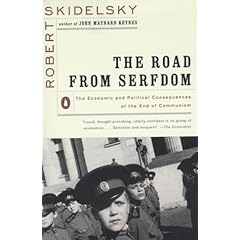
POSTSCRIPT: Much of this history is retold more completely and authoritatively by Robert Skidelsky's excellent The Road From Serfdom, a basic work for understanding the last century. Jonathan Rauch's Government's End (first edition, Demosclerosis) is an indispensable complement to understanding the late welfare state paralysis of interest groups.
---
* For example, before 1914, only diplomats needed passports. During and after World War One, almost all countries adopted much tighter restrictions on travel and immigration for everyone.

** As the citizens of New Orleans well know. We must also speak of "media failure" as well: grotesque, "narrative"-driven misreporting of even basic facts on a grand scale.

Labels: , , , , , , ,

Monday, May 12, 2008

The New Deal reconsidered: The Holocaust crisis

Another important corrective to the hazy nostalgia in which the FDR years were later enveloped is a look at the reaction, or failure of reaction, of the US to the Holocaust. As David Wyman recounts in his essential book on the subject, the nature and scope of the genocide were known in the US by late 1942. For fear of appearing "pro-Jewish," the War and State Departments, respectively, refused and blocked any action to stop it. Until his death, FDR was indifferent to both the genocide itself and the refugees in flight from it. The State Department, under the influence of the British Foreign Office, was also hostile to Zionism and declined to press for Jewish refugees to be allowed into Palestine. The contrast with Churchill is striking. Once he knew of it, he spoke publicly about the genocide and devised schemes for getting weapons to resistance movements in continental Europe. His complaint about Anglo-Jewry was its timidity and lack of organization. In spite of his courageous and public statements and actions in connection with the Holocaust, there were sharp limits on how far he push the rest of the British government on the issue. But there was no question where he stood.

It wasn't supposed to turn out that way. FDR's presidency, and especially his landslide victory in 1936, cemented the love affair of American Jews with the Democratic party. There have been periods of erosion of that affair (Eisenhower in 1956, Nixon in 1972, and Reagan in 1984, all received close to half of the American Jewish vote), but never a real prospect of dissolution. Although anti-discrimination laws before the late 1950s were more limited in scope, applying only to government, the influence of the New Deal's public hiring practices, and later their application through much of the US economy during the war, essentially started the modern civil rights era. The 1930s was not only the most isolationist decade in US history, it was the most nativist, a period of strong intergroup tensions and bigotry. The Depression itself, of course, was the largest single cause. But the message emanating from Germany also exerted a distinct influence. American Jews looked to FDR as "King of the Jews," the "good czar" who would protect them. American Jewish leaders like Rabbi Stephen Wise and Sam Rosenman acted as American versions of "court Jews" familiar from Europe.

And it was "court Jew" politics that failed in the war years. This influential establishment of lay and rabbinical leaders, allied with FDR, were determined to maintain the palace-intrigue approach to Jewish issues. Far from being a help, they seriously harmed Jewish self-interest in those years: for all their backroom dealings, they came up empty on antisemitism, Zionism, or rescuing European Jews.

Eventually, a new, more American type of "bottom-up" politics emerged in response to the Holocaust. Its emergence was too late for most of Europe's Jews. But it led to a stunning breakthrough for America's. After the end of the war, it became clear that, for all his greatness as a leader, FDR and his "court Jews" were the ultimate obstacles to progress on these issues. While he repeatedly used popular anti-semitism as an excuse for inaction, the circumstances of the war itself rapidly changed American opinion, and FDR was left behind by change he himself had helped to instigate. Treasury Secretary Morgenthau's plan to rescue Jewish refugees was largely drawn up by non-Jews. Former president Herbert Hoover, who first made his name leading war relief efforts during and after the First World War, offered to head up a refugee commission. It did form but failed to accomplish much, because of State Department and White House resistance. Even the State Department itself, once the war was over, relented enough to negotiate a settlement of refugee property claims with the Swiss government.*

A critical mass of Jewish groups finally gave up on palace intrigue, organizing and protesting publicly in 1943 and 1944, making Zionism and the rescue of Europe's remaining Jews broadly accepted, nonpartisan issues. By the 1944 election, both parties endorsed this platform, and within a few years, rapid political change led to dramatic changes in American acceptance of Jews and the start of the sharp decline in antisemitism that marked the postwar decades. This decisive change occurred in a space of a few years. Contrast with the 1940 election, where in spite of the bipartisan support for intervention in the war, America First and important isolationist leaders like Lindbergh made discreet but effective use of social prejudice against Jews to bolster their case. The America we live in now was made in those few short years by people (some of them returning from the war) who abandoned the 1930s politics of fear. Given FDR's opposition to Zionism and his stubborn refusal to do anything about the genocide in Europe, it's almost a miracle.**
---
* Contrary to mythology pushed by the media in the 1990s, Switzerland had instituted the secret, numbered bank account system in the 1930s so that people fleeing Germany could move their assets to a safe place. It was generally less antisemitic than the rest of Europe and, in spite of the fact that much of its population was German-speaking, never fell for Hitler's Aryan vision. But most of the owners of the financial assets moved to Swiss banks perished, and several billions (in present dollars) were left unclaimed at the end of the war.

** Kenneth Levin's The Oslo Syndrome retraces Wyman's history in abbreviated form, then relates it to the return of Jewish self-ghettoization in the 1990s. Except that in a liberal democracy, self-ghettoization means self-defeat. "Court Jew" politics and palace intrigue don't work. While Clinton, unlike FDR, was not personally prejudiced against Jews, the political failure was similar, the Oslo "peace process" being the most damaging result.

Labels: , , , , , , , ,

Tuesday, May 06, 2008

The New Deal reconsidered: The war years

Dedicated to the memory of my parents

To organize a society for a cause means facing everyone in one direction, toward an external goal, and what better goal than crushing an enemy? If there is no foreign one, then, as FDR discovered, domestic ones have to be invented. After his 1936 landslide victory, FDR began to do just that, ultimately overreaching with his 1937 Supreme Court-packing scheme. This crisis proved the beginning of the end for the New Deal. And 1938 saw a recession, wiping out the partial recovery that had taken hold in 1935-36, and large losses in Congress for the New Dealers, who were replaced by Republicans and conservative Democrats. The court crisis set off a wave of disillusionment, as more and more voters realized how limited the New Deal's accomplishments were. Voters recoiled in horror at the blatant violation of separation of powers inherent in FDR's attempt to manufacture a Supreme Court that would rubberstamp what he wanted. America would not become a dictatorship.

And then international crisis came. The 1930s was the most isolationist decade in American history (check out Little Orphan Annie and Daddy Warbucks). For much of the decade, FDR not only went along with it, he helped to destroy the world trading system by leaving the gold standard. Central planning is a lot easier with a closed economy, after all. With the New Deal on the way out, however, Roosevelt, like many presidents frustrated with domestic stalemate, turned to foreign affairs. The Spanish Civil War (1936-39) gave a preview of coming attractions, so to speak, not only with fascist Italy and Germany supporting Franco, but the Soviets trying to control the anti-fascist opposition for their own purposes. Roosevelt's distant cousin, Winston Churchill, then on the outs of British politics, was already sounding the warning about Germany. By 1940, the war was underway, and American shipping was being attacked by German submarines in the Atlantic.

But there was nothing close to approaching consensus about whether the US should enter or even support the Allies. Bad memories of Wilson and the "war to end all wars" twenty years earlier were still fresh. The largest peace movement in American history, America First, was formed in 1939 to head off American intervention. These isolationists were a motley collection: opponents of the New Deal and FDR mixed with labor, church, and pacifist leaders. Even with the New Deal gone, modern "total" war would mean a large and possibly permanent increase in federal and presidential power. In the Middle West, Republicans of German and Scandinavian extraction looked favorably upon the Third Reich. Democrats of Irish background (like Kennedy père) looked unfavorably upon Britain. At the fringe were a small but vocal (if embarrassing) group of Nazi fellow-travelers. With the Soviet Union an ally of Germany after August 1939 and the fall of France in June 1940, the anti-German cause looked lost anyway. Only after Britain refused to fold in the summer and fall of 1940, did American public opinion begin to change. Even so, while most Americans in 1941 hoped for an Allied victory, until Pearl Harbor, most were still unwilling to intervene directly. Only the attack on Pearl Harbor banished, at least for a while, the antiwar and anti-FDR voices.

Popular historian Thomas Fleming's witty, readable, and controversial The New Dealers' War: FDR and the War Within World War II details the suspension of normal politics "for the duration" and how FDR and his administration kept grumbling and discontent at bay. The result was remarkable: the US reached a level of consensus on international affairs in those years that, while attacked from various directions afterward, did not fully dissipate until the 1990s. This in spite of serious deception (hiding how ill FDR was in the 1944 election) and strong illusions in some quarters about Stalin's designs on postwar Europe.

The full disillusionment with the New Deal never had time to sink in before America began to turn its attention in 1940 to war. The economic build-up finally did what the New Deal never could, namely, end the Depression. In less than two years, the US economy went from idle capacity and high unemployment to shortages. International crisis - preparing for war, then hot war, the start of the Cold War - delayed the reaction against the New Dealers until the 1950s, in fact. Invented domestic bogeymen were not necessary; for a while at least, there were real ones, on the outside.*

Moral inequivalencies. In spite of the similarities of the different collectivist tendencies, comparison is not equation. In the 1930s, the United States had no concentration camps, no liquidation of political or class enemies, no genocides, no destruction of the Constitution. It did experience under FDR an astonishing transformation of presidential power: compared to the handful of 19th century executive orders, and the hundreds of Wilson, we got thousands in the 1930s and 40s. Congress alienated an entire chunk of its law-making power to executive agencies. Ordinary freedoms were partly suspended "for the duration," and a hundred thousand Japanese-Americans were put into temporary camps. But the political system mostly remained in place, limiting presidential reach. Towards the end of the war, as the nature of the fascist enemy become clear to Americans, an even sharper disillusionment with the all-powerful state set in. Whatever problems a free society suffered from, the modern omni-state had turned out to be the most lethal weapon ever created. Deeper awareness a few years later of the Stalinist system reinforced the lesson. This was era when everyone started reading Orwell's Animal Farm and Hayek's Road to Serfdom, both published in Britain in the war's last years.

Follow the yellow brick road. For FDR's subsequent reputation, the war years made all the difference. The New Deal ended on an ambiguous and largely negative note. It had, in all probability, prolonged the Depression and certainly not ended it. But if FDR is counted among the greatest presidents, it is because of his skillful leading of Americans into the largest conflict in history, one that it was not initially obvious could be won.

When we compare successful war presidents (FDR, Lincoln, Washington, as well as other democratic leaders like Churchill and De Gaulle) to less successful ones (McKinley, Wilson, Bush), the obvious thing that leaps out is the degree to which the political ground was properly prepared before the conflict was engaged. Pearl Harbor, like the attack on Fort Sumter and the battles at Concord and Lexington, was the culmination of a process, not its beginning. The other key to successful war leadership is that, however indispensable they might seem at the start, great democratic leaders, by evoking popular initiative and enthusiasm, make themselves superfluous in the end. Churchill and Roosevelt were indispensable at the outset. Yet the war ended successfully without them, one dead, they other turned out of office by voters. This is far removed from a cult figure like Hitler, whose suicide just a few weeks after FDR's death, marked the end of his entire regime and movement.

Two years before Americans went to war in 1941, they sat in theaters and watched the film version of The Wizard of Oz. In the story that everyone knows, Dorothy and her friends set off to receive prized human virtues from the mysterious and powerful Wizard, who turns out, after his booming, amplified voice is turned off, to be less than imposing. From him, they receive the courage, love, and intelligence they seek, but come to realize that they actually had them all along. After all, they defeated the Wicked Witch of the West and done other marvels without the Wizard's gifts. After the Wicked Witch, even Hitler would seem like a piece of cake.
---
* Several hundred Soviet agents working in Washington in the late 1930s and during the war have been firmly identified from Soviet records available to historians after the Cold War ended. However, the defection of two of them (Elizabeth Bentley and Whittaker Chambers) in 1945 caused the Soviets to shut down their espionage operations. By 1948, there was nothing left of it. Leading liberal lights, however, such as Eleanor Roosevelt and President Truman, could not bring themselves to admit that such things had been going on and that establishment figures such as Alger Hiss, of good family and reputation, were involved in it.

Their lack of honesty on this issue made liberals politically vulnerable. If the Korean War had not broken out, the resulting attacks, by McCarthy and others, probably would have remained on the fringe. But American soldiers dying in a country supposedly already secure made it an irresistible issue.

Labels: , , , , , , ,

Sunday, May 04, 2008

The New Deal reconsidered: Liberal fascism

PRE-POSTSCRIPT: Here's a podcast interview with Jonah Goldberg.
---
Up there on Amazon's best-seller lists for months now has been Jonah Goldberg's Liberal Fascism: The Secret History of the American Left, From Mussolini to the Politics of Meaning. The book has brought back a debate that should be at the forefront of our politics, but rarely is. One of Goldberg's goals is to lay to rest a mythology that has been central to the American left and more mainstream liberals since the 1930s, that Anglo-American conservatism is somehow "fascist"; and more generally the misuse of fascism to describe the free-market and individualist right. It's only become "right" because the left foisted this mythology on us all those decades ago, that leftism and fascism are mutually exclusive and exhaustive poles of politics. Having the slightest familiarity with modern political history, especially from a European perspective, no one educated person could have fallen for this. But in our age of media-induced amnesia, it's helpful to now and then wake up and read some real history for once. It's history that's not hidden, just forgotten, sometimes deliberately so. Readers of Hayek's 1944 classic, The Road to Serfdom, will recognize the essentials.

Most of what is called "conservative" in the English-speaking world in the last 80 years is really a blend of what 19th- or 18th-century educated people would have correctly called "liberal" (meaning limited government and individualist) and "conservative" (meaning traditionalist). The two are still in tension (we think of "conservative" versus "libertarian," for example), but they were also in tension then. In the generation before the First World War, a new force, not answering to either label, arose in opposition to the older limited-government liberal ideal. It went under various names: "reform" liberalism, the "new" liberalism (as opposed to the "old"), "progressivism." Influenced by Marxist and socialist doctrines, they came to dominate American politics in the teens and then again during the Great Depression and the New Deal. It's the basis today of what is conventionally and very misleadingly called "liberalism" in the US and more correctly called "social democracy" or "welfare liberalism" in the rest of the world. We're all familiar from our history classes what this meant: in democratic societies, a much larger and more powerful government; far more overt political involvement in social and economic decisions; the state (to an extent) taking over once-private or familial functions (education, old age and sickness insurance), and so on. The political values associated with classical liberalism largely remained, but its economic and social values were transformed into a form of democratic statism.

But in countries with weaker or non-existent democratic traditions, while it meant all those things, it also meant something else: a comprehensive alternative to liberal democracy altogether. In reconstituted empires like the Russian and Chinese, it was the fantastic and deadly fake, coercive utopia of communism. In countries with old cultural identities but recent and weak political unification (Italy, Germany, Japan), the new collectivism and statism were merged with a post-nationalist imperial chauvinism, eventually christened "fascism" by Mussolini. He named his idea and movement after the Roman fasces, the bundled sticks that represented the supersession of individuals going about their business by a concentrated unity of purpose embodied in the person of the dictator. Hitler and Nazism then did it all better by adding a mystical romantic racism and a Teutonic thoroughness the Italian model lacked.

The non-democratic forms of 20th-century collectivism, rather than being opposites, are best viewed as rival siblings. They were born at around the same time and answered similar needs. The career of Mussolini illustrates their entangled origins: born to radical parents (who named him Benito after the Mexican revolutionary Benito Juarez), drifting through Marxism (too German-pedantic) and anarchism (fit the Latin temperament better), then to the realization that he could really make a big splash if he fused the two rivals, chauvinistic nationalism and socialism. The epiphany came to him, as it did to many, during the first modern "total" war. World War One demonstrated the apparent practicality of nationalized economies, centralized control, and total unity, with the hope that they could be carried over permanently into peacetime.

There were parallels in various countries and between democratic and non-democratic forms. Progressivist Woodrow Wilson viewed the limited government paradigm of the American founders as obsolete, to be replaced by an organic system, with the President as the "head" of the body politic. His younger colleague, Franklin Roosevelt, later succeeded where Wilson failed. H. G. Wells coined the term "liberal fascism" in a 1931 speech in which he called for a synthesis of the older "liberal" (what we now misleadingly call "conservative") political values with state manipulation and control of society and economy. Wells wasn't thinking of Soviet Russia, but of Fascist Italy, where Mussolini had done more than make the trains run on time. Wells had seen this apparent "wave of the future," and it seemed to work. After 1918 and especially after the onset of the Great Depression, liberal democracy, free societies, and free economies seemed passé. All of this was of course deliberately forgotten after 1945. From then on, "liberalism" and "fascism" were supposed to be opposites.*

But Goldberg arrives to tell us otherwise, exhumes this repressed history, and updates it with the distinctive excesses of the 1960s New Left, its eroticized cult of violence and worship of exotic foreign dictators, both reminiscent of fascism and its 30s fellow-travellers in democratic countries. In certain ways, Goldberg exaggerates: the tragedy of American liberalism since Wilson is not that it is fascism (it isn't), but that it tries to combine what cannot be: unlimited government in the service of liberal goals. It has led modern liberals to one predictable disaster after another.
---
* We also can't ignore the effect of the Popular Front period (1936-39), when Stalin and Soviet-oriented zombies worldwide tried to manipulate the democratic left and liberal middle-class parties with a common program in opposition to fascism. The real controlling factor was Soviet policy towards Germany, which zigzagged from neutrality, to hostility, to friendship, all in a few years. In Europe, the PF program made at least superficial sense. In the US, there wasn't much to oppose really - except, strangely, the New Deal itself, which had multiple features in direct and conscious imitation of Mussolini's system. The emotionalistic use of "fascist" as an empty epithet to label anyone not with this program started in the Popular Front era, then reappeared in the 60s.

The Hitler-Stalin pact of August 1939 brought the Popular Front to an end, although the crude manipulation of gullible non-communists to serve Soviet foreign policy goals was already evident before then. And the illusions of the Popular Front survived long after the Popular Front itself.

Labels: , , , , , , , ,

Tuesday, April 29, 2008

Noble savagery and white guilt

PRE-POSTSCRIPT: Not that Rousseau didn't write some pretty dumb things, e.g., in The Social Contract - see here.
---
Some time between the fall of Napoleon and the First World War arose a mentality - in some cases, a full-blown ideology - rightly called "white supremacy." In Europe, it was a never-completely-respectable by-product of the immense lead in knowledge, technology, and social organization that opened up between the West and the rest of the world in the 19th century. While a side effect of the fact of progress, it also sat uneasily with the West's belief in progress and a better future. In the Americas, the mentality was a by-product of the white colonists' earlier destruction of native ways of life and the colonial institution of slavery. While the abolition of slavery marked a first large step away from white supremacy, as a social attitude, abolition in some ways heightened the sense of a gap between white Europeans and others.

Then came the First World War and, even more emphatically, the Second. Some time between the end of the earlier conflict and the end of the latter, "white supremacy" collapsed. It had never been congruent with the West's more "official" thought-systems (Christianity and liberal Enlightenment) anyway. Great 19th century dissidents, like Kierkegaard, Dostoyevsky, Nietzsche, and Mark Twain, had questioned the confusion of moral and political with economic and technical progress.* The physical and, even more, the moral destruction wrought by the major 20th century conflicts badly damaged the sense of automatic progress that the West had come to believe before 1914. While civilization had made possible life in numbers and quality unimaginable a few hundred years ago, the most advanced forms of progress before 1945 were still available to only a minority of citizens. And technical and organizational progress had, almost without anyone noticing, created means of destruction also unimaginable a few centuries ago.

Suddenly, progress and civilization no longer seemed all that. Perhaps, it seemed to some, just "skin-color privilege" anyway. Thus was born white guilt. Strangely, the origins of white guilt had little to do directly with the legacy of slavery or racism, or the decimation of non-European peoples by European colonialism and diseases. It started as an internal crisis of confidence, haunted by the sense that modern history had ended badly.

Most of the resulting agonizing hasn't done white people much good. It has also not done much good for non-white peoples once at the margins of white society but, since 1945, increasingly integrated into modern life. Black author Shelby Steele has written a short but magnificent book on how white guilt has twisted the promise of civil rights, weighing it down with undeserved and often unacknowledged baggage that prevents everyone - whites for their reasons, black for theirs - from understanding the society they live in and how it might be improved. You can find brief summaries of his argument here and here.

Steele explains how racial oppression works and why "black rage" didn't start until after the civil rights movement was nearly finished. The oppressed usually don't feel rage until and unless they're almost free. When the parameters of society change in such a big way, then it becomes okay for the about-to-be-freed to be angry. The strange result is that, in Steele's view, whites had moral authority on questions of race when they were acting as oppressors; only when they stopped did they lose it. From a rational point of view, this makes no sense. It can only be explained if you accept some additional assumptions stolen into the discussion some time between the mid-60s and the 80s, that period when modern liberalism came unglued: all white people are racist, and only white people can be racist. Neither is true, but such assumptions explain why the promise of racial integration, palpable in the 1950s and early 60s, went sour and why later progress, while real, has also been harder than it should have been. What got in the way was identity politics.

While identity is not irrational, identity politics is. It asks politics and politicians to do what they cannot. In the case of groups emerging from oppression, it is an understandable but blind and self-defeating response to a negative past. What it produces is demagogues and racists (like the white supremacists of the defeated South, a Farrakhan, or Hitler, the pseudo-messiah of the humiliated post-1918 Germans) and white liberal pandering, like political correctness.

But the larger irrationality and injustice of identity politics is living in a self-imposed mental slum, hemmed in by knee-jerk, defensive attitudes. For parasitic "identity" demagogues, the point is divide and rule. The way you divide and rule is to chop up voters as a whole into rigidly defined groups and brainwash them into feeling that they're helpless victims. Then they'll keep voting for you. They'll also fail to make connections with people outside their group and thus reinforce their isolation. Does this sound familiar? It also supports stunningly low political standards. Black voters, for example, simply hold black leaders to a low bar. Guaranteed Congressional seats just make it worse: it means some second- or third-rate black politicians will definitely hold office for as long as they want. But it also guarantees they will go no further. Black leaders with biracial appeal find their options very limited.** Obama is exciting, in part, because he doesn't fit this pattern. He had to run state-wide to become an Illinois senator and get white, as well as black, votes. Barack Obama successfully escaped America's "race reservation" system and electrified the nation in the process. Somehow, he slipped through the cracks.

The justice of the civil rights movement was and is beyond question. But the concept of white guilt makes no sense. It strikes me as a shamefaced cousin of white supremacy, exchanging superiority-by-virtue-of-skin-color for unearned-guilt-by-virtue-of-skin-color. Also lurking around this subject is the toxic concept of the "noble savage."† (The Left is incomprehensible without reference to "noble savagery," unearned guilt, and self-hatred - secularizations of familiar Christian concepts.) Civilization is defined, not by race, but by values and institutions - rules, essentially - and civilization is definitely better than non-civilization. The concept of "race," a nineteenth-century pseudoscientific idea of questionable pedigree, needs a hard look. Older definitions of civilization were based on religion or, to put it in more neutral terms, institutions and rules. These definitions are historically much sounder than the race concept.

Underlying "noble savagery" is a feeling that certain people are more pristine, closer to the Earth, or have groovy rhythm - or something. Such thinking is ridiculously patronizing, but it or something like it is widespread among self-loathing white liberals. In their view, civilization itself is a crime, which makes problematic their use of "progressive" as a self-description. Of course, much - maybe most - of this self-loathing has non-political roots. It just seeks political expression and justification in its advanced stages.

Primitive peoples in the state of nature are what they are: in more ways than one, humanity in the buff, showing the full range of what primordial humanity can be. In civilization, people have strong disincentives to violence and strong incentives to be constructive, very different from the lawlessness of a tribal world. Tribes are free as collective units, but not as individuals - they're bound by powerful tribal custom. Only modern civilizations have reconciled individual freedom with civilization, by replacing the alienation of power and sacrifice of personal freedom required in traditional civilizations with civilization based on rational self-interest and common consent - the social contract, in essence, embodied in the rule of law. A free society is necessarily a lawful society, not an anarchy.

In truth, "noble savages" don't exist and have never existed. But the noble savage doctrine in the hands of civilized people imagining themselves to be or desperately searching for those noble savages has been, with no competitor, the most fatal and destructive delusion in history. It's at the core of the lethal radicalisms of the last century, and it's responsible for hundreds of millions of deaths in its genocides and dictatorships, and in the Second World War. The noble savage notion, played with by civilized men and women, is an invisible poison.

POSTSCRIPT: Here's an interesting review of Steele's book.
---
* Seventeenth and eighteenth century thinkers, like the American founders, were much less confused about this than their successors. They were hopeful about progress, but also knew it wasn't magic. And they had few illusions about human nature.

** This pattern is in no way unique to blacks, but part of a larger phenomenon of powerful special interest groups that organize around government-bestowed special status. Once granted, it's rarely taken away, because no politician is powerful enough. The larger public good is lost because of the aggressively reactionary stance of these narrow interest groups and their leaders.

† Actually, Rousseau's notion of the "noble savage" was not so wildly off, and he did recognize the basic problem of pre-state societies, which is their inability to control violence. In this, his view is not so different from Hobbes. His concept of "savage" was "noble," but not the romantic, quasi-pacifist, tree-hugging silliness often implicit in late 20th century concepts. It was apparently Diderot, one of the key figures of the French Enlightenment and editor of the influential and widely-read Encyclopédie (1751-80), who put the notion into its Romantic form.

Labels: , , , , , ,

Sunday, March 30, 2008

William F. Buckley, Jr.: An appreciation

Where to start? A giant of the postwar world, one of the founders of modern conservatism, and a leading light who remade American politics, died just over a month ago. Many tributes have appeared, and his positive influence is everywhere you look.

When World War Two ended, American conservatism seemed to be finished. Although opposition to the increasingly statist bent of liberalism came from many and often conflicting points of view (individualism, religion, nativism, etc.), the two large forms of opposition were isolationism (opposition to American entry into the war - although that was not in any way purely a cause of the Right) and hostility to the dramatic expansion and pretensions of the federal government. Both oppositions appeared discredited, although disillusionment with the New Deal and federal intervention in general was widespread by the time of the 1940 election. And a significant part of the Republican party - its East Coast, Anglophile wing, led by Wendell Wilkie - did support intervention, in fact preventing foreign policy from becoming a major partisan issue in the 1940 and 1944 elections and marginalizing isolationism to a great degree. Nonetheless, while much of the New Deal had been repudiated after the 1938 midterm elections, everyone in 1940 knew what the great question was: to intervene or not, how fast and how deep. Of course, the Germans' undeclared submarine war of 1940-41 and the attack on Pearl Harbor at the end of 1941 rendered that debate moot. The US did intervene in World War Two, on the Allied side, and few regretted it afterwards, in spite of the immense cost and the dubiousness of having the Soviet Union as an ally.

Other factors were at work in the fragmented state of the American right in 1945. It had some of the same components familiar today. There were conservatives, people who deferred to tradition because it was tradition. The fact that the American political tradition was largely a liberal one (with one major exception) created something of a paradox.* That tradition was one of limited government, one overturned by the socialist-tinged "new" or "reform" liberalism of the Progressive and New Deal eras. (The change was large enough that it is questionable whether the adjective "liberal" should be used at all.) Classical liberals (later called libertarians) never bought into tradition-for-tradition's-sake and based their views on straightforward, historically informed ideas (abundantly confirmed by recent experience in the world wars and totalitarian dictatorships) about the negative effect on human liberty and prosperity by too-large and too-powerful a government. Some went further and re-developed the familiar 18th-century theories of natural rights and consensual government in terms understandable to a 20th century audience. To that they added a more modern and deeper appreciation of the limits of social knowledge and the impossibility of social planning.

A striking fact astute readers might notice is that I make no mention of the "religious right" in this potted history. That's because, after the liberal-fundamentalist battles of the late 19th and early 20s centuries, the fundamentalists retreated to their own, anti-political, subculture. To the extend that they were political, they largely voted Democratic, because they were largely southern or urban-ethnic Catholic - and in those days, virtually all white southern and Catholic voters voted Democratic. The "religious right" as we now know it, an alliance between conservative Catholics and conservative Protestants, was 30+ years in the future at the end of the war. In 1945, a few feeble attempts at ecumenism apart, the relation between Protestants and Catholics was one of mutual suspicion, laced with ignorance and prejudice - although the war itself had had a strong positive impact on this state of affairs. The full scope of this impact is in large part the complete transformation of religious and ethnic identity in America in the postwar era. This transformation made black civil rights easier to swallow (for whites), gave rise to a new level of interreligious understanding, and made Buckley's type of "big tent" conservatism possible. All of these were out of reach and almost unthinkable before 1945. In his relationship with American Jews, Buckley's approach was even more radical, given the level of anti-Jewish prejudice still prevalent in 1945. By the late 1950s, his nascent movement and its allies counted a significant number of Jewish thinkers, many of them refugees from Europe and carrying first-hand experience of life under the totalitarian dictatorships. Well before the Republican party, under Nixon, fully embraced support of Israel, Buckley adopted such support as a matter of course, because he understood the basic issues at stake. When the Soviet Jewry movement started in the mid-1960s, Buckley and his followers were among its early non-Jewish allies and supporters.

Buckley was a wealthy liberal Catholic, a man from a social background (including a father who was an American ambassador) that, on the surface, seemed conventionally WASP. It was his quirky Catholicism that initially made the difference. It made him have to think - really think - about political issues in a deeper way than most people have to, people who take their political views without much thought from their parents, teachers, and peers. This led him initially to oppose modern American liberalism from a traditionalist point of view, but also made him open to libertarian approaches. From these experiences, he formed a clear conception of how to rebuild the American right around a few simple and broadly appealing stands that any rational person could assent to, without regard to ethnic or religious background: opposition to the growth of government at home and opposition to the dominant form of collectivist tyranny abroad, communism. Buckley and his allies founded National Review, still the flagship of American conservatism, and began a campaign that stretched from the early 1950s to the late 70s to absorb all opposition to modern liberalism in this way. By doing this, Buckley sidestepped the leftover isolationist-interventionist debate and ended the American right's parochialism. By the late 1950s, all sorts of people, many Protestant, but a large minority of Catholics, and a surprising number of Jewish thinkers had been pulled into Buckley's movement, so much so that by the 1960s, the movement had become a broad political tendency in its own right and no longer a "movement." Buckley concentrated on the crucial common ground, dispensed with the provinciality and ethnocentrism of the prewar right, and even proved ecumenical enough to accept individualist and libertarian followers. (They often rejected him anyway, but that was their doing, not Buckley's.) Buckley even flirted with libertarianism himself, in his 1965 run for Mayor of New York and his famous, offshore 1960s pot parties on his yacht.

The era of Buckley's and conservatism's success was the late 70s and 1980s. In the 1960s, American liberals had obtained a blank check, under Kennedy and Johnson, and led themselves and the country, both domestically and internationally, into a gratuitous mess: instead of triumphing, liberalism went haywire and, after 1965, began a free-fall from which it has never recovered. The fact that the president who brought the Kennedy-Johnson tendencies to their logical conclusion - Richard Nixon - was a Republican seemed at first to set back the conservative cause. But Nixon was not a conservative. He was nominated in 1968 in part because he wasn't Goldwater and couldn't be tarred as a "crazy radical." The Watergate crisis (and the war that led to that crisis) were largely, and correctly, perceived as failures of the new, expensive, obtrusive, and frequently dysfunctional expanded government introduced by liberals. Nixon went along with it ("we are all Keynesians now," he famous said in 1972) and did big government a few times better - wage and price controls, entitlements and affirmative action as we now know them, and so on. His fall opened up a singular opportunity for conservatives, one taken by Reagan. The rest is history: a halt in the growth of domestic spending in the 1980s and 1990s, the successful and peaceful end of the Cold War, the end of "stagflation" and a generation-long success of low-inflation economic expansion and moderating the growth of the federal government. It was a stunning achievement, especially for a political movement - conservatism - that never gained majority acceptance. Buckley's approach saw to it that what we now call "identity politics" would not wreck his coalition and that, even when not having a strong influence over the Presidency, conservative ideas and policies shaped by those ideas would have their continued impact. Certainly, the rise of Clinton in 1992 was a direct response - "neoliberalism" - to the prior failure of liberalism and the success of conservatism. Clinton went on, chastened by the 1994 mid-term elections, to become the most conservative Democrat since - well, Grover Cleveland.

Buckley, like his movement, spent more recent years in ill-health. Certainly, the decline of conservatism after 1994 troubled him. Even more troubling was the return of "Nixonism," in the form of Bush Jr. and Karl Rove. This tendency started at the end of the 90s with a grand throwing-up-of-the-hands by conservatives, a giving-up on ever implementing a conservative program. Being the majority party in Congress put them into the position of actually having to decide whether to go ahead with serious reform, and they couldn't do it. (Many thought conservative reform politically impossible.) Another disturbing trend was the return of authoritarian, big-government populism, as signaled by Perot in 1992 and 1996, with its powerful tendency to split the right-leaning vote. (Indeed, Perot made Clinton's election and re-election possible.) To capture these voters for the Republican party meant dropping much, if not all, of conservatism as Buckley and others had defined it. The prize was permanently incorporating white southern and Catholic voters into the Republican coalition. The price: alienating everyone else - and proving multiple times over that big government fails for an inherent reason, not just when it's done by liberals. It also led, on an intellectual level, to nasty disputes between conservatives and libertarians on one side and neoconservatives on the other, those disaffected liberals who dropped out of the Democratic party in the 1970s and 80s. The opposition of many conservatives and libertarians to the Iraq war sharpened the nastiness.

Buckely's synthesis of traditionalism and "classical" liberalism (to use the L-word in its original and best sense) seemed unstable and incoherent to many. But it has proved enduring, like his very Catholic mix of faith and philosophical reason. It is both seriously intellectual, answering to that part of us that is consciously rational, and attractive because it recognizes the limits of individual reason. It combines with a classical liberal understanding of government a solid understanding of the limits of politics. Conservatives view society as more important than government, culture as more important than politics, and custom as more important than law. Buckley made his own contribution to culture as a prolific author and as host of public television's Firing Line for more than 30 years.**

He will be missed.
---
* That exception was the semi-medieval views that had taken hold in the antebellum South regarding slavery, which then influenced the dominant American thinking about race from the end of Reconstruction, in the 1870s, until the 1950s.

** When Binah was a youngster, he was confused by Buckley's sometimes notoriously Latin-inflected discussions on Firing Line, reflecting Buckley's high-level Catholic education. Latin came later to Binah and, with it, some understanding of what Buckley was talking about. Buckley himself adopted a less erudite and more straightforward style in later years.

Labels: , , , , , , , , , , , , ,

Monday, February 04, 2008

The end of Europe? IV

Utopias appear to be more easily realized than anyone had previously believed. And we find ourselves today before an otherwise harrowing question: How to evade their definitive realization? ... Utopias are realizable. History is marching towards utopias. Perhaps a new century is beginning, a century in which intellectuals and the educated class will dream of the means of escaping utopia and returning to a non-utopian society, less "perfect," and more free.
- Nikolai Berdyaev (1923)

Surveying the future of Europe one last time, we also need to keep in mind that, for all their importance, deep philosophical, spiritual, and existential questions rarely furrow the brows and agitate the minds of most people. (Good thing, too.) Most of their decisions, most of the time, are shaped by straightforward political realities and economic incentives. Europe's welfare states were not born from a vision of continuing progress, but from the socialist vision of heavenly stasis and permanent leisure. More importantly, they were born from the social upheavals and civilizational emergencies of the century-and-a-half ending in 1945. But history never stops: even if you're not interested in it, history is very interested in you. Europe's welfare states embody long-outdated responses to civilizational crisis. They have made it difficult for productive people, between the ages of studenthood and retirement, to sustain themselves economically, much less expand and improve their economic activity, and to raise families. While providing lavishly for the young, old, and sick (they're receiving free benefits no one ever got before - and no one ever will again), welfare state systems of subsidy and taxation penalize responsible adult behavior to an unprecedented degree - often seeing the only way to cushion the burden of high unemployment and low growth in pulling even productive, educated people in their working prime into the welfare state net. This is immoral, crazy, and won't last even another generation: it makes permanent adolescence universal, but drains away all of its benefits. While immediate success is rewarded, continued failure is subsidized, even glorified. Instead of marking an intermediate destination on the way to better things, the prolonged adolescence of welfare state culture is a cul-de-sac, a deadend.* The pervasive underlying principle is the powerful tendency to treat adults of sound mind and body as children, no matter their age - as the prophetic thinkers of the nineteenth century foresaw.

The evidence for such simple reasoning is straightforward: when Europeans emigrate - mainly to the US, but elsewhere too - they respond to lower taxes and less stifling economic conditions by working harder, saving more, and having more children. We can muse, as do Bawer, Weigel, and Berlinski, on hard questions of national identity, Europe's catastrophic modern century, or its spiritual deadness - but let's not lose sight of the obvious. The books of Steyn and Laqueur, in particular, are buckets of common-sense cold water poured on what might otherwise become woozy and interminable Weltschmerz (world-weariness).

All of these authors ask what are the possible and likely futures for Europe. Steyn and Weigel attempt some systematic answers, as does Laqueur, in a more jumbled fashion. None is sanguine. All foresee large parts of urban central and western Europe ceasing to be European in any meaningful way. Some parts will become Islamic, although it's a mistake to view these immigrant communities as monolithic. All of them point to the fact that the big changes have only just started. The biggest will happen in the next couple decades, and Europe is likely to be unrecognizable afterwards. Tourists receive a seriously distorted view by getting such a surfeit of Europe's past - while the ex-pat set (students, temporary and visiting workers) see only the slowly shrinking island of the pampered welfare state lifestyle that is already unaffordable.

The future of the American relationship with Europe. In keeping with our starting principles, this is another subject that requires steady concentration on long-term fundamentals, ignoring immediate episodes of European anti-Americanism, like the most recent one that started in the late 90s and now dissipating.

Until 1917, the US did not interest itself directly in European affairs. European countries were major world powers in their own right, while the US was a new and largely untested power. Almost all of its energy was focused inwards on economic development and political integration. Back then, if they thought about foreign countries at all, many Americans often viewed Latin America and Asia as more important. They were wrong back then - Europe remained a center, if not the center, of the twentieth century's great conflicts. But those Americans then, and their misnamed isolationist cousins of the 1930s, saw a deeper truth. Europe was destroying itself, and the future - for the US - had to be more about Latin America and Asia. That was already evident by the 1980s, but it became central after the Cold War. American intervention in Europe - in four distinct episodes (1917-1919, 1940-1945, 1945-1990, and 1995-1999) - has been founded on the perception that Europe was both important and, at the same time, in so much trouble, that it couldn't straighten itself out.

As Steyn and Laqueur point out - in very different tones - both the US and Europe have, since the late 90s, been focusing on a meaningless rivalry between them, while the heated public rhetoric has ignored the real issues. America's main economic competitors are Asian. Its major, everyday pressing social problem is illegal immigration from Latin America. Its major political problems are internal. Europe's major economic competitors are Asian. Its largest strategic problems are with Russia and the Islamic world. Its major social problems are internal (demographics, welfare state) and externally to the east and south. Europe is in a weaker position to deal with its problems than we are to deal with our problems. For the foreseeable future, Europe will need us more than we need them - just as it has been since 1945. The real change is not Europe's objective condition - in trouble and needing outside help - but in American perceptions of whether it's worthwhile to help Europe. While Europe still needs outside help, Europe is no longer as important as it once was. This fact will be the source of a considerable friction in the years to come. Many Americans don't understand it, especially liberals, who have spent the last 90+ years selling the centrality of Europe as a core principle of US foreign policy. This view will be harder and harder to defend in the coming decades and is another sign of modern liberalism's decline. Certainly, nothing has brought out American liberalism's backward-looking nature the way its colonial-inferiority complex vis-à-vis Europe has. Bawer's book exhibits a strong, lingering whiff of this thinking, although Bawer has spent most of the last decade apparently arguing himself out of his once-firm liberal views on this and other topics. It's even more bizarre given the fact that, until recently, the US was much more firmly committed to liberal political values than was Europe - Europe's continent-wide conversion to these is recent and untested, no matter what the Eurocrats say.**

As we look further and further out beyond the current generation, we must admit that all bets are off. Demographers cannot predict accurately much beyond two generations. It is clear that Europe's native populations will shrink dramatically during that time. In particular, Europe's southern tier and eastern ex-Communist bloc of countries have reached low birth rates that no society, outside of wars and plagues, has ever recovered from. But what comes after is less clear. Right now, the immigrant communities filling in Europe's hollowing-out demographics form compact societies-within-societies, especially the Islamic ones. (This is also true of the Africans, but much less true of Hindus and Sikhs in Britain, whose success is more "American" in nature.) These compact mini-societies might become sovereignties in all but name, just as the western Roman empire fragmented in its last few decades. Or something else entirely might happen - the modern world is not the ancient. These immigrant communities might open up and become far more culturally integrated into their host societies than they are now. Then expect to see a significant decline in traditional religious identities and automatic political solidarity. Although they will remain different for a long time to come, in this scenario, they might become more like the "hyphenated Americans" of 50-100 years ago - on their way to cultural assimilation into Europe, while changing Europe at the same time. This American-style "happy ending" is possible, although I would say now, not terribly likely.

Only time will tell and, as it it always has, holds surprises in store.
---
* The American version is familiar - from the birth of the teenager in the 1940s, captured perfectly in Lolita (the movie, not the novel), to the "death of the grown-up" in Diana West's new book, reviewed here by John O'Sullivan.

** Or perhaps, in their nervous political correctness, they know in their bones better than they know in their heads.

Labels: , , , , , , , , ,

Friday, January 25, 2008

Empires and nations

The earlier postings on Armenians, Jews, Turks, and Israelis (and Kurds!) cut a small way into the Big Issue of empires versus nations. A century ago, much of the world's population lived in multiethnic, multireligious empires, ones rules by a dominant group defined by ethnicity and often religion, with other ethnic and religious groups subordinated in political power and civil rights. Some countries (like the United States and France) were already republics, while others, like Great Britain, had mixed republican-imperial features, a combination of aristocracy and popular representation. But the imposing, centuries-old structures of the pre-1914 era were empires like the Austro-Hungarian (dominated by Austrian Germans and Hungarians and which ruled over Christians, Jews, and even some Muslims), the Russian (which ruled over many non-Russian Christians, as well as Jews and Muslims), the Ottoman (which ruled over non-Turks and non-Muslims), and the Chinese (ethnically mostly Han Chinese, but with a mix of languages). Once empire and theocracy were the way of the world. But they have had their day.

The last century has seen a dramatic growth in the number of nation-states and the dismantling of empires, in three major waves: after World War One, after World War Two, and after the Cold War. Clearly, if we want to understand the modern world, we need to, not just note the fact, but understand the why. Let's step back and take in the basic forces at work here.

The most fundamental is the incompatibility of empire and modernity - they're as incompatible as tribalism and modernity, or modernity and theocracy. National self-rule is essential in the modern world and, indeed, one of the pre-conditions of "being modern." The political unit of a nation-state, republic, or representative democracy is a citizen, who has equal, or nearly equal, rights with other citizens. Citizens participate in society (in political life, but not just political life), a sine qua non of constituting a modern society. Political and social units are integrated to an historically unprecedented degree. Empires, with their aristocracies and monarchies, were a whole world apart. Their political basis was narrow. Their political units were radically heterogeneous and unequal: ruling castes, and conquered ruled with varying levels of granted toleration. Outside their narrow political bases, empires often had ignorant and backwards - and in all cases, helpless - populations. These were subjects, not citizens. This type of political structure is compatible with theocracy as well, although it isn't a requirement.

From the fall of the western Roman empire in the late 400s, it took 1200 years for nations-states to be accepted in principle as the organized basis of political life and, even then, only in western Europe. It took another 300 years to sort out which nations would have states, a not-entirely settled issue even now. This question lies at the root of the great partition wars of the last century, the largest being India, but also encompassing Palestine, Cyprus, and Ireland, for example.

At the highest level, this is the evolution at work in the Middle East and Africa, which the nation-state principle and practice are still not fully accepted or even understood. Outside the West, the rise of radical Islam is the main force today in conflict with nationalism. Within the West, there is increasing confusion - especially in Europe, and especially among European elites - about the necessity of nationalism, instead of empire. (The EU is, in some ways, an empire-by-stealth, what happens when nations given up their sovereignty to non-representative supernational institutions lacking democratic legitimacy.) And Europe might very well be faced with theocratic demands in another generation. Already, parts of certain European cities have seen the abandonment of state sovereignty to Islamic-tribal custom, the first such development since the end of the Middle Ages.

Europeans and some Americans might be surprised to hear this. A central postmodern myth, upon which the EU is built, is that World War Two discredited nationalism. The problem is that for the countries responsible for World War Two (primarily Germany, as well as the Soviet Union to a smaller extent) were not fighting for nationalism, but for supernational ideals, like racism. (Nothing will destroy a nation-state faster than racial ideologies - the two are incompatible.) In any case, Europe's great nationalist moment was not 1939, but 1914. Even then, the First World War was a result of the implosion of the empires of central-eastern Europe, not something about the nation-states of western Europe. These empires had started economic and social modernization before they were politically modern, which in turn created impossible contradictions that then did them in. Their final manifestations were the supernational or "pan" ideologies, like pan-Turkism, Aryanism, and other racist movements.

To be part of the modern world means, among other things, living in a nation-state. That excludes much of the social and political practice that dominated human existence for most of recorded history and all of prehistory. For those of us living on the other side of this divide, the historical reality is often forgotten. When we encounter conflicts across this divide, we look around at how we live, but don't see; hear, but don't listen.

Labels: , , , ,

Friday, December 07, 2007

Armenians, Turks, Israelis, and Jews: A final word

Someone left a lengthy comment on my first posting on Ottoman Turkey and the Armenian genocide, and I responded in the comments section. The larger issues raised by this history are worth returning to, briefly. I've reposed my response below, slightly edited. Apparently, this reader didn't read my second posting, which would have clarified some things he missed.

My response explains the wrongness of the such views and alludes to the reasons why people hold them. Denial of the bare facts is rare today; instead, there's a lot of dancing around the facts and refusal to label them honestly. Rationalizations based on the Ottoman-Russian war are equally flimsy and irrelevant; they fall into the same scapegoating that the Young Turks themselves engaged in at the time. Their "Armenian problem" preceded the outbreak of war in 1914 by decades. But my response also gets deeper into historical detail than most readers will want; and even greater detail is available in the works of Fromkin, Power, and Florence, among other places. Up here, let me just cut to the chase and answer the question of why this sad history is important today.

There are some broad issues of critical importance that the Armenian genocide and the collapse of the Ottoman empire touch on and illuminate: the incompatibility of empire and modernity; the crisis that every modernizing empire has faced with the rise of chauvinistic and racist movements (like pan-Turkism), often confused with nationalism. Countries with strong Christian-liberal-enlightenment traditions were able to keep these forces at bay or marginalize them - plus they had the alternative of liberal and democratic nationalism, a powerful basis for rejecting racist and class-warfare ideologies. Eurasia's great empires could not; while they all went through liberalizing and reformist phases in the 18th and 19th centuries, these forces were shallow and short-lived, expressed as brief episodes of "enlightened despotism." Both czarist Russia and Ottoman Turkey entered their final, post-liberal phases in the late 19th century, while Germany and Austria-Hungary didn't feel the full impact of such trends until after 1918. The whole subject - empire, nations, modernity, self-rule versus autocracy, aristocracy, monarchy, and theocracy - deserves and will get a posting of its own. I'll just say again: Ataturk, the founder of the modern republic of Turkey, understood these points very well, better than rationalizers of the Young Turks and Ottomans do today. All of the Ottoman minorities - even those, like the Jews, who did well for much of the empire's history - came around to this view by 1918. The Armenian genocide of 1915-17 played a large role in their change of view.

For us today, there is a weirder irony. Contrary to what Libby says, few Armenians (at least none that I know) "wallow" in this history. (There's no business here like Shoah business :) This is a far more crucial issue precisely for modern Turkey itself, a basic question that touches on just how modern it is, and how ready it is to join Europe. It's an unavoidable bridge the Turks will have to cross if they are to join. Imagine if Germany were still having fundamental difficulties facing the Nazi period. Obviously, Jews would be outraged. But forget about that for the moment: What would Germany's neighbors think? Would NATO or the EU have ever have been possible, or the Cold War come to an end, with such a fundamental and ominous question mark hanging in the air? This issue is not about Armenians, Jews, or Israel: it's about Turkey.


This is my response to the commenter at the first posting.

[snip]

What you're doing is what a lot of Ottoman-Young Turk apologists do, which is to essentially admit the Armenian massacre of World War One, then rationalize by playing with words, teasing readers with a seductive historical amnesia, or tell Jews in particular that they did well under the Ottomans or that modern Turkey is a good ally of Israel. I didn't compare the Armenian genocide directly to the Holocaust. In certain respects - its Teutonic thoroughness, the irrational paranoia of antisemitism - the Holocaust was unique. But by that standard, the Holocaust would be the only genocide in the book, and that's certainly not right either. I also don't want to stoop to genocide card-trading: you know, I'll swap your Holocaust for two genocides and 20 pogroms, hold the mustard.

As I wrote, the most damning evidence on the genocide was precisely the reaction of the German, Austrian, and American ambassadors, allied to Turkey or neutral. All three diplomatic missions quickly concluded in 1915 that the Young Turks (Enver and Talaat) were trying to exterminate the Armenians within the Ottoman Empire. Enver and Djemal admitted as much to the Germans. That's genocide, period.

Nor was there any military reason for extermination. While apologists try to claim the Ottoman Armenians were rebelling, there's no evidence of such rebellion. The real reason was that Turkey's offensive against Russia in the winter of 1915 was a disastrous failure, and the Young Turks needed someone to blame. The Armenians had already been such targets in the past, and they were near the Russo-Turkish border. So they were convenient scapegoats for [terrible bungling]. Outside the universe of rationalizers and apologists (like Toynbee), historians and observers at the time understood that the Young Turks' program in 1915-17 was continuous with past Ottoman behavior toward their Christian minority subjects - it was NOT about winning the war with Russia. If wiping out the Armenians was so critical to the Turkish war effort, why did the German and Austrian ambassadors protest it? After all, they had a large stake in Turkish success against Russia.

Nor is it true that the Christian minorities "flourished" under the Ottomans, at least not in the Empire's last century. Much of it was in steep long-term decline in any case. But the Ottomans' contradictory efforts to liberalize and modernize their empire, while still keeping the dhimmis in some kind of subordinate status, created an impossible situation, one that could only be resolved in one of three ways: convert all Ottoman subjects into equal citizens (which ran against Islamic law and Turkish dominance), relinquish Turkish rule over the dhimmis (which is what ended up happening), or genocide. This problem was not unique to the Ottomans. Next door, the Russian empire went through a similar cycle, during the same period, and for similar reasons: liberalization and reform earlier in the 19th century, followed by violent reaction (pogroms etc.) aimed at preserving the older imperial-feudal-theocratic structure before it disintegrated. These governments in part created this dilemma by their earlier efforts at reform. The Ottoman Christian subjects suffered in the last couple generations before the war because either granting them full rights or accepting their growing demands for independence would mean the end of the Ottoman empire as traditionally constituted. Once the Ottoman authorities accepted this, they began (in the 1890s, a decade after the pogroms started in Russia) a series of anti-Christian massacres. Something similar happened in German-speaking lands, but not until after 1918. Until then, Germany and Austro-Hungary retained many liberal features.

The reason Jews did so well for so long under the Ottomans was that, being small in number and having no state or political power, they were not a threat. While Enver and Talaat were anti-Christian, they were not anti-Jewish. But the Jews just came late to nationalism, and the Ottomans didn't get the chance before 1918 to persecute them on a large scale. BTW, Djemal did understand this; while not anti-Christian, he did start persecution of Jews during the war. By 1918, almost all the Jews in the empire wanted an Allied victory - among other things, they had seen what happened to the Armenians. [The Jews of Palestine also suffered greatly under wartime Young Turk rule.]

Finally, I don't want to sound as if I'm being mindlessly anti-Turkish. I've been to Turkey and find a lot to admire about it. Ataturk was a great man, for his military brilliance and his political acumen. Everyone chatters about his master stroke of making Turkey a secular republic, abolishing the caliphate/sultanate. (The Sultan was already a prisoner of his own government in any case, before the war.) What people should admire at least as much is that Kemal also understood that Turkey could not become a modern republic unless it abandoned its rule over non-Turkish and non-Muslim subjects. Unlike the Young Turk triumvirate, Ataturk was a great military commander, one with real victories under his belt - and no need to commit genocide to achieve them.

It's more clear in my second posting, but I'll spell it out: why does the modern Turkish republic feel the need to rationalize for what the collapsing Ottoman Empire did? After all, modern Germany is constituted by a very different political regime from the Nazis or even the Kaisers (not that I want to equate the two). This is what baffles a lot of foreign observers otherwise sympathetic toward, and admiring of, modern Turkey.

Labels: , , , , , , , ,