Wednesday, October 15, 2008

"Right-wing extremists"

The recent Austrian elections saw gains by far-right parties. The death of one of their leaders, Jörg Haider (at four times the legal alcohol limit, author of the carnage on the right), brings to mind an important debate in the blogosphere and elsewhere about the nature of Europe's anti-immigration and anti-Islamization parties.
Europe is facing some tough choices, too long put off, about its immigration policies and how they will impact Europe's political future. Will Europe's cities become Islamicized and start sprouting "countries within countries" -- a return to the medieval practice of fragmented sovereignty and theocratic legal systems? Consider that Britain has now endorsed shari'a courts for civil and personal status cases, with the full force of of the state behind them, and you'll see that it's no hypothetical question.

Liberal journalist and historian Ian Buruma has recently written about how important it is to listen to voters' concerns about such issues. Such questions and concerns are generally ignored by Europe's elites, leaving voters frustrated and prone to vote for fringe parties as a protest.
... to see the rise of the Austrian right as a revival of Nazism would be a mistake. For one thing, neither [far-right] party is advocating violence, even if some of their rhetoric might inspire it. For another, it seems to me that voters backing these ... parties may be motivated less by ideology than by anxieties and resentments that are felt in many European countries, including ones with no Nazi tradition, such as the Netherlands and Denmark.

In Denmark, the hard-right Danish People's Party is the third-largest party in the country, with 25 parliamentary seats. Dutch populists such as Rita Verdonk, or Geert Wilders, who is driven by a paranoid fear of "Islamization," are putting the traditional political elites -- a combination of liberals, social democrats and Christian democrats -- under severe pressure.

And this is precisely the point. The biggest resentment among supporters of the right-wing parties in Europe these days is reserved not so much for immigrants as for political elites that, in the opinion of many, have been governing for too long in cozy coalitions, which appear to exist chiefly to protect vested interests. In Austria, even liberals admit that an endless succession of social democrat and Christian democrat governments has clogged the arteries of the political system. It has been difficult for smaller parties to penetrate what is seen as a bastion of political privilege. The same is true in the Netherlands, which has been governed for decades by the same middle-of-the-road parties, led by benevolent but ... paternalistic figures whose views about multiculturalism, tolerance and Europe were, until recently, rarely challenged.
And opposition to such developments hardly makes one a "fascist." The European Left has worked tirelessly to vilify anyone who questions or objects to its project of civilizational suicide. For the most part, the media slavishly parrots this line.

Actually, European parties of the democratic Right are easy to identify and distinguish from fascist parties. The distinctive historical characteristics of fascism -- a closed society and economic system; extreme forms of chauvinism, bordering on racism; contempt for democratic politics and worship of violence and violent leaders -- are less relevant today than certain other hot-button issues.

The most obvious are antisemitism and attitudes toward Israel. Even more important is the question, how do the local Jewish community and Israeli embassy feel about the party in question? Answers to such questions are strongly correlated with deeper attitudes: What is the party's attitude toward political democracy? How does it feel about Islamification, as a social phenomenon? As a political-legal phenomenon? Specific questions better illuminate the issue: for example, are they hostile to the Bosnian Muslims persecuted by the Serbs? If so, what is the nature of their hostility?

An even easier way to make the distinction is to ask, which European figures of the recent past do they admire and mimic? Does the list include conservative, democratically-oriented figures like Churchill, De Gaulle, Adenauer, Thatcher, or the last Pope? Or is the list populated with names like Mussolini, Hitler, Antonescu, Milosevic, or Le Pen?

On a very relevant, hot-button issue, the far-right, quasi-Nazi parties of Europe have been quietly shifting toward support of radical Islam, in spite of their anti-immigrant rhetoric. Austria's Freedom Party, for example, is strongly opposed to the combined American-European attempt to stop Iran from getting nuclear weapons.

Asking the right questions and not fudging the answers are all that is needed to sort this issue out.

(Read this post from earlier this year about the Islamicization debate. See here and here for related posts from last year.)

Labels: , , , , , ,

Monday, August 18, 2008

Back in Madrid

But it's different this time. King Abdullah of Saudi Arabia called a conference on interfaith dialog in Madrid, and the American Jewish Committee, after some initial hesitation, sent a rabbi as a representative.

There are times when I wonder whether all such things aren't really all about Iran. Stay tuned.

Labels: , , ,

Monday, April 28, 2008

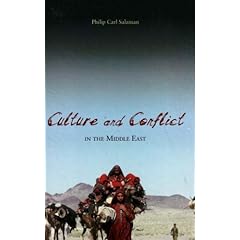
Culture and conflict in the Middle East

Many in our post-modern, "post-liberal" society, intimidated by the pseudointellectualism of the half-educated, stumble when they encounter the unfamiliar world of human societies very different from our own. It is here that the politically correct often find the most profitable point to ram home their confused but potent messages of cultural relativism and nihilism. The spread of higher education in the last 60 years hasn't helped: as an unexpected side effect, it's created an entire class of such people. They know less than they think, and what little they do is garbled and half-baked.

It's refreshing when an anthropologist, used to working in a specialized research in remote parts of the world, addresses the general educated reader with his decades of experience in studying pre-state and tribal societies and simultaneously illuminates an issue of pressing importance. Such are Philip Carl Salzman and his new book, Culture and Conflict in the Middle East. Salzman has taught anthropology at McGill University in Montreal for many years and was a founder of the Commission on Nomadic Peoples of the International Union of Anthropological and Ethnological Sciences. His main research has been the study of the tribal peoples of Iran and Pakistan, in the anthropological mode and thus mainly on the "structure" of their culture. (However, his book does have a fair amount of recent history and some memorable personalities as well.) Anyone familiar with so-called "primitive" peoples will recognize the general point: they're materially primitive and have no government or state; but at the same time, they have an elaborate culture of tribal custom and lore that takes an outsider many years to fully understand. That aspect of anthropology is anything but primitive.

Readers of this blog will recognize the general thrust of Salzman's argument about the nature of tribal society, especially its Middle Eastern version: the unique intertwining of Islam and tribalism, very different from the other great universalistic religions (Christianity, Buddhism, later Judaism) and even from most other, non-universalistic religions (Hinduism, earlier Judaism, classical Greco-Roman paganism); the pattern of conflict along the lines of "balanced opposition," familiar in somewhat different language as the "power challenging" of Pryce-Jones, in his classic, The Closed Circle.** In fact, the similarities to Pryce-Jones are striking, but Salzman's book is shorter, less dense, and focuses on just one large anthropological point. Like Pryce-Jones, Salzman has a precursor, the brilliant scholar and historian Ibn Khaldun, the 14th-century North African author of a universal history with a famous, lengthy philosophical-anthropological preface, the Muqaddimah. Salzman makes liberal use of Ibn Khaldun's ideas about the cycle of Islamic history, the circling from tribal invasion and conquest of decadent, sedentary cities; to the tribal conquerors themselves becoming sedentary and decadent; to their being overthrown by another tribal invasion. The prototype was the original Islamic conquest itself, in the seventh century.

Tribal societies worldwide, Muslim or not, are based on "balanced opposition," with the power to use legitimate violence spread equally among all adult males, regulated only by charisma and luck. This system is incompatible with civilized life and the state, which monopolizes legitimate violence. It is perfectly adapted to nomadic life, but fails when transplanted to sedentary ways. "Balanced opposition" creates endless, unresolvable conflict by its very nature, because it contains no larger peacemaking power: no state, no social contract, no force of public opinion outside small tribal groups. It survives only because (and if) each segment of society is balanced in size against other segments. Oppressive and exploitative states emerge when one group acquires overwhelming power against other groups - then winner takes all. That is how most states emerged historically, in fact. They didn't come into existence to serve the public good. Anthropologists are typically sympathetic to non-state tribes if and when they are crushed by these classical tyrannies - it would be hard not to be. But don't romanticize: the freedom of tribal life is collective. It's not individual freedom, which is a late product of advanced civilization, with civil government and the rule of law.

It's not as if Middle Eastern peoples themselves are blind to the nature of this system. There is a famous Arabic saying: I against my brother, my brother and myself against my cousin, my cousin and I against the world. Islam might have overcome this problem to create a state or states founded on rule of law, but it failed to do that. Instead, the tribal way re-emerged, mixed with Islam (I and my cousin against the non-believer), within Islamic civilization itself. This system, incompatible with the traditional state, is obviously even more incompatible with the modern liberal-democratic state, with its essentials of rights, citizenship, and the public good. The tribal world has exact replacements for each of these, making it self-sufficient and self-contained. The autobiography of Ayaan Hirsi Ali, reviewed here earlier this year, is one large demonstration of these truths by specific example.

It shouldn't need to be said, but I'll say it anyway: modern anthropology is not about social Darwinism or feeling superior to "savages." It's about the power of culture, because humans are cultural animals. They certainly do not function by instinct. Most humans through most of history (including the ancestors of everyone reading this blog) lived in something like this system. The same raw material of human nature is at work among civilized peoples as among as "primitive" peoples, but the collective shape of culture is different. Primitive peoples have many of the same values we do: individualism (at least among adult males), self-interest, notions of fairness and justice. But, in contrast to modern civilizations, nomadic peoples are dominated by group loyalty, with honor and shame typically the overriding motives. It's all there for a reason, because amongst us, we have a substitute that functions in their place: the rule of law, constitutionalism, and an openness to crossing group boundaries. It's just what makes peaceful cooperation and progress possible. At once a source of durability and backwardness, their lack is what makes progress in tribal society impossible.

Most of Salzman's message would have been unexceptional up until about 25 years ago. Since then, liberal academic and intellectual culture has been been subject to the obfuscatory fog of "post-colonialism" (Said). Many in the Arab-Islamic world itself are aware of these conflicting values and critical of the tribal system. The imposition of tribal ways on the Near East's civilized peoples by the Arab-Islamic conquest was the seed of their later decline and these societies' present difficulties in coping with the modern world.* But Said-ian doctrines are so many clubs with which to beat these critics. It's one of the most noxious contributions of the post-modern and post-liberal West to the rest of world and has crippled political debate and clear thinking in Western societies themselves.

POSTSCRIPT: Jared Diamond discusses conflict and revenge in tribal New Guinea here.

As he says, people living in state societies (societies with civil government) and, even more so, living as citizens in modern liberal democracies, have a hard time coping with the conflict between organized killing implicit in war, "civilized" warfare between armies or not, and peacetime life. In tribal societies, the conflict is not felt: there is no sharp boundary between peace and war, or between impersonal justice and simple vengeance. Men aren't ashamed of their killings, but boast of them. It's not exactly the way Hobbes conceived it - tribal life is far from solitary - but he came pretty close to depicting the "state of nature." What's particularly astonishing is that in many tribal societies, most adult males are involved in some way in the killing of other adult males. The obvious advantages of having governments were not strong enough, until recent human history, to overcome the ingrained taste of tribal peoples for their traditional collective freedom.

An interesting corollary of Diamond's analysis is that it explains why so many such tribal societies accepted colonial rule by outsiders so quickly: it reduced or eliminated internal conflict.

Diamond concludes with a relative's harrowing story of the Holocaust and the dilemma those of us who refrain from executing justice on our own face when the state doesn't keep up its end of the bargain.
---
* Ironically, the Arab group that Israel has the fewest conflicts with is the Beduin of the Negev and Sinai deserts. Being nomadic, with no economic need for land to grow food or political claims to sovereignty, they view modern states and borders as little more than nuisances and just slide past them.

** Judaism is a bit of an odd duck here, no doubt because its origins lie in the late Bronze Age (second millennium BCE), before the rise of universalist religious and philosophical thinking in the first millennium. This epoch, the so-called Axial Age, saw the pre-exilic and post-exilic Hebrew prophets, Zoroaster, Siddhartha Gautama (Buddha), Confucius, Lao Tzu, and the philosophical movement among the Greeks. Developments in later antiquity, such as Hellenistic science and philosophy (Stoics, Epicureans, Aristotelians, Platonists), Christianity, rabbinic Judaism, Islam, and Confucianism were secondary outgrowths of the Axial Age. Judaism straddles the earlier tribal/national and later universalist/philosophical eras, with its universal truths implicit and esoteric in biblical times, and open and explicit in later eras. No other religion has seen so much creativity generated by such a tension between the particular and universal.

Labels: , , , , , , ,

Tuesday, April 01, 2008

The bloggers' coven

So there we all were, a generation lost in ... Blogistan, or something. Some decidedly dissident bloggers of the Boston area met tonight in an undisclosed location, and I had the distinct pleasure of meeting the people behind these outstanding sites, whom I now count as friends:
Apologies to bloggers present whom I overlooked!

To start with, we all laughed ourselves silly by reciting out loud Iowahawk's priceless parody (but is it?) of the current Archbishop of Canterbury and his take on the rise of shari'a in Britain. It's a rewrite of Chaucer's Canterbury Tales and not to be missed, especially its surprise ending:

Whan in Februar, withe hise global warmynge
Midst unseasonabyl rain and stormynge
Gaia in hyr heat encourages ....

On a more serious note, we discussed the provocative and controversial short movie Fitna, which has led to death threats for Dutch filmmaker Geert Wilders. We also discussed the larger problem in Europe of developing a consistently non-supremacist approach to opposing the rise of shari'a. There is a wing of the European right with a questionable past and questionable present-day democratic credentials, and who are opposed to Muslim immigration altogether - they were mentioned here last year and denounced perhaps unfairly in overly-sweeping terms. The problem is that serious and difficult issues like this are still often avoided by Europe's mainstream parties, leaving fringe parties to capitalize on them.

Finally, I must mention that the divine Sisu, Mr. Libertarian Leanings, and I had a lengthy discussion on climate. My contribution, besides trying my best to be the evening's instant expert on the subject, was to mention the two most important recent popular books on the subject:
Sisu has an excellent recent posting on temperature and ice trends in Antarctica, which not only continue to track colder and colder, but just this past year, have gone more in that direction than any year recorded. In a rational world, that decisively stop the "global warming" insanity cold, if you'll excuse the expression. Whatever's going on in the Asian/Pacific Arctic, isn't global - it's local.

POSTSCRIPT: Minor updates today - thanks for comments!

Labels: , , , ,

Sunday, March 09, 2008

Leviticus again

It's that levitical-sacrificial thing calling again. It's already next week's portion, Vayiqra.

I was thinking about the strangeness to us today of animal sacrifice. Last year, I pointed how both Judaism and Christianity derived central tenets from ancient sacrifice, even while abandoning the practice itself.

Sick as it sounds, the sort of terrorism practiced by al Qa'eda is intended, in part, to be sacrificial, but with humans, not animals. It's derived from Islamic concepts, yet in a completely twisted way.

Muslims (some Muslims, at least) do still practice animal sacrifice for certain holidays. Here's a interesting December 2007 story from NPR about the Eid ul-Adha sacrifice in north Texas - with an unspoken subtext.

Labels: , , ,

Sunday, February 24, 2008

A culture is a terrible thing to waste

Here's a lesson in cultural decline. Consider one of the greatest natural scientists ("natural philosophers") of the Arabic-Persian golden age, Alhacen of Basra, who lived in the later 900s (see here and here). Then contrast with this flat-earth theorist of present-day Iraq (video clip requires WMP).

What a difference a millennium makes.


This may seem like just shooting fish in a barrel. But here's a serious point: in the West, we're used to progress - the future is better than the past. In our conceited arrogance, we even think progress is automatic, like getting on an UP escalator.

In fact, progress is anything but automatic. It needs the right conditions. We've had those in the West since the late Middle Ages, with some occasional, if terrible, interruptions. The right conditions are always under threat from ideologues, fanatics, and people with obsessive fixed ideas.

Now imagine you live in a land of regress: the past is better than the future. The regress may have been going on for so long - say, seven or eight centuries - that it seems automatic. Of course, that's not right either. But in your land of regress, there are people - including some important and powerful people - with a vested interest in decline. Turning things around seems threatening to them. To make their point, they even get violent.

Labels: , , , , ,

Wednesday, January 30, 2008

The end of Europe? II

And thus spoke Zarathustra to the people: ".... The time has come for man to plant the seed of his highest hope. His soil is still rich enough. But one day this soil will be poor and domesticated, and no tall tree will be able to grow in it .... I say unto you: one must still have chaos in oneself to be able to give birth to a dancing star. I say unto you: you still have chaos in yourselves .... Alas, the time is coming when man will no longer give birth to a star. Alas, the time of the most despicable man is coming, [the one] no longer able to despise himself. Behold, I show you the Last Man.

" 'What is love? What is creation? What is longing? What is a star?' thus asks the Last Man, and he blinks. The earth has become small, and on it hops the Last Man, who makes everything small .... 'We have invented happiness,' say the Last Men, and they blink. They have left the regions where it was hard to live, for one needs warmth .... Becoming sick and harboring suspicion are sinful to them .... A fool, whoever still stumbles over stones or human beings! A little poison, now and then: that makes for agreeable dreams. And much poison in the end, for an agreeable death .... One no longer becomes poor or rich: both require too much exertion ....

"No shepherd and one herd! Everyone wants the same, everyone is the same: whoever feels differently goes voluntarily to the madhouse. 'Formerly, all the world was mad,' say the most refined, and they blink."
- Nietzsche, Thus Spoke Zarathustra, Prologue (1882)

If Berlinski's is the most perceptive and charming of the recent books on Europe, Mark Steyn's America Alone: The End of the World As We Know It is surely the most blunt and original, and of all of them, the most unapologetically conservative. In spite of its title, the book is really about the apparently unstoppable decline of Europe, as reflected by its mix of overburdened economies, inability to defend itself, dicey demographics, unsustainable welfare states, and rapidly growing Muslim populations.

It is also a devastating and almost-irrefutable book, cutting through layers and layers of accumulated conventional wisdom and poisoned junk-food residue left behind by the media. It challenges everyone: realists - Steyn dismisses them as obsolete in a shrinking world; liberals - they're largely unwilling to defend their own liberalism; even neocons - can the Islamic world be reformed - really? In Steyn's view, the real problem is not the Muslims of the Middle East, but Eurabia, the alienated and anti-assimilating Muslims of Europe. America Alone is mainly a book about Europe, and only secondarily about America. The United States simply emerges as an historically normal nation-state, Europe as a doomed post-historical project. Steyn's point on this score: the US doesn't need to join the "rest of the world"; it's Europe that needs to rejoin history. It has a generation left, at most. Otherwise, save your dollars and get over there now to have a look-see: Europe is entering its museum closing time.


The book's style does sometimes veer into Steyn's newspaper column banter. But it has several intertwined broad themes that control its arguments, and Steyn has obviously given them considerable thought. They encompass the post-1945 evolution of Western governments away from "primary" responsibilities (maintaining internal peace and order, self-defense) toward ever-more expansive "secondary" ambitions (refashioning society, labeling everyone a victim and making them objects of solicitude). From this trend arise the relentless expansion and simultaneous unsustainability of the social democratic welfare state - economically, demographically, and politically. At its heart, modern government's "secondary" impulses rest on an incorrigible tendency by elites to treat everyone else as helpless children.

In Europe, another development is being scribbled over top of the first: the basic conflict between Islam as a political project, on the one hand, and the nation-state system and liberal democracy, on the other. ("Terrorism" and the "war on terror" are merely the violent symptoms of this contradiction.) That makes the emerging conflict different in nature there from here: we view it as a foreign war - in Europe, it's headed towards expression as a civil war - not so different from the streets of Gaza or Baghdad. Finally, we have the confusion and fatuity of many liberal and leftist politicians and thinkers when confronted with these unpleasant facts. Steyn is put into the peculiar position many conservatives find themselves in these days, of defending a liberal political system that liberals themselves helped to build, yet are often unwilling to defend. So conservatives do the job that liberals won't, and conservatives end up in a strange position when they do so. That fact alone explains more about the rise of "neoconservatism" (which is really no more than a kind of "right-wing liberalism") than any number of conspiracy theories.

Steyn deftly grasps the self-destructive dynamic here and wonders if Europe can escape the end result: the dynamic of self-hatred, a manifestation of the self divided against itself. For Euro-Muslims, the divided self is a result of a double alienation, both from traditional Muslim society and from post-modern, post-religious Europe. Islamic culture (especially its Arabic core) is markedly underdeveloped in its capacity for self-examination and self-criticism. The resulting self-hatred is projected outward on to the supposed causes, the West and the allied corrupt Muslim governments. For Western post-Christian leftists (and their self-hating post-Jewish allies), self-examination and self-criticism are hypertrophied; the result is self-hatred projected inward, with typical symptoms: a paralysis of self-interested action and rational thought, the invention and invocation of fantasies ("noble savage," "social justice," etc.), and an inability to defend oneself. In Europe (not as much here), the fully-developed symbiosis draws white Europeans and alienated Euro-Muslims into an intertwining of hatred and self-hatred. The suicidal meet the homicidal.

The radical Islamic project has little traction here - it's Europe where the terror cells are being hatched and the political future is in serious doubt. The attempt to buy off the Euro-Muslims with welfare has only produced a generation of lazy, undisciplined resident aliens with no future in European society, but plenty of free time to watch al-Jazeera and think about how much they hate the infidel West. The other pole of this negative dialectic is represented by the European leaders who lack the confidence to defend themselves and their societies. America has far few Muslims to begin with, and they're better educated and integrated into American society. But there's a flip side to this, as Steyn points out: it's because Americans are comfortable with their "liberal" system (including religious freedom) and willing to defend it, that they also have no difficulty expecting immigrants to adapt themselves to it. For the most part, Europeans lack this confidence, and the result is something very different from here: a large, growing population of alienated Muslims who are neither here nor there, doubly alienated, perfect candidates for radicalization. The origins of the European lack of self-confidence are many. But note the fact that traditional national identities in Europe are being euthanized by the Euro-elites. The intended replacement is a weak EU-identity that many Europeans have difficulty taking seriously and which most Euro-Muslims don't identify with at all. The real difference between the US and Europe is not the religion the media and talking heads keep chattering about; it's that the US has a strong secular, national identity and Europe does not. Europe has not only put its religious identity to sleep; it's even putting to sleep the national identities that, a century or two ago, were supposed to replace religion.

In the long run, it might turn out that the 9/11 attacks will prove to be a turning point in European, not American, history. The attacks were planned by Euro-Muslims, not American Muslims. And their successor attacks have mostly happened in Europe. It is the epicenter of the emergent conflict.


Although America Alone -is- a book, not a collection of newspaper columns, it's still studded with the witticisms and zingers we have come to expect from Steyn and that never fail to hit their targets:
  • "In the social democratic welfare state, you don't have kids - you are the kid."
  • "There are moderate Muslims, but no moderate Islam."
  • "Europe is ahead of America, mainly in the sense that its canoe is already halfway over the falls."
  • "The EU is a 1970s solution to a 1940s problem ... a quarter-century past its sell-by date."
  • "Europe's Muslim immigrants are the children Europe couldn't be bothered to have."
  • "[Daniel] Pearl's beheading was the story ... for the jihadis, Pearl [as a reporter] wasn't needed to tell some other story."
  • "The non-imperial hyperpower [the US] does not garrison remote ramshackle outposts, but its most wealthy allies, freeing them from having to defend themselves .... Defense welfare is like any other form of welfare."
  • "Fighting a war is not a lawsuit, its victims are not plaintiffs ...."
  • "As they said of the British at Singapore [in 1942], at least four of those five guns [military, economic, diplomatic, informational] are pointing in the wrong direction."
  • "[Multiculturalism] is a kind of societal Stockholm syndrome .... It doesn't involve actually knowing anything about other cultures ... It just involves making everyone feel warm and fluffy inside, making bliss out of ignorance."
  • "There are three outcomes to the present struggle: surrender, destroy Islam, reform Islam. We can lose."
Bush is conspicuous by his relative absence, probably because Steyn wants to communicate the fundamental conflict and trends, and they have nothing to do with Bush. Like most conservatives, he's also probably gone through multiple stages of Bush disillusionment, and Steyn aims some bitter barbs in his direction: too wimpy, too indolent, too PC, too tolerant of the Saudis and their system of radical schools, too ready to promote big guvmint and overlook its failures.

Steyn's list of possible conflict outcomes is not exhaustive, as many conservative critics point out. But given that the world is getting smaller and smaller, and given the fact that virtually no Muslim country fits liberal-internationalist criteria as "normal," our options, both liberal-internationalist and conservative-realist, are running out.

The larger melancholy of Steyn's book, clear only in the last couple chapters, is the profoundly unhealthy relationship that has developed between the US and the rest of the developed world since 1945, and especially since the end of the Cold War. This is a world deeply dependent on the US for its military protection; its foreign policy; our demand on world markets for their exports; our ability to absorb the world's savings as investment capital into an economy that is stable, non-corrupt, and growing healthily (a combination that occurs almost nowhere else); our role as an escape for the ambitious and talented stymied in their home countries by oppressive dictatorships and stifling welfare states; a place that develops their medicines, because we still have a semi-free medical system - and so on. America far outspends the rest of the developed world in things military, but that is only because the rest of the developed world has abandoned the ability to defend itself or contribute to a common defense. Given American responsibilities, we arguably don't spend enough; what is definitely true is that they don't spend enough. They have become dependencies, not allies. This is what Steyn means by "America alone": the rest of modern civilization is in not-so-good shape. One of the reasons is a potent source of anti-Americanism: the existence of America - the idea of America - is profoundly disturbing to most of the world's elites who are always doing their best to control, if not outright shake down, the countries they rule. These countries still suffer from the very thing that led to the world wars and the near-destruction of civilization in Europe and Asia: modern economic systems functioning in the heart of (at best) semi-modern social and political systems that can't handle modernistic dynamism.

Steyn's scary vision of Europe, the Middle East, and Africa sliding into a new Dark Ages may be too negative. It's certainly only one possible future. But it is a real possibility, and it needs to be taken seriously.

POSTSCRIPT: Steyn has a Web site and a solid presence in the newspaper world, being one of the best and best-known conservative commentators. (Read his famous interview with Monica's dress.) Listen to podcasts with Steyn here, here, and here; and read a recent talk he gave at Hillsdale College.

Labels: , , , , , , , ,

Tuesday, January 15, 2008

The end of Europe? I

But it would seem that if despotism were to be established amongst the democratic nations of our days ... it would be more extensive and more mild; it would degrade men without tormenting them .... [T]his same principle of equality which facilitates despotism, tempers its rigor .... I think then that the species of oppression by which democratic nations are menaced is unlike anything which ever before existed in the world: our contemporaries will find no prototype of which will accurately convey ... the idea I have formed of it, but in vain; the old words "despotism" and "tyranny" are inappropriate: the thing itself is new; and since I cannot name it, I must attempt to define it ....

.... Above this race of men [would stand] an immense and tutelary power, which takes upon itself alone to secure their gratifications, and to watch over their fate. That power is absolute, minute, regular, provident, and mild. It would be like the authority of a parent, if, like that authority, its object was to prepare men for manhood; but it seeks on the contrary to keep them in perpetual childhood: it is well content that the people should rejoice, provided they think of nothing but rejoicing. For their happiness such a government willingly labors, but it chooses to be the sole agent and the only arbiter of that happiness: it provides for their security, foresees and supplies their necessities, facilitates their pleasures, manages their principal concerns, directs their industry, regulates the descent of property, and subdivides their inheritances - what remains, but to spare them all the care of thinking and all the trouble of living? Thus it every day renders the exercise of the free agency of man less useful and less frequent; it circumscribes the will within a narrower range, and gradually robs a man of all the uses of himself. The principle of equality has prepared men for these things: it has predisposed men to endure them, and oftentimes to look on them as benefits.
... [T]he supreme power then ... covers the surface of society with a net-work of small complicated rules, minute and uniform, through which the most original minds and the most energetic characters cannot penetrate, to rise above the crowd. The will of man is not shattered, but softened, bent, and guided: men are seldom forced by it to act, but they are constantly restrained from acting: such a power does not destroy, but it prevents existence; it does not tyrannize, but it compresses, enervates, extinguishes, and stupefies a people, till each nation is reduced to be nothing better than a flock of timid and industrious animals, of which the government is the shepherd.

I have always thought that servitude of the regular, quiet, and gentle kind ... might be combined more easily than is commonly believed with some of the outward forms of freedom; and that it might even establish itself under the wing of the sovereignty of the people. Our contemporaries are constantly excited by two conflicting passions; they want to be led, and they wish to remain free: ... they strive to satisfy them both at once. They devise a sole, tutelary, and all-powerful form of government, but elected by the people. They combine the principle of centralization and that of popular sovereignty; this gives them a respite; they console themselves for being in tutelage by the reflection that they have chosen their own guardians. Every man allows himself to be put in leading-strings [harness], because he sees that it is not a person or a class of persons, but the people at large that holds the end of his chain. By this system the people shake off their state of dependence just long enough to select their master, and then relapse into it again .... [T]hey think they have done enough for the protection of individual freedom when they have surrendered it to the power of the nation at large. This does not satisfy me: the nature of him I am to obey signifies less to me than the fact of extorted obedience.


- Tocqueville, Democracy in America (1838)

More than a year ago and several times since then (see here and here), Kavanna took a look at the situation in Europe and came to rather negative conclusions. But there's only so much a few blog postings can convey about this profound and many-sided topic. More comprehensive are the armful of excellent books on Europe that have appeared in the last few years: Bruce Bawer's While Europe Slept (2006), Mark Steyn's America Alone: The End of the World As We Know It (2006), and Walter Laqueur's The End of Europe: Epitaph for the Old Continent (2007). Laquer's book is a shocker, a sign that the trend is serious and no mere epiphenomenon. The author of the earlier Europe in Our Time: A History (1992) - a laudatory account of Europe's post-1945 reconstruction - Laqueur's view of Europe has obviously changed in recent years.

While all these books are important, Claire Berlinski has the distinction of kicking off serious discussion in the US with a stream of articles and her book, Menace in Europe: Why the Continent's Crisis is America's Too. Berlinski writes regularly for the Washington Post, National Review, etc., and now lives in Istanbul. She's even written a couple of well-received novels. Menace in Europe was published in late 2005. Nothing has happened since to lessen its validity and much that re-validates it.

Before starting with Berlinski's book, we need to clear away some myths that get in the way of informed discussion of contemporary Europe. There are three major misconceptions. One is that what's happening in Europe doesn't matter to America. This myth has some currency on the center and right of American politics. Two other myths are still widespread among American liberals and leftists. These are the "Europe is more sophisticated than America" myth and that stubborn urban legend, "It's all W.'s fault, and the problem will vanish when he leaves office." None of these myths is true.

What's happening in Europe does matter - Europe is the West's "other half," and if Europe fails, the United States will need a Plan B for many things. And what happens there is paralleled, in certain ways, by what happens here. Nor is it all, or even mainly, W.'s fault. European anti-Americanism has a history stretching back to the 1920s, to the immediate aftermath of part one of Europe's civilizational suicide. It surged in the 1970s and early 80s, died down afterwards, then reappeared in the late 90s, with globalization and Europe's glaring failure in Yugoslavia. While Bush's actions and political style have aggravated the problem, anti-Americanism has also dissipated somewhat compared to a few years ago - but it will not disappear when he leaves office. Fresh events and new personalities will keep the kettle boiling. As for European sophistication, read on and judge for yourself.

Part of the problem is that older Americans have a distorted picture of Europe picked up in the immediate postwar period, when much of Europe's traditional culture was still alive; and that all Americans have misleading experiences as tourists spending time admiring an older European civilization that isn't where and how most Europeans live today.

The most painful chapter of Menace in Europe is the one on Britain. It is, in part, an excursus on Britain's Muslims, largely of south Asian origin, and the heritage of British imperialism. But it also, by comparison, makes telling observations on Britain's non-Muslim former imperial subjects and why, upon immigration to Britain, they have so few of the problems that Muslims do.

The causes are partly socioeconomic: many, although not all, of Britain's Muslims come from villages; the other immigrant groups are overwhelmingly educated, urban, and middle class. The causes are also partly connected to the history of the Indian subcontinent, spanning the whole of British-ruled India before 1947 (encompassing modern India, Pakistan, and Bangladesh). Britain's empire in India was at first strictly economic-exploitative, run by the private East India Company, the same whose tea was dumped in Boston Harbor in a well-known incident. Later it became a political entity - an empire within an empire - created at the expense of India's minority Muslim rulers, the Mughals. The British Raj, first unwittingly, later wittingly, became a powerful force on behalf of India's Hindu majority, its non-Muslim minorities, and (after 1920 or so) its women.

This mixed Anglo-Indian heritage is visible today in India, but especially in Britain, where the south Asian Hindus, Christians, Parsees, and Sikhs do well, but the Muslims often do not. The baleful heritage of the Deobandi school of Islam, south Asia's verion of Wahhabi or Salafi Islam, sticks out clearly in this generation of anti-assimilated south Asian British Muslims and their attraction to Islamic militancy.

Berlinksi's most fun chapter is that on the French port city of Marseille. Although it might surprise some of her readers (it shouldn't), her evaluation of France, the French, and France's secular republican ideal is very positive, even as she acknowledges that that ideal has probably outlived itself and met an insuperable barrier in the form of Islam.

Affectionate yet disapproving is her other chapter on France, an extended and satirical take on antiglobalization activist José Bové, exposing the layers of Europe's mystical and apocalyptic movements that stretch back 1500 years, to the origins of modern Europe. Here we are treated to the successive reincarnations of the charismatic romantic mystic, with his striking eccentricities and strong sex appeal. Until the 18th century, they were religious revolutionaries, proclaiming the coming of heaven on earth, the abolition of wealth, rank, and distinction, and (before the Reformation) demonizing the Jews as the people of Satan. The first modern (secular) revolutionary of this type was Rousseau, the founder of leftism and creator of the "noble savage" myth - the origin of all politics of adolescent rage against modern civilization. Modern Europe's angry, mystical political movements are secularized re-creations of these older religious movements, with virtually the same themes.* The chapter is a mixed-mood piece because Berlinski herself feels disturbed by the anonymous nature of globalization and questionable nature of modern factory farming and food production, harmful to animals and sometimes to humans. The spectacular British case of "mad cow disease" just underscores the point.**

The mosht dishtuurbing chapter is that covering Germany and its famous heavy metal band, Rammstein. (They're all over the Web - see here.) Berlinski uses Rammstein as a foil to explore the return of nihilistic late Romanticism - Expressionism - as a feature of German kultur. This is a crucial theme in modern German history, Germans as the people of nihilism and the people of Faust. Important German thinkers (Goethe, Nietzsche, Thomas Mann) were themselves acutely aware of this aspect of "national personality." You can't imagine Rammstein's songs sung by anyone, say, French or Italian. British and American heavy metal bands are about personal rebellion and angst. But in Germany, where music exposes the national soul, juvenile angst is automatically political, with an unmistakable esthetic familiar from the 1930s and 40s.

While French, British, and American Romantic tendencies have usually taken the form of personal rebellion, and its political form consists of delusional searching for the noble savage somewhere else - among workers, brown and black people, or among animals - in Germany, Romanticism was xenophobic from the start: the German Romantics decided that they didn't need to look elsewhere for noble savages. Rather, they felt that the Germans themselves were the noble savages, possessing deep Germanic "culture" in opposition to the superficial and materialistic Anglo-Franco-American "civilization" or the "mere barbarism" of the Slavs. This view, increasingly important in the 19th century, became, after 1918, the sickness of much of German-speaking Europe. In exploring this history, Berlinski's personal venom is evident here, understandable given her family's history in Germany. This disapproving chapter is not at all affectionate.

Germany sadly remains a crime scene still cordoned off after all these years, with people continuing to stand around and wondering what the hell happened. Germany's civilized and semi-civilized neighbors have all peered into the gloom of the dark Teutonic forest. They squint and scratch their heads.

Berlinski's final chapter, "To Hell with Europe," seems flippant at first sight. But she doesn't mean, to hell with France, or Britain, or Germany, etc. Her point is the "persistence of national personality." When she writes "to hell with Europe," she means just that: to hell with the false unity of the EU, the pretense that Europe's real nations have been made to go away, and that Frenchmen, Britons, Germans, etc., are now all just Europeans.

The modern West has its origins in the Dark Ages that immediately followed the collapse of the western Roman empire, which was replaced with a variety of what historians once called "petty kingdoms, dukedoms, and principalities." Europe in some ways has never left that state. The barbarian peoples - the Celts, the Germans, and later, the Slavs and others - rebuilt civilization from what was left in the Roman wreckage, including the Church. Modern Europe has rejected these sources of its civilization, leaving an immense spiritual, cultural, and political void. Into the void step what Berlinski calls "black-market religion" (Bové) and "black-market nationalist hate/nihilism" (Rammstein). No pan-European unification project since the end of the Roman Empire has succeeded - not the Catholic Church, the Holy Roman Empire, the Hapsburgs, the Bourbons, Napoleon, Hitler, or the Communists - in spite of the attractive appeal of new religions and utopias. In reminding her readers of these facts, Berlinski is passing on an essential perception of modern Europe's history, its arc from origins to finish.

Berlinski recommends some sensible changes as a necessary start to saving Europe - none of them is original, as she acknowledges: reforming its deadly economic mix of overregulation and unsustainable entitlements; dealing with Islamic extremists - both as individuals and institutions - in a more consistent and punitive way; applying Western legal and social standards equally to Muslim men and women without apology. (This is one of a number of her points of admiration for the French, whose policy towards Islamic radicalism is one of zero tolerance.) Major changes will happen soon: Europe's social democratic systems will either be reformed or collapse; its demography will change dramatically in the next generation; the political unification project will fail. Some of these changes are already starting. Other possibilities are more speculative.

Menace in Europe has a fragmentary form, which might at first make it seem like a jumble. But its thematic and stylistic unity is powerful; Berlinski grabs her readers and shakes them, saying "See?" and "See?" She has a Web site of her own, and you can listen to a podcast interview with her here.
---
* I mean identical in some cases. For example, the program of the anonymous German Revolutionary of the Upper Rhine, circulating in manuscript just before the Reformation, called for the expulsion or extermination of the Rhine Valley Jews, the end of Germany's economic relations with the outside world, the independence of a unified Germany from the Papacy, and the creation of a new religion mixing Christianity and a restored pantheon of old German gods. Reading it, you get confused: is it from 1500 - or 1933?

Then there's Joachim from the Italian town of Flora: his speculative tripartite theory of history, published in manuscript around 1300, postulated a three-stage historical evolution leading to an Age of Pure Spirit, where everyone would be living equally in a barracks or a monastery. The tripartite stuff sounds a little like Hegel and a lot like Marx; the equality of the barracks and the monastery, like the pre-Marxian socialists whom Marx himself ridiculed as "utopian."

In laying bare the religious and utopian origins of the modern West's extremist political movements, Berlinski and the rest of us are profoundly indebted to the works of Norman Cohn, especially his classic In Pursuit of the Millenium (1957). Cohn's work explodes the claim that these modern movements made about themselves, that they were "scientific," "progressive," or "enlightened." There's nothing scientific or enlightened about Marxism or race theories; these movements repackaged tribal, mystical, and apocalyptic ideas in a superficially modern garb of pseudoscience. Environmentalism bears strong traces of the same.

** Consider too America's industrialized food production, with its heavy use of subsidized corn, bestowing upon us the dubious blessings of corn syrup, corn feed, and ethanol.

Labels: , , , , , , , , , , , , , ,

Saturday, January 12, 2008

Rock the casbah

This posting isn't really about that venerable song by the Clash ... but it sounded cool :)

This weekend's Wall Street Journal had a very interesting article on the possibility of an independent and critical scholarship of the Qu'ran, similar to the sort of thing that Christian and, later, Jewish scholars achieved in the last 300 years with regards to the Hebrew and Greek scriptures that make up the Bible. German scholars at the forefront of "Oriental" research made a start from the end of the nineteenth century, until the rise of the Nazi regime. The project was suspended and much of its materials (photos of old Quranic texts taken in the 1920s and 30s) apparently lost during the war. The subject is also, of course, one of extreme sensitivity in the Muslim world. Nine years ago, the Atlantic Monthly published a prescient article on the subject, and the politico-religious minefield around it, available if you can find a print or online database copy of their January 1999 issue. (It's available on the Atlantic site only to their subscribers.)

The Journal article announces a stunning discovery: the photo archive was not actually lost. It survives and has been made publicly available. See here and here for more.

POSTSCRIPT: Here we go again with the mindcrime of publishing the Danish-Muhammad cartoons, accompanied by the same weird mixture of the medieval and the postmodern (charges of blasphemy mixed with bogus charges of victimhood). See the brilliant videos from the ludicrously misnamed Ontario "Human Rights" Commission here.

No Danes or Canadians have committed violence against Muslims because of the cartoons.

Labels: , , , , , ,

Saturday, January 05, 2008

Ayaan Hirsi Ali: Further thoughts

One of the most interesting features of Ali's thinking is her view of Islam as failed social utopia. She says: I'm from a clan in Somalia; long ago we accepted Islam and following the divine will as the path to an ideal society, and we have failed. This approach marks an arresting starting point and allows her to connect the civil war anarchy she escaped with the "theologico-political problem" of early modern Europe (à la Spinoza, Hobbes, etc.), as well as the great failed secular utopias of our own time. Of course, she is a political scientist by academic training - the University of Leiden in Holland, to be exact. Her drive to understand why the modern West has succeeded and the floundering of the tribal-theocratic world she came from is why she decided on graduate school in the first place. It was academic, but not just academic.

There is a line of thinking - exemplified by Pryce-Jones' The Closed Circle - that postulates the problem of the Islamic world, not as religion, but as a failed overcoming-of-tribalism. There is a serious case to be made for this view. The tribal world is not a "civil society" - there is no voluntary, peaceful cooperation, the kind required for progress. Instead, everything cancels everything else out - the closed circle. The relation of Islam to political power is different from Christianity or Judaism: there is neither a separate state with a monopoly on power, nor a voluntary self-organized community. Religion, politics, family or clan - all are mixed together in primitive society. This gives exceptional urgency to the problem of succession to Muhammad (khalifa). Without a single, agreed-upon successor, there is no legitimacy. Yet such a figure is a necessity in classical Islamic political thought for truly legitimate political authority. In reality, there is a void, filled by plausible or implausible claimants.

A completely different example of the impact of tribal custom is the barbaric practice of female genital mutilation.* Mentioned nowhere in the Qu'ran, female genital mutilation, where it is practiced (in some Muslim countries - not all - as well as some non-Muslim ones), is intended as a kind of female-chastity protector and female-sexual-pleasure-destroyer. It's rationalized as a way to keep girls and young women "pure." This sort of tribal-custom-rationalized-by-Islam is at work in the purist Wahhabi or Salafi Islam of Saudi Arabia and the tribal code (Pashtunwali) of the Pashtuns of Pakistan and Afghanistan.** One of the basic dilemmas posed by Muslim immigration to Europe is the assertion of tribal custom in Europe's cities, in a way not compatible with the rule of law or state sovereignty. In some ways, "Talibanism" is an assertion of extreme tribal reaction against urban, middle-class life. This cycle has a long history in Islam, discussed in the classical sources such as ibn Khaldun's Muqadimah. Such ways of thinking have almost been lost to us here in the West, and so we often have a hard time recognizing them for what they really are when we encounter them elsewhere.

These are among the many not-just-academic questions that arise from Ali's Infidel and The Caged Virgin, as well as the other recent additions to the bookshelf on Islam by Muslim women. Ali's autobiography blends the personal and political in a powerful way that illuminates both, leaving the chatterboxes of post-modern academia far behind in the dust.
---
* Sometimes mislabeled "female circumcision." The actual male equivalent, were it practiced, would be something like cutting off a quarter or more of the male sexual organ - depending on size, of course :)

** The link between the two is the 19th-century Deobandi school of Islam on the Indian subcontinent. Both the Salafi and the Deobandi schools were early reactions to the incipient clash of Islam and modernity, one in the context of the Ottoman empire, the other in the context of a polyreligious India under the British Raj.

Labels: , , , , , , , , ,

Friday, January 04, 2008

Meet the thinkers: Ayaan Hirsi Ali

I just finished reading Ayaan Hirsi Ali's autobiography, Infidel. You can read here about her opinions and thoughts on politics, the West, and Islam. But in this book, she wisely chose to tell her story personally. Abstractions often wash over and through our minds - easy come, easy go - but facts and events like those of Ali's life will not wash over and through anything - they will stick in readers' minds for a long time. Infidel is a powerful book and must reading for anyone in the West who wants to understand the unfolding confrontation of Islam and modernity, and avoid diversionary rationalizing. Women, particularly young women, should especially read it. Muslims should read it as well, for a whole set of different, if overlapping, reasons.

Ali's books (Infidel, as well as the earlier The Caged Virgin) and film Submission Part I (the later parts remain unmade after her partner Theo Van Gogh's murder) don't force her own answers on her viewers and readers. But they do push unavoidable questions to the fore and provoke everyone to consider their own answers. Her attitude is a refreshing and positive contrast to the proselytizers of the "new" atheism popular of late.

Her encounters with Christianity and its concept of a covenantal or "partnership" relation between man and the divine forced her to see something contrasting about Islam, a word that means "submission" in Arabic. (Muslim means "one who submits.") Lurking around here is an old argument about whether a "social contract" style of civil government is even possible in the Muslim world. The "social contract" of Western governments has its ultimate roots in the the biblical notion of covenant. It's different from autocratic government (rooted in conquest and overlordship) or the clan-aristocratic political culture of the ancient and medieval worlds. Theocentric in its original form, the humanized covenant becomes a contract among people, reflected in constitutions and consensual and representative forms of government.

What is a consistent approach to this war for the world, this contest between Islam and modernity?* This is not a conflict we can decide; Muslims have to. But we can consistently follow the rule that sticking to our rights is the best policy: defend ourselves and maintain the firm view that peaceful interaction between Muslims and the outside world is possible - if Muslims are willing to treat non-Muslims and "deviant," liberal, and secularized Muslims as equals. That's a big "if." The decision is theirs to accept or reject, not ours. But our response to the Muslim decision, either way, should be unapologetic.

Ali's larger and unmistakable point is that the West must abandon the claptrap of multiculturalism and its attendant subcults of victimhood and noble savagery. Ayaan, daughter of Hirsi, great-granddaughter of Ali, has been there and done that, and it's no fun. People are equal; cultures are not.

POSTSCRIPT: Read Ali's brief self-explanation here at Cato (PDF), and listen to a 2007 NPR interview with her here.
---
* And, by the way, these days, the world's only real war on women. Read Anne Applebaum's review of Infidel at the Amazon page.

Labels: , , , , , , , ,

Sunday, December 30, 2007

A horrifying milestone

PRE-POSTSCRIPT: It's another Middle East sick-humor moment - but it's real: Pakis flee to the relative safety of Afghanistan (via Instapundit). It's also a measure of how rapidly the situation is evolving.
---
There's not much to add to what's been said about the assassination of Benazir Bhutto. She wanted to return to Pakistan and, with Musharraf weakening in the last couple years, agreed with Rice and the State Department to a strange "arranged marriage" with the Pakistani government. While there's a lot of tongue-clucking about Bush's policy being dead, the reality is the opposite: it was the old policy of giving Musharraf a blank check that is now not only dead, but dead and buried. Bhutto's assassination was carried out by al Qa'eda-Taliban operatives, extremist groups that owe their existence to Pakistan's Inter Services Intelligence (ISI) service and Saudi money and ideology. These groups do not and have never had widespread support from Pakistanis, and the government's main repressive actions have been directed against liberal and secular movements, not against the extremists.

What Rice and others in the administration realized a couple years ago was that giving Musharraf a blank check after 9/11, when Pakistan decided to at least officially side with the US, was good short-term strategy, but bad in the long run. As with many of these apparently clever "realist" strategies, we're now living in the long run. The era of "he's our bastard" realpolitik is over.

The future of fighting these extremist movements lies with allying ourselves to and strengthening Muslim governments that have greater legitimacy. They don't necessarily have to be electoral democracies. They can also be conservative monarchies, if they are open to reform. Relying on rulers with narrow bases of support is a deadend.

For Pakistan itself, the problem isn't just radical Islam, because in the Islamic world, religion isn't just a belief system as we think of it. Radical Islam comes with a political program (the caliphate fantasy versus nation-states) and social forces (the world of village clans and tribes versus the urban, the middle class, and the liberal). The resurgence of purist Islam is a result of the failure of "modernization," itself a relic of European colonialism. All of these older forms of Westernization had a narrow basis and limited appeal. Without a broader popular demand for better government, the rebarbarization of former European colonies is a real possibility. And because we live in a smaller and smaller world, we will not be able to run away from the consequences.

Mark Steyn put it well:
Benazir Bhutto's return to Pakistan had a mad recklessness about it which give today's events a horrible inevitability ....

Since her last spell in power [in the 1990s], Pakistan has changed, profoundly. Its sovereignty is meaningless in increasingly significant chunks of its territory, and, within the portions Musharraf is just about holding together, to an ever more radicalized generation of young Muslim men Miss Bhutto was entirely unacceptable as the leader of their nation .... Miss Bhutto could never have been a viable leader of a post-Musharraf settlement, and the delusion that she could have been sent her to her death. Earlier this year, I had an argument with an old (infidel) boyfriend of Benazir's, who swatted my concerns aside with the sweeping claim that "the whole of the western world" was behind her. On the streets of Islamabad, that and a dime'll get you a cup of coffee ....

When you invent an artificial country, you better be sure that your artificial identity will stick. Pakistan today is not what the British and Jinnah had in mind, nor Ayub Khan, nor Zulfikar Ali Bhutto, nor General Zia, nor Nawaz Sharif. Instead, across 60 years, their failures incubated an identity that would have seemed utterly deranged to even the more excitable Punjabi Muslims of the early 1940s. As ... noted earlier, according to one recent poll, 46% of Pakistanis support Osama bin Laden.

What should be easy to agree [upon] is that Pakistan is getting worse. Even those who thought at the time that its creation was one of the most unnecessary mistakes in British imperial policy wouldn't have predicted that a mere half-century later it would be a coup-prone nuclear basket-case exporting both its tribal marriage customs and irredentist jihadism to the heart of the western world. Fifty years ago, Pakistanis emigrating to England and Canada brought with them an essentially Britannic education and a moderate Sufi Islam that was not a barrier to integration. Today they bring a narrow madrassah education and [Wahhabi- or Salafi-inspired] Deobandi Islam, which is deeply hostile to assimilation. In other words, what a "Pakistani" is[,] is profoundly different. I liked Benazir Bhutto very much, but she represented Pakistan's past, and her murder is a horrible confirmation of that fact.
I'm sure Steyn would love to be wrong about Pakistan, but there's a good chance he isn't.

Labels: , , , , , , , , ,

Thursday, November 29, 2007

A guide for the perplexed II

In the last posting, I pointed to Britain as the new odd man out in the Euro-Trio. Again, what gives?

One sign is the surge of antisemitism that began in the late 1990s. Although far-left antisemitism and anti-Zionism are not new in western Europe - they first reappeared in the 1970s - they derive new power from their synergy with the Islamic radicalism now common in Britain's cities, among its second- and third-generation Muslims of south Indian extraction. The first signs appeared in popular culture (for example, Zadie Smith's novel White Teeth and Udayan Prasad's film, My Son the Fanatic). Next was the explosive growth of Afghanistan- and Pakistan-bound and trained terrorists living in or coming from Britain. Law enforcement officials in continental Europe and the US began to bitterly refer to "Londonistan" - indeed the name of Melanie Phillips' excellent book on the subject.

But there's more disturbing aspect to this sudden return of antisemitism. The phenomenon is historically most prominent and dangerous when a country or a whole civilization experiences an existential crisis of the first order. Antisemitism is a powerful outlet for an otherwise fractured society to direct its hatreds and problems outward to a ready scapegoat. Jews have unwillingly been thrust into this role before, and Europe seems unable to shake the habit. Today, the aftereffects of European imperialism (the sudden and unplanned jerking of the Islamic world into modernity; post-imperial immigration to the metropoles) and the inability of European countries to successfully integrate their Muslim populations have fractured these societies and destroyed their confidence - they're unable to live politically and culturally with Muslim immigrants, yet cannot live economically without them. Jews, both in Europe and in Israel, are again a convenient escape from reality: it's really all their fault. With Europeans unable to master their current difficulties in a workable and humane fashion, wacky conspiracy theories and irrational hatreds grow instead.

Britain also faces internal fracturing, as the central government in London negotiates with the regional Scottish and Welsh parliaments over federalism - a new and disorienting idea in Britain, one of Europe's oldest unified states. The peculiar evolution of the Western left in the face of its discrediting is also at play here. By the 1970s, classical Marxism of the old-fashioned kind was dead. The hard left mutated into new forms in the 1960s and 70s - cultural leftism, political correctness, the sorts of the things you see here in academia, Hollywood, and the news media. Outgoing Prime Minister Tony Blair's "New Labour" had the opportunity to defeat these forces for good in the 1990s and was supposed to have reoriented the party to toward the center and greater viability. He was the center-left's answer to Thatcher, much the same way Clinton was the Democrats' answer to Reagan. Blair carried it off, but the hard left didn't disappear in the UK. Instead, he and his allies were led into a compromise that has come back to haunt him and everyone else. The far left today doesn't care about the working classes - what it wants is control of the culture, so it can brainwash the next generation with its authoritarian mumbo-jumbo of political correctness and multiculturalism. Blair, not grasping their importance, gave control of cultural and educational matters to the hard left, while he took the apparently more important bits, politics and economic policy. The far left gave up class warfare and socialist economics. But while Blair was busy reforming the post-Thatcher welfare state, the far left got, in exchange, unchallenged control of Britain's official cultural life, its schools and universities, trade unions, and government-owned news media.

This is the origin of the recent attempts by Britain's unions (always farther to the left than America's) to boycott Israeli universities. These attempts were defeated, but only after a two-year effort. Of course, these are the equivalent of what we call public-employee unions - they're not your grandfather's unions and feature no sweaty proletarians. Drifting away from the Old Left, they have fully swallowed the "cultural" or "new" left identity politics and search for scapegoats for all imperial sins, real and imagined. Jews and Israel have now become, not for the first or last time, whipping boys for European extremist movements.

But Britain has a longer tradition of elite antisemitism that should not be neglected. The "new" antisemitism traces from the late 90s back to the 1973-74 oil embargo, the rise of "Palestinianism" (it won't do to call it nationalism), and the 1982 Israeli invasion of Lebanon and counterassault on the PLO. Until the late 90s, our view of this issue was shaped and perhaps warped by the Cold War. Further perspective is possible by looking farther back into the earlier twentieth century, the 1920, 30s, and 40s. Here we encounter the anti-Jewish prejudices of Britain's interwar upper classes (a phenomenon far more marginal before 1914, by the way). A figure like George Galloway, for example, cannot be understood apart from this modern tradition of elite antisemitism and strong affinity for foreign dictators and populist demagogues on the part of the educated classes and self-styled "radicals" - the same tradition that gave us Unity and Diana Mitford and Lord Haw-Haw.* Of course, people now have less shame and more incentive, given our media-driven exhibitionist culture, to let it all hang out, so to speak. In the 1930s, only those who had really gone around the bend put on such public displays. And we mustn't forget resentment over the accelerating loss of empire and displacement by the US (definitely found on the left as well, usually without the guts to admit it). The intellectual classes were hardly immune - exemplified by the once-important historian Arnold Toynbee and his antisemitism, opposition to Zionism, and extraordinary rationalizing for the Armenian genocide.

What's stunning about these developments, is how opinions and tendencies once (correctly) viewed as far-right and reactionary poison, have now become an everyday staple among the postmodern left. For more about the tangled origins of the "new" antisemitism, see here.

What's happening in Britain now is not at all like Germany in the 1930s or even Russia and Romania in the early 20th century. It's more like Austria and France in the late 19th century. Both countries had just been humiliated by Germany. While their economies boomed throughout that period, the growth was uneven in both time and in its effect on different social classes. Both countries experienced political and social turmoil. Today, the rise of the EU and the possible break-up of the United Kingdom have combined with the vicious political correctness of the far left and the radical muzzein's call to leave Britons' confidence in, not only their present institutions, but basic political principles, badly shaken. To follow the argument of English doctor Theodore Dalrymple, the "rebarbarization" of Britain is a real possibility. While the world wars and the end of empire left mid-century Britain materially damaged, middle-class decency and intellectual leadership were still solid. These apparently can no longer be counted on, although many in Britain are deeply unhappy about this.**

A few years ago, Richard Wistrich vividly spelled out the profound and accelerating shift in Britain:
None of this is to say that British culture is inherently or overwhelmingly hostile to Jews. Great Britain, which was the birthplace of liberalism in its modern political and economic senses, continues to be a liberal society today, with a healthy democracy, a free press, and an independent judiciary dedicated to protecting individual liberties. Indeed, in the last several centuries, and through World War II, Great Britain was, relative to the rest of Europe at least, a model of tolerance. Nor does it follow that the Jews of the United Kingdom are about to enter a dark era of persecution or the curtailment of basic individual rights.

What it does suggest, however, is that the widely held image of Britain as a realm uniquely hospitable to its Jewish citizens - similar in this regard to the United States, Canada, and other English-speaking countries - no longer seems accurate. In dry numbers, Great Britain has become home to a wave of anti-Semitic violence second only to France in all of Europe. Considered more substantively, anti-Semitic sentiments, motifs, symbols, and methods have gained a legitimacy in British public discourse that enjoys little parallel in the Western world.

Today the United Kingdom stands at a crossroads. Great ideological battles - over European unification, the effort to reassert elements of sovereignty in Scotland and Wales, and the future of long-standing traditions such as hunting and the monarchy - have brought about a profound erosion of the very idea of Britain. But when nations are so deeply unsure of the stability of their values and the security of their future, anti-Semitic sentiment often bubbles to the surface, as people deflect blame for a nation’s problems instead of addressing them head-on. For this reason, it is often said that the way a nation treats its Jews is a litmus test for its true character. As Britain’s subjects ponder their future among the community of nations, they would do well to keep these lessons of the past in mind.
These developments also give the lie - again! - to the absurd idea widely-held by American liberals that Europe is more sophisticated than the US or worthy of American imitation. The truth is very different. For an update on the situation, see here.

But - Europe's resurgent post-Cold War demons: that's another posting - or two, or three.

POSTSCRIPT: Some observers are struck by the fact that a significant number of the propagandists and leaders of the boycott movement are Jewish - but this should be no surprise. Pair them up with Islamic radicals, and inward-looking self-hatred meets outward-directed aggression. It's like one of those "high affinity" reactions you learned about in high school chemistry: acid-base, alkaline-halide: a violent encounter between sadism and masochism - and a strongly bound molecule emerges.

A people's vices are often related to their virtues. The rise of the self- and Jew-hating post-imperial left in Britain has been facilitated by the ingrained English sense of fair play and tolerance for eccentricity. (Something similar was at work in the 1930s appeasement era.) It is precisely because of Britain's long tradition of tolerance that far-left and radical-Islamic antisemitism have run so rampant there. But the rise of political correctness in Britain has not gone unresisted.† On the Tory side, the criticism of the Blair-era rampage of academic and media elites has been trenchant. These elites have more influence in Britain than do their opposite numbers here. But that does not mean their critics have disappeared.

Counterboycotts have been proposed, but they need to be painted with a finer brush and properly directed. General boycotts of Britain are not warranted.†† These are not, after all, government policies. In fact, instead of drawing the boundaries around countries, we can understand and fight these ideas and these people better if we draw boundaries around "the media," "academia," and "far-left activist organizations." Then all those people in Britain who are irritated by political correctness end up on the right side of that boundary. And the boundaries are international - we can see all of these same PC tendencies at work here as well - they just lack the concentrated clout they have in Britain.
---
* Familiar to any student of British politics and foreign policy in the 1930s and echoed, for example, in Kazuo Ishiguro's novel Remains of the Day and the movie based on it.

** As suggested by the striking success of Conn and Hal Iggulden's anti-PC The Dangerous Book for Boys, written to counter the simultaneous dumbification and couch-potato-ization of at least half of the West's adolescents. Listen here to an interview.

† A British book published recently, Robert Irwin's Dangerous Knowledge, is a comprehensive and irrefutable critique of Edward Said and his noxious influence on Orientalism (study of the Middle East). It's the most important book on the subject in decades.

Strikingly, while Irwin is sympathetic to the Palestinians, he goes out of his way to point out the large contributions to modern Oriental studies by Jewish scholars (German, British, American, Israeli, and Ottoman/Middle Eastern). Irwin firmly rejects the attempt to annex the intellectual life of our or any society to "political correctness." However you come down on some burning current issue, the forming of meaningful opinions and of successful policies for the Middle East by outsiders is impossible without real knowledge. What "Middle East studies" needs is more - not a Edwardian ban on - free inquiry and discussion. While knowledge alone can't make our decisions for us, what's dumber than a willfully uninformed opinion?

Since Said was educated at elite Christian boarding schools and came from an Anglophile family, he was himself a personal link between the snobbish Christian and bourgeois antisemitism of the pre-war decades and the new-style anti-Zionism of the radical left - once he doctored his autobiography and reinvented himself as an oppressed noble savage.

†† Nobel laureate physicist Steven Weinberg recently canceled appearances at a number of British schools because of the attempted boycotts. He hasn't engaged in or called for a general boycott of Britain, however.

Labels: , , , , , , , ,

Thursday, November 01, 2007

Clarification of language

A minor dispute over language has broken out in the blogosphere over the use of the term "Islamofascism." And back in the real world, some objection was raised to "Islamofascism Awareness Week," organized on campuses by David Horowitz and his Center for the Study of Popular Culture. At one point, Binah also objected to this term, although on fairly narrow grounds. Christopher Hitchens defends the term here, and I want to register my basic agreement, with some qualifications.

Sometimes such criticism is both patronizing and ignorant. For example, the pathetic and ridiculous Tony Judt has attacked even the use of, not just "Islamofascism," but the term jihad.

Objection here to "Islamofascism" was in connection to the influence European fascism had on secular Arab nationalism earlier in the 20th century. Secular, modernizing dictators like Nasser, Ghaddafi, and Saddam were under the strong spell of Mussolini and Hitler, as were many of the Third World populist demagogues of the postcolonial era. Later, after the late 1950s, they were seduced by Soviet and other types of Marxism. But such secularist, modern ideologies have been in decline since the 1970s and, in the Arab world, were effectively dead by the time Saddam invaded Kuwait in 1990.

Hitchens is using "Islamofascism" more as an analogy or parallelism and compares it to clerical fascism, a phenomenon important in Catholic countries from the end of the 19th century until the end of World War Two. Neither created nor approved by the Church, clerical fascism (which is a fair term for someone like Franco) was generally led by more junior and renegade clergy, but mostly by lay Catholics. (Americans should think of Father Coughlin.) Its politics was more strictly reactionary than fascism of the Benito-Adolf type. Insofar as a cross-civilization analogy is possible at all, the shoe fits - on bin Laden, Nasrallah, the Iranian theocracy, et al. The fact that these leaders are often not traditional hierarchs within their religious establishments, but in fact, usurpers and renegades, only reinforces the point.

At a deeper level, all such analogies break down, because we're comparing two different civilizations in crisis, with different histories and different relations between religion and political power. Both claim to represent the Near Eastern monotheistic heritage and both were, in their greatest periods, also strongly influenced by classical Greco-Roman antiquity. But large differences remain. Christianity started as a persecuted minority in the later Roman empire and spread mostly through missions and voluntary conversion. The early Church did fuse with the Roman imperial structure to create what we know today as the Roman Catholic and Eastern Orthodox churches. Even then, however, "holy war" was not in their vocabulary until the arrival of Islam. (Christians fought wars, but did not think of them as "holy." War was just another bad thing - like sex or money - in a fallen world controlled by Satan.) Jihad has acquired many meanings over the centuries - from a vague notion of defending Muslims or Islam, to "inner struggle" - but its classical meaning is spreading Islam as a religion and Islamic political rule by force.* Christians picked up the idea of holy war from Muslims and from it eventually formulated the Crusades as both an imitation of jihad and a reaction to it.** Christians only abandoned religious coercion after some centuries of religious wars. Most Christian religious violence historically has been directed at other Christians, not at non-Christians. It usually started with attempts to impose a self-styled orthodoxy, often in alliance with a secular ruler who viewed himself as champion of that orthodoxy.

Muhammad, unlike Moses or Jesus, arrived into his promised land, on this Earth, in command of political power and an army. Ideally, spiritual, political, and military leadership in the Islamic world are fused in one person, a caliph or successor to Muhammad. After a few centuries of their own internal conflicts, Muslims found themselves without a single legitimate caliph, but some form of the ideal has remained even until today.

The modern wave of Islamic radicalism started in the 1920s with the rise of the Muslim Brotherhood in Egypt. All radical Islamic groups, figures, and ideas today can trace themselves back to that moment. They're not secularizing or modernizing like Mussolini and Hitler. But they represent a crisis of political and religious reaction, as Muslims stand at the threshold of the modern world - a world largely created by their erstwhile rivals, the Christians, with significant pieces contributed by a despised minority, the Jews.† The Muslim Brotherhood and its derivatives, while rejecting the secularizing component of fascism, welcomed its reactionary and antisemitic features. Later on, the Muslim Brotherhood and its derivatives, while opposed to godless communism, were nonetheless strongly influenced by Soviet antisemitic and anti-Israel propaganda. People aren't always willing to admit where they pick up things.

With such qualifications in mind, "Islamofascism" is fine - imperfect, but it gets the point across, of violent religious reaction that turns into a brutal tyranny if it acquires power. And the term jihad is not only completely defensible, it and its derivatives are precisely the words Islamic radicals themselves use. There's no reason why everyone else can't.
---
* That includes its cognates, such as mujahed, one who struggles or fights. A different word, shaheed, originally the Arabic translation of martyros, Greek for "witness," later acquired the connotation of one who dies in spreading Islam or Islamic rule by force.

** The First Crusade was declared in 1095 by Pope Urban II.

† Although many "Christians" in the West nowadays don't think of themselves that way. Some (like Hitchens) even think of themselves as atheists. But civilizational conflict brings out deeper truths. Even if Hitchens and others like him technically are atheists, they're Christian atheists. Anyone who's spent time in the Middle East will understand: over there, your religion is your nationality - it doesn't matter if you are believing or church-going or not. Many Western people have a hard time wrapping their heads around this fact. Five hundred or a thousand years ago, Western people (all Catholics then, except for a small minority of semi-tolerated Jews) would have understood without even thinking about it.

Charles Maurras, the head of the clerical fascist Action Française before World War II, put it perfectly when he admitted to being an atheist, but added that he was a Catholic atheist.

Labels: , , , , ,