Saturday, October 25, 2008

I'm Binah, and I approved this posting


It's a shame, but I have reached the point of no longer having the time to blog as I once did -- life has too many other demands at this point. So I'm quitting the blogging life, perhaps for good, perhaps just for a time.

I don't need to expand much on the depressing political developments probably coming our way -- a large step backwards to about 30 or 40 years ago -- in the form of Barack Obama, his movement, and the flunky journalist class that surrounds and protects him. Falsely sold as an agent of change, Obama in reality is the politics of Boomer nostalgia made flesh and dwelling among us, as well as a false messiah of the panicked establishment now filling his campaign coffers. It's older voters and older Boomers who are his core supporters. He's not the future, but very much the past, nicely scripted and teleprompted.

There will be no more seemingly limitless easy credit from our Asian lenders after the current financial crisis ends. Once discredited, nostalgia-filled "progressive" politics is likely to turn into nasty or even violent reaction. Constitutional and democratic government will be under exceptional stress, with suppression of dissent and free speech very likely. With its voter fraud schemes and bullying of local radio and television stations, the Obama campaign is a foretaste.

Somewhere between cult and hoax, an Obama presidency will probably be one term only. But don't get your hopes up too fast. An enfeebled GOP will take at least a decade to rebuilt an effective opposition, and we don't have a decade to respond to the crisis brought on by a vast credit bubble and a decade and a half of overborrowing. The coming breakdown of the welfare state will only add more woe. The problems created by too much debt cannot be solved by more borrowing. Politicians' new false promises can't undo the damage done by past false promises.

Political opposition is likely to take more bizarre forms. Backward steps in tax and other policies will undoubtedly make the US an even more hostile place than it already is for businesses that produce goods and services -- as opposed to financial institutions and politicians that encourage Americans to pile on more debt to buy from elsewhere. The dollar's long period as the world's main reserve currency enabled much of this excess. Expect the dollar to lose much or all of this status. The terms of borrowing from foreigners will become much tougher.

If we had a free press in America -- ah, but we don't. (See here and here, curiously, both by Democrats.) What we have instead is a class of would-be courtiers and lackeys, all primping themselves to serve as Obamamerica's unpaid Ministry of Popular Enlightenment. The conventional media is a junk-food banquet in which most of the dishes are poisoned. The best thing you can do is the simplest: turn it off. Conservatives, libertarians, and independents need to abandon the media-driven populist posturing that has displaced their older political wisdom in the last 15 years. The conservative movement so successful in the 1970s, 80s, and 90s was a movement of personal experience, thought, conversation, and books, not a movement of televised talking heads, Washington cocktail parties, and pandering.

This is Binah, signing off, till who knows when. To quote a journalist from a different era, when America actually had reporters, good night and good luck. Let's hope the night doesn't last longer than it needs to.


POSTSCRIPT: How could I forget "blogal warming"? :) Good news to report: more and more scientists are publicly rejecting the idea, as the negative evidence keeps piling up. Don't ignore your personal experience: the last two years really have been colder. The polar regions, especially the Antarctic, are cooling. The connection to the Sun's weakening magnetism can no longer be disputed, even if it is not yet understood.

It's refreshing to see scientists responding to evidence and ignoring mistaken computer models. If only Wall Street had taken this to heart earlier ....

Labels: , , , , , ,

Monday, October 20, 2008

Our sins and our debts ...

... are often more than we know, or so runs an old English proverb.

Linking to a post by Fabius Maximus, I recently pointed out the heavy level of societal indebtedness in America, especially household and consumer debt. The developing economic downturn will probably be an international episode, lasting part or all of a decade, like what Japan went through in the 1990s, the so-called "Lost Decade." (The recession proper might be short, but not the subsequent stagnation.) Post-bubble, the name of the game is deleveraging, working off debt, renegotiating debt, and (in some cases) defaulting on debt. The need to undo some of this indebtedness (the dead hand of the past) will put a definite crimp in everyone's style for at least a while, now and in the future.

The so-called "credit crisis" we've just passed through isn't really a "credit" crisis so much as a "creditworthiness crisis". If you have good credit and can prove it, you can borrow, even though the terms will be tougher. What has lending markets paralyzed is distrust of borrowers in unknown financial condition. Many are fine, some are struggling, and some are bankrupt. Helping bankrupt actors (banks, businesses, individuals) continue to borrow is a big mistake; it just prolongs the crisis and sends good money after bad. We have ways of dealing with bankruptcy, including deposit insurance for bankrupt banks. The right thing to do -- and what was done in the savings and loan crisis of the early 90s -- is to let the bankrupt go bankrupt, compensate depositors, collect and sell assets, and allow the non-bankrupt to prove their creditworthiness. Once everyone's financial state, both good and bad, is clarified, lenders will start lending again.


Friends keep asking me if (especially if Obama wins) we'll get a new New Deal. The answer is no, we won't. The New Deal did not cure the Great Depression, but undoubtedly prolonged it. The world economy is far too interconnected to allow such economic experiments today: socialism requires, among other things, a closed economy and a fairly closed society. We're moving farther and farther away from conditions that made such maneuvers possible.

It is possible that reckless politicians could launch a trade war, fueled by demagoguery about globalization and alleged "deregulation." Investor concern about this, here and elsewhere, is one of the reasons for the big drops in stock exchanges worldwide in the last month. If it starts to develop, it must be stopped dead in its tracks. It would leave the world a less secure and poorer place, impacting the poorest countries the most.

But there are reasons closer to home why we won't be seeing a new New Deal, and that is that governments are no longer in the strong position vis-a-vis their economies the way they were in the 1930s. Western governments today are among the world's biggest debtors. Given the global economic integration we have now, inflating away the debt (by printing money) is not an option, and governments cannot raise taxes much, if at all. Both options would cause investors to flee and a much more serious credit crisis. The remaining possibilities are deflation (which I think we're definitely heading into in any case, central banks being unable to stop it) and a higher probability of government debt defaults. I don't think the US federal government is in that situation, but a number of states and municipalities are.

In a sentence: governments will not be counteracting private retrenchment; they will themselves be retrenching.

Deflation will bring some good things, the most important being the undermining of "commodity dictatorships" like Russia, Venezuela, and Iran. Commodity prices are sensitive barometers of demand. With demand slackening off, all such governments are and will remain in serious trouble.

Although I strongly doubt the conventional wisdom that the Democrats will gain in Congress -- given Congress' unpopularity, they're more likely to lose some seats in the House -- my recommendation is to sit back and let an Obama administration go about its wrecking work. Voters will quickly suffer a shattering disillusionment once the Candyman Messiah is discredited. The real question is whether an effective conservative movement can be rebuilt from the wreckage of the last ten years. What we're seeing now -- a Republican administration looking the other way in the face of government-enabled bad debt, effectively nationalizing banks, extending government credit far beyond anything ever conceived, and so on -- is what happens when you don't have a conservative party or effective conservative politicians.

Labels: , , , , , , ,

Wednesday, October 01, 2008

Who are the debtors?

PRE-POSTSCRIPT: Drowning in the firehose of commentary about the crisis and "bailout," I can only recommend my favorites, Instapundit (Glenn Reynolds) and Megan McArdle's joint. Reynolds' entries are terse but frequent; McArdle's less frequent and sometimes a bit long-winded (like I'm one to talk). Both have good links to other places. Megan has a funny screed against bad metaphors for the crisis here. Glenn correctly nudges people to use "rescue" instead of "bailout."*

An idea definitely worth supporting is replacing Pelosi and Reid as House Speaker and Senate leader, respectively. Both have been embarrassments to their party and country. Bush's popularity oscillates between 30 and 40%. This Congress' ratings have never been higher than low 20s and have sunk, at times, into single digits. With good reason, it's the most unpopular Congress since World War Two. Assuming the Democrats maintain control of the House (which they probably will, with a smaller majority), the best choice is Clintonista Rahm Emanuel. Politics makes strange bedfellows: weird as I feel typing these words, everyone's disgusted with Reid-elosi, and the Dems desperately need a counter to the cultish children's crusade that is their presidential campaign.


The credit market and housing debt crisis continues to gyrate. Strangely, it seems to have boosted the prospects of the party that bears much of the blame for it. Remember: government is now involved in backing about 40% of home mortgages.

While I would have voted for the bailout bill if no alternative were available, I completely understand the motives of the House members who voted against. They got an earful from their constituents and only weak pressure from the House leadership. It's essential to decouple the credit-liquidity crunch from the longer-term asset-decline problem. It's too early to seriously discuss responding to the latter. The former needs a response now.

Finance/economics blogger Fabius Maximus (F.M. from this point) recently published a fascinating and frightening look at American debt trends since World War Two. While his views are always loaded with doom and gloom, this argument is worth a look; he's backed it up with hard numbers ultimately based on what the Federal Reserve tracks. F.M.'s debt ratio charts show various categories of debt from 1952 until now, as a fraction of GDP. (The GDP is gross domestic product, the annual output of the American economy, the world's largest, at a little more than a quarter of the global total). I'll admit: my jaw dropped too.

Such high debt ratios are the deep fact now spooking credit markets and foreign investors, deeper than the immediate credit crisis or falling housing prices. No society can get into as much debt as we're in and not create a huge crisis of confidence among lenders. With no sign that the debt accumulation will stop, they've cut back their lending, even to the creditworthy. We've been lucky that this debt is denominated in our own currency, allowing the Fed to massage the money supply and keep credit crises at bay in the past. But, still, there is a limit. Evidently, we've reached it.


From these charts, both the numbers and their trends, we can draw some conclusions at some variance with received wisdom.

Government itself, far from being the main debt culprit, is the least. Its ratio reached an absolute peak in 1945 and has not approached it since.

A large federal debt does seem to be a permanent feature of modern America. The period of the 1960s and 1970s, when the federal debt ratio dropped, is misleading in one respect. In that era, government policy was to print money rather than borrow it. The tendency to borrow, established in the 1930s and 40s, returned in the 80s. OTOH, the effect of peace dividends is real: the drop of the federal debt ratio after World War Two and in the late 80s and early 90s reflects the end of one very large and another, less intensive, conflict. Both the 1950s and the 90s were periods of falling federal debt ratios, because the pressure to increase government spending had eased off. The period after 2000 was marked by a smaller, but still significant, surge in federal debt, mostly a result of the Republicans' new eagerness for big government.**

Business enterprises, both financial (banking and insurance, essentially) and non-financial, have developed a large leveraging habit, borrowing in good times -- during economic expansions -- and paying down in bad -- during and just after recessions. They learned to start doing this in the Great Inflation of the 1970s, because inflation makes debt attractive.

But the habit persisted long after high inflation ended in the 80s. The rationale for business debt is simple: borrow now, found or expand a business, and future profits will more than take care of it. While this "leveraging" generally works, it doesn't work consistently enough to prevent major debt crises from hitting poorly performing corporations at every recessionary downturn. It's a risky strategy with extravagant real payoffs, but frequent casualties as well.

Finally, Americans as consumers, individuals and households, have by far the biggest taste for debt -- an extraordinary taste for it, in fact -- much more than corporations and government.

The largest component of this debt consists of mortgages. But it also consists of credit cards, student and home equity loans, and all the rest. Almost 40% of this debt ratio's increase occurred just in the last 15 years or so.

Powerful institutional and social habits reinforce the preference for personal and household debt. Many of our institutions, both public and private, make debt look and feel very attractive. While bankruptcy was made more punitive a few years ago, lending standards have continued to drop (at least, until a few weeks ago). Inevitably, there will soon be a lot of people in a lot of financial pain and legal trouble. It was fine to make bankruptcy more punitive -- but only if borrowing itself had been made more difficult as well.

F.M.'s charts make me wonder something else. Rather than take on too much debt themselves, government (in relation to housing and higher education) and banks (in relation to credit cards, mortgages, and home equity loans) have instead encouraged ordinary people to take on debt, a lot of it. Preaching prudence and probity, but also enticing us with borrowing and spending, often ready to "juice" the economy with cheap credit, these are institutions at war with themselves, sending very mixed messages.
---
* More accurately, Part I (credit crunch) is a "rescue"; Part II (falling house prices) is a "distressed asset collection and fire sale."

But, ah!, a cynical Ann Althouse smirks in the background :)

** An important feature F.M.'s charts is that his current federal debt totals about $6 trillion, not the $9 trillion you usually hear.

The reason is that he doesn't count $3 trillion in past Social Security and Medicare debt, which (as he rightly points out) merely consists of IOUs written by government to itself. It is not part of the federal debt held by bondholders. In any case, present entitlement costs are at this time paid for by present tax revenue. That will start to change in the next decade, however.

Labels: , , , , ,

Saturday, September 27, 2008

What is to be done?

UPDATE: The post below was composed on Friday and Saturday, so the news is a little outdated.

The distinction I made is parallel to the distinction Virginia Postrel makes in her recent post between the "illiquid" (the immediate credit crunch, the unwillingness of lenders to lend) and the "insolvent" (the narrower and longer-term problem of serious restructuring or bankruptcy, caused by mortgage loans not performing or in default). She also makes the wonderful suggestion that any net profit Treasury makes on federal intervention should be rebated directly to taxpayers.
---
The Paulson-Bernanke proposal for a financial sector bailout still seems to be floundering in Washington. The House Republicans, at last report, are still split on the idea, and without a united front from them, the Democrats are not willing to jump in alone.

For a moment, set aside the economics of the proposal and focus on the politics. The Congressional Republicans suffered in the 2006 elections from the perception that they had completely lost it on restraining federal spending. They had also spent six years in partisan lockstep with Bush on spending, expanding government, and the Iraq war. Enough conservative and independent voters got pissed off by the Republican abandonment of anything resembling conservative policies that many just stayed home or, in some cases, voted Democratic. The Republicans lost control of Congress.

That painful lesson floats in the background now as the House Republicans struggle with the question of whether to support the plan. Some support it because they think it's a good idea, and others oppose because they think it's bad. What hangs in the balance is how much Bush can call on simple partisan and personal loyalty. He lacks the automatic Republican support he enjoyed in his first term, and thus we see a political cliffhanger.


Now turn back to the economics of the plan. Paulson and Bernanke got themselves in some trouble because they failed to explain the situation and their proposal completely enough.

Some of the problem is everyone's ignorance about when and where the housing market will bottom. That event will be crucial in determining the final, diminished values of the assets that back the financial paper (bonds and other credit instruments) that many now suddenly mistrust. Those values in turn will determine the ultimate losses that lending institutions, depositors, and bondholders will face. Many will just have a bad day; a subset will suffer large losses; a subset of that subset will go bankrupt. No one knows the full scope yet. Yesterday's Washington Mutual failure threw some more paint on the canvas and filled in another part of the still-incomplete picture.

Paulson and Bernanke are also wrestling with a crisis that has two very distinct parts, subcrises with different origins, time horizons, and consequences. Their plan addresses both at once, which was probably a mistake, and thus evokes a lot of skepticism.

There's a large advantage to separating these two parts. Part two will take a few years to fully work out and make sure that the government is not overpaying for distressed assets. No one can make those judgments now -- it's too early. At the same time, part one can address the credit crisis right away, but through short-term loans, not buying up assets.

Part one, the credit market crisis, is immediate and needs to be confronted quickly. Failure here would cause severe economic problems, as short-term credit acts as quasi-money for businesses, government, and individuals. If banks and other lenders suddenly decide all at once to stop lending, we will have something like the Great Depression on our hands. The Fed is already acting as it should to prevent this, keeping low the interest rates it controls (federal discount and interbank overnight). It also injects cash by buying up Treasury and government agency bonds and exchanges longer-term bonds for shorter-term. All act to keep the money supply flowing, or "liquid," as economists say.*

But it might prove necessary to do more with the credit crisis than the Fed, under its normal rules, can do. The New York Federal Reserve's AIG loan is the model to follow. It's a relatively short loan (twenty-four months) and, during its term, gives the Treasury some say in how AIG is run. The Treasury, by charging AIG interest, is also forcing AIG to pay for the privilege of rescue.** Such an approach is about preventing a short-term credit crisis, nothing else. It should be ad hoc and address serious dangers quickly as they arise with time-limited rescues. It's not about the collapse of underlying asset values (houses, mainly).

Dealing with that collapse is part two of the crisis, where we have to think in terms of a few years or even a decade, not weeks or months. The model should be the Resolution Trust Corporation that dealt with the savings and loan bust of the early 90s. Here's where the RTC-like agency collects distressed assets in a kind of giant fire sale.† It then resells them, not immediately, but over a period of time, to get better prices and not glut the market for those assets all at once. The RTC worked well in the end, costing taxpayers only about $100 billion.†† The initial cost seemed much higher, because the RTC was in buying mode at first. But in resale mode later on, it recouped most of its gross costs. It worked because it spread out the impact of the S&L bust over a number of years, preventing the cost from being felt all at once.
---
* Bernanke has a strong interest in the Great Depression, when banks failed in large numbers, as the Fed kept pursuing the exactly wrong policy. In effect, it hoarded gold (the dollar was backed by gold in those days) and starved its member banks.

The Federal Reserve is actually not part of the government. It's a publicly chartered, non-commercial private entity that regulates the money supply, which includes not just cash, but various forms of credit and foreign exchange. It's a "bank of banks," which federally chartered banks are required to join and contribute to. Other banks can join too, if they want.

Recently, proposals have been floated to allow non-bank entities (insurance companies like AIG, for example) to join. They would get the help the Fed can provide in a crisis, but they would also have to pony up some of their assets in exchange and accept a higher level of regulation.

** From the government and taxpayer point of view, a loan is better than a guarantee. It makes AIG's assets collateral in case of default. The conditions are more spelled out than a guarantee usually is, and the term is limited in time. Someday, people will thank Paulson and Bernanke for this.

† By themselves, assets are not "distressed." They become so when a loan or some other financial obligation is attached to them that assumes a value well above what they can actually be sold for. Selling the asset raises some cash, but not enough to fully cover the attached obligations.

†† I know, I know - "only" :)

Labels: , , , , , , , ,

Thursday, September 18, 2008

Lucky you

After seven years, full resolution remains open on the question of how to deal with al Qa'eda terrorists: ordinary criminals, prisoners of war, or something else? The Bush administration's improvised approach, based on the unprecedented situation, was one of administrative detention, modified by court rulings and Congress' 2005 action on military tribunals.

Many of the Bush administration critics can't be taken seriously. They seem to think government's job is hairsplitting rather than protecting the public at large. Government is elected to do nothing else.

The situation actually is unprecedented, at least for the US. Terrorist groups are not state armies and thus not protected by the Geneva Convention. OTOH, they act as enemies of American society and not just criminals. They're private armies in all but name. No existing body of law comprehensively reflects this fact.

The central problem with the Bush policy is not that it is a "torture policy," but rather, no policy at all. Improvised from the start by wide-ranging executive discretion, the Bush non-policy was shaped by Cheney's obsession with executive privilege and secrecy and threatens to vanish when he leaves office. Only a new legal structure, qualified and honed by court precedent, can last.

This is one of the basic points of Jack Goldsmith's The Terror Presidency. His title reflects the new reality that every president from now on will have to respond to. Goldsmith served as legal counsel to the Bush administration and found much of its improvisation in this department seriously flawed. His points of comparison are the reactions of FDR and Lincoln in roughly analogous situations. But he also convincingly shows the dereliction of Congress, which increasingly seems silly and irrelevant. Its lack of involvement is the big black hole of this issue. Today it spends most of its energy on attacking Bush when convenient and otherwise ducking its responsibilities.

Goldsmith's points are underscored and given deeper resonance by Benjamin Wittes' recent fine book, Law and the Long War. Even more than in Goldsmith's book, Congress is the main target of Wittes' contempt.


The larger situation is worth a long look. Dealing with private armies is, for us, a new kind of war. Many of the misgivings that people feel about this conflict stems ultimately from the nature of the Middle Eastern and Muslim governments who make up some of our most crucial allies. All of them are dysfunctional and corrupt, frequently oppressive and mostly autocratic. Most of them routinely use torture and treat accused terrorists outside of any regular legal process.

Such facts make policies like "rendition" all but inevitable. It is certainly in no way a new policy. The first rendition occurred under the Reagan administration, and the Clinton years saw over a hundred. There's no way to cooperate with these regimes and get their cooperation for our purposes without it. To ask for something else would mean having to reconsider our whole alliance and cooperation with these regimes from scratch. Talk otherwise is fantasy.

We have democratic allies with experience in this area. We can start by studying them: Britain, France, Israel. The French system is all-civilian but tough (tougher than the American in many ways), but requires the highly centralized and unitary state of France. The British and Israeli experience is more relevant to our own, because of their mixed and divided systems of government. They feature military capture and interrogation on the "front end" and civilian review and closure on the "back end." That is what the American system is stumbling towards. But it needs real Congressional supervision, not hot air and grandstanding.

DISTURBING POSTSCRIPT: Have you noticed a repeated theme here and elsewhere? It's the irrelevance of Congress. Over at Volokh Conspiracy, Todd Zywicki has a thoughtful and disturbing post on this topic. Are we turning into a bureaucratic dictatorship, where we get to vote on the dictator every four years?

Of course, the fact that the present Congress is the most non-productive in modern history is perhaps a blessing. No one's aching to see them turn their attention to anything serious, as they'll just further screw it up.

POST-POSTSCRIPT: Speaking of torture, McCain's former captors in Vietnam admire him and want him as US president -- seriously! Of course, it's been a while since that nasty and strange war ended. In the meantime, the US has normalized relations with Vietnam (thanks, in part, to McCain and other Vietnam vets) and has spent over a decade expanding military cooperation, in an effort to offset China's rising power. Why, the US Navy is even back in Cam Ranh Bay :)

In politics, it really is better to be respected than loved.

Labels: , , , , , , , , ,

Saturday, September 13, 2008

Media's end

Is there any way to keep up with the jaw-dropping mix of bias, arrogance, adulterated junk food, and obtuse stupidity that the American news media has on display for us this election year? Bloggers, talk-show hosts, and others who are about to replace the American news industry struggle to come up with the words that will, in effect, form its epitaph.

The recent flap over Sarah Palin's ABC interview with Charles Gibson has even sympathetic media observers agog. Just pick a random blog in the blogroll to the right and look. Start with Mary Madigan comparing the raw and doctored interviews, and finish up with this classic Simpsons clip (requires WMP 11 or IE7). Like the indispensable Onion, only parody can now do justice to the schlock, "advocacy," and strutting, vicious pretense -- both cutthroat and petty -- that make up so much of our so-called "news."

The core problem here is that Palin, limited as her political experience is, is smart, as well as direct and plain-spoken. Her mere existence highlights the phoniness of liberal and "progressive" politics. Her limited but real accomplishments in Alaska underscore, every time those intolerable boobs on MSNBC open their mouths, the empty hype and puffery of the Obama campaign.

So media-land is in a tizzy. I don't take polls that seriously, but one poll and survey after another in the last decade has indicated that a large swath of the voting public knows what they're seeing and reading and are willing to say so. Some of these polls indicate that even a majority of self-described liberals now admit that the media is biased junk. And there's no mystery as to the nature of that bias.

In all likelihood, this election cycle will be the last in which the conventional news media has a dominant role in "reporting" and shaping the outcome. The media's credibility and prestige have been eroding for 25 or more years. But few foresaw the stunning speed of collapse we're now watching.

Labels: , , ,

Friday, September 05, 2008

The fall of the Kyoto Accord, continued

Here's one more sign of the end of the Kyoto era. No country that signed the Accord a decade-plus ago has met its carbon dioxide emissions targets.

The conventional wisdom was that Britain had come closest and showed that significant reductions in CO2 emissions were possible. But the conventional wisdom is wrong.

The respected Stockholm Environment Institute, in York, has done its own CO2 emissions audit and found that Britain's emissions have been rising along with everyone else's, at a similar pace. The official figures demonstrate how open the entire issue is to manipulation.

Labels: , , ,

Wednesday, September 03, 2008

None of the above

It's been a significant trend that has frustrated Republican efforts to become the majority party: since the late 90s, a significant number of voters who used to vote Republican for fiscal and/or national security reasons have become turned off. Some of them (at least in 2004 and 2006) voted Democratic. But most are abstaining from voting for any major-party candidate in general elections. Discrepancies in vote tallies in 2000 and 2004 between congressional and presidential votes seem to reflect this, as did the Ron Paul candidacy. Whether McCain can overcome this trend in 2008 remains to be seen.

But this year, I'm detecting something similar happening to Democrats. (See here and here, for example.) Obama's failure to win a majority of the Democratic primary vote has set the Democrats up for trouble. Some of these voters will vote for McCain; others will just abstain. The 2008 general election will thus feature two growing blocs of the disaffected, adding a multidimensional wild card to the outcome.

Labels: , , , ,

Tuesday, September 02, 2008

Are you experienced?

PRE-POSTSCRIPT: Oh, and how could I forget Juno? The movie's director talks here about life imitating art imitating life imitating art ....
---
One of the most remarkable things about American society today is how long it takes the average middle or upper-middle class person to mature into adulthood.

I was comparing notes with a friend about Obama and Palin versus JFK at the same point in his life, and several large facts struck both of us. When JFK ran for president in 1960, he had been in Congress for 14 years and had served in the Navy four years before that, a total of 18 years of public service. Obama is frequently compared to JFK, but honestly, there is no comparison: Obama is man of manifest talent and no achievement. Only the media's relentless promotion of him has obscured this and the fact that he's lost without coaching and teleprompter. He's the perfect icon for the entitlement mentality. Even Palin, limited as her political career has been, has more on her resumé.

Part of the explanation is that everyone's living longer today and the Boomers and their immediate predecessors, the Depression-war babies, fill and will remain in positions of importance for many years to come. That means advancement for anyone under, say, 50 is harder than it was in JFK's day.

But today's American society, and the Western world in general, is also set up to make adulthood harder than it once was. Adolescence was once a prologue to adulthood. Today, adulthood is a prolongation of adolescence.

.... But not for Bristol Palin, obviously eager to jump into adulthood a little too early. An object lesson for the way we infantilize, not only adults, but late teens on the verge of adulthood. What they need is, not infantilization, but as much responsibility as they can handle, along with a little adult supervision. Without adult responsibility handed to them, the pluckier and more risk-tolerant will seek it out themselves, whether they know what they're getting into or not.

POSTSCRIPT: Bless her heart, Megan McArdle has two very sensible postings (here and here) about the women of the Palin household. (I count Bristol as an adult.)

Labels: , , , , ,

Friday, August 29, 2008

Shaken up

And I mean in a good way -- congratulations to Alaska governor Sarah Palin on being tapped as McCain's VP nominee. I didn't think John-John had it in him: he's hit not just a home run, but a home run out of the park.

We've been out of the political loop here at Kavanna for the last month or so, busy with many of life's pressing things. I've been meaning to blog for some time on the changing dynamics of American politics and what's gone wrong with the Republican party, and I will soon. (See here for my earlier thoughts.)

Suffice it for now to say that, with Palin on the ticket and the credibility she brings on the "shrink-bloated-corrupt-big-government" front, McCain has now massively confirmed his earlier, tentative push to break the Republicans out of their self-imposed ghetto. They spent ten years building a prison for themselves out of partisan hysteria and attempts to awe and buy off voters with ever more lavish activist big government. But they found instead that they had only alienated larger and larger swaths of the electorate. Except for 2002, it's placed a steepening cost on them in every election since 1998 and now threatens the party's and country's future.

McCain has his core domestic theme down: run against Congress, and don't be partisan about it. The era of Bush, Rove, and braindead loyalty is thankfully over.

Not bad for a guy with an enlarged prostate :)

POSTSCRIPT: Sissy Willis is also happy: "It's a girl!" No confirmation yet on the HRC suicide watch! ;-D

POST-POSTSCRIPT: And progress on closing the "supermodel gap"?

Labels: , , ,

Sunday, July 20, 2008

Candidacy or cult?

American politics seems to be, far more than in any time in living memory, falling into an era both silly and dangerous. The most recent sign was the Democratic primaries, a largely empty contest of identity politics where the most qualified candidates were eliminated early on. The ultimate result was Barack Obama's success in getting the Democratic presidential nomination, backed heavily by the wealthy, white, and ultraliberal wing of the party. But it's also hard to remember an election when the news media were so thought-free and ready to divert attention from political substance, while relentlessly promoting a candidate as the center of a celebrity cult. Obama is probably the most underqualified presidential candidate since the 1920s and maybe ever. His candidacy is a testimony to the continuing, if declining, influence of the media. More than anything, Obama is their candidate. One of the few good side effects is that what's left of the media's credibility is being hosed away before our eyes.

Obama's candidacy is also a fantasy of ultraliberal wealthy donors who like the fact that he's a blank slate. They're competing with each other to be the first to scribble it. They want to shape him the same way Bush was "turned" by the neocons after 9/11 -- another sign of a cult, hangers-on competing to manipulate the image of the figurehead. For his supporters, Obama is an exciting Rorschach inkblot. But he's not baggage-free. The notion that Obama is "post-partisan" or all about "change" is the phoniest thing about his candidacy. His political career in Chicago and voting record demonstrate this. Even more striking is Obama's combination of ignorance and arrogance.* While Obama went in six months from "not black enough" to "the black candidate," his politics has always been white-bicoastal-ultraliberal. The cult tendencies are most obvious and disturbing whenever the media's largely successful attempt to protect Obama from questions or criticism breaks down. The campaign reacts with anger: how outrageous, how racist. Isn't this a preview of an Obama administration, both authoritarian and empty, with a lackey press in tow?

There's only one reason to vote for Obama, and that's if you want a seriously underqualified candidate with all the baggage of the Democratic left: semi-isolationist parochialism, free-trade phobia, high taxes, high inflation, greedy interest group paralysis. All the other reasons being kicked around are bad ones. What we're electing in November 2008 is the president for the next four years, not the last four, or the four before that. (As for the Iraq war, it's essentially over.) The attraction of some conservatives and libertarians to Obama especially needs a cold shower of this sort. While a majority of Democratic votes and elected delegates did not go to him, there is also the attraction of the anti-Hillary voter to Obama: how else to explain otherwise rational women falling for him?

My experience with foreigners on this issue continues to be different from what I expected. For the most part, they can't understand why American voters would be attracted to someone so inexperienced, even more than Bush in 2000 or Carter in 1976. Obama's politics are a pre-1980 throwback, with the Democrats' post-60s isolationist-protectionist tendencies added. This isn't just idle talk. People keep tearing their hair out about the price of oil. Most of its recent increase is actually due to the decline of the dollar. That decline, in the last six months, is strongly influenced by a perception outside the US that Americans have entered another period of self-righteous navel-gazing and political weakness. It's true, although the causes are not widely understood outside the US. Without consciously thinking it, the words tumbled out of my mouth while explaining this to a foreign friend: certain voters are attracted to Obama because he's an underqualified blank slate.

Since the 1980s, the left wing of the Democratic party has wanted to tear down the two pillars (economic and security) of post-1945 American leadership under the guise of "progressive" politics. The Democrats were the party that built this system, but they've repudiated it. Keep that in mind when you hear the continuing chatter about American "unilateralism" and "restoring American's reputation." Obama's provinciality on these issues, to the extent he knows anything about them, is astounding. (Mostly, he sounds like the last adviser to brief him.) This is not your father's Democratic party, or even Bill Clinton's. Something has gone terribly wrong.

Hillary is the ambitious 18-year-old Tracy Flick, now forced to attend "Kumbaya" exercises with the 12-year-old set. But Hillary and her husband are no longer the issue: it's the voters who voted for her. The not-surprising upshot is a sight familiar over the last forty years, a large group of voters who would like to vote for a Democrat, but not for the party's candidate. A majority of Democratic primary voters failed to determine the nomination, and the non-Obama Democrats are growing firmer in their rejection. The party has a major problem on its hands. What's more amazing is the repudiation by the party's wealthy elite of what the Democrats once stood for as the main creators of the post-1945 international order. Instead, Democratic politicians and activists have ever more completely rejected free trade and foreign entanglements, being now beholden to narrow interest groups and devoted to non-stop pandering to the party's nutty fringe. It's no wonder the dollar is falling, foreigners are worried, and American voters are disoriented.
---
* Like his insistence that Americans learn French before they go to Europe. Really -- Americans should be learning European. Not everyone in Europe speaks French :)

Labels: , , , , ,

Saturday, June 28, 2008

The polar bear disaster

A sidelight on the strange world of climate hysteria and what Official Science has done to us ....

The "endangered polar bear" fiasco is an example of the madness of manufactured ignorance. The new Bush administration position, putting forth polar bears as endangered but attempting to not invoke the full regulatory apparatus of the Endangered Species Act, is an incoherent piece of cynical political maneuvering. The decision should be rescinded immediately.

For one thing, the decision puts us in immediate conflict with Canada and other Arctic-bordering countries. Polar bear numbers are healthy, and there are more than a few decades ago. ("Endangered" means populations so small they risk not being able to reproduce themselves.) Instead, the new policy is based on speculative judgments about the Arctic ice shrinking, in spite of the facts: the polar bear population is growing, most of the Arctic ice is not shrinking, the Antarctic is cooling and icing up, and polar bears range mainly along shorelines. There's no scientific basis for considering them endangered.

Here's another case of the authoritarian mummery of Official Science putting science and scientists into conflict with policy. What do they say? What they know (polar bears aren't in danger)? Or, what they're supposed to say? Climate hysteria has loaded a wide range of scientific subjects, journals, scientists, and professional societies with this dilemma. Go with the politics, be a "player" - or stick to the science? As scientists, what do we traffic in: authority, or knowledge?

The Bushies seem to think this will mollify some people, but without giving the environmentalist wackos a powerful new legal lever to start demolishing industrial civilization in the US. Here again, we see a breakdown of governmental sovereignty, how government's power, especially under a weak president, becomes fragmented, taken over by narrow interest groups, and abused at the expense of society as a whole. The situation is frightening, opening up a limitless dictatorship over everyday life by environmentalist and legal fanatics.

Labels: , , , , ,

Friday, June 27, 2008

Climate policy after Kyoto

The first thing to understand about the policy implications of abandoning the Official Science of climate is that we are, indeed, living after the Kyoto era. Many don't understand this yet.

In quick succession, the seeds of the "climate change" hysteria sown in the late 80s sprouted into the 1992 Rio "Earth" summit, followed by the Intergovernmental Panel on Climate Change (IPCC) of the UN, which started issuing regular reports in 1997. A pact committing signatory nations to significant reductions in CO2 emissions (back to 1990 levels) was negotiated in Kyoto, Japan, in 1996. Many countries ratified it. The US gave preliminary presidential approval. But a 95-0 advisory vote in the Senate rejected the treaty, and the Clinton administration didn't even bother to formally submit the treaty for Senate ratification.

The scientific case fails. The years since have seen two basic developments. One is that the case for current and recent warming, never more than ambiguous, underwent the rise and fall of the "hockey stick." For ten years, people were sent running around in circles by a manifestly wrong scientific claim. In the end, in 2007, the IPCC implicitly abandoned the "hockey stick" for the pre-1980s climate and implicitly acknowledged the long-term, four-to-five century warming trend (far too long to have anything to do with human activity), sticking to much more modest claim of post-1980 human-caused warming. Even this claim has fallen in the last decade, however, as mixed trends of the 1990s have been followed by a clear, decade-long cooling trend. The observational case for "global warming" fell apart. There was never any serious theoretical case.*

The Kyoto Accord fails. The other development is that, after a decade-plus of the Kyoto emission limits, the countries that ratified the Kyoto Accord have failed to come anywhere close to their quotas. They never will. The cost is politically unacceptable. In the last two years, the revolt against Kyoto has spread far and wide in the signatory countries, now that they're faced with "put up or shut up." The required reductions in CO2 emissions would inescapably shut down a noticeable chunk of industrial civilization. The people who devised and signed the Accord were, at least to an extent, aware of this. Always pious frauds, the Kyoto agreement and its regulatory system are dead.

Some economic comparisons. I'm fortunate in that Freeman Dyson, the last of those mid-century physics greats, has done most of the policy work for me in his recent and refreshingly honest article in the New York Review of Books. Couched as a review of two recent policy books on climate, Dyson lays out the issue with a scientific simplicity and clarity rare today. He summarizes the conclusions of economist William Nordhaus in considering the one- to two-century results of following various policies, given the IPCC's already exaggerated predictions.
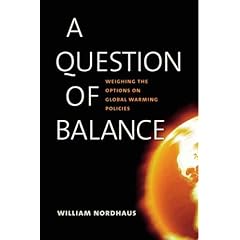
Nordhaus estimates economic benefits and costs, both from climate change and policies designed to combat it and uses constant 2005 US dollars as his unit, with time discounting at 4% yearly. He estimates the absolute cost of "do nothing about CO2 emissions" at $23 trillion over a century, or about $230 billion annually. His figure of merit for comparing policies is a "net benefit," the total benefit relative to the "do nothing about CO2 emissions" baseline. (For comparison, the US annual economic output is about $15 trillion and constitutes about a quarter of the world's production.)

In rank order of "net benefit," the results are:
  • Low-cost with technological breakthrough(s) (Nordhaus), +17
  • Realistic and economically optimal policy (Nordhaus), +3
  • Kyoto Protocol with (without) the US (Kyoto Accord), +1 (+0)
  • Stern (Nicholas Sterna), -15
  • Gore (Al Gore), -21
aStern is a British science advisor and was part of Tony Blair's government.

We must take the exact numbers with a grain of salt, since the inherent unknowns in such estimates are large. (Nordhaus assumes economic growth and inflation at the overall rate of the last century.) But the rank ordering, and the strikingly close results of the second and third policies, and the fact they are close to zero (that is, close to "do nothing about CO2 emissions") are very telling. $230 billion a year is about 1/65th (1.5%) of the annual US output, or 1/260th (0.38%) of global output. It's smaller than current interest rates, which can be taken as an overall social "discounting" rate incorporating risk and uncertainty.

From such results, "climate change" looks like, not non-existent, but still quite marginal. And the policies pushed by Gore and Stern, far more restrictive than Kyoto, are clearly lunatic and should not be considered further.

Dyson's article is also one of the few, outside of narrow technical forums, I've seen that discusses the effect of plants. That alone makes it invaluable, and I strongly recommend that you read the whole thing, as they say. To Dyson's lucid discussion should be added some additional points. The time scale for noticeable climate impact from CO2 emissions is one to two centuries. When we consider the smallness of the effect, scaling the costs of "do nothing about CO2 emissions" and the benefits of "doing something about CO2 emissions" down to account for the IPCC's exaggerations (at least a factor of two, probably three, in temperature change), the case for any but minimal countermeasures vanishes. Indeed, once you step outside the media- and environmentalist-saturated Western world, you run into much stronger skepticism about both the science and policy of "climate change." The reasons are no more than those presented here and in previous postings.**

Some important quibbles. I have only two significant points of disagreement with Dyson. The first concerns his characterization of "climate change consensus" as representing the large majority view of "climate change" among climate and allied scientists. This is simply false. The IPCC's scientific annexes alone, with their broad and large differences with the summary reports, demonstrate this. Consider as well organized protests by climate and other geoscientists against the Official Science of "global warming," such as the Heidelberg Appeal and Leipzig Declarations. The media generally capture the same group of self-appointed "true believers" over and over.

My other point of disagreement is Dyson's overly sanguine view of environmentalism, which he correctly acknowledges as the great secular religion of our time and the latter-day replacement for socialism, the last big secular religion. Disconnecting the "climate change" propaganda machine, starting at the governmental level and in the schools, is an essential step. The "climate change" hysteria has needlessly frightened both adults and children, warped and darkened their view of science, technology, and industrial civilization, and corrupted how science is taught and understood. The rampant runaway bad metaphors alone represent a new level of manufactured ignorance, something our society is getting better and better at.†

Slightly more than nothing. Dyson's article is a sanity tonic in a subject that, 15+ years ago, left scientific standards and protocols behind for the status of religious belief. The smorgasbord of policy alternatives he summarizes from Nordhaus, together with the other considerations presented here, leads to some natural policy conclusions. The phenomenon should be viewed on the time scale of a couple centuries, with at least a guess of cloud enhancement, plant metabolism, and ocean absorption taken into account. The IPCC's reports don't currently do this in a serious way, because the reliable science to do it isn't there.

Based on what we know now and what we don't know, there's no justification for any active countermeasures against CO2 emissions, beyond a mild form of geoengineering, which I've previously and cheerfully denounced as crazy. Here's my one exception: the most important geoengineering scheme, the one with the least risks, is more and better plants. Dyson reaches the same conclusion. The coming century will be one of biotechnology, just as much as the last was one of electronics and information. Superplants with enhanced CO2 metabolism are not at all impossible. Genetically engineered, or simply cultivated by the selective breeding that humans have been doing for millennia, such plants, spread wide enough, put the atmosphere's CO2 level under human influence no less than CO2 emissions form burning fuels do.

If a more aggressive policy toward slowing human emissions of CO2 and CH4 should ever prove necessary, the right approach is to tax them.†† Of course, politicians hate taxes for environmental purposes, because they hate putting the cost of their pet policies up front and visible to all. Complex and obscure regulatory systems are far more attractive to environmentalists, because they hide the real costs of the regulation. In any case, CO2 is not a poison or a pollutant in the classic sense. (Is π=3? Is the Earth flat? Why are courts involved in deciding such issues?) It's a naturally occurring gas respired and metabolized by plants and absorbed by oceans. If anything, it should be treated like water. No one thinks of water as a pollutant, even though people occasionally drown in floods, and clear-air water vapor is the main infrared-active gas at the heart of "global warming." At about 30 billion metric tons (Gt) of CO2 emitted per year and using Nordhaus' estimates, the external costs run to roughly $23,000 billion/100 years/(30 Gt/yr) = (US 2005) $7.80/metric ton.‡ The US is a relatively efficient burner of fossil fuels, by comparison with China, now the world's biggest CO2 emitter, or Russia and India. Their technologies are simply not as efficient or clean as ours: here's the world's real contemporary pollution crisis.

Finally, and always, keep in mind the crucial point made so effectively by Bjørn Lomborg: wealthy and technologically advanced societies have more means and choices at their disposal. There's no problem that we face, have faced, or will ever face made harder by better technology. (Whether we make good use of it is another matter.) Whatever the future holds for humanity and Earth's climate, there's no case for shutting down civilization or significantly impairing it. On the contrary, the better science and technology we have, the better we understand both the climate and the limits of our knowledge, the better decisions we'll make and the better off we and our descendants will be in facing whatever's headed our way.
---
* Anyone who thinks otherwise has been fooled by fuzzy, runaway bad metaphors about "greenhouses" and a climate modeling science still in its early infancy.

** I've never met a Russian scientist who takes the "global warming" hysteria seriously or views the climate problem as anything more than marginal. And the Chinese aren't about to impoverish the next two generations of Chinese for marginal and uncertain benefits.

† It's not the natural ignorance we're all born with. We're an advanced society and have the means to "do" ignorance far better now :)

†† "Cap-and-trade" should be abandoned as soon as possible. It's easily corrupted and subject to confusing manipulation by all parties involved. Also see this by Megan McArdle. Work like that of Nordhaus provides a first answer to the question of "costing" the CO2. But there's no "natural and optimal" level of CO2; all we can do is compare scenarios and ask, "What do we want?" (BTW, it's carbon dioxide gas, not "carbon.")

‡ One gigaton (Gt) of CO2 would fill about 89 million Goodyear blimps. The CO2 emission control schemes of Gore and Stern imply costs of $300-1000/metric ton CO2, which shows in a different way how far out of line with reality their proposals are.

A metric ton of CO2 emitted in the US produces about $1850 of economic value. Compare with the Nordhaus estimate of external cost ($8) and, again, the marginality of the problem is evident. And remember, these Nordhaus numbers assume the IPPC's already exaggerated claims.

Labels: , , , , , , , ,

Wednesday, June 25, 2008

Abandoning Official Science

Junk science has several warning signs: It advocates a cause, pays little attention to the investigative process, ignores contrary evidence and advertises a high moral purpose.

- Ron W. Pritchett, "Recognizing Junk Science," The Professional Geologist (December 1997)

For its two-decade history, the "global warming" craze has been an outstanding case - perhaps the supreme one in our time - of something I've called Official Science. It's not quite the same as what some people call "junk science," although it includes a fair amount of that. But it has something else: an authoritarian mummery that looks like science, but isn't. I've called this "para-science." In the case of climate, the key elements - the IPCC and its false "consensus" - are political in nature, not scientific. Blame it on Rio: they were enshrined in the policy world by the 1992 Rio "Earth" summit, a party to which scientists, for the most part, were pointedly not invited. The summit was a jamboree of environmentalist politics and activism, not ecology, climate, or any other science.

The kernels of Official Science are the pet theory and the politically, ideologically, or theologically predetermined conclusion. Science, among other things, is mostly bottom-up and inside-out knowledge. In areas where many open questions remain, it's stimulated by surprise discoveries and unexpected insights. Basic research is especially important here because it tries to frame questions and find answers with potential for wide-ranging impact, both in theory and application. Official Science is the opposite: top-down and outside-in. Non-scientists (politicians, political intellectuals, journalists, activists), often in alliance with ex-scientists either cynical, ambitious, delusional, or all three, apply the pressure from the outside. Blow-ups, dilemmas, and intellectual corruption begin where the two cultures - science and "para-science" - collide.

Cultures in collision. This is origin of the unusual social phenomena associated with the "global warming" craze. They include the misrepresentation of an actually non-existent "consensus" about "climate change," which consensus is then repeatedly invoked to isolate and demonize "deniers," skeptics, and fence-sitters (who, all told, actually make the up the majority of climate and geoscientists). Environmentalists attempt to smear scientists with often false or misleading "reports" detailing alleged "secrets" about funding sources.* Quasi-official institutions (bureaucratic leaders of government and academia, scientific journal editors) create an echo chamber where otherwise normal skepticism and criticism are silenced. Publications once noted for their high standards (like Scientific American) degenerate into politically correct propaganda outlets, with scientific reasoning playing less and less a role in their arguments. In its place are invocations of authority, something having no place in science. In fact, in no other area of science are such non-scientific procedures so routinely made use of. The mere existence of an "official panel" on climate (the IPCC) is far from scientifically kosher.

Follow the (public) money. Scientists in climate and allied areas have protested, repeatedly, against the fake "consensus." The protests are ignored by the IPCC and the non-science media. But the situation is more subtle and disturbing than a simple black-white opposition. Incentives both positive and negative have been applied to reshape the sociology of the field (and don't doubt that this reshaping is a conscious political effort.) Public funding has moved from open-ended basic research, in which questions are paramount, to a situation where the larger answer is assumed and research proposals have to be tailored to "get with the program." Professional societies (American Geophysical Union, American Physical Society, American Statistical Association, etc.) leave the provinces and move to Washington, where their staffs shift gears and become political players in a politically- and journalistically-shaped arena, leaving scientific questions far behind. These societies - or at least their headquarters staff - then join the "consensus," often over the protest of their scientific members.**

The IPCC itself offers a particularly insidious temptation for scientists, the IPCC reports' scientific annexes, which are produced by a large body of "working groups" (a couple thousand scientists) routinely confused in the media and by politicians with the the much smaller IPCC staff (a couple hundred). To compare the working groups' annexes and the IPCC's summary report is to compare two apparently different planets. The couple thousand scientists in the working groups become, in effect, wittingly or not, ventriloquists' dummies.

The folks back home. So why the scientific annexes to the IPCC reports? Essentially, to impress the rubes. Nothing else can explain why the scientific reports keep getting included, yet contradict what the Summary report says. The gap has not closed in 16 years of these reports. The rubes are politicians, journalists, even other scientists, and you and me. It makes the reports look authoritative, while allowing the IPCC and "global warming" fanatics to ignore scientific criticism and demonize and isolate individual critics as "skeptics" or "deniers" (as if skepticism is out of place in science, instead of being its daily bread). Meantime, outside of their respective scientific disciplines, few actually read the scientific reports. (I've read parts of the 2002 and 2007 reports.) Under the baleful influence of Official Science, scientists amongst themselves and individually express one view, but assembled "officially," express a very different view. That's a sure sign of arm-twisting and Official Science overriding of scientific criticism. It's no road to knowledge: science makes more progress through criticism, by demolishing bad ideas and disproving wrong hypotheses, than through converging on correct ideas. Not that these processes are separate: converging on the right conclusion requires a lot of clearing away first.

Official Science equals bad science. Under the usual circumstances of scientific practice, the extravagant claims of the IPCC - being able to predict future weather; denying or selectively "cherry picking" the behavior of the current, recent, and paleoclimate - would be laughed out of the room, so to speak. Specific instances of sloppily done or simply mistaken scientific embarrassments, the "hockey stick" above all, would have been ripped apart through the usual process of criticism, counterproposals, and so on. Without an externally enforced preconceived and dogmatic conclusion, progress would result, as it usually does when scientists work on something in their usual mixture of cooperation and competition.

But with the "boundary conditions" changed, so to speak, and an externally imposed, preconceived conclusion forced on the issue, something very different happens. Badly done science, embarrassing fallacies, and outright fraud start to win, no matter how horrifying, because they fit the dogma. Really good science, superb insights with clear implications (for example, the ice core results), are disallowed, rejected for publication, ridiculed, or otherwise ignored and languish in a narrow specialty in a way that doesn't threaten the dogma. When editors of leadings journals (like the editors of Nature and Science in the 1990s) undergo conversion and baptism in the Cause of "global warming," excellent work contradicting the official line doesn't get published, at least not their journals.† Mistakes that would be marked wrong on a test or homework assignment, or corrected by a graduate research advisor, instead get perpetuated in prestigious venues.

Official Science must go. There's a lot of positive progress that awaits climate and allied sciences, once they're freed from this monkey on their backs. But before anything positive happens, the big negative has to be cleared away first. There's no "reforming" Official Science, or "making it responsive." The spirit animating it and the spirit animating science are in direct conflict and can't be reconciled. The right thing to do with Official Science is to abandon it.

In the case of climate, the IPCC should simply be scrapped. It keeps committing the same crime over and over, providing the fanatics of "global warming" in the political, environmentalist, and journalistic worlds more clubs (or hockey sticks) to beat up their designated targets simply for practicing science in public. The IPCC carries on under the auspices of the UN, but is rooted in a multinational convention that grew out of the 1992 Rio summit. It's true that this convention, the IPCC, and the Kyoto Treaty that resulted are not in America's interests. But they're really not in anyone's interests. The US should withdraw from any official involvement in or funding of the IPCC and strongly encourage other countries to do the same. What private individuals and institutions do on their own time and nickel is their business. It's become everyone else's business just because ways have been found to force it on everyone else.

That's a first big step in the right direction for the science and scientists and frees them to look at positive possibilities. Such a step also has a whole set of separate implications for policy.

SPOT THE FALLACIES! I ran across this item recently in Physics Today, flagship publication of the American Physical Society. It's a not a refereed technical journal, but a magazine at a high level for physicists and scientists in related areas, as well as students and interested outsiders, with the main articles and much else written by scientists. PT has high standards, so the item came as a shock, if not a complete surprise. It commits at least four climate fallacies in two paragraphs. See if you can spot them.†† (Disclaimer: I don't meant to criticize anything about the research article discussed in this news item. I haven't read it.)
---
* Sorry: even if these reports were correct, "funding sources" is not a scientific argument.

** The American Statistical Association, in the past a reputable professional scientific organization, recently announced its endorsement of the already debunked "hockey stick," creating some shock in the scientific world. Important members of the ASA were involved in the earlier debunking and were not consulted in this change of "official" view. Apparently, the ASA is working hard to "get with the program," a political, not a scientific, imperative. The problem is not that the "official" view needs to be changed; the problem is rather that there is an "official" answer to the question at all. This is the essence of what's wrong with Official Science.

Disaster results from such trends: good people leave the field or shut up; good students don't enter, and so on. This has now gone on for almost a generation, and climate and allied scientists are waking up to the cold truth of how much damage this crusade has done to their science, their research, and their teaching. (How do you teach this stuff to students with a straight face, when there are so many things so obviously wrong with it?) These are the sort of dilemmas faced more and more over the last 15+ years by natural scientists in geosciences, climate, and neighboring subjects.

† Then these same editors have claimed - with a straight face! - that their journals don't have many papers that conflict with the fake "consensus."

†† The fallacies I spotted are:
  • Solar radiation is not reflected from the Earth's surface, but absorbed and re-radiated. That's why the Earth's surface warms up. Reflected, radiation can't warm anything.
  • Extra warming does not occur because IR-active (misnamed "greenhouse") gases absorb the IR radiating from the surface. These molecules are good at IR absorption; they're also good at IR emission. They're a more efficient IR "bucket brigade." The "extra warming" is not a retention of heat, but actually a steepening in the slope, or lapse rate, of the radiation temperature.
  • A greenhouse doesn't work like this.
  • The Earth's climate isn't a greenhouse anyway.
Official Science does rot your mind.

Labels: , , , ,

Friday, June 20, 2008

Don't ask

That Pentagon policy of "don't ask, don't tell" from the 90s is still in force. By itself, not such a problem, but the military is still discharging servicemen who are "outed" somehow, sometimes through their own inadvertence.

The policy isn't just silly, but since the wars in Afghanistan and Iraq, actually harmful. Gay service members with critical skills are being discharged when they're needed most. In some cases, the Defense Department rehires them as civilians. But still -

Here's Deroy Murdock in the Boston Herald explaining what's wrong with this policy. The Pentagon has released a new report on this subject. There's no real excuse for this. If serving in a conservative Muslim country means gay soldiers can't be open about it, the solution is a little discretion. Female soldiers have to observe some rules along these lines as well.

Murdock is right: it's a Clinton-era relic, like Monica's kneepads and other talismans of 90s frivolity. "Don't ask, don't tell" can't be defended.

Labels: , , ,

Wednesday, June 18, 2008

Thoughts on the environment

Tout commence en mystique et finit en politique.
- Charles Peguy

Thinking about pollution as a public health problem and selective conservation of the natural world, for the sake of present and future generations, are in no way new endeavors. They arose toward the end of the 19th century, led by a variety of people who never dreamed of reading humanity out of nature or expressing hostility toward scientific understanding of nature, then emerging from its infancy. One of the best-known representatives of this movement - which predates the modern environmentalist movement by almost a century - was Teddy Roosevelt, who experienced raw nature first-hand, exploited it by hunting, wrote about it - and then created parks so others could taste the same experience. He was our first, and so far only, "environmental" president. There was nothing coffee-table-ish or armchair about his views, and he made his forays in the wilderness before cell phones, waterproof matches and tents, and other hi-tech paraphernalia were available. Today's environmentalist movement has moved far that orientation, representing a very different and basically mistaken view of nature and of humanity's relation to it. Environmentalism is a movement, not a science. The science is ecology, as practiced by ecologists. That hasn't prevented a long-standing and pervasive confusion between the two.

Born during the period that saw the breakdown of liberalism and its turn towards punitive and backward-looking guilt, the environmentalist movement started as a piece of counterculture and absorbed the older conservation and public health movements, usurping popular acceptance of the latter for its own ends. These ends are motivated by a hatred of technology, science, and modern civilization and bring in train all the classical fallacies of Romanticism: pre-existent "natural harmony," "noble savages," and the evil corruption of civilized humanity. Only once American civilization had reached a certain level of material development could such thinking take hold among more than a tiny number of the unbalanced. It's had a longer run in Europe, where it arose in the late 18th century in reaction to the rise of modern science, industry, and commercial society. The Germans gave a special twist to this thinking, one that merged nature-mysticism with reverence for the Volk and pre-industrial life.

The environmentalist movement has raided non-Western cultures and creatively invented bogus quotes about their attitudes toward the natural world. As shown by Dan Botkin and others, almost all of the supposed wisdom the movement peddles about natural "harmony" and "balance" comes from pre-modern and pre-scientific thinking within Western history, precisely the thinking that has been abandoned by modern science. (It wouldn't be modern or scientific otherwise.) The "pre-existent harmony" or "balance of nature" metaphor is the most common of these fallacies. Such discoveries as organic evolution and chaos (in the technical sense of the word) have forced ecologists to give up "equilibrium" pictures of ecosystems and face the reality of their ceaseless and usually messy change. Ecosystems come and go, start from a little, grow into a lot, mature into a period of glory - then fall apart and are replaced by something else. For example, it's precisely because the chaotic atmosphere and oceans have only a limited "invariant" structure that pinning down what "climate" means is so hard. So it has been throughout the 3.5 billion-year history of life on Earth; human activity just adds some more twists to the mix of permanent chaos.

But the "harmony," "balance," and "equilibrium" metaphors have, since the scientific revolution of the 17th and 18th centuries, taken on a life of their own, now divorced from scientific thought and philosophical criticism. They continued to be sustained by religious feeling and the rise of counter-Enlightenment Romanticism. It helps that the core of Western religious thought since the rise of Christianity has been the template of Paradise-Fall-Redemption, with perhaps an apocalypse in there somewhere. The relationship of environmentalism to this paradigm and the related concept of Original Sin is too obvious to require comment. So is the environmentalist hope that humanity's supposed trashing of the planet demonstrates that humans are still at the center of things, if only in a negative way. High German Romantic thought of the 19th century (with echoes and variations from the American Transcendentalists) recommended withdrawal from both human society and the five senses as a preliminary to communing inwardly with Nature - not the thing you can perceive, but a "telephone from the beyond," as Nietzsche wittily
once put it.*

This is the paradigm of Thoreau's time living alone at Walden Pond, a Romantic exercise if there ever was one. He wasn't scientifically studying the ecosystem at Walden, getting his hands dirty. Not to put too fine a point on it, he was staring at his navel.** The root of environmentalism lies in a restless search for a new religion to replace older faiths no longer believable or relevant.

After the fallacy of pre-existent balance, the most powerful bad metaphor reigning over environmentalist thinking is its misplaced and often childish anthropomorphism and zoomorphism. Wild animals are not pets or farm animals, which are selectively plucked out of "wild" nature and bred by us to heighten characteristics that fit into human domestic and food needs. (After all, the wild ancestors of dogs could have been selectively bred to heighten other characteristics and turned into mean predators with no socially redeeming features.) Ecosystems and, indeed, the whole planet lack the integrated purposive and functional unity of individual animals and humans. It's a gross mistake to take metaphors like "Gaia" as more than fanciful poetic usages; the Earth doesn't think, feel, remember, or command anything.

But environmentalist literature and discourse are thoroughly polluted with such language and the concepts behind it. "Charismatic megafauna" (such as polar bears and baby seals) are projected as quasi-pets (instead of, respectively, hungry predators and their tasty, blubbery lunch). Gorgeous nature photography (itself a selective and superposed human art) is twisted into a "picture-window" or "don't-spoil-my-view" environmentalism that is really little more than middle- and upper-class kitsch. Debate about the human and non-human environments is mired in superstition and dishonesty if it assumes that nature would remain frozen were it not for our interference. It becomes enlightened and honest when the question shifts to, "Well, what do we want it to look like?" Not that we always get our wishes - but they're our wishes, not nature's. Nature has none.


If we're interested in a scientifically-informed view of nature and our relationship to it, we must abandon any notion of pre-existent "harmony" or "balance" that we are violating, restoring, or revering as an authoritative command. Nature commands nothing and speaks nothing. Or - better - it speaks many contradictory things: it's prodigious, wasteful, and hidden; beneficent and poisonous; abundant and barren; peaceful, aggressive, and indifferent - all at once. It is relentless change, on all scales of space and time, with incessant destruction, creation, and overturning. Any harmony or balance we bring to our relationship with nature is a balance or harmony strictly of our own devising. We're not even "managing" nature, except in a limited way. In limiting and modifying how we use nature, we really managing nothing but ourselves.

That is why environmentalism is not science, but a political and religious movement. It is why this movement so frequently turns tyrannical: there's nothing so satisfying to a fanatic than "managing" other people as a vehicle of righteousness. Perhaps this is the unwittingly ironic sense in which Job urges his friends to "speak with the Earth, and she will teach you." She will teach you all right: she'll teach you that she has no trite moral lessons to offer. Equilibrium, balance, and harmony are not the norm, but temporary and local. Indeed, at the center of Job's encounter with the divine is, not a garden or a zoo, but a whirlwind.

In absorbing and condescending to the older public health and conservation movements, the nearly forty years of modern environmentalism have done our society a large disservice. It is the most potent social force today in attracting the general public away from science. Scientists involved in ecology themselves often lead mentally conflicted lives, caught between knowing and believing. People now routinely use meaningless or wrongheaded concepts to misunderstand the world around them and how human activity affects it. Recycling is often more harmful than just throwing things out. No one has a "carbon footprint," unless they've rubbed graphite on the bottom of their shoes. The Earth's climate is not a greenhouse. Nuclear power plants are not bombs, any more than a coal-fired power plant is a firearm. Runaway metaphors and bad policies motivated by them are the fallacies of the Boomers - history's first mass over- and miseducated generation - and now constitute the brainwashing of the next generation. Led by their delusional gurus, currently starting with Al Gore, they have injected a potent revulsion against modern technological and progressive civilization into our politics. But that passion proves nothing about the rightness of their cause, which is essentially romantic, pessimistic, and reactionary.‡

POSTSCRIPT: For an example of what I'm talking about, consider M. Night Shyamalan's embarrassing new movie, The Happening, "the most morally abhorrent film ever made" - but still, important for laying bare the logic, which pervades conventional environmental politics in a watered-down form. Or just read this New Republic blog posting and skip the film itself :)

POST-POSTSCRIPT: Everyone interested in this problem, whatever their opinions, should read Wallace Kaufman's No Turning Back: Dismantling the Fantasies of Environmental Thinking. Published 14 years ago, it is more relevant than ever, and a blog posting cannot do it justice. In related vein, consider as well the two books by Alston Chase, In a Dark Wood and Playing God in Yellowstone.
---
* While not able to speak English, Nietzsche could read it and counted an edition of Emerson's works as one of his prized possessions; he annotated it, heavily in places. His famous Übermensch, or Overman, probably owes something to Emerson's Oversoul. I don't know if Nietzsche read any Thoreau.

** That said, I like Walden Pond as it is now and try to swim it at least once every summer. There's been no attempt to "freeze" it in some mythical past, and it is accessible by car. It was pretty accessible in Thoreau's day, and he was never more than an hour walk from the center of Concord and medical and food supplies. Thoreau even took his laundry home to his mother for washing periodically. The old railroad line, already in existence when Thoreau spent his two years there, still runs right past the pond, behind some trees. Even more than in Thoreau's day, the setting now is as much a product of human artifice as it is of nature and a perfect example of the older conservation movement - but not of modern environmentalism.

† Thoreau himself said it: a man feels a disturbance in his bowels - and he sets off on a crusade to save humanity.

†† Using "progressive" again in the right sense.

‡ The absolute weirdness of our political vocabulary strikes me more and more. Opponents of environmentalism are usually called "conservative" - are they, really? And is environmentalism really "liberal" and "progressive"?

Labels: , , , , , , , , , ,

Tuesday, June 17, 2008

Thoughts on pollution

"Pollution" can mean different things in different contexts. Here it means something in the human environment that causes harm to humans. Since that can include both natural and manmade things, let's narrow it further to manmade. Finally, to exclude the obviously different situation of someone deliberately trying to poison someone else, let's narrow it further to the inadvertent, the "side effect" of otherwise beneficial activities. Economists call these "external costs." It's what happens when I throw a party on my lawn, pay for the party, but leave my party trash on your lawn for you to clean up. If it's a result of routine, repeated activity, we have what people usually mean by "pollution."

There are four ways to deal with pollution:
  • Harmed party takes harming party to court after the fact. This works for something that happens once or very occasionally. Otherwise, it's pretty cumbersome.
  • If it's a routine occurrence, government regulates the level of emission of the pollutant. This often works, but depending on the type of pollutant and available technology, it can be difficult or very expensive to continue the polluting activity and limit the polluting side effect.
  • If it's a routine occurrence, restrict the use of the pollutant or ban it entirely. This is sometimes feasible, occasionally desirable, but again often expensive or difficult if the underlying polluting activity is to keep going. If that activity is otherwise beneficial, this is hard to justify.
  • Tax the emission of the pollutant and leave it up to the polluter to figure out the best way to limit the emission. Unless something should be tightly restricted or banned, this is usually the best approach, because it's the least cumbersome and most flexible. Ask an economist how to deal with pollution, and that's most likely the answer you'll get.
Governments around the world have spent more than a century coping with the side effects of modern economic development in these ways. In pre-industrial societies, there was pollution too, of course: think of all that horse manure in the streets. But it was on a generally smaller scale and, crucially, no one cared or understood enough to do anything about it. The modern public health movement started in the second half of the 19th century to deal with these side effects of development, because the understanding was there, for the first time, and the scale and concentration of the problem were bigger.


When a pollutant (defined in this way) is around us, how do we gauge its potential for harm? The essential answer is concentration times exposure. The more concentrated it is, the longer we're exposed to it, or both, the more harm. The exact concentrations and exposure times vary from pollutant to pollutant and, to a lesser extent, from person to person. Concentrations in the environment generally fall with time, if the pollution source is stopped.

Some important conclusions follow.

The first is that the most harmful things we are exposed to are the things we do to ourselves. After all, we're exposed to ourselves all the time, and the things we put into our bodies ourselves are generally the most concentrated things we encounter in everyday life. The most obvious, and deadly, is smoking, whether it's tobacco or something else. The smoker is getting a certain pleasure out of it, but the harmful side effect is large and cumulative. Living as we do in a society that likes to think of itself, at least, as free, we inconsistently allow people to do some harmful things to themselves, but not others. It's usually a bad idea to try to stop people from doing such things by force, because force rarely works over time. But that doesn't mean we can't nudge people in the right direction. And it means governments have no excuse for, say, subsidizing growing tobacco.*

The second is that home, school, and workplace hazards are the next on the list. These are the places we spend the most time and often have limited control over and knowledge of what we're exposed to. If the hazards are routine, there's a good case for legal regulation. But where and when we do have control, there's an even stronger case for exercising common sense.

The third is that everything else is generally less important. The reason is that, whatever the exposure times, the concentrations are much lower. Cut off from its source, chemical pollution disperses and transforms over time. Of course, if you live next to a smokestack that's going all the time, say, then you're closer to the "workplace" situation. And occasionally, nature itself mixes in with manmade pollution to concentrate the problem, instead of dispersing it. The classic "smogs" that used to form over industrial cities (smog being a mix of natural dust and water vapor with manmade smoke) are one example. Another familiar to residents to Los Angeles and Mexico City is vertical atmospheric temperature inversion (remember that from last year?), which can trap smoke and other aerosols that would otherwise disperse.


Dividing the world up into the categories of "harmful, neutral, and beneficial" to us is completely separate from dividing it up into the "natural" and the "manmade." Nature has lots of harm out there is store for us if we're not careful. Bacteria blindly doing their thing can sometimes kill a baby or an adult. Insects, snakes, and plants sometimes have deadly poisons. Floods and storms can destroy what we've built and kill us. Certain plants have dioxin-like chemicals no different in their harm from the harm done by artificial ones. There's no malintent involved, although much of what's true about manmade pollution harming us is also true about an insect bite or allergen harming us. Our bodies themselves have defense mechanisms against the harm, at least up to point. How are bodies react to these things is a function only of our bodies and the harmful agent - whether or not it was manmade, whether or not it was the product of evil intent.

Until around 1970 or so, such distinctions and commonalities were taken for granted, and much of the time, they still are today. The rise of the modern environmental movement around 1970, however, changed how we think about these issues, deeply confusing them together, blocking out simple truths about nature that our ancestors had no problem seeing, and injecting agendas into our politics that are superficially about one thing (public health, say, which wasn't discovered by the environmentalist movement) but are really about something else entirely (like stopping economic development, no matter what the harm to humans, or punishing private economic activity simply for being private). The independent distinctions of "natural-manmade" and "beneficial-harmful" were merged. Side effects of civilization, and ultimately civilization itself, were demonized as the results of harmful intent. Since about 40 years ago, such thinking, the groups that promote it, and the politicians who pander to and depend on it, have done real harm in the most advanced countries, especially in the ultra-litigious US. More recently, environmentalist groups and politicians have tried to confuse the subject further by peddling the wishful thinking that regulation (of any kind, beneficial or not) has no or minimal costs. That can't be true; otherwise, people would implement the practice themselves. Even beneficial regulation has costs, but we enjoy the benefit (if it is actually beneficial), and its cost can often be offset by economic progress elsewhere. In poor countries, those options are often not available, and terrible harm has been inflicted there, by denying them (for example) pesticides and, more recently, selectively bred crop seeds that reduce the need for pesticides. The cumulative effect of such abuse of government power is major and persists if nothing is done to reverse it. Such a movement is not about public health, clearly. And it is a movement, not a science.

Economic valuing is based on benefits, costs, and harms to someone. It's meaningless to discuss benefits and costs outside that framework; there are no "intrinsic" costs and benefits without a party benefited or harmed. Since nature as a whole has no "body," no intentions, and no "health" the same way an individual human or animal has, the environmentalist movement has to operate on a metaphysical plane, even as it abuses political and social mechanisms designed for strictly human use. While it claims to speak for "nature," it really speaks for no one but itself.
"According to nature" you want to live? O you noble Stoics, what deceptive words these are! [Stoicism was an ancient philosophical school that exhorted its followers to "live according to Nature."] Imagine a being like nature, wasteful beyond measure, indifferent beyond measure, without purposes and consideration, without mercy and justice, fertile and desolate and uncertain at the same time; imagine indifference itself as a power - how could you live according to this indifference? Living - is that not precisely wanting to be other than this nature? Is not living - estimating, preferring, being unjust, being limited, wanting to be different? And supposing your imperative "live according to nature" meant at bottom as much as "living according to life" - how could you not do that? ....

In truth, the matter is altogether different: while you pretend rapturously to read the canon of your law into nature, you want something opposite .... Your pride wants to impose your morality, your ideal, on nature ... you demand that she should be nature "according to the Stoa," and you would like all existence to exist only after your own image - as an immense eternal glorification and generalization of Stoicism. For all your love of truth, you have forced yourselves so long, so persistently, so rigidly-hypnotically to see nature the wrong way, namely Stoically, that you are no longer able to see her differently. (Nietzsche, Beyond Good and Evil, 9)
---
* While trying to discourage its use. That means that the tobacco has to be exported to other countries. Which it is, and that's government-subsidized too.

Labels: , ,