Friday, August 22, 2008

Oh yes

Readers of my travelogue from last fall might recall my revulsion at crocs, especially on adults, and especially in the Holy City.

Well -- it turns out there's Facebook group with over a million members, I Don't Care How Comfortable Crocs Are, You Look Like A Dumbass. And they're even sponsoring an International Put Away the Crocs Day on December 16, 2008.

Not that I need to put away any crocs for a day.

Labels: ,

Wednesday, July 30, 2008

"Monsters, monsters from the id!"

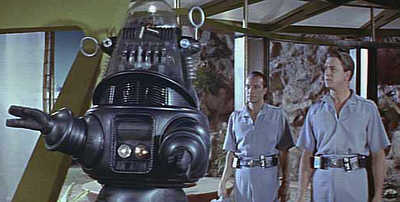
While rummaging through movie classics recently, I ran across one of the greatest of science fiction films ever, Forbidden Planet. Released in 1956, it starred Leslie Nielsen as spaceship commander Adams, Walter Pidgeon as the mysterious Dr. Morbius*, and Anne Francis as his lovely, innocently wise daughter, Alta. Loosely based on Shakespeare's Tempest, no movie did more, in one stroke, to make science fiction a respectable genre.

Today, Forbidden Planet seems somewhat awkward. The original trailer didn't quite know what to do: proclaim it just another B.E.M. ("bug-eyed monster") movie, or pitch it "highbrow"? But its innovations make up a long list copied in obvious ways by almost all later movie and television science fiction. Looking for the origin of the Star Trek transporters and warp drive, or the suspended animation of Lost in Space and 2001? Looking for the origin of the whole Star Trek paradigm -- an Earth ship encountering humans stranded on an alien world, humans needing but not wanting rescue; or the familiar trio of captain, executive officer, and doctor? Looking for the origins of a sophisticated visual science fiction with literary roots? The origin of Star Wars' charming, superhuman robots? The sinister potential of advanced technology? Far-out electronic "space" music for a score? Here it is.

MGM knew what it was doing and spared no expense or care for detail. The production values were astonishing for the time. The robot later known as Robby was introduced by Forbidden Planet and would later make multiple movie and television appearances. Here he is an aloof but ever-helpful machine that (who?) can, from a small sample, make apparently endless supplies of anything desired. Reminiscent of his avatar Caliban, he is the remains of a race of superintelligent beings called the Krell, whose technology Morbius reconstructs and uses to enhance his own mind to superhuman levels. Glimpses of the Krell's technical achievements are thrown out to whet the audience's appetite. The only mystery is the why the Krell vanished.

The movie's most brilliant stroke is that the Krell and their likeness are never shown, only hinted at. Also never shown directly is the monster that kills several starship crew members and which is only glimpsed in one scene produced by some Disney personnel "lent" to MGM. A technique borrowed from horror flicks -- never showing the danger directly -- moves Forbidden Planet far beyond the staple sci-fi movies of the Fifties. The cinematography in Technicolor and the score entirely produced by electronics, not traditional instruments, reinforces these qualities.

The full force of the story doesn't kick you in the head until the last scene. Watching the detonation of the planet from far away, Anne Francis and Leslie Nielsen are left to contemplate the failure of a high civilization, the awesome Krell, whose technical mastery put them under the illusion that they had escaped their own animality.

POSTSCRIPT: The electronically-scored soundtrack is available on a separate CD, which was first released in 1986 for the film's thirtieth anniversary. A special two-disc DVD set was issued for the movie's fiftieth anniversary in 2006.

The score's creators, husband-and-wife team Louis and Bebe Barron, were not sure they were doing sound effects, or music -- until John Cage convinced them that it was music.
---
* An interesting merger of "morbid" and "Möbius," as in the non-orientable Möbius strip.

Labels: , ,

Monday, June 23, 2008

The odyssey continues

Here's a review of Keir Dullea's appearance two Thursdays ago in Boston and the screening of 2001: A Space Odyssey for its 40th anniversary.

Labels: , , ,

Friday, June 13, 2008

"Open the pod bay doors please, HAL"

Arthur Clarke is no longer around to guide us into the future. But the 40th anniversary of the release of 2001: A Space Odyssey brought one of the film's stars, Keir Dullea, right here to Boston (the Brattle Theatre in Cambridge, to be precise) last night for an evening's talk about his career and the filming of 2001, co-written by Clarke and director Stanley Kubrick. Dullea played astronaut/starman David Bowman, the sole survivor of the Hal 9000's murder spree. A fun evening of interviewing and audience questions was had by all. A screening of 2001 followed. The movie was released in April 1968.

POSTSCRIPT: Dullea's co-star Gary Lockwood, who played astronaut Frank Poole, one of Hal's victims, has his own web site. Hard-core Star Trek fan's will remember that he also starred in that series' second pilot, Where No Man Has Gone Before.

Labels: , , , , ,

Tuesday, June 10, 2008

Why did the chicken cross the road?

Some answers, from Upper Left Coast.

Labels: , ,

Sunday, June 01, 2008

Geek = cool

America might not be able to produce enough scientists and engineers on its own - it has to import quite a number, mainly from Asia, to fill up the grad school classes - but you wouldn't know it from pop culture. After going into hiding in the 70s, geekdom is experiencing a rebirth, beyond just Bill Gates and the 90s Internet boom.

One sign is the wicked funny Big Bang Theory from CBS, airing since its premiere last fall. How does a show like this stay on the air? Will it? (The season finale is tomorrow night.) Speaking from personal experience, I'd say it's dead-on. Physicists, young and full of themselves, really are like that - at least, some of them :)

Another is Rivka Galchen's new novel, Atmospheric Disturbances, her first, about weather control and narrated by a middle-aged psychiatrist who thinks he's going crazy. The book was released just this past Tuesday and is getting lots of good buzz. She's even speaking up in favor of science, scientists, and what she calls the "scientific imagination." Perhaps a marriage of science and art and a repair of the breach dating from the late Renaissance are in the offing. Galchen is herself the child of scientists.

Read about Galchen and her book at the New York Observer (that pink paper) and over at Daily Candy-New York (that gossip-fashion blog).

Labels: , , ,

Sunday, May 11, 2008

Happy Mother's Day!

It's Mother's Day, and it's not all just about keeping the greeting card companies in business - call your mother :)

Labels:

Sunday, January 27, 2008

See, Tracy really wanted it ...

There are those of us who, last decade, were deeply impressed by the parallels between the career of a real Democratic First Lady-turned-candidate and a certain fictional high-school class presidential candidate, Tracy Flick, in Tom Perrotta's novel Election. Flick was memorably played in the 1999 movie by Reese Witherspoon. High school class president, boss's wife ... what's next?

Now that an upstart has come to challenge the One Who Is Not To Be Challenged, the parallels deepen. SlateV reports in-depth.

Labels: , , , , ,

Monday, January 21, 2008

The speediest planet

The NASA Messenger spacecraft just executed its first flyby of Mercury, the first spacecraft to visit in over three decades. After ricocheting around the inner solar system a few more times, it will brake enough to execute a short rocket burn and slip into orbit around the solar system's innermost and fastest-moving planet. Messenger will be the first spacecraft to study Mercury long-term from orbit. It's already returned some very nice pics.

A lot will be learned about the formation of the solar system's inner, rocky planets. Of course, Mercury doesn't look all that different from the last visit in the 1970s. But those of us who can remember the 70s, do look different - for example, I've lost my 'fro D:-)

POSTSCRIPT: And, in this season of Hillary poking around in the racial underside of American politics and Barack trying hard to be black, let's remember Dr. King and his vision.

Labels: ,

Friday, January 18, 2008

Things fell apart

... and everywhere the ceremony of innocence is drowned.
- Yeats, The Second Coming

Joan Didion's classic Slouching Towards Bethlehem was published 40 years ago, just as American culture and politics were coming apart and the conformist liberalism nurtured by the Great Depression and World War Two caved in. Her perceptions of the Boomers (a half-generation younger than she) were uncannily on-target and ring true all these decades later. The famous title chapter, "Slouching Towards Bethlehem," dug into the hippie culture of Haight-Ashbury right around the Summer of Love (1967) and discovered anomie and profound social disconnection. But don't miss some of the other essays as well, about California dreamin', the concluding gems on places, and the sublime "Personals," especially the two on self-respect and morality - or what she called the "insidious ethic of conscience." *

What would become so characteristic of the Boomer style - the morality of private conscience versus a social ethic - was pioneered by people - the first "hipsters," the Beatniks, activists, people fascinated by hobos and the "bluesmen" - born in the 1930s and somewhat older than the first Boomers. The 1930s were the only truly radical decade in American history ("radical" in the European sense). But those who came of age in the 1950s found little attractive in the totalitarian cults of the 30s. Postwar expanding opportunity deflated political impulses, which became rechanneled instead into a radicalism of personal style, with a strong esoteric tinge - all very different from the earlier American taste for the plain and obvious. In full flower - Didion's book is a snapshot album of that moment of flowering - it would lead to an anarchy of petty and sometimes violent competing authoritarianisms, most obviously in the form of "lifestyle" and religious cults, but also the student and "new" Left and the Black Power movement. This indeed informs the Boomers' most characteristic political trait, their taste for fringe ideas and converting them into irritating crusades. Later, in middle age, the Boomer obsession with such culty ideas would turn into such causes as "global warming" and, in some respects, the war in Iraq.

Didion's point is reinforced by a thought from Lionel Trilling:
Some paradox of our nature leads us, when once we have made our fellow men the objects of our enlightened interest, to go on to make them the objects of our pity, then of our wisdom, ultimately of our coercion.
Didion firmly rejected the cult of private conscience and the incessant attachment of "morality" to every desire or need. Lest we think this makes us better people, we should remember that people rarely carry out the worst evils purely from self-interest. Such evils are always strongly tinged or even determined by a fanaticism and one-ups-man-ship often labeled "idealistic." The cult of fake absolute morality lies at the root of much of what's wrong with the Boomers, or at least their politically active wing. It's not totally new in American culture; moralistic streaks are obvious in older generations, evidenced by certain Presidents like Wilson and Carter. But never have pet zealotries become so widespread and democratized as they have in the years since 1965. It was then that, as she put it, "the whine of hysteria" came to be heard in the land.

Here we can also better understand the nature of the moral sickness, often mislabeled "moral relativism," that afflicts the Boomers and their children. The problem is not moral relativism. It is rather, too many competing moral absolutisms. The media, by serving up a fresh set of moral absolutes every day, compound the problem. It's like atonal music - the center does not hold, and there's no "key" to come home to. It's every key at once.

The arts have also bowed to cults of inner and private fantasies. Didion's deadpan-witty "I Can't Get That Monster Out of My Mind," about the decline of Hollywood movies, skewers the then-new, now-old and tiresome, system of auteur-ship that replaced the older studio system. What it allowed was directors and producers to film their private fantasies, but not necessarily good movies. Perhaps they're worth making, but not always worth watching.
So. With perhaps a little prodding from abroad, we are all grown up now in Hollywood, and left to set out in the world on our own .... Whether or not a picture receives a Code seal no longer matters much at the box office. No more curfew, no more Daddy, anything goes. Some of us do not quite like this permissiveness; some of us would like to find "reasons" why our pictures are not as good as we know in our hearts they might be. Not long ago I met a producer who complained to me of the difficulties he had working within what I recognized as the [old studio] System, although it did not call it that. He longed, he said, to do an adaptation of a certain Charles Jackson short story. "Some really terrific stuff," he said. "Can't touch it, I'm afraid. About masturbation."
Didion's politics might be described as "eclectic-liberal." But her book is essentially conservative, inasmuch as it implicitly holds culture as more important than politics. Some of her pieces (hint!) are quiet satire, an inherently conservative form.** Didion's work is often bracketed with that of Tom Wolfe and Hunter S. Thompson - the "new journalism" of the 60s and 70s. But while she was writing in and about the same period, her style is engaged but definitely third-person. She's sometimes passionate, but not the intensely subjective, in-the-midst-of-it, writer trying to erase the line between herself and her subjects.

The Boomers often still flounder in their playpen of narcissism, so well captured by Didion, and many of them will apparently never leave it. They'll grow old first.

POSTSCRIPT: And when they're sixty-four, and older, what will things look like? Take a peek with Megan McArdle.
---
* This perception of the post-1965 free-fall of American culture and politics informed her title, taken from the famous poem by Yeats. The poem is frequently alluded to and short enough to read in its entirety in a minute or two. Yeats penned it in 1919, just after the First World War.

The kulturpessimismus that engulfed Europe in the 1920s and 30s took a while longer to sink in here. The fad for existentialism and nuclear-holocaust anxieties of the late 40s and 1950s were the first signs of it. But until the mid-60s, American society still largely retained the nineteenth-century faith in reason, progress, and humanity that had been killed off in Europe.

** So quiet, that in fact, some readers have mistaken Didion herself for a hip-ironic-mocker of California. But of course, if you read the book, you'll learn that from she's from California - the Central Valley - and thus the real McCoy. Perhaps Slouching Towards Bethlehem is, at bottom, the diary of a Sacramento girl come to San Francisco and New York to wonder at the hippies and ask some embarrassing questions.

Labels: , , , , , , , ,

Thursday, January 17, 2008

The passion of Saint Barack

PRE-POSTSCRIPT: Maybe this is all part of Obama's larger, secret plan ....
-----
Well - now people are fully remembering what it was, exactly, they didn't like about the Clintons and their peculiar family values. Y'all remember, no?

Barack Obama currently stands between Hillary Clinton and something she badly wants. The Clinton Manipulation-Sleaze Machine, safely tucked away in a suburban garage somewhere in Westchester County for the past six or seven years, has been wheeled out, fueled up, and given a good tryout. Its first major victim this time is not the Vast Right-Wing Conspiracy, but a fellow Democrat.

I wouldn't vote for Obama - when his politics are defined, he's too liberal; more often, his politics are suspiciously fuzzy and free-floating. But he's smart, eloquent, and an important turning point in American race relations - he's our first important "post-racial" politician.* As he keeps getting hit with undeserving crap flung his way by that nefarious Machine, it's hard not to feel for the guy.
---
* Curiously, Obama himself seems to be not fully aware of himself in this light. There's a significant gap between what he believes and what he is.

Labels: , , , ,

Tuesday, January 15, 2008

The end of Europe? I

But it would seem that if despotism were to be established amongst the democratic nations of our days ... it would be more extensive and more mild; it would degrade men without tormenting them .... [T]his same principle of equality which facilitates despotism, tempers its rigor .... I think then that the species of oppression by which democratic nations are menaced is unlike anything which ever before existed in the world: our contemporaries will find no prototype of which will accurately convey ... the idea I have formed of it, but in vain; the old words "despotism" and "tyranny" are inappropriate: the thing itself is new; and since I cannot name it, I must attempt to define it ....

.... Above this race of men [would stand] an immense and tutelary power, which takes upon itself alone to secure their gratifications, and to watch over their fate. That power is absolute, minute, regular, provident, and mild. It would be like the authority of a parent, if, like that authority, its object was to prepare men for manhood; but it seeks on the contrary to keep them in perpetual childhood: it is well content that the people should rejoice, provided they think of nothing but rejoicing. For their happiness such a government willingly labors, but it chooses to be the sole agent and the only arbiter of that happiness: it provides for their security, foresees and supplies their necessities, facilitates their pleasures, manages their principal concerns, directs their industry, regulates the descent of property, and subdivides their inheritances - what remains, but to spare them all the care of thinking and all the trouble of living? Thus it every day renders the exercise of the free agency of man less useful and less frequent; it circumscribes the will within a narrower range, and gradually robs a man of all the uses of himself. The principle of equality has prepared men for these things: it has predisposed men to endure them, and oftentimes to look on them as benefits.
... [T]he supreme power then ... covers the surface of society with a net-work of small complicated rules, minute and uniform, through which the most original minds and the most energetic characters cannot penetrate, to rise above the crowd. The will of man is not shattered, but softened, bent, and guided: men are seldom forced by it to act, but they are constantly restrained from acting: such a power does not destroy, but it prevents existence; it does not tyrannize, but it compresses, enervates, extinguishes, and stupefies a people, till each nation is reduced to be nothing better than a flock of timid and industrious animals, of which the government is the shepherd.

I have always thought that servitude of the regular, quiet, and gentle kind ... might be combined more easily than is commonly believed with some of the outward forms of freedom; and that it might even establish itself under the wing of the sovereignty of the people. Our contemporaries are constantly excited by two conflicting passions; they want to be led, and they wish to remain free: ... they strive to satisfy them both at once. They devise a sole, tutelary, and all-powerful form of government, but elected by the people. They combine the principle of centralization and that of popular sovereignty; this gives them a respite; they console themselves for being in tutelage by the reflection that they have chosen their own guardians. Every man allows himself to be put in leading-strings [harness], because he sees that it is not a person or a class of persons, but the people at large that holds the end of his chain. By this system the people shake off their state of dependence just long enough to select their master, and then relapse into it again .... [T]hey think they have done enough for the protection of individual freedom when they have surrendered it to the power of the nation at large. This does not satisfy me: the nature of him I am to obey signifies less to me than the fact of extorted obedience.


- Tocqueville, Democracy in America (1838)

More than a year ago and several times since then (see here and here), Kavanna took a look at the situation in Europe and came to rather negative conclusions. But there's only so much a few blog postings can convey about this profound and many-sided topic. More comprehensive are the armful of excellent books on Europe that have appeared in the last few years: Bruce Bawer's While Europe Slept (2006), Mark Steyn's America Alone: The End of the World As We Know It (2006), and Walter Laqueur's The End of Europe: Epitaph for the Old Continent (2007). Laquer's book is a shocker, a sign that the trend is serious and no mere epiphenomenon. The author of the earlier Europe in Our Time: A History (1992) - a laudatory account of Europe's post-1945 reconstruction - Laqueur's view of Europe has obviously changed in recent years.

While all these books are important, Claire Berlinski has the distinction of kicking off serious discussion in the US with a stream of articles and her book, Menace in Europe: Why the Continent's Crisis is America's Too. Berlinski writes regularly for the Washington Post, National Review, etc., and now lives in Istanbul. She's even written a couple of well-received novels. Menace in Europe was published in late 2005. Nothing has happened since to lessen its validity and much that re-validates it.

Before starting with Berlinski's book, we need to clear away some myths that get in the way of informed discussion of contemporary Europe. There are three major misconceptions. One is that what's happening in Europe doesn't matter to America. This myth has some currency on the center and right of American politics. Two other myths are still widespread among American liberals and leftists. These are the "Europe is more sophisticated than America" myth and that stubborn urban legend, "It's all W.'s fault, and the problem will vanish when he leaves office." None of these myths is true.

What's happening in Europe does matter - Europe is the West's "other half," and if Europe fails, the United States will need a Plan B for many things. And what happens there is paralleled, in certain ways, by what happens here. Nor is it all, or even mainly, W.'s fault. European anti-Americanism has a history stretching back to the 1920s, to the immediate aftermath of part one of Europe's civilizational suicide. It surged in the 1970s and early 80s, died down afterwards, then reappeared in the late 90s, with globalization and Europe's glaring failure in Yugoslavia. While Bush's actions and political style have aggravated the problem, anti-Americanism has also dissipated somewhat compared to a few years ago - but it will not disappear when he leaves office. Fresh events and new personalities will keep the kettle boiling. As for European sophistication, read on and judge for yourself.

Part of the problem is that older Americans have a distorted picture of Europe picked up in the immediate postwar period, when much of Europe's traditional culture was still alive; and that all Americans have misleading experiences as tourists spending time admiring an older European civilization that isn't where and how most Europeans live today.

The most painful chapter of Menace in Europe is the one on Britain. It is, in part, an excursus on Britain's Muslims, largely of south Asian origin, and the heritage of British imperialism. But it also, by comparison, makes telling observations on Britain's non-Muslim former imperial subjects and why, upon immigration to Britain, they have so few of the problems that Muslims do.

The causes are partly socioeconomic: many, although not all, of Britain's Muslims come from villages; the other immigrant groups are overwhelmingly educated, urban, and middle class. The causes are also partly connected to the history of the Indian subcontinent, spanning the whole of British-ruled India before 1947 (encompassing modern India, Pakistan, and Bangladesh). Britain's empire in India was at first strictly economic-exploitative, run by the private East India Company, the same whose tea was dumped in Boston Harbor in a well-known incident. Later it became a political entity - an empire within an empire - created at the expense of India's minority Muslim rulers, the Mughals. The British Raj, first unwittingly, later wittingly, became a powerful force on behalf of India's Hindu majority, its non-Muslim minorities, and (after 1920 or so) its women.

This mixed Anglo-Indian heritage is visible today in India, but especially in Britain, where the south Asian Hindus, Christians, Parsees, and Sikhs do well, but the Muslims often do not. The baleful heritage of the Deobandi school of Islam, south Asia's verion of Wahhabi or Salafi Islam, sticks out clearly in this generation of anti-assimilated south Asian British Muslims and their attraction to Islamic militancy.

Berlinksi's most fun chapter is that on the French port city of Marseille. Although it might surprise some of her readers (it shouldn't), her evaluation of France, the French, and France's secular republican ideal is very positive, even as she acknowledges that that ideal has probably outlived itself and met an insuperable barrier in the form of Islam.

Affectionate yet disapproving is her other chapter on France, an extended and satirical take on antiglobalization activist José Bové, exposing the layers of Europe's mystical and apocalyptic movements that stretch back 1500 years, to the origins of modern Europe. Here we are treated to the successive reincarnations of the charismatic romantic mystic, with his striking eccentricities and strong sex appeal. Until the 18th century, they were religious revolutionaries, proclaiming the coming of heaven on earth, the abolition of wealth, rank, and distinction, and (before the Reformation) demonizing the Jews as the people of Satan. The first modern (secular) revolutionary of this type was Rousseau, the founder of leftism and creator of the "noble savage" myth - the origin of all politics of adolescent rage against modern civilization. Modern Europe's angry, mystical political movements are secularized re-creations of these older religious movements, with virtually the same themes.* The chapter is a mixed-mood piece because Berlinski herself feels disturbed by the anonymous nature of globalization and questionable nature of modern factory farming and food production, harmful to animals and sometimes to humans. The spectacular British case of "mad cow disease" just underscores the point.**

The mosht dishtuurbing chapter is that covering Germany and its famous heavy metal band, Rammstein. (They're all over the Web - see here.) Berlinski uses Rammstein as a foil to explore the return of nihilistic late Romanticism - Expressionism - as a feature of German kultur. This is a crucial theme in modern German history, Germans as the people of nihilism and the people of Faust. Important German thinkers (Goethe, Nietzsche, Thomas Mann) were themselves acutely aware of this aspect of "national personality." You can't imagine Rammstein's songs sung by anyone, say, French or Italian. British and American heavy metal bands are about personal rebellion and angst. But in Germany, where music exposes the national soul, juvenile angst is automatically political, with an unmistakable esthetic familiar from the 1930s and 40s.

While French, British, and American Romantic tendencies have usually taken the form of personal rebellion, and its political form consists of delusional searching for the noble savage somewhere else - among workers, brown and black people, or among animals - in Germany, Romanticism was xenophobic from the start: the German Romantics decided that they didn't need to look elsewhere for noble savages. Rather, they felt that the Germans themselves were the noble savages, possessing deep Germanic "culture" in opposition to the superficial and materialistic Anglo-Franco-American "civilization" or the "mere barbarism" of the Slavs. This view, increasingly important in the 19th century, became, after 1918, the sickness of much of German-speaking Europe. In exploring this history, Berlinski's personal venom is evident here, understandable given her family's history in Germany. This disapproving chapter is not at all affectionate.

Germany sadly remains a crime scene still cordoned off after all these years, with people continuing to stand around and wondering what the hell happened. Germany's civilized and semi-civilized neighbors have all peered into the gloom of the dark Teutonic forest. They squint and scratch their heads.

Berlinski's final chapter, "To Hell with Europe," seems flippant at first sight. But she doesn't mean, to hell with France, or Britain, or Germany, etc. Her point is the "persistence of national personality." When she writes "to hell with Europe," she means just that: to hell with the false unity of the EU, the pretense that Europe's real nations have been made to go away, and that Frenchmen, Britons, Germans, etc., are now all just Europeans.

The modern West has its origins in the Dark Ages that immediately followed the collapse of the western Roman empire, which was replaced with a variety of what historians once called "petty kingdoms, dukedoms, and principalities." Europe in some ways has never left that state. The barbarian peoples - the Celts, the Germans, and later, the Slavs and others - rebuilt civilization from what was left in the Roman wreckage, including the Church. Modern Europe has rejected these sources of its civilization, leaving an immense spiritual, cultural, and political void. Into the void step what Berlinski calls "black-market religion" (Bové) and "black-market nationalist hate/nihilism" (Rammstein). No pan-European unification project since the end of the Roman Empire has succeeded - not the Catholic Church, the Holy Roman Empire, the Hapsburgs, the Bourbons, Napoleon, Hitler, or the Communists - in spite of the attractive appeal of new religions and utopias. In reminding her readers of these facts, Berlinski is passing on an essential perception of modern Europe's history, its arc from origins to finish.

Berlinski recommends some sensible changes as a necessary start to saving Europe - none of them is original, as she acknowledges: reforming its deadly economic mix of overregulation and unsustainable entitlements; dealing with Islamic extremists - both as individuals and institutions - in a more consistent and punitive way; applying Western legal and social standards equally to Muslim men and women without apology. (This is one of a number of her points of admiration for the French, whose policy towards Islamic radicalism is one of zero tolerance.) Major changes will happen soon: Europe's social democratic systems will either be reformed or collapse; its demography will change dramatically in the next generation; the political unification project will fail. Some of these changes are already starting. Other possibilities are more speculative.

Menace in Europe has a fragmentary form, which might at first make it seem like a jumble. But its thematic and stylistic unity is powerful; Berlinski grabs her readers and shakes them, saying "See?" and "See?" She has a Web site of her own, and you can listen to a podcast interview with her here.
---
* I mean identical in some cases. For example, the program of the anonymous German Revolutionary of the Upper Rhine, circulating in manuscript just before the Reformation, called for the expulsion or extermination of the Rhine Valley Jews, the end of Germany's economic relations with the outside world, the independence of a unified Germany from the Papacy, and the creation of a new religion mixing Christianity and a restored pantheon of old German gods. Reading it, you get confused: is it from 1500 - or 1933?

Then there's Joachim from the Italian town of Flora: his speculative tripartite theory of history, published in manuscript around 1300, postulated a three-stage historical evolution leading to an Age of Pure Spirit, where everyone would be living equally in a barracks or a monastery. The tripartite stuff sounds a little like Hegel and a lot like Marx; the equality of the barracks and the monastery, like the pre-Marxian socialists whom Marx himself ridiculed as "utopian."

In laying bare the religious and utopian origins of the modern West's extremist political movements, Berlinski and the rest of us are profoundly indebted to the works of Norman Cohn, especially his classic In Pursuit of the Millenium (1957). Cohn's work explodes the claim that these modern movements made about themselves, that they were "scientific," "progressive," or "enlightened." There's nothing scientific or enlightened about Marxism or race theories; these movements repackaged tribal, mystical, and apocalyptic ideas in a superficially modern garb of pseudoscience. Environmentalism bears strong traces of the same.

** Consider too America's industrialized food production, with its heavy use of subsidized corn, bestowing upon us the dubious blessings of corn syrup, corn feed, and ethanol.

Labels: , , , , , , , , , , , , , ,

Monday, December 31, 2007

Before there was gay marriage ...

... there was Rudolph and his shiny red nose.*

I'm supposed to start commenting on ... politics ... I guess ... ugh. Right now, the primary voters are in their final swoons. The Ron Paul silliness seems to have peaked but not disappeared - yet (via Megan McArdle's must-read blog). The Obama swoon hasn't maxed out yet. But pretty soon, they're gonna have to get serious and settle down with Responsible Girls and Fellas, so let them have their final weeks of free love. We'll wait til we're married. But read the always-sensible advice from Peggy Noonan too.

Happy new year!
---
* It's scary what you can find on Wikipedia - some people, it seems, have far too much free time on their hands :)

Labels: , , , , , ,

Saturday, December 01, 2007

Ferris saves

Really, he does :)

Ferris Saves is a Web archive of all those fun-filled teens and twenties movies of the 1980s and 90s. While the site has not seen much activity recently, it's a treasure trove of reviews and links of all those greats of yesterday, starting with John Hughes and his immortal creation, and Saint Molly too.

Labels: ,

Wednesday, June 06, 2007

How do you say McDonalds in Hebrew?

Funny video (via YouTube): Israeli ad for McDonalds. Warning: it's designed for Israeli audiences, so the English is subtitled in Hebrew and the Hebrew not subtitled at all.

Labels: ,

Saturday, April 28, 2007

Saved by satellite radio?

Not so fast.

Those of us searching for better radio and a replacement for the degenerating broadcast radio industry have long been intrigued by satellite radio. You subscribe, and there are no ads - not even "sponsors" the way NPR has. Transmitted on much higher frequencies (shorter wavelengths) than broadcast AM and FM, satellite radio has bandwidth to burn and therefore huge potential for variety and satisfying every niche taste. The move towards a single technical standard, with inexpensive receivers installed in new cars, could make satellite, not broadcast, radio the new norm.

But alas, satellite radio has its enemies, in the form of the National Association of Broadcasters, a classic special interest group acting on behalf of existing broadcasters to attempt to squash improved radio via competition. And satellite radio has been hobbled by some of its own self-inflicted wounds. Radley Balko of Reason magazine reports.

Labels: ,

Tuesday, April 10, 2007

Classical music radio R.I.P.

Is there any industry in America more confused than broadcast radio? Here's what the Washington Post's Howard Kurtz has to say:

All these folks (including me) are paying for satellite [radio] because they're tired of cookie-cutter radio formats stuffed to the gills with commercials. They're also fed up with focus-grouped music stations that play the same 60 songs until you start hearing the chords in your sleep.

And local radio stations covering news? There are a few across the country. For the rest, forget about it.

Really, can you think of an industry (okay, maybe American automakers) that has frittered away such huge advantages and sent its customers scrambling for alternatives?
Guess not. One of the really distressing aspects of this overall decline of broadcast radio is the decline of classical music radio. One station after another of this venerable industry is being sold to create yet another unneeded sports or top-40 station. Each of these stations will be chasing the same stagnating pool of advertising revenue and drive away more listeners.

The most recent casualty is Washington's WGMS, once a flagship of classical radio. It switched for good from classical broadcasting in January. (Fortunately, public radio WETA took over WGMS' call letters and repeater and switched back to classical from its former news-talk format. And Baltimore still has the great WCJB.)

WGMS follows hard on another recent causalty (wounded, not dead - yet), Boston's WCRB, which recently switched to a different frequency, lower power, and programming even more dumbed down than the recent trend in classical radio, which was bad enough. When the big classical radio audience changes happened in the 70s and 80s, the trend was to eliminate opera and obscure works. Short works were in demand for drivers in the morning and afternoon rush hours. But in the 90s, the trend got much worse - longer, more difficult, or lesser-known works of all types were eliminated at all hours, and the playlist reduced - like the pop playlists - to the same 40 or 50 works, repeated incessantly, along with ever growing time devoted to ads. Whole works are now being cannibalized for movements - anything that can be played in under 10 minutes.

The obvious explanation, changes in audience, is off the mark. The same trend is visible at non-commercial public radio stations, which have been dropping their jazz and classical programming in favor of more and more news and talk, even when listeners don't want it. The problem is the people running the industry: in the commercial sector, they will not budge from the totally safe formula; in the public sector, they won't give up the pretense of 'round-the-clock "serious" journalism. You can't fill 24 hours in the day with "serious" journalism - there isn't enough to go around. But you can fill it up with music - not just the standard composers and works, but lots of beautiful lesser knowns as well.

The result will be what Kurtz predicts: listeners will jump ship to satellite or Internet broadcasts as soon as they can. There's no evidence that listeners want more news, more ads, or the same playlists repeated ad infinitum. FM was once a haven for better-quality broadcasting, but the same forces that destroyed AM are now destroying FM too.

Labels: ,

Sunday, December 24, 2006

Year-end round-up and a merry ...

Random thoughts on the year's best books and movies ....

* Lawrence Wright's The Looming Towers: Al Qaeda and the Road to 9/11 is the best narrative history of the 9/11 attacks so far. It's tightly focused on the primary actors and shows you through personal vignettes how the attackers succeeded and how the defenders failed. For more background, see this posting. C-SPAN's BookTV interviewed Wright recently.

* The year's best political book is Mark Steyn's America Alone: The End of the World as We Know It. We're living through an era of rapid geopolitical change, and unfortunately, our political elites mostly spent the post-Cold War period asleep, misunderstanding, or lost in absurd partisan follies. Steyn's book will get you thinking, get you infuriated, get you to agree or disagree - but most of all, it will get you to wake up, open your eyes, and pay attention. As a bonus, it features Steyn's trademark zany humor and wordplay. He's shamelessly promoting it over on his Web site (greedy bastards, these conservatives :).

In connection with the theme, consider Niall Ferguson's much larger tome, The War of the World: Twentieth Century Conflict and the Descent of the West and this related posting.

* Another Big Book is Diarmaid MacCulloch's The Reformation, released in paper this year, and the best one-volume history in a long time. It focuses mainly on the religious and social aspects of the Reformation, but also lays into the relief the unintended consequences: the simultaneous growth of religious freedom and oppression, the separation of religious authority and civil government, the divergent histories of western and central-eastern Europe, the rise of skepticism and the Enlightenment, and the rise of the nation-state. Useful for understanding the modern Western political system and to compare with the many-centuries decline of the Muslim world. (Don't let all that oil $$ fool you!) A tale both interesting in its own right and highly relevant to our current mess.

* For popular science, I've beaten the subject of string theory and its failure to death, but remember Peter Woit's Not Even Wrong and Lee Smolin's The Trouble with Physics.

On a more positive note, don't forget Nina Planck's Real Food, reviewed here. Related is The Omnivore's Dilemma, which I haven't read, but have heard good things about.

* It has nothing to do with 2006, but I rediscovered it this year, William Least Heat-Moon's Blue Highways, a quintessentially American book about a quintessentially American thing, the road trip - in this case, around the US in 1978 in a van called Ghost Dancing. A good companion is another, rather different classic also based on a road trip, Robert Pirsig's Zen and the Art of Motorcycle Maintenance, the first book I read in college and never forgot.

Both books are sometimes compared to Kerouac, but either one is far better.

* The year's funniest movie is Little Miss Sunshine, a sweet, sharp barely-functional family comedy of mini-epic proportions, with an unforgettable ending.

* The year's sexiest movie: The Devil Wears Prada. It's really a chick flick, but no healthy male should pass up two hours with Anne Hathaway. Plus it has KT Tunstall's catchy theme song.

* NOT the year's funniest movie, but still worth watching for its bizarre scatology and unique "plot," is Borat: Cultural Learnings of America for Make Benefit Glorious Nation of Kazakhstan. Sacha Baron Cohen brings Ali G. and his questionable antics to America, to impress and awe the unwashed natives. The BBC was less impressed: see please here for BBC reviewing of Borat cinema.

* And don't forget United 93, a small gem of a movie that never got the attention it deserved. Democracy in action: airliner passengers don't wait for Homeland Security; they figure it out for themselves and act.
---
On Donner, on Blitzen ... on Donder, for purists ... oy ... and to all the nice goyim out there, merry Christmas and happy new year ... and to all, a gut yuntif :)

Labels: , , , , ,

Tuesday, September 26, 2006

The rise and fall of patriotic internationalism

What was patriotic internationalism? A precious but ultimately unstable amalgam of patriotism and liberal internationalism that defined popular support for American foreign policy from about 1940 to about 1990. There is still a large residual of it even now in American life. But the liberals who once were the exemplars and promoters of patriotic internationalism are today largely defined by nostalgia, if not paranoia and hysteria -- now that modern liberalism is dead and liberals are a beleaguered minority.

Patriotic internationalism is the recognition of the unique legitmacy of national self-rule, combined with the realization that no nation can go it alone. Historically, it was defined by World War II and the Cold War and had its roots in the failure to create a robust international order in the interwar years. Such an international order was successfully created after 1945. It was flawed in certain ways, but it worked, at least as far as the "old Core" (Japan, North America, Western Europe) went. The attempts since 1980 to extend it were only partly successful: it was most successful in Asia and eastern Europe, less so in Latin America, mostly a failure in Africa, and a total failure in the Middle East. A key problem in the last two areas is the lack of robust, sovereign nation-states. In one case, the weakness is due to tribalism; in the other, due to a volatile mix of tribalism and religion. In those areas, no one tried very hard either.

Since the end of the Cold War, although it makes many Americans unhappy, America has drifted into a new moralistic nationalism that oscillates between isolationism and unilateralism (confused with religion or imperialism by some people who should know better -- it's neither). Europe has drifted into a covertly imperial project of sacrificing national sovereignty to an illegitimate supernational entity, the European Union. The EU is not a truly international treaty organization (like NATO). It's an attempt at laws imposed from "above" (super) nations, not "in between" (inter) nations. (See here for more about illegitimate forms of "super"-national law -- and the parallel need for constitutional self-policing of foreign policy. This point is somewhat dated by now-acknowledged dead-end of EU governance and the Supreme Court's Hamdan decision [PDF] and consequent Congressional action in response.)

There is a real need to clear the air of the confusion and obfuscation surrounding nationalism. Nationalism is the opposite of imperialism. Nationalism is not fascism; fascism was an exceptionally violent and illiberal form of imperialism. Here's a further clue: the opponents of fascism were nationalists: Churchill, Roosevelt, Stalin (when faced with German invasion), De Gaulle, Adenauer, and various anti-fascist resistance movements. The fascists, like Hitler, Mussolini, Tojo, were not. The nationalist character of the European anti-fascist movements gave a unique panache to colonial independence movements. European countries had resisted fascism in the name of nationalism; so too they had to recognize the legitimacy of national aspirations of the colonial peoples they ruled.

The collapse of America's uniquely blended traditions of patriotism and internationalism, in both liberal-internationalist and conservative-realist forms, is spreading across the political spectrum. For an example of the retarded regression of the Democrats, read Sebastian Mallaby at the Washington Post. See Clay Risen at the New Republic (requires subscription) for the gyrations of Republicans no longer committed to free markets, but shameless and destructive protectionism. Since the end of the Cold War and the first Persian Gulf war, the American news media has also cut back drastically on what it invests into foreign coverage.

Everywhere, not just in the United States, political elites are abandoning the common good in favor of pandering to narrow, parochial interests. The parallel politics is a provincial narcissism, tending towards conspiracy theories, with the local and the obscure blown up into cosmic significance.


Others have noticed. Mark Lilla just published an interesting but flawed essay in TNR on this subject (requires subscription). According to Lilla, America was sleepwalking through the 80s, woke up in 1989, then went to sleep after September 2001. Lilla deploys this analysis in support of a false evaluation of Clinton's presidency. The phenomenon Lilla is pointing to is real, but he seriously misunderstands it.

After a very troubled decade in the 1970s (a decade that, in some ways, never ended in Europe), America slowly came back to its senses in the 80s, reaching a state of full awakeness between 1989 and 1991, after which it went into a deep sleep of indifference to the outside world. Clinton's 1992 election slogan ("It's the economy, stupid!") and Perot's hostility to free trade reflected a larger swing against foreign involvements, represented by the sudden intense hostility of both elites and the larger public to Bush Sr. Clinton's second term did feature a significant return to foreign policy concerns, but only in a half-blind, groping fashion and with neither party showing more than tepid support or interest. America's descent into political triviality continued, climaxing with the Lewinsky scandal. The next period, from 1998 to 2001, might be called the period of troubled sleep; the first signs of opposition to globalization and the America-dominated unipolar world appeared following the 1997-98 global financial crisis. Americans barely noticed, since their economy continued to suck in the world's savings, buy the world's surplus output, and import the world's ambitious poor as immigrants. After the 9/11 attacks, America came back fully awake. The awakeness lasted somewhat longer than a year. What put us back to sleep were the 2002 mid-term elections and the second Iraq war. Since late 2003, American politics has turned back towards self-referential triviality, powerfully reinforced by the electronic media. The Iraq war and the controversy surrounding it are mired in this self-referentiality. The real quagmire is at home.

The new force that fills the vacuum left by the decline of liberalism and the marginalization of conservatism is moralistic nationalism. It naturally tends toward isolationism, but when foreign intervention is necessary, it swings towards unilateralism. It distains both liberal internationalism and conservative realism. Domestically, its natural tendency is towards hyperactivist big government, not traditional conservatism - less Reagan, more Nixon. But its style is echt-Baby Boom: pop culture, not bookish or intellectual; less substance, more posturing and attitudinizing; less Friedrich Hayek, more Ann Coulter.

The real problem here may be the Baby Boomer generation itself, which is nothing if not narcissistic -- it's a defining generational trait. (I emphatically include Bush Jr. in this characterization.) To the narcissist - if he pays any attention to the world at all - everything in the world is about him, especially everything negative.

POSTSCRIPT: If you want to read what's wrong with foreign elites, with their insistent and myopic recycling of anti-American mythology - fully awake before September 2001, contrary to the revisionist history now peddled by Bush critics - see here for a reminder from Anne Applebaum.

Labels: , , , , ,