Sunday, October 05, 2008

The last credit show

PHOTO OF THE YEAR: I love this picture, taken at the Capitol Friday, just after the bailout passed.

Pelosi hasn't the slightest clue what just transpired. Hoyer's distracted smile suggests he knows something bad is going down, but he can't put his finger on it. Only Emanuel's glum look indicates someone who gets it.


I don't know about all those bloggers who post every few hours, but I've virtually run out of things to say about the financial crisis.

I'm not happy with some of the conservative talk radio types denouncing businesses for running on short-term credit as a form of money. Modern business activity couldn't proceed at the level it does, accomplish what it accomplishes, and employ the people it employees, on a cash-only basis. Long ago (in the 19th century, actually), capitalism outgrew the cash-only system, just as it eventually outgrew the gold standard. Businesses, consumers, and governments make extensive use of short-term credit because spending and income don't always match at every instant in time. Short-term credit is a way to shift money flows so that it does all balance out. The Federal Reserve counts cash and cash equivalents as basic forms of money (M1). But short-term credit functions as money as well and gets added to form M2. It walks and quacks like a duck. Thus, it's a duck.

Sometimes it strikes me that certain conservatives, unfettered, would abolish fractional reserve banking and credit-as-money, thinking that they're just some slick phony-baloney. I wonder if they think a modern economy could function that way.


OTOH it has been impressive to see economists, especially younger ones, publicly denouncing the bailout. Part of the opposition is prompted by the bailout's being embarnacled with "sweeteners"; i.e., bribes to get the Congress-critters to pass it. But the opposition also has an intrinsic economic basis: the government shouldn't be pledging taxpayer money to buy up assets with declining prices, when we don't yet have a good sense of what their real prices are.

Most economists -- excluding economists opposed outright to any rescue -- have pushed "recapitalization": essentially, some way of tiding over lenders, equivalent to my pet proposed series of ad hoc, strings-attached, short-term loans.* But it's vital to decouple steadying the credit markets and falling asset prices, precisely so that the asset shakeout can proceed without threatening the financial system. To reiterate: the credit crunch has to be dealt with first.

The larger tidying up, with its lessons about moral hazard and its punishment of the innocent and rewarding of the guilty, will take a few years. The government shouldn't be in the business of buying up and reselling distressed assets, except as part of larger post-bankruptcy settlements. Once an economic actor is bankrupt, it's out of the game, so to speak, and the risk of open-ended commitments and market distortions is much lower.

POSTSCRIPT: Some of the biggest doomer-gloomers (like our friend Fabius Maximus) have been pushing the "end of the American era" as a result of this crisis. But the dollar's rise belies such talk. Related crises are happening in Europe and Asia, and they are in some ways worse than ours.

That's also why investment banking, as practiced on Wall Street until recently, won't be decamping to London or Hong Kong. It really is dead.
---
* I was probably too harsh on Krugman for pushing "recapitalization." It's the right idea, but banks and other lenders will eventually have to do something about the mismatch between falling housing prices and yesteryear's mortgages. The credit crunch can't wait for that resolution.

Labels: , , , , , ,

Friday, July 11, 2008

Academic standards and academic freedom

Faced with the negative effects of "political correctness" and post-modernism on academia, some people feel there is a conflict between academic standards and academic freedom. An example is the recent El-Haj tenure controversy in anthropology at Columbia. But if we look closely at this or any other example, we will see over and over how academic standards and academic freedom stand or fall together.

Academia's only real purpose is knowledge, its discovery, preservation, understanding, and handing on. When academic decisions and values are informed by this principle, there are no such conflicts. Academic freedom and standards are so intertwined that it's impossible to separate them in practice. The freedom, of faculty and students, to ask questions, to seek and arrive at answers, and to burn away the false through open criticism are essential to the fully engaged enterprise of knowledge. Only when that purpose is no longer valued, is there a crisis. The final granting of tenure to El-Haj was the end point of a larger process that began in the late 1980s, when the universities began to be taken over by post-60s post-modernists, who look down on knowledge and reason as bourgeois, patriarchal, and otherwise objectionable. The destruction of academic standards cannot proceed without destroying academic freedom at the same time. Criticism and questions have to be suppressed. Something else -- social engineering, "diversity" -- is at work, and knowledge is no longer the purpose.

Post-modernists took over American academic departments, especially in the humanities, by selectively driving out or not hiring people with ideologically "incorrect" views. The minority of such people who were there in the 80s or 90s felt enough of a hassle -- from speech codes and "sensitivity training" -- to make it worth their while to simply leave. The result after 20 years is an academic world overwhelmingly (at least in the humanities) left-liberal and "post-modern" in its politics and view of the world. OTOH, student bodies, at least at large public schools, are close in their views to the larger societies. Hence, the eruption of PC censorship and intimidation at universities in the last 20 years.*

The American system of academic self-governance was set up in the 1920s and 30s largely to protect faculty and, to a lesser extent, students from arbitrary interference by trustees, state legislatures, political figures, donors, and so on. The "free knowledge" model certainly needs protection from such people, because they can and have overridden the "knowledge paradigm" with sometimes ill-informed intervention. As long as the larger society charges the university with its purposes concerning knowledge, such protections are necessary.

But this system, copied from the German universities in their classical period (before 1933), always had a fatal weakness. It assumed that the forces impinging on "free knowledge" could only come from outside the university. It was not designed to protect the university from those who wanted to destroy it from the inside. Thus, from the mid-60s on, the universities have been unable to consistently beat back internal threats to both academic freedom and standards. It could prevent politically-motivated firings of faculty by administrators or trustees in politically tense periods, like the 1930s or the early 1950s. It can help to stop what happened in communist countries -- an outside political force trying to "coordinate" all institutions in society and mold them into ideological conformity. But what it couldn't stop was what happened in Germany in early 1930s, when faculty and students themselves, from within, upended both standards and freedom as part of their participation in a larger, anti-rational political revolution.**

A slow-motion version of the same has been happening on American campuses since the late 1980s, even though there is no larger anti-rational political revolution: the 60s New Left was consistently and decisively rejected by voters. On campus, there are no book-burnings and little violence -- just a lot of slow-acting, but long-lasting, professional and ideological pressure. A few schools, and schools in certain areas of the country, have become refuges as the dominant paradigm at the top bicoastal schools changed and American academia entered its "post-liberal" era.

The cure is not anything as silly as "affirmative action for conservatives." The cure is to stop the application of the underlying anti-knowledge, anti-reason paradigm.
---
* The students bodies at the more expensive and elite schools are closer to the left-liberal or left politics of their faculties. It's been a long time since American liberalism was a political tendency of the "masses." For several decades, it's been a largely elite movement.

** Even now, there is little comprehension of what happened in Germany in that period. The gutting of German universities, including book-burnings, was an inside job.

Labels: ,

Friday, June 27, 2008

Climate policy after Kyoto

The first thing to understand about the policy implications of abandoning the Official Science of climate is that we are, indeed, living after the Kyoto era. Many don't understand this yet.

In quick succession, the seeds of the "climate change" hysteria sown in the late 80s sprouted into the 1992 Rio "Earth" summit, followed by the Intergovernmental Panel on Climate Change (IPCC) of the UN, which started issuing regular reports in 1997. A pact committing signatory nations to significant reductions in CO2 emissions (back to 1990 levels) was negotiated in Kyoto, Japan, in 1996. Many countries ratified it. The US gave preliminary presidential approval. But a 95-0 advisory vote in the Senate rejected the treaty, and the Clinton administration didn't even bother to formally submit the treaty for Senate ratification.

The scientific case fails. The years since have seen two basic developments. One is that the case for current and recent warming, never more than ambiguous, underwent the rise and fall of the "hockey stick." For ten years, people were sent running around in circles by a manifestly wrong scientific claim. In the end, in 2007, the IPCC implicitly abandoned the "hockey stick" for the pre-1980s climate and implicitly acknowledged the long-term, four-to-five century warming trend (far too long to have anything to do with human activity), sticking to much more modest claim of post-1980 human-caused warming. Even this claim has fallen in the last decade, however, as mixed trends of the 1990s have been followed by a clear, decade-long cooling trend. The observational case for "global warming" fell apart. There was never any serious theoretical case.*

The Kyoto Accord fails. The other development is that, after a decade-plus of the Kyoto emission limits, the countries that ratified the Kyoto Accord have failed to come anywhere close to their quotas. They never will. The cost is politically unacceptable. In the last two years, the revolt against Kyoto has spread far and wide in the signatory countries, now that they're faced with "put up or shut up." The required reductions in CO2 emissions would inescapably shut down a noticeable chunk of industrial civilization. The people who devised and signed the Accord were, at least to an extent, aware of this. Always pious frauds, the Kyoto agreement and its regulatory system are dead.

Some economic comparisons. I'm fortunate in that Freeman Dyson, the last of those mid-century physics greats, has done most of the policy work for me in his recent and refreshingly honest article in the New York Review of Books. Couched as a review of two recent policy books on climate, Dyson lays out the issue with a scientific simplicity and clarity rare today. He summarizes the conclusions of economist William Nordhaus in considering the one- to two-century results of following various policies, given the IPCC's already exaggerated predictions.
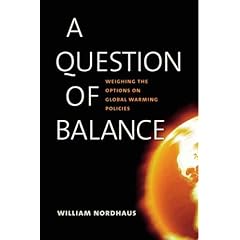
Nordhaus estimates economic benefits and costs, both from climate change and policies designed to combat it and uses constant 2005 US dollars as his unit, with time discounting at 4% yearly. He estimates the absolute cost of "do nothing about CO2 emissions" at $23 trillion over a century, or about $230 billion annually. His figure of merit for comparing policies is a "net benefit," the total benefit relative to the "do nothing about CO2 emissions" baseline. (For comparison, the US annual economic output is about $15 trillion and constitutes about a quarter of the world's production.)

In rank order of "net benefit," the results are:
  • Low-cost with technological breakthrough(s) (Nordhaus), +17
  • Realistic and economically optimal policy (Nordhaus), +3
  • Kyoto Protocol with (without) the US (Kyoto Accord), +1 (+0)
  • Stern (Nicholas Sterna), -15
  • Gore (Al Gore), -21
aStern is a British science advisor and was part of Tony Blair's government.

We must take the exact numbers with a grain of salt, since the inherent unknowns in such estimates are large. (Nordhaus assumes economic growth and inflation at the overall rate of the last century.) But the rank ordering, and the strikingly close results of the second and third policies, and the fact they are close to zero (that is, close to "do nothing about CO2 emissions") are very telling. $230 billion a year is about 1/65th (1.5%) of the annual US output, or 1/260th (0.38%) of global output. It's smaller than current interest rates, which can be taken as an overall social "discounting" rate incorporating risk and uncertainty.

From such results, "climate change" looks like, not non-existent, but still quite marginal. And the policies pushed by Gore and Stern, far more restrictive than Kyoto, are clearly lunatic and should not be considered further.

Dyson's article is also one of the few, outside of narrow technical forums, I've seen that discusses the effect of plants. That alone makes it invaluable, and I strongly recommend that you read the whole thing, as they say. To Dyson's lucid discussion should be added some additional points. The time scale for noticeable climate impact from CO2 emissions is one to two centuries. When we consider the smallness of the effect, scaling the costs of "do nothing about CO2 emissions" and the benefits of "doing something about CO2 emissions" down to account for the IPCC's exaggerations (at least a factor of two, probably three, in temperature change), the case for any but minimal countermeasures vanishes. Indeed, once you step outside the media- and environmentalist-saturated Western world, you run into much stronger skepticism about both the science and policy of "climate change." The reasons are no more than those presented here and in previous postings.**

Some important quibbles. I have only two significant points of disagreement with Dyson. The first concerns his characterization of "climate change consensus" as representing the large majority view of "climate change" among climate and allied scientists. This is simply false. The IPCC's scientific annexes alone, with their broad and large differences with the summary reports, demonstrate this. Consider as well organized protests by climate and other geoscientists against the Official Science of "global warming," such as the Heidelberg Appeal and Leipzig Declarations. The media generally capture the same group of self-appointed "true believers" over and over.

My other point of disagreement is Dyson's overly sanguine view of environmentalism, which he correctly acknowledges as the great secular religion of our time and the latter-day replacement for socialism, the last big secular religion. Disconnecting the "climate change" propaganda machine, starting at the governmental level and in the schools, is an essential step. The "climate change" hysteria has needlessly frightened both adults and children, warped and darkened their view of science, technology, and industrial civilization, and corrupted how science is taught and understood. The rampant runaway bad metaphors alone represent a new level of manufactured ignorance, something our society is getting better and better at.†

Slightly more than nothing. Dyson's article is a sanity tonic in a subject that, 15+ years ago, left scientific standards and protocols behind for the status of religious belief. The smorgasbord of policy alternatives he summarizes from Nordhaus, together with the other considerations presented here, leads to some natural policy conclusions. The phenomenon should be viewed on the time scale of a couple centuries, with at least a guess of cloud enhancement, plant metabolism, and ocean absorption taken into account. The IPCC's reports don't currently do this in a serious way, because the reliable science to do it isn't there.

Based on what we know now and what we don't know, there's no justification for any active countermeasures against CO2 emissions, beyond a mild form of geoengineering, which I've previously and cheerfully denounced as crazy. Here's my one exception: the most important geoengineering scheme, the one with the least risks, is more and better plants. Dyson reaches the same conclusion. The coming century will be one of biotechnology, just as much as the last was one of electronics and information. Superplants with enhanced CO2 metabolism are not at all impossible. Genetically engineered, or simply cultivated by the selective breeding that humans have been doing for millennia, such plants, spread wide enough, put the atmosphere's CO2 level under human influence no less than CO2 emissions form burning fuels do.

If a more aggressive policy toward slowing human emissions of CO2 and CH4 should ever prove necessary, the right approach is to tax them.†† Of course, politicians hate taxes for environmental purposes, because they hate putting the cost of their pet policies up front and visible to all. Complex and obscure regulatory systems are far more attractive to environmentalists, because they hide the real costs of the regulation. In any case, CO2 is not a poison or a pollutant in the classic sense. (Is π=3? Is the Earth flat? Why are courts involved in deciding such issues?) It's a naturally occurring gas respired and metabolized by plants and absorbed by oceans. If anything, it should be treated like water. No one thinks of water as a pollutant, even though people occasionally drown in floods, and clear-air water vapor is the main infrared-active gas at the heart of "global warming." At about 30 billion metric tons (Gt) of CO2 emitted per year and using Nordhaus' estimates, the external costs run to roughly $23,000 billion/100 years/(30 Gt/yr) = (US 2005) $7.80/metric ton.‡ The US is a relatively efficient burner of fossil fuels, by comparison with China, now the world's biggest CO2 emitter, or Russia and India. Their technologies are simply not as efficient or clean as ours: here's the world's real contemporary pollution crisis.

Finally, and always, keep in mind the crucial point made so effectively by Bjørn Lomborg: wealthy and technologically advanced societies have more means and choices at their disposal. There's no problem that we face, have faced, or will ever face made harder by better technology. (Whether we make good use of it is another matter.) Whatever the future holds for humanity and Earth's climate, there's no case for shutting down civilization or significantly impairing it. On the contrary, the better science and technology we have, the better we understand both the climate and the limits of our knowledge, the better decisions we'll make and the better off we and our descendants will be in facing whatever's headed our way.
---
* Anyone who thinks otherwise has been fooled by fuzzy, runaway bad metaphors about "greenhouses" and a climate modeling science still in its early infancy.

** I've never met a Russian scientist who takes the "global warming" hysteria seriously or views the climate problem as anything more than marginal. And the Chinese aren't about to impoverish the next two generations of Chinese for marginal and uncertain benefits.

† It's not the natural ignorance we're all born with. We're an advanced society and have the means to "do" ignorance far better now :)

†† "Cap-and-trade" should be abandoned as soon as possible. It's easily corrupted and subject to confusing manipulation by all parties involved. Also see this by Megan McArdle. Work like that of Nordhaus provides a first answer to the question of "costing" the CO2. But there's no "natural and optimal" level of CO2; all we can do is compare scenarios and ask, "What do we want?" (BTW, it's carbon dioxide gas, not "carbon.")

‡ One gigaton (Gt) of CO2 would fill about 89 million Goodyear blimps. The CO2 emission control schemes of Gore and Stern imply costs of $300-1000/metric ton CO2, which shows in a different way how far out of line with reality their proposals are.

A metric ton of CO2 emitted in the US produces about $1850 of economic value. Compare with the Nordhaus estimate of external cost ($8) and, again, the marginality of the problem is evident. And remember, these Nordhaus numbers assume the IPPC's already exaggerated claims.

Labels: , , , , , , , ,

Wednesday, June 25, 2008

Abandoning Official Science

Junk science has several warning signs: It advocates a cause, pays little attention to the investigative process, ignores contrary evidence and advertises a high moral purpose.

- Ron W. Pritchett, "Recognizing Junk Science," The Professional Geologist (December 1997)

For its two-decade history, the "global warming" craze has been an outstanding case - perhaps the supreme one in our time - of something I've called Official Science. It's not quite the same as what some people call "junk science," although it includes a fair amount of that. But it has something else: an authoritarian mummery that looks like science, but isn't. I've called this "para-science." In the case of climate, the key elements - the IPCC and its false "consensus" - are political in nature, not scientific. Blame it on Rio: they were enshrined in the policy world by the 1992 Rio "Earth" summit, a party to which scientists, for the most part, were pointedly not invited. The summit was a jamboree of environmentalist politics and activism, not ecology, climate, or any other science.

The kernels of Official Science are the pet theory and the politically, ideologically, or theologically predetermined conclusion. Science, among other things, is mostly bottom-up and inside-out knowledge. In areas where many open questions remain, it's stimulated by surprise discoveries and unexpected insights. Basic research is especially important here because it tries to frame questions and find answers with potential for wide-ranging impact, both in theory and application. Official Science is the opposite: top-down and outside-in. Non-scientists (politicians, political intellectuals, journalists, activists), often in alliance with ex-scientists either cynical, ambitious, delusional, or all three, apply the pressure from the outside. Blow-ups, dilemmas, and intellectual corruption begin where the two cultures - science and "para-science" - collide.

Cultures in collision. This is origin of the unusual social phenomena associated with the "global warming" craze. They include the misrepresentation of an actually non-existent "consensus" about "climate change," which consensus is then repeatedly invoked to isolate and demonize "deniers," skeptics, and fence-sitters (who, all told, actually make the up the majority of climate and geoscientists). Environmentalists attempt to smear scientists with often false or misleading "reports" detailing alleged "secrets" about funding sources.* Quasi-official institutions (bureaucratic leaders of government and academia, scientific journal editors) create an echo chamber where otherwise normal skepticism and criticism are silenced. Publications once noted for their high standards (like Scientific American) degenerate into politically correct propaganda outlets, with scientific reasoning playing less and less a role in their arguments. In its place are invocations of authority, something having no place in science. In fact, in no other area of science are such non-scientific procedures so routinely made use of. The mere existence of an "official panel" on climate (the IPCC) is far from scientifically kosher.

Follow the (public) money. Scientists in climate and allied areas have protested, repeatedly, against the fake "consensus." The protests are ignored by the IPCC and the non-science media. But the situation is more subtle and disturbing than a simple black-white opposition. Incentives both positive and negative have been applied to reshape the sociology of the field (and don't doubt that this reshaping is a conscious political effort.) Public funding has moved from open-ended basic research, in which questions are paramount, to a situation where the larger answer is assumed and research proposals have to be tailored to "get with the program." Professional societies (American Geophysical Union, American Physical Society, American Statistical Association, etc.) leave the provinces and move to Washington, where their staffs shift gears and become political players in a politically- and journalistically-shaped arena, leaving scientific questions far behind. These societies - or at least their headquarters staff - then join the "consensus," often over the protest of their scientific members.**

The IPCC itself offers a particularly insidious temptation for scientists, the IPCC reports' scientific annexes, which are produced by a large body of "working groups" (a couple thousand scientists) routinely confused in the media and by politicians with the the much smaller IPCC staff (a couple hundred). To compare the working groups' annexes and the IPCC's summary report is to compare two apparently different planets. The couple thousand scientists in the working groups become, in effect, wittingly or not, ventriloquists' dummies.

The folks back home. So why the scientific annexes to the IPCC reports? Essentially, to impress the rubes. Nothing else can explain why the scientific reports keep getting included, yet contradict what the Summary report says. The gap has not closed in 16 years of these reports. The rubes are politicians, journalists, even other scientists, and you and me. It makes the reports look authoritative, while allowing the IPCC and "global warming" fanatics to ignore scientific criticism and demonize and isolate individual critics as "skeptics" or "deniers" (as if skepticism is out of place in science, instead of being its daily bread). Meantime, outside of their respective scientific disciplines, few actually read the scientific reports. (I've read parts of the 2002 and 2007 reports.) Under the baleful influence of Official Science, scientists amongst themselves and individually express one view, but assembled "officially," express a very different view. That's a sure sign of arm-twisting and Official Science overriding of scientific criticism. It's no road to knowledge: science makes more progress through criticism, by demolishing bad ideas and disproving wrong hypotheses, than through converging on correct ideas. Not that these processes are separate: converging on the right conclusion requires a lot of clearing away first.

Official Science equals bad science. Under the usual circumstances of scientific practice, the extravagant claims of the IPCC - being able to predict future weather; denying or selectively "cherry picking" the behavior of the current, recent, and paleoclimate - would be laughed out of the room, so to speak. Specific instances of sloppily done or simply mistaken scientific embarrassments, the "hockey stick" above all, would have been ripped apart through the usual process of criticism, counterproposals, and so on. Without an externally enforced preconceived and dogmatic conclusion, progress would result, as it usually does when scientists work on something in their usual mixture of cooperation and competition.

But with the "boundary conditions" changed, so to speak, and an externally imposed, preconceived conclusion forced on the issue, something very different happens. Badly done science, embarrassing fallacies, and outright fraud start to win, no matter how horrifying, because they fit the dogma. Really good science, superb insights with clear implications (for example, the ice core results), are disallowed, rejected for publication, ridiculed, or otherwise ignored and languish in a narrow specialty in a way that doesn't threaten the dogma. When editors of leadings journals (like the editors of Nature and Science in the 1990s) undergo conversion and baptism in the Cause of "global warming," excellent work contradicting the official line doesn't get published, at least not their journals.† Mistakes that would be marked wrong on a test or homework assignment, or corrected by a graduate research advisor, instead get perpetuated in prestigious venues.

Official Science must go. There's a lot of positive progress that awaits climate and allied sciences, once they're freed from this monkey on their backs. But before anything positive happens, the big negative has to be cleared away first. There's no "reforming" Official Science, or "making it responsive." The spirit animating it and the spirit animating science are in direct conflict and can't be reconciled. The right thing to do with Official Science is to abandon it.

In the case of climate, the IPCC should simply be scrapped. It keeps committing the same crime over and over, providing the fanatics of "global warming" in the political, environmentalist, and journalistic worlds more clubs (or hockey sticks) to beat up their designated targets simply for practicing science in public. The IPCC carries on under the auspices of the UN, but is rooted in a multinational convention that grew out of the 1992 Rio summit. It's true that this convention, the IPCC, and the Kyoto Treaty that resulted are not in America's interests. But they're really not in anyone's interests. The US should withdraw from any official involvement in or funding of the IPCC and strongly encourage other countries to do the same. What private individuals and institutions do on their own time and nickel is their business. It's become everyone else's business just because ways have been found to force it on everyone else.

That's a first big step in the right direction for the science and scientists and frees them to look at positive possibilities. Such a step also has a whole set of separate implications for policy.

SPOT THE FALLACIES! I ran across this item recently in Physics Today, flagship publication of the American Physical Society. It's a not a refereed technical journal, but a magazine at a high level for physicists and scientists in related areas, as well as students and interested outsiders, with the main articles and much else written by scientists. PT has high standards, so the item came as a shock, if not a complete surprise. It commits at least four climate fallacies in two paragraphs. See if you can spot them.†† (Disclaimer: I don't meant to criticize anything about the research article discussed in this news item. I haven't read it.)
---
* Sorry: even if these reports were correct, "funding sources" is not a scientific argument.

** The American Statistical Association, in the past a reputable professional scientific organization, recently announced its endorsement of the already debunked "hockey stick," creating some shock in the scientific world. Important members of the ASA were involved in the earlier debunking and were not consulted in this change of "official" view. Apparently, the ASA is working hard to "get with the program," a political, not a scientific, imperative. The problem is not that the "official" view needs to be changed; the problem is rather that there is an "official" answer to the question at all. This is the essence of what's wrong with Official Science.

Disaster results from such trends: good people leave the field or shut up; good students don't enter, and so on. This has now gone on for almost a generation, and climate and allied scientists are waking up to the cold truth of how much damage this crusade has done to their science, their research, and their teaching. (How do you teach this stuff to students with a straight face, when there are so many things so obviously wrong with it?) These are the sort of dilemmas faced more and more over the last 15+ years by natural scientists in geosciences, climate, and neighboring subjects.

† Then these same editors have claimed - with a straight face! - that their journals don't have many papers that conflict with the fake "consensus."

†† The fallacies I spotted are:
  • Solar radiation is not reflected from the Earth's surface, but absorbed and re-radiated. That's why the Earth's surface warms up. Reflected, radiation can't warm anything.
  • Extra warming does not occur because IR-active (misnamed "greenhouse") gases absorb the IR radiating from the surface. These molecules are good at IR absorption; they're also good at IR emission. They're a more efficient IR "bucket brigade." The "extra warming" is not a retention of heat, but actually a steepening in the slope, or lapse rate, of the radiation temperature.
  • A greenhouse doesn't work like this.
  • The Earth's climate isn't a greenhouse anyway.
Official Science does rot your mind.

Labels: , , , ,

Thursday, June 05, 2008

Do knowledge and reason make you "right-wing"?

Well, maybe. Depends on what you mean by knowledge - and by "right-wing."

I have that feeling sometimes when I look around at the state of politics in the most "liberal" (leftist) parts of American society, or of Europe. But then I wonder: are these people and their politics really "liberal"? And the paradox is even more apparent looking the (supposedly) other way: people who accept economic reasoning, oppose Islamic jihad, accept and tell the truth about the Middle East, and find much of environmentalism underwhelming from a rational point of view are routinely labeled "right-wing." Why?

I've mentioned here a smattering of causes and views that have, by mindless convention, come to be accepted as "liberal" without anyone really thinking about it. Accepting economic reasoning is accepting the facts of life. Islamic jihad is profoundly illiberal, and it is what it is by virtue of nothing that the US does. It's one side of an elemental clash of political values. A lot of environmentalism is actually a religion with only a flimsy relationship to science. The radical wing of the environmentalist movement is useful, if for no other reason, because it pushes environmentalist assumptions to their logical conclusions: civilization, progress, and science are crimes. Humanity is a blot upon nature, and the results of human progress need to be offered up on a altar of sacrifice to placate whatever's out there angry at us. Much of the movement is a search to recover a pre-modern, pre-scientific authority to forcibly order society the way aristocracies, monarchies, and churches once did.

There was a time, forty or fifty years ago, when reason and knowledge were supposed to be monopolies of liberals and others leftward. Conservatives were supposed to be mindless preservers of the status quo or blind worshippers of tradition for tradition's sake. Obviously, something big has changed since then.

Part of it has to do with the recognition of conflict and trade-offs. Liberals were once able to accept this reality. Perhaps such acceptance is "conservative" if, using language I'm not completely comfortable with, we view such possibilities as an aspect of a "fallen" world, one that doesn't allow us to have everything we'd like, all the time, all at once. Awareness of a world outside one's comfortable middle-class existence, within a very narrow range of assumptions, also seems weak among today's so-called "progressives." The fact of unresolvable conflicts of political values and claims prompts them either to denial or to an automatic assumption of guilt. But such conflicts are usually about something much more basic, so basic that people living in liberal societies are usually unaware of it. Narcissism is not the answer: these things are rarely about you and me. And even faced with such conflicts, we still have choices. Knowing what any experienced and honest person knows about the Middle East, for example, will lead one to accepting its reality as fact (which by itself implies neither guilt nor moral approval). But it also leads to skepticism about, say, the Iraq war and its purposes, as being in conflict with what is feasible and prudent. The war has proven it's easy to topple a dictator, but very hard and costly to transform a culture, especially in time for the next election here at home.

The use of the term "right-wing" to describe perfectly rational views and people is more like the emotionalistic use of the word "fascist" - it's just something incompatible with whatever the current leftist mindfad is. Leftists are not liberals. Liberals value individual freedom, self-interest, and reason. Leftists are coercive, revolutionary, utopian, motivated by an apocalyptic vision. As the "cultural" or "new" left has spread in American society and become dominant in certain American institutions, self-described "liberals" and "progressives" have caved in to it, coming to half-accept its assumption of unearned guilt and mindless self-hatred. This puts them on the way to rejecting precisely what made them liberals in the first place. The results are visible all around us, especially on campuses and in the media.

So maybe reason and knowledge do make one "right-wing" - but that's only by way of twisting the language. Those who created and propagated political correctness, hostility to economic and technological progress, and a general denial of facts of life are the ones who need to re-check their "liberal" and "progressive" bona fides.

Although there's nothing dumber than a willfully uninformed decision, knowledge and reason alone can't make our decisions for us. We have a range of choices of how to response the facts of life. Such choices are actions, but also statements of our values. Reason, knowledge, freedom, critical thought, and skepticism are liberal in any meaningful sense of that word. But that "L" word! It's been twisted in strange ways, almost out of recognition. (June 2)

POSTSCRIPT: Rick Hills at PrawfsBlawg makes and elaborates on an important distinction, which he phrases as "anti-intellect vs. anti-intellectual." He finds self-labeled "intellectuals" often guilty of being "anti-intellect"; that is, strong on preconceived, poorly founded opinion and groupthink, and weak on knowledge. Not a new insight (and he doesn't claim it as one), but relevant to the point I'm making here:
Being anti-intellectual is not the same as being anti-intellect. My beef is with a particular social class - the "intelligentsia" - and not with the practice of using one's intellect to reflect on experience. In my experience, intellectuals (as a class) are ideologically intolerant, easily offended by ordinary humor, and pretentious in their prejudices, which they disguise as universal truths ....

Moreover, I find a direct relationship between the academic obscurity of self-consciously "intellectual" writer's prose and the willingness of that writer to justify the unjustifiable.

It takes the convoluted abstractions of a Carl Schmitt or a Heidegger to offer apologetics for Hitler; a Sartre, to temporize about Stalin; a Foucault, to defend Khomeini. In this respect, I stand with George Orwell who spent the 1930s and 1940s denouncing the obscurity of intellectuals' prose as a cloak for tyranny (and, incidentally, who was also accused of being an anti-intellectual). Intellectuals spray polysyllables like squid ink, to evade the democratic decencies of conversation.
(Hat tip to Instapundit.)

Labels: , , ,

Friday, May 09, 2008

Now it gets interesting

The coming fall of PCU, triggered by intolerable costs, is preceded by the final stages of rising prices and hemorrhaging subsidies. This bubble is now the subject of more and more active discussion in the blogosphere and the specialized higher ed press.*

Over at the Yeah Right blog, the mysterious Batman refers to this article on the student loan bubble, following the lead started by Instapundit:
... about "the next market bubble" being higher education, where government subsidies (obstensibly, to improve access to higher education) have had the unintended (but certainly foreseeable) consequence of inflating the costs of college: "Over the last 10 years, after adjusting for inflation, tuition is up 48% at public schools and 24% at private schools."

There are several important parallels with the recent housing bubble; policy goals of extending participation (in higher education, in home ownership) led to people with serious credit risks borrowing a lot to pay a lot for something that, it turns out, isn't worth what they paid....

This bubble, like all bubbles, will have its tragic stories, so I don't want to cheer this on. But if there's a silver lining, it's that it may make people rethink the value of those four years that polite society assumes you need.

Discussion ensues.

How much you wanna bet now on a federal plan in 2009 or 2010 to "save" higher education from a government-enabled burst bubble? And, of course, to keep pushing college education on students who don't need or want it? Just like pushing houses on people who don't need or can't afford them ....

POSTSCRIPT: Nice blog, BTW. Although Batman seems even more mysterious than we are :)

Additional thoughts about how the cultural elite skews education spending the wrong way, from Jerry Pournelle.

POST-POSTSCRIPT: Some bloggers caught Megan McArdle's hysterically funny take on HillaryPlan, but not all of us saw it:
What do Americans care most about this election season? The troubled housing market, and the short supply of oil. That's why Hillary is here with a plan. Specifically, a plan to discourage investment in the oil industry through a windfall profits tax, and to destroy the mortgage market by freezing foreclosures and interest rates. That way, no one has to worry about oil or houses, because there won't be any to worry about. That's just the kind of thoughtful, caring politician she is.
Plus Megan has some really cool economics charts that take me back to college days. I guess my public college education is worth something. And it means Megan is way cool.

And that is why my new life goal is to meet and marry Megan McArdle.
---
* Your guides to the academic scene, Inside Higher Ed and the Chronicle of Higher Education.

Labels: , , , , , , , ,

Saturday, May 03, 2008

More on the end of PCU*

One sign of the impending fall of PCU is the aggressive sniffing of state legislatures around college endowments and other academic assets and income streams. States don't have much leeway here, because of federal charitable tax rules. Yet the trend is striking, for example, right here in Massachusetts and Beantown. See also this, about the explosion of non-educational costs in academia. Might this not be like the dissolution of the monasteries and economic assets of the Catholic Church during the Reformation? The comparison is neither new nor unique to me.

The rise of PCU was never enough to provoke a large, direct revolt by alumni, taxpayers, and students, although it has greatly diminished the prestige and influence of academia in the larger society, compared to 30 or 40 years ago.** Rather, it's costs that will stimulate the revolt, and more generally the perception of academia as an island of bloated privilege. It's not a completely correct perception, but there's enough truth in it that political hay can and will be made.

The right solution is not to revoke universities' charitable status (unless the whole concept is changed across the tax code), but to take a hard look at public and private subsidies to universities and their unwillingness or inability to control costs. Profit-making activity by schools should be spun off into taxable regular commercial enterprises that universities own, but which are legally separate. That's what some schools do already, and it's a common approach in other countries. In any case, the financial problem is not for-profit activity, but "cost-plus" activity.

Such academic blogs as those mentioned last time (Althouse, Instapundit, Volokh Conspiracy, as well as so many others: Augean Stables, Cranky Professor, Professor Bainbridge, Daniel Drezner, and ChicagoBoyz) keep a steady track on the bundle of trends that define PCU: costs, endowments and other subsidies, political correctness, censorship, and declining standards. They know the insides as only insiders can.
---
* Politically Correct University, like the movie!

** One major reason for the rise of think tanks, especially conservative and libertarian ones.

Labels: , , ,

Friday, May 02, 2008

The coming fall of PCU*

It is one thing to wish to have truth on our side, and another to wish sincerely to be on the side of truth.

- Richard Whately, Archbishop of Dublin

In the last generation, something terrible has gone wrong with American colleges and universities. They've become grotesquely overpriced, anti-intellectual, and increasingly repressive backwaters. Outsiders looking in can see it, and, remarkably, so can a growing number of insiders. Outsider Michael Barone:
I am old enough to remember when America's colleges and universities seemed to be the most open-minded and intellectually rigorous institutions in our society. Today, something very much like the opposite is true: America's colleges and universities have become, and have been for some decades, the most closed-minded and intellectually dishonest institutions in our society.
Barone points out that there's no reason why taxpayers, trustees, parents, and students have to continue supporting this. It's unlikely they will continue for much longer. And for its insiders, academia has become a gilded cage, locking up its brightest minds in narrow, obscure corners and conditioning them on a steady diet of the Three Cs: conformism, credentialism, and careerism. William Stuntz of Harvard Law School said it a couple years ago, after the Larry Summers fracas, when he declared Harvard the "General Motors of academia":
... rich, bureaucratic, and confident - a deadly combination. Fifty years from now, Larry Summers's resignation will be known as the moment when Harvard embraced GM's fate.
Political correctness isn't the whole problem, but it is a large part of it. Universities, especially the elite ones, no longer know what to do with their undergraduates. They used to have something called "liberal education," but that has disappeared:
The humanities have destroyed themselves over the past 30 years…. Through an obsession with European jargon and a shallow politicization of discourse, the humanities have imploded…. There’s hardly a campus you can name where the most exciting things that are happening on campus are coming from the humanities departments…. I think the entire profession is in withdrawal at the moment. (Camille Paglia)
I hope people don't think P.C. was just some early 90s fad, like grunge. It's institutionalized - that was the whole point: a generation of tenured intellectual corruption. Along the way the P.C. faculty pressured the non-P.C. to leave or retire and made sure younger non-P.C. faculty weren't hired. They continue to use superficially liberal language for profoundly illiberal ends - it's called "postmodernism," and there's nothing liberal about it. As in 1968, they don't believe in truth or reason; they believe in the fist.


The intellectual origins of this debacle lie in the prestigious 19th century German academia, as Allan Bloom tried to communicate in his prickly classic The Closing of the American Mind, published in 1986, just before the rise of P.C. Occasionally, brave thinkers, such as South African Nobel literature laureate Doris Lessing, will press home the same point. Like Bloom, but coming from a different political direction, she put her finger on the origins of "political correctness":
...the pedantries and verbosity of Communism had their roots in German academia. And now that has become a kind of mildew blighting the whole world.
It's a sad legacy for the great German Enlightenment thinkers, Kant and Hegel. Their style set the stage for later mystagogues and obscurantists to peddle banalities or poisonous nonsense with profound-sounding mumbo-jumbo. Their modern avatar is Heidegger.

We're still suffering the consequences, which came about demographically by the rise of the Boomers to positions of authority in academic institutions. Remember this is the generation that 40 years ago rejected facts-as-such and independent truth. Paul Goodman, one of the best of the 60s radical thinkers (anarchist, founder of gestalt therapy, two generations older than the Boomers), discovered the hard truth about America's Worst Generation in a late 1969 graduate seminar on professionalism:
Didn't every society, however just, require experts? ... [No, his students insisted.] ... Suddenly, I realized that they did not really believe that there was a nature of things. Somehow all functions could be reduced to interpersonal relations and power. There was no knowledge, but only the sociology of knowledge .... they did not believe there was such a thing as the simple truth. To be required to learn something was a trap by which the young were put down and co-opted. Then I knew that I could not get through to them. I had imagined that the world-wide student protest had to do with changing political and moral institutions, to which I was sympathetic, but I now saw that we had to do with a religious crisis of the magnitude of the Reformation in the fifteen hundreds, when not only all institutions but all learning had been corrupted by the Whore of Babylon [the Church].
This is not a generation that can "speak truth to power" - quite the contrary. Political correctness is all about speaking power to truth.**

The most blatant abuses of this type occur when particular individuals are targeted by militant faculty out to "make examples" of designated hate objects. The Larry Summers affair was one. (See here and here.) Another, far worse, was the false case against the Duke lacrosse team, where academic intolerance merged with prosecutorial abuse and media hysteria. We've met the abusive prosecutor before in, for example, the "Scooter" Libby case. And the media: it can't run, it seems, on anything but fake "narrative" expressly built to demonize its targets. It's extravagant spectacle, never mind the facts.***


The problem is not faculty tenure, which American universities and colleges have had since the 1920s and 30s. That privilege was originally balanced off of a small set of powerful administrators who could get things done, while letting faculty go about their teaching and research business. Powerful administrator presence also deterred the worst tendencies of the worst faculty. After academic administrators lost their authority in the 1960s and 70s, concentrated power and responsibility were diffused into "faculty self-governance." Since most faculty are busy with teaching and research, a power vacuum opened up, one filled by the small but vocal and aggressive minority of irresponsible faculty who, more and more, wield veto power over departmental and college decisions and are invariably at the center of eruptions of identity politics and P.C. Contrary to an old misimpression left from the 1960s, it's generally not students, who are in any case too transient a population to do sustained damage to universities.


Political correctness blends with other university trends to produce something beyond just simple closed-mindedness and petty dogmatism. Universities are also big businesses, for-profit in all but name, yet not run the way normal businesses are run to keep costs and waste under control. Instead, being heavily subsidized with little oversight, they're run as "cost-plus" institutions that pass on costs to everyone else, because they can get away with it. Much of higher ed is simply a racket.

Curiously, it's generally not faculty who benefit. While older, tenured faculty have done well in the last 40 years, younger faculty hired since the 1980s are doing much more poorly. They are not only less likely to get tenure, they're increasingly hired off the tenure track; instead, they end up as adjunct or part-time faculty.

You then might wonder what is driving costs up. The answer is found in university budgets: it's "other" - everything else not connected with the university's business of knowledge. It includes vastly expanded student services and athletic departments (which, contrary to myth, rarely make money for their schools). Above all, rising costs are driven by massive growth in administration. As once-powerful academic administrators have lost authority, they have compensated by hiring armies of underlings. Top administrators, in any case, no longer do as much administering as they once did; their jobs have been redefined as money-chasing.

Here's Marty Nemko in the Chronicle of Higher Education:

Colleges should be held at least as accountable as tire companies are. When some Firestone tires were believed to be defective, government investigations, combined with news-media scrutiny, led to higher tire-safety standards. Yet year after year, colleges and universities turn out millions of defective products: students who drop out or graduate with far too little benefit for the time and money spent. Not only do colleges escape punishment, but they are rewarded with taxpayer-financed student grants and loans, which allow them to raise their tuitions even more.

I ask colleges to do no more than tire manufacturers are required to do.
The American Association of University Professors (AAUP) has attempted to counter the mounting criticism with a lame and beside-the-point statement that evades the real issue and astonishingly implies a blank check to universities and doctrinal infallibility to their faculties, with everyone else footing the bill. Conservative critics are saying it (see here and here), but remarkably, even liberal academics are too (here and here). Taxpayers, parents, and alumni continue to pay to be abused in this way. But there's no reason for them to, and I predict that postmodern academia has no more than a decade of life left.

Academia was originally granted its special privileges and status, along with bucketloads of money, to serve a bundle of larger purposes connected with knowledge. It has drifted far from that mandate. Until a few years ago, we might have held hope that universities and colleges could be reformed from within. But the Larry Summers case, more than any other, showed that sympathetic liberal insiders can't pull it off. Summers was the last of his kind. Change will come, but the reformers will not be liberal, sympathetic, or insiders. As Harvard's Stuntz put it, academia, and in fact, America's whole liberal elite, including its fake aristocracy of celebrity, feels a lot like the French aristocracy before 1789, although without the latter's powerful residue of taste and refinement. But for now, it's 1786 - say - and life's good.

POSTSCRIPT: Hat tips to the terrific blogs out there kept by academics, especially those of Ann Althouse, Glenn Reynolds (Instapundit), and Eugene Volokh (The Volokh Conspiracy).
---
* Politically Correct University, like the movie :)

** Here's another striking example, one of many, from the crazy anthropology department at Columbia/Barnard, an incorrigible center of the rot of "Middle East studies." After reading this, my first reaction was, why didn't Reinharz and other liberals like her raise these objections to the wave of P.C. and postmodernism when it started 20 years ago? Columbia is the same place Ahmadinejad got his fawning reception.

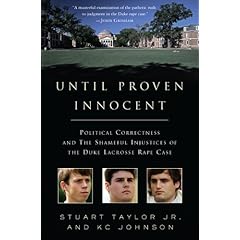
*** There's a rich online and print literature on the Duke travesty, starting with Johnson and Taylor's Until Proven Innocent and the Durham-in-Wonderland blog. Check out these items, from the New Yorker and Harvard's George Borjas, as well this review. (The link above goes to the Economist's review.) The concentrated essence of PCU is all there in one ugly case.

Labels: , , , ,

Tuesday, April 29, 2008

Noble savagery and white guilt

PRE-POSTSCRIPT: Not that Rousseau didn't write some pretty dumb things, e.g., in The Social Contract - see here.
---
Some time between the fall of Napoleon and the First World War arose a mentality - in some cases, a full-blown ideology - rightly called "white supremacy." In Europe, it was a never-completely-respectable by-product of the immense lead in knowledge, technology, and social organization that opened up between the West and the rest of the world in the 19th century. While a side effect of the fact of progress, it also sat uneasily with the West's belief in progress and a better future. In the Americas, the mentality was a by-product of the white colonists' earlier destruction of native ways of life and the colonial institution of slavery. While the abolition of slavery marked a first large step away from white supremacy, as a social attitude, abolition in some ways heightened the sense of a gap between white Europeans and others.

Then came the First World War and, even more emphatically, the Second. Some time between the end of the earlier conflict and the end of the latter, "white supremacy" collapsed. It had never been congruent with the West's more "official" thought-systems (Christianity and liberal Enlightenment) anyway. Great 19th century dissidents, like Kierkegaard, Dostoyevsky, Nietzsche, and Mark Twain, had questioned the confusion of moral and political with economic and technical progress.* The physical and, even more, the moral destruction wrought by the major 20th century conflicts badly damaged the sense of automatic progress that the West had come to believe before 1914. While civilization had made possible life in numbers and quality unimaginable a few hundred years ago, the most advanced forms of progress before 1945 were still available to only a minority of citizens. And technical and organizational progress had, almost without anyone noticing, created means of destruction also unimaginable a few centuries ago.

Suddenly, progress and civilization no longer seemed all that. Perhaps, it seemed to some, just "skin-color privilege" anyway. Thus was born white guilt. Strangely, the origins of white guilt had little to do directly with the legacy of slavery or racism, or the decimation of non-European peoples by European colonialism and diseases. It started as an internal crisis of confidence, haunted by the sense that modern history had ended badly.

Most of the resulting agonizing hasn't done white people much good. It has also not done much good for non-white peoples once at the margins of white society but, since 1945, increasingly integrated into modern life. Black author Shelby Steele has written a short but magnificent book on how white guilt has twisted the promise of civil rights, weighing it down with undeserved and often unacknowledged baggage that prevents everyone - whites for their reasons, black for theirs - from understanding the society they live in and how it might be improved. You can find brief summaries of his argument here and here.

Steele explains how racial oppression works and why "black rage" didn't start until after the civil rights movement was nearly finished. The oppressed usually don't feel rage until and unless they're almost free. When the parameters of society change in such a big way, then it becomes okay for the about-to-be-freed to be angry. The strange result is that, in Steele's view, whites had moral authority on questions of race when they were acting as oppressors; only when they stopped did they lose it. From a rational point of view, this makes no sense. It can only be explained if you accept some additional assumptions stolen into the discussion some time between the mid-60s and the 80s, that period when modern liberalism came unglued: all white people are racist, and only white people can be racist. Neither is true, but such assumptions explain why the promise of racial integration, palpable in the 1950s and early 60s, went sour and why later progress, while real, has also been harder than it should have been. What got in the way was identity politics.

While identity is not irrational, identity politics is. It asks politics and politicians to do what they cannot. In the case of groups emerging from oppression, it is an understandable but blind and self-defeating response to a negative past. What it produces is demagogues and racists (like the white supremacists of the defeated South, a Farrakhan, or Hitler, the pseudo-messiah of the humiliated post-1918 Germans) and white liberal pandering, like political correctness.

But the larger irrationality and injustice of identity politics is living in a self-imposed mental slum, hemmed in by knee-jerk, defensive attitudes. For parasitic "identity" demagogues, the point is divide and rule. The way you divide and rule is to chop up voters as a whole into rigidly defined groups and brainwash them into feeling that they're helpless victims. Then they'll keep voting for you. They'll also fail to make connections with people outside their group and thus reinforce their isolation. Does this sound familiar? It also supports stunningly low political standards. Black voters, for example, simply hold black leaders to a low bar. Guaranteed Congressional seats just make it worse: it means some second- or third-rate black politicians will definitely hold office for as long as they want. But it also guarantees they will go no further. Black leaders with biracial appeal find their options very limited.** Obama is exciting, in part, because he doesn't fit this pattern. He had to run state-wide to become an Illinois senator and get white, as well as black, votes. Barack Obama successfully escaped America's "race reservation" system and electrified the nation in the process. Somehow, he slipped through the cracks.

The justice of the civil rights movement was and is beyond question. But the concept of white guilt makes no sense. It strikes me as a shamefaced cousin of white supremacy, exchanging superiority-by-virtue-of-skin-color for unearned-guilt-by-virtue-of-skin-color. Also lurking around this subject is the toxic concept of the "noble savage."† (The Left is incomprehensible without reference to "noble savagery," unearned guilt, and self-hatred - secularizations of familiar Christian concepts.) Civilization is defined, not by race, but by values and institutions - rules, essentially - and civilization is definitely better than non-civilization. The concept of "race," a nineteenth-century pseudoscientific idea of questionable pedigree, needs a hard look. Older definitions of civilization were based on religion or, to put it in more neutral terms, institutions and rules. These definitions are historically much sounder than the race concept.

Underlying "noble savagery" is a feeling that certain people are more pristine, closer to the Earth, or have groovy rhythm - or something. Such thinking is ridiculously patronizing, but it or something like it is widespread among self-loathing white liberals. In their view, civilization itself is a crime, which makes problematic their use of "progressive" as a self-description. Of course, much - maybe most - of this self-loathing has non-political roots. It just seeks political expression and justification in its advanced stages.

Primitive peoples in the state of nature are what they are: in more ways than one, humanity in the buff, showing the full range of what primordial humanity can be. In civilization, people have strong disincentives to violence and strong incentives to be constructive, very different from the lawlessness of a tribal world. Tribes are free as collective units, but not as individuals - they're bound by powerful tribal custom. Only modern civilizations have reconciled individual freedom with civilization, by replacing the alienation of power and sacrifice of personal freedom required in traditional civilizations with civilization based on rational self-interest and common consent - the social contract, in essence, embodied in the rule of law. A free society is necessarily a lawful society, not an anarchy.

In truth, "noble savages" don't exist and have never existed. But the noble savage doctrine in the hands of civilized people imagining themselves to be or desperately searching for those noble savages has been, with no competitor, the most fatal and destructive delusion in history. It's at the core of the lethal radicalisms of the last century, and it's responsible for hundreds of millions of deaths in its genocides and dictatorships, and in the Second World War. The noble savage notion, played with by civilized men and women, is an invisible poison.

POSTSCRIPT: Here's an interesting review of Steele's book.
---
* Seventeenth and eighteenth century thinkers, like the American founders, were much less confused about this than their successors. They were hopeful about progress, but also knew it wasn't magic. And they had few illusions about human nature.

** This pattern is in no way unique to blacks, but part of a larger phenomenon of powerful special interest groups that organize around government-bestowed special status. Once granted, it's rarely taken away, because no politician is powerful enough. The larger public good is lost because of the aggressively reactionary stance of these narrow interest groups and their leaders.

† Actually, Rousseau's notion of the "noble savage" was not so wildly off, and he did recognize the basic problem of pre-state societies, which is their inability to control violence. In this, his view is not so different from Hobbes. His concept of "savage" was "noble," but not the romantic, quasi-pacifist, tree-hugging silliness often implicit in late 20th century concepts. It was apparently Diderot, one of the key figures of the French Enlightenment and editor of the influential and widely-read Encyclopédie (1751-80), who put the notion into its Romantic form.

Labels: , , , , , ,

Saturday, April 05, 2008

A century later: The Dreyfus case

Boston University is currently showing an exhibit, with a symposium, on the Dreyfus affair, the legal case and scandal that engulfed France between 1894 and 1906. The bare facts are easy enough to state. The French military's general staff had a turncoat in its midst, a certain Colonel Esterhazy, who prepared, for sale to Germany, France's enemy, a complex document (bordereau) of military secrets. He framed Dreyfus for this treason. Dreyfus was then tried and convicted, with falsified evidence, and sent to the French penal colony at Devil's Island, off the coast of Guyana. He was tried and falsely convicted again by a military court in 1899, but pardoned by the French president.

The exhibit ("The Power of Prejudice: The Dreyfus Affair," with participation by such Boston luminaries as Alan Dershowitz) tries hard to connect l'Affaire (as it still called in France) to the present-day, and there are some connections and echos, although many aspects of it seem strange today - the past really is a foreign country. And unfortunately, some of the real lessons of the Dreyfus scandal (shouldn't it be called the Esterhazy scandal?) are not the ones the exhibit so clearly and earnestly wants to draw.

At the heart of the injustice lay the French military and military courts, which were dominated by officers of a strongly royalist, aristocratic, and Catholic-reactionary bent, deeply hostile to successive French revolutions and the contemporary Third Republic. Although France underwent strong, if uneven, economic growth then, and the whole pre-1914 era is remembered as la Belle Époque - the era of the Impressionists and post-Impressionists, and of Saint-Saens, Fauré, Debussy, Ravel, and Satie - French political life in that era did exhibit deep weaknesses, constant scandals, and incessantly falling governments. (To prevent a new Bonaparte, the Third Republic had a weak presidency and incoherent parliamentary-cabinet government.) Strong political subcultures arose at the end of the 19th century in reaction to these developments, all of them hostile to the Third Republic. Among these tendencies was what might be called an anti-patriotic Right. Hostile to the republicanism, egalitarianism, dynamism, and secularism of modern France, they dreamed vainly of restoration - restoration of the monarchy, the established Church, the landed aristocracy, and the pre-industrial, pre-democratic age generally. Under modern conditions, these tendencies could not go but nowhere, but they seeded something that would later flower in demonic form - the word had not yet been coined by Mussolini - the phenomenon of fascism. Actually, it isn't quite correct to call them "anti-patriotic." They were deeply chauvinistic (to use the word the French themselves use) about all things connected to what they called "deep France" (la France profonde, a somewhat mythical place), but viscerally antagonistic to the post-1789 world of middle- and working-class France, of republican institutions, and lack of respect for the Old Regime and its manifestations. The roots of their own treason to France lay here, although it would be a generation after Dreyfus before the rot came to its fullness.

Contrary to legend often repeated later, the intellectual and educated classes of France did not, by and large, rush to Dreyfus' defense at the time of his first and second trials. Educated opinion in France was divided among a small but devoted group of Dreyfusards, a larger and vicious group of anti-Dreyfusards, and a lot of people of mixed or no opinion in the middle who were eventually swayed by a certain Colonel Picquart, who came forward after the first trial with definitive proof that Dreyfus was framed and his writing on the bordereau forged. After the first trial, the Dreyfusards came under the leadership of novelist Émile Zola, but it was well after Dreyfus' second trial before most educated French opinion came to see the truth of how Dreyfus had been railroaded. (Zola quipped that the original Dreyfusard party could be fit into a small room.) Educated persons outside of France were, on the whole, more sympathetic to his plight - they could see more clearly the conflict between democratic-republican France (exemplified by an emancipated Jew falsely accused of treason) and the heavily reactionary French military, which had never reconciled itself to the post-1789 world.*

Lessons today? The one Professor Dershowitz wants us to learn is that we should doubt the conviction of anyone on trial for anything. But - sorry, Alan - that's not the point. (The exhibit features his disembodied head and voice droning on about such things.) The most striking facet of the scandal to the modern eye is the largely negative and sensationalistic role played by the then-new mass media in their graphical, dumbed-down form, featuring crude antisemitic cartoons and the like. The French mass media, too, was slow to come around to Dreyfus' innocence. The point about miscarriages of justice is not that everyone accused is innocent - we have trials to make that determination - but that crimes and trials can be expressions of larger political conflicts, ones in which individual innocence and guilt don't matter. There was a guilty officer in this case, but it was Esterhazy. He came precisely from the reactionary aristocratic class mentioned earlier. Beyond simple personal sympathy for Dreyfus, it is this conflict that energized Zola, who had a remarkable intuition of the dangers posed by an official institution so antagonistic to the larger public order and society. The hostile ambivalence that this class felt toward the French republic was to show its full face in the 1930s, culminating in the disgrace of defeat and surrender to Germany in 1940, followed by the Vichy episode. This anti-patriotic Right was hostile enough to France itself, that they felt, better to be ruled by the Germans than by some damned - **

At the top of the list of striking continuities remains the immense power and usefulness of antisemitism: it's the rocket fuel of a certain type of ugly politics. The Dreyfus affair began shortly after the rise of the first modern antisemitic parties in Austria, Germany, and France, in the 1870s and 1880s. Antisemites repeatedly attribute to Jews a preternatural power of protean shape-shifting - "rootless cosmopolitanism" it was to be called in Stalinist Russia. But the most striking protean power is antisemitism itself. Sometimes used by the 19th century Left to agitate against the mysteries of international finance and the then-new commercial society, it proved useful to reactionary classes of the late 19th century, who then passed it on to a new force, the antisemitic populism that succeeded the old politics of aristocracy with an anti-democratic but mass politics of agitation and bigotry.† The most successful practitioner of this politics would turn out to be Hitler, but junior versions of the same type appeared all over Europe in the generation before 1914 and became a dominant force in the interwar years. While the Left belatedly joined the Dreyfusards by the time of his exoneration, it largely felt out of tune with a middle-class republic and typically middle-class concepts like individual guilt and innocence, as well as Zola's intense patriotism and love of republican France. And, while modern, political Zionism was already in existence by that point, the impact of the Dreyfus case on Theodor Herzl, visiting from Vienna, sent him in a new and unexpected direction: the realization that Jews were not just a religion, but a people as well.

Antisemitism of course has moved on since 1945 to new forms. Within the Western world today, its main carriers are to be found on the Left, who, like those displaced and resentful French aristocrats of a century ago, resent the nature and evolution of modern capitalist society and global civilization. As always, it's starts with a need for scapegoats and reaches its climax with a general crisis of society or civilization - it's really not about Jews. It never is.

Dreyfus was finally exonerated in 1906. He went on to serve in French military ministries at the cabinet level and then with distinction on the western front in 1914-18, along with millions of French and German troops, counting many thousands of Jewish soldiers and officers among them on both sides. But that's another story.
---
* It was amusing to read the reaction of the overwhelmingly pro-Dreyfus British and American educated classes to the obvious injustice of the Dreyfus case - the Anglo-Saxon tendency to view the French as "degenerate" and "perverse" has a long history :)

One imaginative artist's sketch from 1896 has the military court sitting under a large painting of Jesus on the cross. At first, you might think this is supposed to symbolize the hyper-Catholic class dominating the proceedings. But it's really one railroaded innocent Jew looking down on another. It was probably understood that way at the time.

** The last French prime ministers before the German invasion in 1940 were Léon Blum, a French-Jewish socialist, and Édouard Daladier, leader of the middle-class Radicals - not the "right sort of the people," in either case.

There's no real analogue in American experience to a large political force of this type, except in some respects the wave of nostalgia that swept over the South after the Civil War. The admittedly tiny fringe of the "militia movement" of the 1990s might fit: intensely racist, believing in an America that's never existed, hating the actual one.

† It would be wrong to view the French aristocracy and Church as uniformly opposed to the Republic, the 1789 revolution, and its emancipation of the French Jews. After all, the earliest stages of revolution were led precisely by liberal aristocrats and clerics. While the middle class was the backbone of the revolution and the peasants and working classes its foot soldiers, these aristocrats and clerics had something the toiling classes lacked, which were leisure and contemplation. They were pivotal in the spread of the Enlightenment, and the modern world is profoundly in their debt.

Labels: , , , ,

Wednesday, March 26, 2008

The decline of basic research

The true mystery of the world is the visible, not the invisible.
- Oscar Wilde

The "global warming" hysteria has contributed to and been enhanced by a worrisome and strengthening trend of the last 20 years, the decline in interest and support for basic research. Behind this trend, among other causes, is the feeling that hard and deep scientific questions are already answered or are unimportant.

Climate hysteria as a major culprit. Neither is true, certainly not in the case of weather and climate. But if conclusions about climate and "global warming" already predetermined, then why bother with fundamental research about the question? And with so much of the political and media establishment already with settled and closed minds on the issue - not on any rational basis, mind you, but with the righteous assurance that "something must be done!" - open-ended, curiosity-driven research suffers. After the 1992 Climate Summit at Rio de Janeiro, scientists, even ones with long-standing careers and impressive track records in climate research, suddenly found themselves having to couch their research grant pitches in language reminiscent of medieval theology: the conclusions were foreordained, and research questions had to take a back seat to "something must be done!" The demand certainly came from, not scientists, but politicians and later the media: from the point of view of scientists, it was top-down, not bottom-up, and outside-in, not inside-out.

Distinct but related is the redirection of educational resources - talent, time, and money - away from scientifically sound disciplines like climatology, meteorology, and geosciences, toward poorly-defined and overtly politicized programs in "environmental studies," ones with - again - poorly grounded but preordained conclusions narrowing the scope of what can be asked or investigated.

Stem cells: Another case. "Global warming" isn't the only instance of politicians and journalists doing more than prejudging scientific outcomes and actually attempting politicized science made-to-order. Another is stem-cell research, upon which subject the conventional news media can be safely assumed to misreport or outright lie about. Most of what they say about the subject is done in the service of - again - predetermined political "narratives" with only the most tenuous connection to reality.

Embryonic stem cell research has produced and continues to produce important basic research results. However, it has produced nothing of therapeutic value so far, a fact apparently lost in all the bruhaha. Therapies are coming out of adult and placental stem cell research.

The stem cell research episode did highlight a disturbing trend, the "porkification" of public science funding - the conversion of government research support into patronage and pet projects of politicians and their followers. There are many examples. Apart from its fanaticism, the "global warming" cult fits this pattern in many ways. The trend started in the late 1980s, but did not become fully evident until the late 1990s.

Climate scientists have, to a large extent, been similarly abused as dummies by powerful groups "throwing their voices." This is not to say that certain scientists haven't been in on the cause themselves. But the most important of them are not climate scientists, and their scientific arguments are often a joke: sloppy and demagogic, violating much of what's been learned about climate in the last two centuries, and sometimes violating basic physical principles. Furthermore, there is no conspiracy by the Bush administration to suppress good science, and its approach to the "global warming" cult has been inconsistent and confused rather than just negative. There are serious disagreements about policy, no doubt - stem cells was the most significant, not climate - but these are not disagreements about science proper, but rather about what's ethical and deserving of government funding.

What's worrisome here is the lack of recognition of the need for embryonic stem cell research as a basic research priority - understanding reproduction, genetics, and so on. Instead, the "hard sell" is nonexistent applications and therapies based on embryonic stem cells, often in pathetic language better fit to a revival meeting.

Knowledge versus authority. The long-term cost of all this is subtle but no less devastating for all that. It means we've entered an era in which, thanks to the pervasiveness of politicized news media chatter, scientific questions increasingly can no longer be investigated and debated scientifically. Instead, the authorities (politicians) and pseudo-authorities (journalists) will pre-decide the conclusions, and scientists will just have to "go along to get along" if they want public research funding and publication in reputable journals.* That's what did in Galileo: he thought he was debating science ("natural philosophy" in those days); unwittingly, he had been sucked into an authority struggle.

Science will never be fully cut-and-dried, a cookbook. It requires a certain level of taste and a good intuition for good problems, ones that are interesting, exciting, and solvable. That's what distinguishes it from empty speculation. But a political culture unheedful of the non-authoritarian nature of science, its open-endedness, can't help but create a crisis of science once politically-determined conclusions are used as clubs to beat the non-compliant into submission. Meanwhile, policies are increasingly built on things known to be wrong or still unanswered, all because people don't want to look at hard questions or don't like the answers.

The essential conflict here is one between knowledge and political authority. Knowledge is not about political authority; the two are hard to reconcile with one another. Politicians, who carry political authority in our society, are in conflict with knowledge. Appointed bodies of "official" and "consensus" science - mostly not scientists, and not at all acting scientifically - establish the conclusions, then not-too-subtly hint to the news media that, with "consensus" science already pre-established, it's okay to vilify and smear dissenters and to spread the lie that there is a "consensus" of scientists on the issue. This Big Lie is then used as another club to keep dissenters quiet. Facts are turned into decontextualized factoids, misleading half-truths, or ignored altogether - when they don't fit the "narrative" the media is desperate to push, all so "something can be done." When the basis for the hysteria fizzles, the subject is changed and the lies, mistakes, and half-truths forgotten.

It's not all just about the money. The entire fake crusade of "global warming" is built on the falsehood that we have a climate theory that can answer the relevant questions. But, really, we don't. Spending more money for "climate change" research will actually make things worse if it's misdirected into "research" that takes such answers as known and given, instead of as unknowns. It will drown us in more thinly-disguised special pleading and propaganda, distracting everyone from important issues and pushing scientists into dead-ends.

Support for basic research doesn't necessarily mean an increase in total science funding. When one considers the money squandered on the Space Shuttle or the International Space Station, it's clear that total dollars is not the best metric. The real problem is the creation of political bodies specially empowered to decree pre-ordained conclusions that are are then relentlessly repeated by the media and start to shape scientific and educational agendas.**

People at large can believe whatever they want to, although they also have to accept whatever the consequences of those beliefs are. But the political dictation of science itself is a distressing and potentially catastrophic trend. It's happened before: in the 17th century, it nearly destroyed astronomy and related sciences in Italy during the Inquisition. Early modern natural science survived in certain Protestant countries and in Catholic countries (like France) where the Inquisition was barred from entering. It destroyed genetics and biology in the Soviet Union during the Lysenko episode. Biology survived in the West. Hitler and his allies among academic faculty and students destroyed what had been the leading scientific culture in the world. It took Italian science two centuries to recover. Russian science still hasn't recovered, and in many ways, neither has the German.

Will this fate overtake climate and geosciences in the West? In our case, it won't be a powerful Church or Party that will do the deed. It will be fanatical activist groups, demagogic politicians, and cynical ex-scientists, all under the spell of a sanctimonious crusade - with opportunists of all types and lackey scribblers tagging along, trying to ride a tiger they should never have gotten on in the first place.
---
* A striking case is the decline of Scientific American, once a highly literate and superbly written venue for the popularization of science. The articles were largely written by scientists or writers trained and practicing in science. But when it passed from Greatest Generation to Worst Generation (in the late 1980s, at the same time as America's universities), it entered an era of turmoil, sale and resale, and ultimately conversion into something like People magazine - and I don't mean that to insult People.

Now Scientific American is just another tiresome rag screaming misleading B.S. about, say, string theory, and (it practically doesn't need to be said) fully on-board with the "global warming" hysteria, smearing critics and misleading and brainwashing its readership. Of course, in our post-modern, post-literate age, does "readership" even make sense? Its writers consist of few scientists any more. That era seems to be gone for good.

** The 1986 Challenger Space Shuttle explosion was a very telling episode illustrating the difference between what the engineers knew from first-hand experience and what the higher, non-technical management at NASA found expedient to believe about their spaceship.

Labels: , , ,