Saturday, October 25, 2008

I'm Binah, and I approved this posting


It's a shame, but I have reached the point of no longer having the time to blog as I once did -- life has too many other demands at this point. So I'm quitting the blogging life, perhaps for good, perhaps just for a time.

I don't need to expand much on the depressing political developments probably coming our way -- a large step backwards to about 30 or 40 years ago -- in the form of Barack Obama, his movement, and the flunky journalist class that surrounds and protects him. Falsely sold as an agent of change, Obama in reality is the politics of Boomer nostalgia made flesh and dwelling among us, as well as a false messiah of the panicked establishment now filling his campaign coffers. It's older voters and older Boomers who are his core supporters. He's not the future, but very much the past, nicely scripted and teleprompted.

There will be no more seemingly limitless easy credit from our Asian lenders after the current financial crisis ends. Once discredited, nostalgia-filled "progressive" politics is likely to turn into nasty or even violent reaction. Constitutional and democratic government will be under exceptional stress, with suppression of dissent and free speech very likely. With its voter fraud schemes and bullying of local radio and television stations, the Obama campaign is a foretaste.

Somewhere between cult and hoax, an Obama presidency will probably be one term only. But don't get your hopes up too fast. An enfeebled GOP will take at least a decade to rebuilt an effective opposition, and we don't have a decade to respond to the crisis brought on by a vast credit bubble and a decade and a half of overborrowing. The coming breakdown of the welfare state will only add more woe. The problems created by too much debt cannot be solved by more borrowing. Politicians' new false promises can't undo the damage done by past false promises.

Political opposition is likely to take more bizarre forms. Backward steps in tax and other policies will undoubtedly make the US an even more hostile place than it already is for businesses that produce goods and services -- as opposed to financial institutions and politicians that encourage Americans to pile on more debt to buy from elsewhere. The dollar's long period as the world's main reserve currency enabled much of this excess. Expect the dollar to lose much or all of this status. The terms of borrowing from foreigners will become much tougher.

If we had a free press in America -- ah, but we don't. (See here and here, curiously, both by Democrats.) What we have instead is a class of would-be courtiers and lackeys, all primping themselves to serve as Obamamerica's unpaid Ministry of Popular Enlightenment. The conventional media is a junk-food banquet in which most of the dishes are poisoned. The best thing you can do is the simplest: turn it off. Conservatives, libertarians, and independents need to abandon the media-driven populist posturing that has displaced their older political wisdom in the last 15 years. The conservative movement so successful in the 1970s, 80s, and 90s was a movement of personal experience, thought, conversation, and books, not a movement of televised talking heads, Washington cocktail parties, and pandering.

This is Binah, signing off, till who knows when. To quote a journalist from a different era, when America actually had reporters, good night and good luck. Let's hope the night doesn't last longer than it needs to.


POSTSCRIPT: How could I forget "blogal warming"? :) Good news to report: more and more scientists are publicly rejecting the idea, as the negative evidence keeps piling up. Don't ignore your personal experience: the last two years really have been colder. The polar regions, especially the Antarctic, are cooling. The connection to the Sun's weakening magnetism can no longer be disputed, even if it is not yet understood.

It's refreshing to see scientists responding to evidence and ignoring mistaken computer models. If only Wall Street had taken this to heart earlier ....

Labels: , , , , , ,

Sunday, October 12, 2008

House: Wonderful life to Boomer nightmare

Ross Duthat has an interesting piece in today's Washington Post about the origins of America's romantic obsession with home-owning. He picks an interesting culprit, one George Bailey -- yes, that one -- and traces the consequences in our tax code, public subsidies, zoning laws, transportation systems, and much else. Real estate is undoubtedly our true religion.

But I don't agree with his conclusions. He seems to think oil will remain at $140 a barrel, while the new deflation means oil will actually continue to drop in its dollar price -- it's already virtually half its peak price now. And there's no evidence that mass transit or other "new urbanism" is affordable or even desired by most Americans. (See here for California's breathtaking rail boondoggle, for which the state wants federal help and which it should absolutely not get.) And until the 1990s, the federal agencies for helping people buy houses (the VHA and FHA) did act in a conservative way. They were regular government agencies, founded by people who lived through the Depression and largely insulated from direct Congressional pressure, that also did not lobby Congress in turn -- very different from the quasi-private but government-backed patronage-graft extravaganzas of Fannie and Freddie.

What will result instead is probably a more sensible version of the automotive-suburban dream: more hybrid and other efficient cars (we had more efficient cars in the 80s!), smaller houses, and more compact development. Nor is so-called "sprawl" unique to America: it's increasingly common in other countries too, like France (see here). The "new urbanism" is largely a reactionary, elite fantasy.

The debt-based consumption excess of the last 15 years is really a generational tale, of Boomers and their kids gone wild. They treat what their parents and grandparents viewed correctly as a dream requiring hard work and good choices as a mindless and easy entitlement.

Labels: , ,

Monday, September 22, 2008

They were a nice middle class couple, just buying a house

They keep saying it, and it's true: an era is ending on Wall Street. In fact, "Wall Street" as defined for the last 30 years, centered on independent investment banks seeking large returns by taking large risks, will be only a memory in a few months. Wall Street's two remaining large investment houses (Morgan Stanley and Goldman Sachs) are seeking to become much more like commercial banks. They will still do investing, but it won't be their sole business any longer. Diversified commercial banking is apparently the future of finance. Investment banking as an independent activity is about to disappear, at least as an institutional phenomenon.

The origins of this almost-gone era lie in the Great Inflation of the 70s and the reaction of investors desperately seeking higher returns to compensate. One asset bubble after another followed: commodities, such as gold; loans to developing countries, leading to an early 80s bust; the savings & loans (S&L) bubble and crack-up in the late 80s; the stock bubble of the mid- to late 90s; and lastly and most grandly, the 30-year-long housing boom that culminated in a bubble (2002-2007) and bust (2007-?). The housing boom lasted as long as it did because of the demographic bulge of the Baby Boomers, who entered their prime house-buying years in the mid-70s and exited just a few years ago.

The whole investment landscape is rapidly changing. Expect thinking and practice to become much more traditional, "square," and 9-to-5-ish. The era of the frantic, 14-hour investment banking workday is surely finished.


The new government intervention in financial markets is evolving in strange and not necessarily good directions. The danger is that the Treasury Department and Fed have developed a premature, pre-emptive, and open-ended intervention -- the risk and cost to taxpayers are vague and potentially large.

Unlike previous government bailouts, there's no clear criterion of which actors really are in distress and which are just having a bad day. The supposed model of the current intervention, the Resolution Trust Corporation (RTC) of the late 80s, resold assets from savings and loan institutions that were already bankrupt and, in the end, didn't cost taxpayers that much. The present crisis hasn't progressed far enough to make such judgments. Treasury's seizure of Fannie Mae (FNMA) and Freddie Mac (FHLMC) drew its authority from the nature of their charters: their assets were essentially collateral pledged to the government anyway.

Ensuring liquidity and promoting greater transparency in the murky interconnections of bonds and the institutions that own and trade them are good things for Treasury and the Fed to be doing now. But much of more of a shake out is needed. The epicenter of the crisis is the subprime mortgage collapse. But in line with its major role in creating this particular crisis, the federal government is on the road to sorting out the resulting mess.

The larger question has no answer yet: where is the bottom of the housing market? Prices have been falling for about a year and a half. But there is still a large glut of houses in many parts of the country. The national average market time for selling houses is around 10 months; in some areas, it's much longer. Economists estimate that the housing market was about 20-30% overvalued in late 2006. Prices have fallen roughly 15 to 20% since then. The bottom might be near, or it might be another year or more away.

The lending markets are scared of this situation because, while not non-performing, many house mortgages are now collateralized by assets (houses) worth significantly less than the face value of the mortgages. Even a modest default rate on such mortgages puts many lending institutions at risk.

It's hard to see why the Treasury or Fed should be entering with a bailout in such an unripened situation. They have no knowledge, superior to the knowledge of private actors, of when and where the housing market will bottom. While the Fed did enhance the housing boom into a bubble with cheap credit over the last decade, the federal government has no particular legal obligation here. Better to catalyze private buyouts and rescues while waiting until the most serious systemic dangers have been isolated.


The current problems are concentrated in the bond and money markets, not the stock market. Why the media and others are obsessed with stocks is therefore a mystery. That crisis is having impact elsewhere -- insurance, the money market, and short-term credit -- but it's far from the end of the world.

Other undying myths keep popping up in the media and the blogosphere, and I suppose I should do my part to debunk them. I'm not sure how much good it'll do, but I'll try.

A popular one is that the financial sector's problems were made possible by the "repeal" of the 1933 Glass-Steagall Act, which separated investment and commercial banking. The latter continues to be more regulated and conservative in its practices and carries some level of government insurance for individual depositors; the former does not. The 1999 Gramm-Leach-Bliley Act didn't abolish this distinction, although it did make it possible for commercial banks to get indirectly involved in investment markets.

The present crisis has nothing to do with the commercial-investment distinction. As many of my more sensible journalist and blogger confrères and consoeurs have pointed out, the trouble is in the housing and debt markets. Banks, brokerages, and investors heavily in the mortgage market are the ones in trouble. Like the stock market, diversified commercial banks are not in trouble; in fact, what's striking is how well they're weathering the crisis. They're doing well, in part, because they're diversified and not especially exposed to the mortgage mess. Allowing commercial banks to diversify has built a large additional quantum of safety into the system, not made it more fragile.

Another pseudohistorical absurdity making the rounds is that the "securitization" of mortgages in recent decades is to blame; that is, the packaging, sale, and resale of mortgage debt as bonds. Actually, this has been going on since the 1970s and poses no problems as long as accurate credit information is available. Mortgage bond buyers scrutinize such numbers carefully. There is a certain amount of unnerving ignorance in the bond and money markets right now about who's financially sound and who isn't. But that is driven by the two factors already mentioned: the subprime sector of the mortgage market not having accurate credit information, with the distortion of governments guarantees for non-creditworthy borrowers; and the more general problem of no one knowing exactly where the housing market bottom is. Whether the mortgage creditor is a bank or a bond owner is irrelevant.

Ditto for the attacks on "short-selling." Short-selling can't drive down the price of a sound security, at least not for long. Short-selling only works on securities that are weak to begin with. The public service that short-sellers do is to expose weak securities; that way, people will not waste their money buying more of them.

Finally, certain commentators and the media generally have tried to deflect criticism away from the political figures, mainly Democrats, who played such a large role in setting up the Fannie Mae-Freddie Mac failure. The larger housing market woes are indeed shaped by many decades of government policy promoting the overbuilding and overbuying of houses, stretching back to the 1940s.

But the narrower crisis of subprime mortgages -- the epicenter -- is of more recent origin, specifically in the Clinton years, when a strong push was made to make owning a house a government-backed entitlement. Fannie Mae and Freddie Mac's profits were partly funneled back into
a patronage pot called the Affordable Housing Trust Fund. And, yes, politicians, mostly Democrats, were up to their ears in it, doling out this fund to friends and supporters.* Certain others, like Joe Biden and Barney Frank, played a pivotal role in setting up the disaster. Biden helped to push the states into getting rid of lending standards. Frank is a one-man wrecking crew, being the main Congressional protector of Fannie Mae and Freddie Mac's special status and pushing to virtually eliminate regulatory oversight of both corporations. In 2005, the New York Stock Exchange and the Securities and Exchange Commission were bullied into continuing to list Fannie Mae as active, even though it had stopped reporting on its financial condition, and its bonds could no longer be accurately rated as to their quality. That year, the first signs of trouble were already apparent (rising defaults and foreclosures). From then until now, an important part of the mortgage debt market has been flying blind, in a cloud of ignorance about its true situation.

The main fault of the Republicans? Not putting up strong and consistent opposition to these schemes. Occasional fits of opposition, an episode of hard questions from the Bush Treasury in 2004 -- that was about it. Rubin and Summers, both Treasury Secretaries under Clinton, did raise questions about Fannie Mae and Freddie Mac in the late 90s. But such questions were not part of the Democrats' political agenda and were ignored.

POSTSCRIPT: Another half-baked theory has been floated by New York Times economics columnist Paul Krugman, that the financial sector's problems are due to not having enough capital. In fact, the problem is the (too-low) ratio of good assets to total assets. More capital might help and is generally a good idea. But shedding bad assets is a more certain way to reduce the financial sector's immediate agony. Hence, the attempts to create a public RTC-style clean-up/rescue company, to collect and resell bad assets. The problem with the proposed bailout is that no one yet knows the full identity and scope of these bad assets and which institutions are in the deepest trouble. In fact, until the housing market hits bottom, we can't know -- at least, not fully.

Krugman's overrated lucubrations are a sad spectacle of outstanding technical economics talent wasted on dumb politics. Krugman's political obsessions, over and over again, get him into trouble with his economic reasoning. If you want a serious journalistic treatment of economic and financial matters, read the Washington Post's Robert Samuelson instead.
---
* Obama's friend, Tony Rezko, is merely the best known of these characters.

There is also the long list of former Congressmen and Senators, former staffers, and relatives who became FNMA and FHLMC employees and part of the army of lobbyists working on Congress to maintain their special status.

Labels: , , , , , ,

Tuesday, September 02, 2008

Are you experienced?

PRE-POSTSCRIPT: Oh, and how could I forget Juno? The movie's director talks here about life imitating art imitating life imitating art ....
---
One of the most remarkable things about American society today is how long it takes the average middle or upper-middle class person to mature into adulthood.

I was comparing notes with a friend about Obama and Palin versus JFK at the same point in his life, and several large facts struck both of us. When JFK ran for president in 1960, he had been in Congress for 14 years and had served in the Navy four years before that, a total of 18 years of public service. Obama is frequently compared to JFK, but honestly, there is no comparison: Obama is man of manifest talent and no achievement. Only the media's relentless promotion of him has obscured this and the fact that he's lost without coaching and teleprompter. He's the perfect icon for the entitlement mentality. Even Palin, limited as her political career has been, has more on her resumé.

Part of the explanation is that everyone's living longer today and the Boomers and their immediate predecessors, the Depression-war babies, fill and will remain in positions of importance for many years to come. That means advancement for anyone under, say, 50 is harder than it was in JFK's day.

But today's American society, and the Western world in general, is also set up to make adulthood harder than it once was. Adolescence was once a prologue to adulthood. Today, adulthood is a prolongation of adolescence.

.... But not for Bristol Palin, obviously eager to jump into adulthood a little too early. An object lesson for the way we infantilize, not only adults, but late teens on the verge of adulthood. What they need is, not infantilization, but as much responsibility as they can handle, along with a little adult supervision. Without adult responsibility handed to them, the pluckier and more risk-tolerant will seek it out themselves, whether they know what they're getting into or not.

POSTSCRIPT: Bless her heart, Megan McArdle has two very sensible postings (here and here) about the women of the Palin household. (I count Bristol as an adult.)

Labels: , , , , ,

Wednesday, July 23, 2008

Mae I help you?

PRE-POSTSCRIPT: Within the "MAE/MAC" story are wheels within wheels. They're government-backed and subsidized. But they also have their own PACs and spread the campaign donation funds around to Congress. Nonlinear feedback government corruption!

Read here for more from the Wall Street Journal, which was all over this long before it became "news."
-----
The non-recession continues, with strengthening economic growth figures. Since we live in an age when the media is its own parody, leave it to the Onion to tell it to us straight.*

But what about rising energy prices? That's due more to the falling dollar than anything else. The falling dollar does boost exports. Among other things, strong exports are keeping us from slipping into recession.

But what about the mortgage/finance crisis? That's real, but it effects only one part of the economy. Its roots lie mostly with bad government policies, although demographics play a role too: the Boomers have exited their prime house-buying years. In fact, I wouldn't be surprised if this thing doesn't end with the government-backed mortgage sector going through a controlled disintegration. It's just like the savings and loan crisis from 15 years ago, except Fannie Mae, Freddie Mac, and Ginnie Mae are government-created and government-guaranteed. If their loans go bad, government has to step in and make good on them for their investors. That's what "government-backed" means. Don't expect that fact to stop a lot of whining about "bailing out investors." If we want to not do that, we should stop the government from backing private-sector loans.

The Wall Street Journal has waged a lonely, decade-plus-long campaign against the reckless credit practices of the government-backed mortgage industry. (See this from a year ago.) Reality has caught up, at last, but -- alas -- not the rest of the media.

Boogie Nights return: Here's a depressing item from Megan McArdle on a recent, ignorant declaration by a bunch of University of Chicago professors protesting the positive influence of two of the school's crown jewels, its Economics and Finance departments. Here is more of the Boomer, New Left "progressive" illiteracy at work. Instead of telling people the truth (which is known in the "global south," by the way) -- that the accelerating integration of economies has been immensely beneficial to poorer countries -- we get stale neo-Marxist blather from the 1970s.

Even trained economists who should know better, but who are also infected with desire to relive their long-haired youth -- like Krugman -- are swooning for specious arguments against free trade. And don't mistake it: such willed ignorance is foretaste of an Obama administration, wiping out 30 years of economic progress on an altar of Boomer nostalgia.

We really do seem to be slipping back 30 years or so, what with inflation, the disappearance of a conservative alternative in American politics, and the revival of discredited leftism. Similar policies (an explosion of public spending) lead to similar results. The only things missing are the bad drugs, bad sex, and polyester leisure suits.

But I do hear a cheezy ABBA soundtrack in the background ....
---
* Of course, Samuelson does get it right, as he always does. He routinely puts the rest of the media to shame.

Labels: , , , ,

Friday, July 11, 2008

Academic standards and academic freedom

Faced with the negative effects of "political correctness" and post-modernism on academia, some people feel there is a conflict between academic standards and academic freedom. An example is the recent El-Haj tenure controversy in anthropology at Columbia. But if we look closely at this or any other example, we will see over and over how academic standards and academic freedom stand or fall together.

Academia's only real purpose is knowledge, its discovery, preservation, understanding, and handing on. When academic decisions and values are informed by this principle, there are no such conflicts. Academic freedom and standards are so intertwined that it's impossible to separate them in practice. The freedom, of faculty and students, to ask questions, to seek and arrive at answers, and to burn away the false through open criticism are essential to the fully engaged enterprise of knowledge. Only when that purpose is no longer valued, is there a crisis. The final granting of tenure to El-Haj was the end point of a larger process that began in the late 1980s, when the universities began to be taken over by post-60s post-modernists, who look down on knowledge and reason as bourgeois, patriarchal, and otherwise objectionable. The destruction of academic standards cannot proceed without destroying academic freedom at the same time. Criticism and questions have to be suppressed. Something else -- social engineering, "diversity" -- is at work, and knowledge is no longer the purpose.

Post-modernists took over American academic departments, especially in the humanities, by selectively driving out or not hiring people with ideologically "incorrect" views. The minority of such people who were there in the 80s or 90s felt enough of a hassle -- from speech codes and "sensitivity training" -- to make it worth their while to simply leave. The result after 20 years is an academic world overwhelmingly (at least in the humanities) left-liberal and "post-modern" in its politics and view of the world. OTOH, student bodies, at least at large public schools, are close in their views to the larger societies. Hence, the eruption of PC censorship and intimidation at universities in the last 20 years.*

The American system of academic self-governance was set up in the 1920s and 30s largely to protect faculty and, to a lesser extent, students from arbitrary interference by trustees, state legislatures, political figures, donors, and so on. The "free knowledge" model certainly needs protection from such people, because they can and have overridden the "knowledge paradigm" with sometimes ill-informed intervention. As long as the larger society charges the university with its purposes concerning knowledge, such protections are necessary.

But this system, copied from the German universities in their classical period (before 1933), always had a fatal weakness. It assumed that the forces impinging on "free knowledge" could only come from outside the university. It was not designed to protect the university from those who wanted to destroy it from the inside. Thus, from the mid-60s on, the universities have been unable to consistently beat back internal threats to both academic freedom and standards. It could prevent politically-motivated firings of faculty by administrators or trustees in politically tense periods, like the 1930s or the early 1950s. It can help to stop what happened in communist countries -- an outside political force trying to "coordinate" all institutions in society and mold them into ideological conformity. But what it couldn't stop was what happened in Germany in early 1930s, when faculty and students themselves, from within, upended both standards and freedom as part of their participation in a larger, anti-rational political revolution.**

A slow-motion version of the same has been happening on American campuses since the late 1980s, even though there is no larger anti-rational political revolution: the 60s New Left was consistently and decisively rejected by voters. On campus, there are no book-burnings and little violence -- just a lot of slow-acting, but long-lasting, professional and ideological pressure. A few schools, and schools in certain areas of the country, have become refuges as the dominant paradigm at the top bicoastal schools changed and American academia entered its "post-liberal" era.

The cure is not anything as silly as "affirmative action for conservatives." The cure is to stop the application of the underlying anti-knowledge, anti-reason paradigm.
---
* The students bodies at the more expensive and elite schools are closer to the left-liberal or left politics of their faculties. It's been a long time since American liberalism was a political tendency of the "masses." For several decades, it's been a largely elite movement.

** Even now, there is little comprehension of what happened in Germany in that period. The gutting of German universities, including book-burnings, was an inside job.

Labels: ,

Wednesday, June 18, 2008

Thoughts on the environment

Tout commence en mystique et finit en politique.
- Charles Peguy

Thinking about pollution as a public health problem and selective conservation of the natural world, for the sake of present and future generations, are in no way new endeavors. They arose toward the end of the 19th century, led by a variety of people who never dreamed of reading humanity out of nature or expressing hostility toward scientific understanding of nature, then emerging from its infancy. One of the best-known representatives of this movement - which predates the modern environmentalist movement by almost a century - was Teddy Roosevelt, who experienced raw nature first-hand, exploited it by hunting, wrote about it - and then created parks so others could taste the same experience. He was our first, and so far only, "environmental" president. There was nothing coffee-table-ish or armchair about his views, and he made his forays in the wilderness before cell phones, waterproof matches and tents, and other hi-tech paraphernalia were available. Today's environmentalist movement has moved far that orientation, representing a very different and basically mistaken view of nature and of humanity's relation to it. Environmentalism is a movement, not a science. The science is ecology, as practiced by ecologists. That hasn't prevented a long-standing and pervasive confusion between the two.

Born during the period that saw the breakdown of liberalism and its turn towards punitive and backward-looking guilt, the environmentalist movement started as a piece of counterculture and absorbed the older conservation and public health movements, usurping popular acceptance of the latter for its own ends. These ends are motivated by a hatred of technology, science, and modern civilization and bring in train all the classical fallacies of Romanticism: pre-existent "natural harmony," "noble savages," and the evil corruption of civilized humanity. Only once American civilization had reached a certain level of material development could such thinking take hold among more than a tiny number of the unbalanced. It's had a longer run in Europe, where it arose in the late 18th century in reaction to the rise of modern science, industry, and commercial society. The Germans gave a special twist to this thinking, one that merged nature-mysticism with reverence for the Volk and pre-industrial life.

The environmentalist movement has raided non-Western cultures and creatively invented bogus quotes about their attitudes toward the natural world. As shown by Dan Botkin and others, almost all of the supposed wisdom the movement peddles about natural "harmony" and "balance" comes from pre-modern and pre-scientific thinking within Western history, precisely the thinking that has been abandoned by modern science. (It wouldn't be modern or scientific otherwise.) The "pre-existent harmony" or "balance of nature" metaphor is the most common of these fallacies. Such discoveries as organic evolution and chaos (in the technical sense of the word) have forced ecologists to give up "equilibrium" pictures of ecosystems and face the reality of their ceaseless and usually messy change. Ecosystems come and go, start from a little, grow into a lot, mature into a period of glory - then fall apart and are replaced by something else. For example, it's precisely because the chaotic atmosphere and oceans have only a limited "invariant" structure that pinning down what "climate" means is so hard. So it has been throughout the 3.5 billion-year history of life on Earth; human activity just adds some more twists to the mix of permanent chaos.

But the "harmony," "balance," and "equilibrium" metaphors have, since the scientific revolution of the 17th and 18th centuries, taken on a life of their own, now divorced from scientific thought and philosophical criticism. They continued to be sustained by religious feeling and the rise of counter-Enlightenment Romanticism. It helps that the core of Western religious thought since the rise of Christianity has been the template of Paradise-Fall-Redemption, with perhaps an apocalypse in there somewhere. The relationship of environmentalism to this paradigm and the related concept of Original Sin is too obvious to require comment. So is the environmentalist hope that humanity's supposed trashing of the planet demonstrates that humans are still at the center of things, if only in a negative way. High German Romantic thought of the 19th century (with echoes and variations from the American Transcendentalists) recommended withdrawal from both human society and the five senses as a preliminary to communing inwardly with Nature - not the thing you can perceive, but a "telephone from the beyond," as Nietzsche wittily
once put it.*

This is the paradigm of Thoreau's time living alone at Walden Pond, a Romantic exercise if there ever was one. He wasn't scientifically studying the ecosystem at Walden, getting his hands dirty. Not to put too fine a point on it, he was staring at his navel.** The root of environmentalism lies in a restless search for a new religion to replace older faiths no longer believable or relevant.

After the fallacy of pre-existent balance, the most powerful bad metaphor reigning over environmentalist thinking is its misplaced and often childish anthropomorphism and zoomorphism. Wild animals are not pets or farm animals, which are selectively plucked out of "wild" nature and bred by us to heighten characteristics that fit into human domestic and food needs. (After all, the wild ancestors of dogs could have been selectively bred to heighten other characteristics and turned into mean predators with no socially redeeming features.) Ecosystems and, indeed, the whole planet lack the integrated purposive and functional unity of individual animals and humans. It's a gross mistake to take metaphors like "Gaia" as more than fanciful poetic usages; the Earth doesn't think, feel, remember, or command anything.

But environmentalist literature and discourse are thoroughly polluted with such language and the concepts behind it. "Charismatic megafauna" (such as polar bears and baby seals) are projected as quasi-pets (instead of, respectively, hungry predators and their tasty, blubbery lunch). Gorgeous nature photography (itself a selective and superposed human art) is twisted into a "picture-window" or "don't-spoil-my-view" environmentalism that is really little more than middle- and upper-class kitsch. Debate about the human and non-human environments is mired in superstition and dishonesty if it assumes that nature would remain frozen were it not for our interference. It becomes enlightened and honest when the question shifts to, "Well, what do we want it to look like?" Not that we always get our wishes - but they're our wishes, not nature's. Nature has none.


If we're interested in a scientifically-informed view of nature and our relationship to it, we must abandon any notion of pre-existent "harmony" or "balance" that we are violating, restoring, or revering as an authoritative command. Nature commands nothing and speaks nothing. Or - better - it speaks many contradictory things: it's prodigious, wasteful, and hidden; beneficent and poisonous; abundant and barren; peaceful, aggressive, and indifferent - all at once. It is relentless change, on all scales of space and time, with incessant destruction, creation, and overturning. Any harmony or balance we bring to our relationship with nature is a balance or harmony strictly of our own devising. We're not even "managing" nature, except in a limited way. In limiting and modifying how we use nature, we really managing nothing but ourselves.

That is why environmentalism is not science, but a political and religious movement. It is why this movement so frequently turns tyrannical: there's nothing so satisfying to a fanatic than "managing" other people as a vehicle of righteousness. Perhaps this is the unwittingly ironic sense in which Job urges his friends to "speak with the Earth, and she will teach you." She will teach you all right: she'll teach you that she has no trite moral lessons to offer. Equilibrium, balance, and harmony are not the norm, but temporary and local. Indeed, at the center of Job's encounter with the divine is, not a garden or a zoo, but a whirlwind.

In absorbing and condescending to the older public health and conservation movements, the nearly forty years of modern environmentalism have done our society a large disservice. It is the most potent social force today in attracting the general public away from science. Scientists involved in ecology themselves often lead mentally conflicted lives, caught between knowing and believing. People now routinely use meaningless or wrongheaded concepts to misunderstand the world around them and how human activity affects it. Recycling is often more harmful than just throwing things out. No one has a "carbon footprint," unless they've rubbed graphite on the bottom of their shoes. The Earth's climate is not a greenhouse. Nuclear power plants are not bombs, any more than a coal-fired power plant is a firearm. Runaway metaphors and bad policies motivated by them are the fallacies of the Boomers - history's first mass over- and miseducated generation - and now constitute the brainwashing of the next generation. Led by their delusional gurus, currently starting with Al Gore, they have injected a potent revulsion against modern technological and progressive civilization into our politics. But that passion proves nothing about the rightness of their cause, which is essentially romantic, pessimistic, and reactionary.‡

POSTSCRIPT: For an example of what I'm talking about, consider M. Night Shyamalan's embarrassing new movie, The Happening, "the most morally abhorrent film ever made" - but still, important for laying bare the logic, which pervades conventional environmental politics in a watered-down form. Or just read this New Republic blog posting and skip the film itself :)

POST-POSTSCRIPT: Everyone interested in this problem, whatever their opinions, should read Wallace Kaufman's No Turning Back: Dismantling the Fantasies of Environmental Thinking. Published 14 years ago, it is more relevant than ever, and a blog posting cannot do it justice. In related vein, consider as well the two books by Alston Chase, In a Dark Wood and Playing God in Yellowstone.
---
* While not able to speak English, Nietzsche could read it and counted an edition of Emerson's works as one of his prized possessions; he annotated it, heavily in places. His famous Übermensch, or Overman, probably owes something to Emerson's Oversoul. I don't know if Nietzsche read any Thoreau.

** That said, I like Walden Pond as it is now and try to swim it at least once every summer. There's been no attempt to "freeze" it in some mythical past, and it is accessible by car. It was pretty accessible in Thoreau's day, and he was never more than an hour walk from the center of Concord and medical and food supplies. Thoreau even took his laundry home to his mother for washing periodically. The old railroad line, already in existence when Thoreau spent his two years there, still runs right past the pond, behind some trees. Even more than in Thoreau's day, the setting now is as much a product of human artifice as it is of nature and a perfect example of the older conservation movement - but not of modern environmentalism.

† Thoreau himself said it: a man feels a disturbance in his bowels - and he sets off on a crusade to save humanity.

†† Using "progressive" again in the right sense.

‡ The absolute weirdness of our political vocabulary strikes me more and more. Opponents of environmentalism are usually called "conservative" - are they, really? And is environmentalism really "liberal" and "progressive"?

Labels: , , , , , , , , , ,

Saturday, June 07, 2008

The non-recession continues

More evidence continues to appear that the US economy, while struggling, is not in or headed into a recession. The first-quarter annualized growth rate has been revised upward to +0.9%. Employment has continued to rise, although very slowly.* Retail sales have been doing better for several months. Exports are rising strongly, boosted by the cheaper dollar.

That's not to say that parts of the economy aren't in serious condition. The picture continues to be very mixed, with housing and related sectors (construction, finance) doing poorly. The strength of other sectors is currently enough to compensate.

Housing remains the major sore spot. It's sometimes called a "crisis" (what doesn't the media label a "crisis"?), but the collapse of the recent housing bubble is actually the end of a crisis, the crisis of housing unaffordability. Something big has changed: what's ending is the long, demographics-driven 35-year housing boom, the era in which rising house prices practically guaranteed "house = piggy bank." That is a shock to people who planned on housing prices rising at unsustainable rates forever.

The trouble in the housing sector can be gauged in one way by the supply available. In healthy times, the housing stock available for sale is about a four- to six-month supply. Right now, it's about 11 months and still climbing. The housing bubble implosion won't be over until that last number starts dropping.

Should there be a government bailout of the housing sector? No. It's especially important that falling prices be allowed to seek a new equilibrium, rather than attempt to hold them up or bail out the housing construction sector. That will only prolong the backlog of unsold houses. There is a case for a more limited government buyout of low-income housing buyers who were suckered into buying houses by cheap credit and government-sponsored enterprises (GSEs, like Fannie Mae). Government itself played a large role in converting what, under any circumstances, would have been a housing boom anyway into occasional bubbles. There was a brief housing bubble in the late 80s and another, much larger one recently, both sustained by spurts of low interest rates from the Fed.

The bubble clean-up should be treated as the savings and loan clean-up was in the early 90s. That too was the aftermath of a government-enabled bubble. The Federal Reserve responded by encouraging banks to buy out the S&Ls. Congress made one-time payouts to the depositors hurt. At the same time, the S&L industry itself was phased out and a new regulatory structure put in place that limited the government's exposure to bank deposit insurance risk. It would be hard to guarantee that a future Fed won't again flood the economy for sustained periods with cheap credit in order to allay recession fears. What can be done, however, is to phase out agencies like Fannie Mae and Freddie Mac. They're obsolete relics from the 1940s and 50s, before the rise of the modern mortgage industry.


Some observers have pointed to inflation as a much more serious threat than recession, and Bernanke seems to have shifted closer to this view. Certainly the evidence so far supports it. We've seen jumps in raw material and food prices reminiscent of the early 70s and the Great Inflation. As it was then, a falling dollar is a major factor.

At the same time, there are strong countertendencies not present back then. The drop in housing prices, which will continue for at least another couple years, is one. Productivity and export growth remain strong. There is no push upward on wages and salaries beyond what productivity growth can sustain. All these factors are strong inflation dampers. What we're likely to see in the next few years, therefore, is a limited-inflation environment punctuated by brief but sharp, repeated raw materials price changes. This is a "price shock" environment that economists talked about so much back in the 70s, but without the structural factors that promoted sustained inflation.

Still, it's disturbing that tendencies from the Nixon-Carter era long thought dead have re-appeared: chronic inflation, weakening dollar, raw materials price shocks, the specter of "stagflation." The combination of a large surge in government spending and loose monetary policy, resulting in bubble and bust, is the culprit.
---
* It might seem like a paradox, since the unemployment rate increased three of the last five months. But the unemployment rate isn't just people laid off; it's also people looking for work. The latter group has surged in the last couple months, as people neither employed nor looking for work have re-entered the job search pool. The economy hasn't been growing fast enough to absorb all of them into jobs.

Labels: , , , , , ,

Wednesday, June 04, 2008

From the frat house to the White House

PRE-POSTSCRIPT: For a different take on these books, harder on McClellan and more attentive to Feith, see this by Christopher Hitchens.

He is right about one thing: on substantive policy, Feith's book is much more important than McClellan's. The Feith memoir is massively well documented, including embarrassing tidbits from people once in favor of the Iraq war and now opposed to it - and a document-rich web site too.

But I can't help feeling that Hitch has missed something important, about how everyone outside the White House (including the neocons themselves) has been manipulated and jerked around by the "permanent campaign." Even now, some of them are still not awake.
---
As the Bush presidency mercifully enters its final months, it's time to take stock and make some preliminary evaluation of a wrenching period in American politics. No one can know now what future historians will think of Bush. If they're not all not liberal Democrats and warped by the hysterical hyperpartisanship of our era (itself worth a long look from future historians), Bush Jr. will probably be seen as "Nixon lite" - not as consequentially bad as Nixon, but still bad enough. His foreign policy adds up to a very mixed bag; his domestic policy, to simply and gratuitously awful.

The fire has been stoked by the publication this week of Scott McClellan's new, would-be tell-all memoir of his role as White House press secretary, What Happened: Inside the Bush White House and Washington's Culture of Deception. The Bush people are of course harsh in their criticism of McClellan and his tale of manipulation and disillusionment. But pillars of establishment liberal journalism, like the New York Times, the Washington Post, and the New Republic, are also piling on McClellan for simply being opportunistic and weakly rehashing themes heard many times before. They have weighty arguments on their side. There's not a lot in McClellan's memoir that's truly new, and he raises issues (like the Wilson-Plame affair) that are now definitively settled.*

But, as Peggy Noonan says, McClellan still needs to be listened to. His book does fill in a lot more about the mentality of the Bush administration. Even this isn't completely new: Paul O'Neill's 2004 memoir, The Price of Loyalty, written by Ron Suskind, presented the themes back when they were new and still had the power to shock. They include Bush and his aides' obsession with personal and partisan loyalty, Cheney's 35-year fixation with secrecy and executive privilege (stemming from the Nixon era), the mutual passivity of Bush and the Congressional Republicans, and the noxious results of the Republicans and Bush's style of "permanent campaigning."

If elected, I promise to ... get re-elected. Traditionally, politicians campaign and get elected in order to govern and set policy. Voters still expect that, bless their hearts. But American politics, since the early 90s, has been moving in a different direction: governing for the sake of campaigning and getting re-elected, not vice versa. This style was part of the reason for the lack of substantive results from the so-called Republican revolution of 1994. Although they did get Clinton to accept welfare reform (a stunning success, by the way) and even managed, incredibly, to phase out agricultural subsidies for a couple years, their fear of being voted out eventually overcame their original goals. By the late 90s, spending discipline broke down. Then with a Republican president unwilling to act as a check on a Republican Congress, things really started to get out of control. Even shockers like the McCain-Feingold bill, Leave No Child's Behind, Sarbox, and Medicare Part D got through - and got Bush's signature.

Such is Bush's obsession with loyalty. The outsized role of Karl Rove, Bush's campaign strategist, in shaping policy was a prime indicator of where American political culture is today. Even the Iraq war was, in part, packaged as re-election extravaganza. McClellan should have subtitled his book, "Washington's culture of permanent campaigning."

With perfect faith. But the Bush fraternity house culture isn't the whole story. Running through the Bush presidency is a bright streak of the "true believer" mentality, no more strikingly and tragically obvious than with Bush's fixation on Iraq. After languishing at the margins of the administration for its first nine months, administration neoconservatives found an opportunity to inject their misguided theorizing about the Middle East into the administration's response to the 9/11 attacks. Bush did not run or win on such issues in 2000. Before the 9/11 attacks, the neocons and the increasingly populist conservative media outlets were agitated, if anything, by China.** But in looking for a larger and more ambitious response to those and earlier al Qa'eda attacks, the administration, instead of focusing on the theocratic and jihadist element of Middle East politics rooted in Saudi Arabia and Iran, zeroed in on the unfinished business of Iraq. Defeated in the 1991 Gulf War and subject to containment and sanctions afterwards, Iraq posed no obvious threat to anyone.† But Saddam did expel UN weapons inspectors in 1998 and acted in a way that strongly suggested he had restarted his advanced weapons program.

To this uncertain if understandable motive (understandable after 9/11) was added something much loopier, the strategic fantasy of neoconservative theorists, making the Middle East democratic. Since the Iraq war started in March 2003, many have criticized the Bush administration for supposedly hiding this, its larger strategic motive. But the critics are wrong: Bush did mention it, in a number of major speeches, before the actual invasion of Iraq. In the media hysteria surrounding the weapons inspections, the issue was never properly framed and probed. Instead, its legitimacy and feasibility were mostly taken for granted, if anyone really thought about it at all. The neocon failure to understand the Middle East is most glaring here. If some fraction of the weapons hysteria had been focused instead on this point and the related issue of what to do with Iraq after invading it, the war either might not have happened or happened very differently.

That is why, for all the bruhaha surrounding McClellan's book, the other recent book about the Iraq war, that of Douglas Feith, one of its main architects, deserves more attention and response. Unfortunately, the establishment liberal media won't get off its high horse and actually review it: it's been embargoed apparently. It's critically important, because one of the most extraordinary things about the Bush presidency is the crossing of wires between two very distinct political forces, the obsessed-with-loyalty, frat-boy culture of Bush and Rove and the strategic theorizing of the neocons. Bush's weakness for "road to Damascus" conversion experiences seems to be a starting point. But we really need to understand it. Frat house, revival tent, and the neoconservative academy all collided in Bush's first term. The Iraq war was the result.
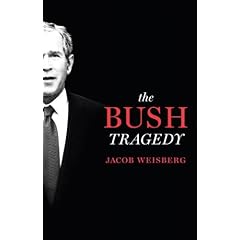
Once more into the breach. McClellan is not looking at the Bush frat house culture from the outside, of course. He's a disillusioned frat brother himself. For an outsider's look at the Bush White House, one should consider the best book on the Bush presidency to appear so far, Jacob Weisberg's The Bush Tragedy. Weisberg uses an analogy (not original with him) of Bush Jr. and Prince Harry as portrayed in Shakespeare's Henry IV Part 2. After the riotous and misspent youth depicted in the earlier play, Harry undergoes a dramatic change. The later Henry V portrays a serious, transformed, and deeply religious Harry as king, determined to reclaim the French throne, reviving the Hundred Years War between England and France that his father had put on hold.

Weisberg's analogy is strained in places, but it's still a striking parallel, especially the Oedipal angle. In Bush's case, it helps to understand why the rest of Bush's foreign policy has been more conventional: when it comes to foreign trade, Yugoslavia, North Korea, or any other foreign issue you care to name, it's hard to find such distorted and delusional thinking in the Bush policies. In the genesis and first few years of the Iraq war, we're getting to the heart of something unusual in democratic politics, an intense bout of blind belief. For Bush, the neoconservative theories became objects, not of thought, but faith.

The American weakness for moralistic crusades. Such episodes are not new in American politics: its soul is still that of a Protestant church. In the Civil War, we had a president who had mastered these forces to the point where he was not dominated by them, even as they animated millions of Americans in the crusade to crush the South. The disillusioned generation that fought World War One is better case for us today to look to. In the last extended presidential episode of blind belief, Woodrow Wilson the crusader rallied Americans to launch "making the world safe for democracy." With cooler heads and more detached eyes, he and his aides might have steered the peace in the direction of successful new alliances to rebuild Europe and contain Germany. Instead, Wilson overpersonalized the issues, thought of himself as a messianic figure, and failed to give Americans a stake in the long-term success of his policy. As a result, Americans became jaded in the 1920s and, later in the 1930s, turned xenophobic. It took another, much larger, war to resolve what remained unresolved.

Worst president ever? Wars of choice are especially dangerous for any political leader. Wars of necessity, even though they also provoke dissent, tend to focus the mind and keep people from drifting off into strange ideas. In American history, these include the War of Independence, the War of 1812, the Civil War, World War II, and the Korean and Afghan Wars. Wars of choice include the Mexican war, the Spanish-American war, World War I, and the Vietnam and Iraq wars. The latter form a very mixed bag: brilliantly successful (Mexican war), success-almost-disaster-success (Spanish-American war, including its Philippine sequel), ambiguous success with ultimately very bad consequences (World War I), and just plain bad (Vietnam and Iraq).

Given this list, it's hard to justify to condemning Bush as the worst president in American history. Nonetheless, my guess is that Bush will end up on the short list of the worst ten, and not just because of the Iraq war. There is also the mistaken domestic policy change, into new, large, and gratuitous spending commitments and regulations that have undone the healthier evolution American politics had been following in the 80s and 90s.††

Pace the neocons, Bush is not Truman. The 9/11 attacks were handed to Bush, as the Korean war was handed to Truman. But the Iraq war was a war of choice, dubious in conception and profoundly botched in execution. Personal character is the real difference: while reasonably intelligent, Bush is lazy and dogmatic, hyperactive yet strangely passive, insecure and uncertain about taking responsibility for anything. Thankfully, his character flaws are not in Nixon territory; he lacks Nixon's paranoia and cynicism.

But Bush, in spite of his attempt to fashion a populist self-image, is not a hayseed, ordinary folks, or even a cowboy. He's the dried-out, eldest son of wealthy parents, a rich kid - not a self-taught and self-made, essentially 19th century, figure like Truman. Even if his bank accounts have done well, Bush is a spiritual slacker, a downwardly mobile figure of the Baby Boom, who reinvented himself as a populist chieftan, sounding on good days like a cartoon superhero in his own comic book. Looking to the future, we must, if nothing else, avoid electing as presidents half-formed politicians who wrestle with serious personal and political deficiencies while they occupy the world's most powerful office.
---
* Unfortunately, there are still people in the media still trying to flog this dead horse, holding out for some substantive role by "Scooter" Libby, Dick Cheney, or Karl Rove in the outing of Plame. We've known for a year that it was Richard Armitage of the State Department who did that, probably inadvertently. As for Joe Wilson, he outed himself. There's really nothing left to this story. But its continued life shows how much of our "news" now consists of manufactured pseudo-events and pseudo-scandals, salacious pseudo-crimes parlayed into lucrative book contracts. Counterfactual "reporting" - even contradicting what the news media itself reported last year - is now the norm on this, like so many other, non-stories.

Such is the biased and incorrigible stupidity of America's media culture.

** A few prescient exceptions apart, like Steve Emerson, Michael Ledeen, and Daniel Pipes. And then there was Gary Condit - remember him from those hot, dry summer days just before 9/11?

† So much so that, after 1991, Israel's main security focus became Iran, quite rightly. Apparently, no one told Wolfowitz or Feith.

Another important question about the Bush presidency is, why did people with previously reasonable public careers (Rumsfeld, Rice, Powell, even Cheney) behave as strangely as they did under Bush? The 9/11 attacks clearly had something to do with it, but they're not the whole story.

†† Someday, once the partisan hysteria dies down, people will view the 80s and 90s correctly, from Carter's last year through the last year of Clinton's second term, as a single political era. Between 1998 and 2001, something changed.

Labels: , , , , , , , , , , , ,

Friday, May 16, 2008

The New Deal reconsidered: Reforming the welfare state

A few postings ago, I alluded to the approaching crisis of the welfare state. If it is to survive in some form and not bankrupt the federal government and create the largest economic and political crisis since the Great Depression, we need to start now to negotiate the critical choices. The Republicans had their chance to get the ball rolling in the 1990s, but (welfare reform apart) threw away their opportunity, then headed off in a very different direction after 1998. The result was a strange parody of liberalism, the Republicans' attempt to create their own version of vote-buying on a national scale with two new middle-class entitlements, in education and health care. A latter-day version of Nixonism, it worked for a few years, but has now lost credibility and heightened the federal government's burden.

It's not as if the problem is new. A spate of books published in the 90s (books by Jonathan Rauch, David Frum, Robert Samuelson, and Alice Rivlin) and, more recently, histories (like those of Goldberg and Shlaes) and policy briefs (like Bruce Bartlett, George Shultz, Charles Murray, and Cass Sunstein's) have mapped out the problem from different points of view. Previous crisis points, in the late 30s and late 70s, have periodically reminded Americans of the question: what to do about this behemoth born in the 1930s and periodically threatening to devour us with its ravenous demands for money and authority?

But the political context is different now. The imperial presidency is a greatly shrunken institution. Keynesian theories of inadequate demand, the business cycle, and "fine-tuning" have been discredited and replaced by newer versions of classical, neoclassical, and monetarist theories. We live today with a government that is fat but weak, unable to say no, tied down by an army of pressure groups jockeying to grab a piece of government power and impose narrow agendas at the expense of everyone else, proliferating and inconsistent laws, and politically-driven litigation. We lack powerful parties or executive leaders who can decisively steer or shape it. The last president to try was Reagan, with only modest success. Equilibrium, as in Clinton's second term, is only the accidental product of partisan stalemate.

Too much of the politics of the West, especially in Europe, but here as well, takes this behemoth for granted as an eternal presence that has always been with us. But it is not so. The welfare state in Europe dates from the 1880s; in the US, at the federal level, from the 1930s, although its seeds were planted earlier. From the start, observers could see the contradiction between claiming to represent the public good, while in actuality helping self-serving interest groups at the larger public expense. After the totalitarian era passed, the war ended, and the New Deal coalition broke down, the danger of greedy interest groups became all the stronger. Added to this were new, long-term dangers, especially the demographic danger, as the postwar Baby Boom gave way to bust, of not being able to afford the extravagant promises. Something less all-encompassing, yet still noxious, the fantasy of "fine-tuning" the economy through a mix of taxation, monetary policy, and subsidy led to stagflation - and later, in the 1990s and '00s, to a surge of asset bubbles and exploding public sector costs, especially in health care and education.

Reforming the welfare state to the degree that will be necessary in the next 10 to 15 years will require leaders nearly as powerful as those who originally created it. The once-powerful parties and presidency have lost their authority, but the large, intrusive, and expensive government they created is still with us. Every governmental transfer program creates a class of beneficiaries and intermediaries who immediately become vested interest groups. Without strong political parties or presidents to keep them in check, these groups become the real controllers (or at least veto powers) of politics. And these veto powers in turn have made it almost impossible for liberals to later change the programs or conservatives to later dismantle them. Our politics needs serious reform as well, to free our electoral system from its current nightmare of suppressed free speech and media tyranny.

It's all about you and me. The welfare state is sometimes confused with "helping the poor," but at the federal level, this is not its main role. For that, I'll direct you over here instead. Briefly, the negative income tax for the working and able-bodied poor would be better than the current system. While the 1996 welfare reform was a remarkable success, more could be done in that direction. But the federal spending on the poor is a fraction of federal spending on the middle and working classes. That's what "welfare state" means here.

The middle class welfare state consists of four functions. The first two are mainly "entitlements," meaning that citizens can receive their benefits by meeting certain eligibility requirements and nothing else. The original programs were passed earlier, but their present form (with automatic spending and without discretionary choices by Congress) dates to the Nixon years.

Social insurance - that is, Social Security and Medicare. The former will need reform by the end of the next decade to avoid bankruptcy; the latter is in even more dire shape and will need it sooner. The minimal reforms needed are not drastic: they include a mix of changing eligibility requirements and means testing (concentrating full benefits on beneficiaries with lower incomes). To go beyond that is less a necessity and more ideological preference, but larger redesigns are worth discussing. The main favor we can do for future generations is, to the extent possible, make these programs self-financing through forced saving, rather than transferring from present taxpayers to present retirees, which is what they do now. These programs are an incredibly bad deal for younger workers and immigrants.

The subsidy-loan guarantee state, which has caused growing mischief of all sorts and has few justifications in a society as wealthy as ours. It covers everything from pushing home ownership on people who can't afford it to exploding higher education costs to destructive ethanol subsidies. The federal government's role as lender of last resort and backer of otherwise private-sector loans opens it up to dangerous vulnerabilities, as well as encouraging what economists call "moral hazard" - beneficiaries taking excessive risks because they know someone will bail them out.

The regulatory-litigation state, which was originally more modest and with strong justification, for example, in the financial sector.* This federal function has become more and more twisted over the years by judicial passivity in the face of an aggressive trial bar. Tort reform is one answer here, including requiring judges to take a more active role and not defer to the lawyers. The role of Congress and regulatory agencies has been twisted in a different way, by the formation of the "iron triangle" of interest groups, the media, and politicians. Only stronger political parties and presidents not in thrall to the news media can enable positive change here.

The pork barrel state, perhaps the most characteristic feature of the welfare state in its mature phase. This is the system of special favors, earmarks, and patronage pioneered mainly by Democrats, but recently imitated and taken to new levels by Republicans. This development is often misunderstood as a result of private parties (interest groups, corporations, etc.) "buying" politicians. In fact, it's the politicians who typically take the initiative in creating these relationships in the first place. Remember: each such special favor granted to this group or that, makes a vested interest out of that group. Subsequent politicians are only occasionally able to buck these groups, once they're created.**

The tragedy of modern America is that the ideas and tools needed for this reform are not missing. Voters are in many ways well ahead of the politicians, their obnoxious handlers and advisors, and the news media complex they've enslaved themselves to (our age's equivalent of court scribblers and flunkies). Voters have seen through - very through - the politicians' empty promises. We lack education and wisdom, even as we drown in a torrent of often irrelevant or twisted "information." Real history and real intellectuals are what's needed to bring out Americans' latent skepticism about government and politicians and turn it into real understanding and real change. Not only do we need to abandon false ideals like equality of condition, but even half-truths like equality of opportunity. While it's an improvement, no modern society can guarantee the latter (much less the former) and remain modern. What is reasonable to expect is freedom of opportunity, and it is here that modern liberalism has left a positive mark, in lifting inherited and often arbitrary prejudices about what people in stigmatized groups are capable of. Traditionally, what such people suffered from was not exploitation, but barriers to full participation in society, and we should be grateful for what liberalism, in its heyday, was able to accomplish here. If the much-abused phrase "social justice" means anything, it means that.

Some final thoughts. The federal budget today is largely entitlements (more than two-thirds), which continue to grow in absolute terms and in proportion to the whole. There's still a lot of confusion about this, as well as mythology about the size of the military budget, which is smaller as a proportional of national income than it has been since 1940.

The main damage done by Bush is this: while early on, it was recession and tax cuts that led to renewed deficits, and the deficit situation improved once the economy started to expand again in 2002, the problem has more recently morphed into a structural spending-driven condition and will become steadily worse in the coming decade. Apart from Reagan and the Fed's singular achievement of taming inflation, the most important achievement of the 20-year period from 1979 to 1999 was what did not happen: no major new domestic spending commitments; a large step up in military spending, followed by an even larger drop after 1986; and very favorable conditions from 1994 to 2000, with a conservative Congress and a president unable and ultimately unwilling to push for more. The real disaster after 2000 was the almost total disappearance of influential conservatives at the national level, and partisan lock-step between Congress and the White House on spending. Even now, not many people have really absorbed the enormity of what went wrong under Bush - Republicans often don't get it, and everyone else is still talking about Bush as "right-wing" or "conservative." This mind-set has to end if we are to see clearly what went wrong and why, where we're headed, and what needs to be done.

Politically, it means that, while few conservatives are available, we will have to make do with liberal Republicans and conservative and moderate Democrats. They're the few at the national level who might see what's gone wrong and galvanize the public's skepticism about government. Obama and Clinton have little credibility here. McCain does have some personal credibility - but his party, no longer.
---
* A benefit of the New Deal was the creation of a truly national banking and financial regulatory system, as Hamilton foresaw would be needed and Jefferson resisted.

** To get a sense of the pretense and folly of "progressive" politics these days, here's an example of what it really means. And let's not forget Massachusetts, which long ago moved from nuts-and-bolts government to bloated "big thinking" (or "big digging").

Labels: , , , , , , , ,

Friday, May 02, 2008

The coming fall of PCU*

It is one thing to wish to have truth on our side, and another to wish sincerely to be on the side of truth.

- Richard Whately, Archbishop of Dublin

In the last generation, something terrible has gone wrong with American colleges and universities. They've become grotesquely overpriced, anti-intellectual, and increasingly repressive backwaters. Outsiders looking in can see it, and, remarkably, so can a growing number of insiders. Outsider Michael Barone:
I am old enough to remember when America's colleges and universities seemed to be the most open-minded and intellectually rigorous institutions in our society. Today, something very much like the opposite is true: America's colleges and universities have become, and have been for some decades, the most closed-minded and intellectually dishonest institutions in our society.
Barone points out that there's no reason why taxpayers, trustees, parents, and students have to continue supporting this. It's unlikely they will continue for much longer. And for its insiders, academia has become a gilded cage, locking up its brightest minds in narrow, obscure corners and conditioning them on a steady diet of the Three Cs: conformism, credentialism, and careerism. William Stuntz of Harvard Law School said it a couple years ago, after the Larry Summers fracas, when he declared Harvard the "General Motors of academia":
... rich, bureaucratic, and confident - a deadly combination. Fifty years from now, Larry Summers's resignation will be known as the moment when Harvard embraced GM's fate.
Political correctness isn't the whole problem, but it is a large part of it. Universities, especially the elite ones, no longer know what to do with their undergraduates. They used to have something called "liberal education," but that has disappeared:
The humanities have destroyed themselves over the past 30 years…. Through an obsession with European jargon and a shallow politicization of discourse, the humanities have imploded…. There’s hardly a campus you can name where the most exciting things that are happening on campus are coming from the humanities departments…. I think the entire profession is in withdrawal at the moment. (Camille Paglia)
I hope people don't think P.C. was just some early 90s fad, like grunge. It's institutionalized - that was the whole point: a generation of tenured intellectual corruption. Along the way the P.C. faculty pressured the non-P.C. to leave or retire and made sure younger non-P.C. faculty weren't hired. They continue to use superficially liberal language for profoundly illiberal ends - it's called "postmodernism," and there's nothing liberal about it. As in 1968, they don't believe in truth or reason; they believe in the fist.


The intellectual origins of this debacle lie in the prestigious 19th century German academia, as Allan Bloom tried to communicate in his prickly classic The Closing of the American Mind, published in 1986, just before the rise of P.C. Occasionally, brave thinkers, such as South African Nobel literature laureate Doris Lessing, will press home the same point. Like Bloom, but coming from a different political direction, she put her finger on the origins of "political correctness":
...the pedantries and verbosity of Communism had their roots in German academia. And now that has become a kind of mildew blighting the whole world.
It's a sad legacy for the great German Enlightenment thinkers, Kant and Hegel. Their style set the stage for later mystagogues and obscurantists to peddle banalities or poisonous nonsense with profound-sounding mumbo-jumbo. Their modern avatar is Heidegger.

We're still suffering the consequences, which came about demographically by the rise of the Boomers to positions of authority in academic institutions. Remember this is the generation that 40 years ago rejected facts-as-such and independent truth. Paul Goodman, one of the best of the 60s radical thinkers (anarchist, founder of gestalt therapy, two generations older than the Boomers), discovered the hard truth about America's Worst Generation in a late 1969 graduate seminar on professionalism:
Didn't every society, however just, require experts? ... [No, his students insisted.] ... Suddenly, I realized that they did not really believe that there was a nature of things. Somehow all functions could be reduced to interpersonal relations and power. There was no knowledge, but only the sociology of knowledge .... they did not believe there was such a thing as the simple truth. To be required to learn something was a trap by which the young were put down and co-opted. Then I knew that I could not get through to them. I had imagined that the world-wide student protest had to do with changing political and moral institutions, to which I was sympathetic, but I now saw that we had to do with a religious crisis of the magnitude of the Reformation in the fifteen hundreds, when not only all institutions but all learning had been corrupted by the Whore of Babylon [the Church].
This is not a generation that can "speak truth to power" - quite the contrary. Political correctness is all about speaking power to truth.**

The most blatant abuses of this type occur when particular individuals are targeted by militant faculty out to "make examples" of designated hate objects. The Larry Summers affair was one. (See here and here.) Another, far worse, was the false case against the Duke lacrosse team, where academic intolerance merged with prosecutorial abuse and media hysteria. We've met the abusive prosecutor before in, for example, the "Scooter" Libby case. And the media: it can't run, it seems, on anything but fake "narrative" expressly built to demonize its targets. It's extravagant spectacle, never mind the facts.***


The problem is not faculty tenure, which American universities and colleges have had since the 1920s and 30s. That privilege was originally balanced off of a small set of powerful administrators who could get things done, while letting faculty go about their teaching and research business. Powerful administrator presence also deterred the worst tendencies of the worst faculty. After academic administrators lost their authority in the 1960s and 70s, concentrated power and responsibility were diffused into "faculty self-governance." Since most faculty are busy with teaching and research, a power vacuum opened up, one filled by the small but vocal and aggressive minority of irresponsible faculty who, more and more, wield veto power over departmental and college decisions and are invariably at the center of eruptions of identity politics and P.C. Contrary to an old misimpression left from the 1960s, it's generally not students, who are in any case too transient a population to do sustained damage to universities.


Political correctness blends with other university trends to produce something beyond just simple closed-mindedness and petty dogmatism. Universities are also big businesses, for-profit in all but name, yet not run the way normal businesses are run to keep costs and waste under control. Instead, being heavily subsidized with little oversight, they're run as "cost-plus" institutions that pass on costs to everyone else, because they can get away with it. Much of higher ed is simply a racket.

Curiously, it's generally not faculty who benefit. While older, tenured faculty have done well in the last 40 years, younger faculty hired since the 1980s are doing much more poorly. They are not only less likely to get tenure, they're increasingly hired off the tenure track; instead, they end up as adjunct or part-time faculty.

You then might wonder what is driving costs up. The answer is found in university budgets: it's "other" - everything else not connected with the university's business of knowledge. It includes vastly expanded student services and athletic departments (which, contrary to myth, rarely make money for their schools). Above all, rising costs are driven by massive growth in administration. As once-powerful academic administrators have lost authority, they have compensated by hiring armies of underlings. Top administrators, in any case, no longer do as much administering as they once did; their jobs have been redefined as money-chasing.

Here's Marty Nemko in the Chronicle of Higher Education:

Colleges should be held at least as accountable as tire companies are. When some Firestone tires were believed to be defective, government investigations, combined with news-media scrutiny, led to higher tire-safety standards. Yet year after year, colleges and universities turn out millions of defective products: students who drop out or graduate with far too little benefit for the time and money spent. Not only do colleges escape punishment, but they are rewarded with taxpayer-financed student grants and loans, which allow them to raise their tuitions even more.

I ask colleges to do no more than tire manufacturers are required to do.
The American Association of University Professors (AAUP) has attempted to counter the mounting criticism with a lame and beside-the-point statement that evades the real issue and astonishingly implies a blank check to universities and doctrinal infallibility to their faculties, with everyone else footing the bill. Conservative critics are saying it (see here and here), but remarkably, even liberal academics are too (here and here). Taxpayers, parents, and alumni continue to pay to be abused in this way. But there's no reason for them to, and I predict that postmodern academia has no more than a decade of life left.

Academia was originally granted its special privileges and status, along with bucketloads of money, to serve a bundle of larger purposes connected with knowledge. It has drifted far from that mandate. Until a few years ago, we might have held hope that universities and colleges could be reformed from within. But the Larry Summers case, more than any other, showed that sympathetic liberal insiders can't pull it off. Summers was the last of his kind. Change will come, but the reformers will not be liberal, sympathetic, or insiders. As Harvard's Stuntz put it, academia, and in fact, America's whole liberal elite, including its fake aristocracy of celebrity, feels a lot like the French aristocracy before 1789, although without the latter's powerful residue of taste and refinement. But for now, it's 1786 - say - and life's good.

POSTSCRIPT: Hat tips to the terrific blogs out there kept by academics, especially those of Ann Althouse, Glenn Reynolds (Instapundit), and Eugene Volokh (The Volokh Conspiracy).
---
* Politically Correct University, like the movie :)

** Here's another striking example, one of many, from the crazy anthropology department at Columbia/Barnard, an incorrigible center of the rot of "Middle East studies." After reading this, my first reaction was, why didn't Reinharz and other liberals like her raise these objections to the wave of P.C. and postmodernism when it started 20 years ago? Columbia is the same place Ahmadinejad got his fawning reception.

*** There's a rich online and print literature on the Duke travesty, starting with Johnson and Taylor's Until Proven Innocent and the Durham-in-Wonderland blog. Check out these items, from the New Yorker and Harvard's George Borjas, as well this review. (The link above goes to the Economist's review.) The concentrated essence of PCU is all there in one ugly case.

Labels: , , , ,