Saturday, September 27, 2008

What is to be done?

UPDATE: The post below was composed on Friday and Saturday, so the news is a little outdated.

The distinction I made is parallel to the distinction Virginia Postrel makes in her recent post between the "illiquid" (the immediate credit crunch, the unwillingness of lenders to lend) and the "insolvent" (the narrower and longer-term problem of serious restructuring or bankruptcy, caused by mortgage loans not performing or in default). She also makes the wonderful suggestion that any net profit Treasury makes on federal intervention should be rebated directly to taxpayers.
---
The Paulson-Bernanke proposal for a financial sector bailout still seems to be floundering in Washington. The House Republicans, at last report, are still split on the idea, and without a united front from them, the Democrats are not willing to jump in alone.

For a moment, set aside the economics of the proposal and focus on the politics. The Congressional Republicans suffered in the 2006 elections from the perception that they had completely lost it on restraining federal spending. They had also spent six years in partisan lockstep with Bush on spending, expanding government, and the Iraq war. Enough conservative and independent voters got pissed off by the Republican abandonment of anything resembling conservative policies that many just stayed home or, in some cases, voted Democratic. The Republicans lost control of Congress.

That painful lesson floats in the background now as the House Republicans struggle with the question of whether to support the plan. Some support it because they think it's a good idea, and others oppose because they think it's bad. What hangs in the balance is how much Bush can call on simple partisan and personal loyalty. He lacks the automatic Republican support he enjoyed in his first term, and thus we see a political cliffhanger.


Now turn back to the economics of the plan. Paulson and Bernanke got themselves in some trouble because they failed to explain the situation and their proposal completely enough.

Some of the problem is everyone's ignorance about when and where the housing market will bottom. That event will be crucial in determining the final, diminished values of the assets that back the financial paper (bonds and other credit instruments) that many now suddenly mistrust. Those values in turn will determine the ultimate losses that lending institutions, depositors, and bondholders will face. Many will just have a bad day; a subset will suffer large losses; a subset of that subset will go bankrupt. No one knows the full scope yet. Yesterday's Washington Mutual failure threw some more paint on the canvas and filled in another part of the still-incomplete picture.

Paulson and Bernanke are also wrestling with a crisis that has two very distinct parts, subcrises with different origins, time horizons, and consequences. Their plan addresses both at once, which was probably a mistake, and thus evokes a lot of skepticism.

There's a large advantage to separating these two parts. Part two will take a few years to fully work out and make sure that the government is not overpaying for distressed assets. No one can make those judgments now -- it's too early. At the same time, part one can address the credit crisis right away, but through short-term loans, not buying up assets.

Part one, the credit market crisis, is immediate and needs to be confronted quickly. Failure here would cause severe economic problems, as short-term credit acts as quasi-money for businesses, government, and individuals. If banks and other lenders suddenly decide all at once to stop lending, we will have something like the Great Depression on our hands. The Fed is already acting as it should to prevent this, keeping low the interest rates it controls (federal discount and interbank overnight). It also injects cash by buying up Treasury and government agency bonds and exchanges longer-term bonds for shorter-term. All act to keep the money supply flowing, or "liquid," as economists say.*

But it might prove necessary to do more with the credit crisis than the Fed, under its normal rules, can do. The New York Federal Reserve's AIG loan is the model to follow. It's a relatively short loan (twenty-four months) and, during its term, gives the Treasury some say in how AIG is run. The Treasury, by charging AIG interest, is also forcing AIG to pay for the privilege of rescue.** Such an approach is about preventing a short-term credit crisis, nothing else. It should be ad hoc and address serious dangers quickly as they arise with time-limited rescues. It's not about the collapse of underlying asset values (houses, mainly).

Dealing with that collapse is part two of the crisis, where we have to think in terms of a few years or even a decade, not weeks or months. The model should be the Resolution Trust Corporation that dealt with the savings and loan bust of the early 90s. Here's where the RTC-like agency collects distressed assets in a kind of giant fire sale.† It then resells them, not immediately, but over a period of time, to get better prices and not glut the market for those assets all at once. The RTC worked well in the end, costing taxpayers only about $100 billion.†† The initial cost seemed much higher, because the RTC was in buying mode at first. But in resale mode later on, it recouped most of its gross costs. It worked because it spread out the impact of the S&L bust over a number of years, preventing the cost from being felt all at once.
---
* Bernanke has a strong interest in the Great Depression, when banks failed in large numbers, as the Fed kept pursuing the exactly wrong policy. In effect, it hoarded gold (the dollar was backed by gold in those days) and starved its member banks.

The Federal Reserve is actually not part of the government. It's a publicly chartered, non-commercial private entity that regulates the money supply, which includes not just cash, but various forms of credit and foreign exchange. It's a "bank of banks," which federally chartered banks are required to join and contribute to. Other banks can join too, if they want.

Recently, proposals have been floated to allow non-bank entities (insurance companies like AIG, for example) to join. They would get the help the Fed can provide in a crisis, but they would also have to pony up some of their assets in exchange and accept a higher level of regulation.

** From the government and taxpayer point of view, a loan is better than a guarantee. It makes AIG's assets collateral in case of default. The conditions are more spelled out than a guarantee usually is, and the term is limited in time. Someday, people will thank Paulson and Bernanke for this.

† By themselves, assets are not "distressed." They become so when a loan or some other financial obligation is attached to them that assumes a value well above what they can actually be sold for. Selling the asset raises some cash, but not enough to fully cover the attached obligations.

†† I know, I know - "only" :)

Labels: , , , , , , , ,

Wednesday, September 03, 2008

None of the above

It's been a significant trend that has frustrated Republican efforts to become the majority party: since the late 90s, a significant number of voters who used to vote Republican for fiscal and/or national security reasons have become turned off. Some of them (at least in 2004 and 2006) voted Democratic. But most are abstaining from voting for any major-party candidate in general elections. Discrepancies in vote tallies in 2000 and 2004 between congressional and presidential votes seem to reflect this, as did the Ron Paul candidacy. Whether McCain can overcome this trend in 2008 remains to be seen.

But this year, I'm detecting something similar happening to Democrats. (See here and here, for example.) Obama's failure to win a majority of the Democratic primary vote has set the Democrats up for trouble. Some of these voters will vote for McCain; others will just abstain. The 2008 general election will thus feature two growing blocs of the disaffected, adding a multidimensional wild card to the outcome.

Labels: , , , ,

Sunday, June 15, 2008

Iraq, five years later

What people, including historians, in the future will think about the Iraq war is anyone's guess. The answer will depend in part on events that have not yet happened and things we cannot now know. But it has been more than five years since the US-led invasion of Iraq, and the operation seems to be coming to a conclusion. US troop levels will start dropping even before the election and drop faster afterwards.

The most important thing about the Iraq war is not how it started, but how it is ending, with the so-called "surge" that started late last summer - essentially, concentrating a large number of the best combat troops in and around Baghdad. It reflects classical counterinsurgency doctrine, with its origins in previous wars (El Salvador, Vietnam, Algeria, Philippines, etc.) only dimly remembered by most today, but carefully studied by the military. However, the "surge" only became a reality after the Republican defeat in the 2006 elections and Bush's relinquishing of operational control of the war. Instead, a civilian, Defense Secretary Gates, and a military officer, General Petraeus, were put in charge, with the civilian as the senior partner, the optimal approach. At the urging of the military and members of Congress (including McCain), Bush was forced to accept the policy, having nowhere else to go. His dogmatism and incompetence had left him in a deadend.

The surge has led to two large positive results: a sharp decline in violence and the decisive defeat of al Qa'eda in Iraq, reflective of its apparent larger disintegration. (See the articles by Lawrence Wright in the New Yorker and Peter Bergen and Paul Cruickshank in the New Republic.) Al Qa'eda's mistake was the most obvious one that can be made by any guerrilla movement or insurgency, choosing or being forced to fight an organized professional army in the open. Contrary to widespread myth, no guerrilla movement alone has ever won a war, and such movements cannot survive a direct fight with an army.

But the US has also had a large bit of luck here. To be defeated, an insurgency has to lose its cover among the civilian population, while the civilian population has to feel that casting its lot with the counterinsurgency is the lesser risk. In 2004, 2005, and 2006, al Qa'eda seemed on the way to winning in Iraq, because they had cover among Iraq's suddenly powerless and angry Sunnis. But al Qa'eda made the fatal mistake of imposing its harsh version of Islam on those Sunnis, who then turned on them in 2007 and 2008. Al Qa'eda had nowhere to run. It's a scenario that has played out before in the Arab and Muslim worlds: a population attracted to a radical Islamic movement, only to be totally alienated by it. Al Qa'eda took the lives of about 50,000 of their fellow Muslims to prove this, again.*

All of which demonstrates a perennial truth about war: it often ends in a place far from where it started.

The price of the surge. Like any such sudden turnaround, the success of the surge has come at price. There's the large amount of cash (bribes, essentially) doled out to Sunni tribal chiefs to cement their shaky loyalty to the Baghdad government. The US is now following a policy of no interference in purely internal Iraqi conflicts, which means that such conflicts and the mix of corruption and violence surrounding them evolve in their own way, without American attempts to shape them, so long as they do not become connected with jihadis.

Those changes reflect a larger change in American policy, the de facto abandonment of the democratization strategy. This policy lies in tatters elsewhere in any case, by the very forces that the Bush policy never came to grips with: jihadis from Iran, Pakistan, and Saudi Arabia; the persistence of powerful tribal-sectarian divisions in the Middle East; and the sharp rise in the price of oil, which provides these forces with more material resources.** Restoration of democratic sovereignty has failed in Lebanon, thanks to Syria and Iran. Where elections do occur, they fragment populations into religious and tribal shards and open the way for jihadist groups. These forces threaten the democratically elected governments currently in charge in both Baghdad and Kabul, which could not survive in their present form without the presence of Western (mainly American) troops.

Military transformation collides with nation building. By making do with the troops available, rather than vainly wishing for the much larger number needed for a traditional occupation and "nation-building" effort, the "surge" has reasserted a more conservative and realist conception of military force and succeeded in making lemonade from lemons.

But why the lemons to begin with? The immediate cause was the push for "military transformation" which began after the Cold War and entered a heightened phase under former Defense Secretary Rumsfeld in 2001. The essence of "military transformation" was to continue to shrink US troop levels, while improving their ability to fight hi-tech conventional wars against other states. The idea is to be ready to fight another army - as in Korea or World War II - but with the newest technology, moving the US forces even further in the direction of an agile, light force capable of defeating conventional enemies quickly, but even less able to act as an occupation and nation-building force. The quick defeat of the Iraqi army in the spring of 2003 demonstrated "military transformation" perfectly. It was a faster, cheaper, and less deadly version of the 1991 Gulf war.

But that was merely three or four weeks, of toppling Saddam, out of more than five years, of "now what?" The Rumsfeld doctrine of military transformation has been harshly criticized by both neocons and liberals as sacrificing "boots-on-the-ground" in favor of a shiny, hi-tech military future. Rumsfeld, like Colin Powell, was shaped by the Vietnam era and the rejection by American society in general, and the officer class in particular, of "nation building." Following this powerful prejudice of senior American military officers, its forces are prepared and equipped for wars only, in the narrow sense, like the 1991 war. The failure of preparation for a post-Saddam Iraq led to a spectacular collision of the military transformation doctrine with the reality of occupation and has put unprecedented strain on the American army.† Given that Rumsfeld was completely out of tune with what would be needed in Iraq, it's surprising he stayed as long as he did. He was originally opposed to the war and tried to resign at the end of 2003 and again in the spring of 2004. But Bush leaned hard to keep him from leaving. Here we get to another difficult puzzle, the strange effect of Bush's obsession with loyalty on the people around him.

The failure to foresee what post-Saddam Iraq would look like is at the heart of the depressing story told by the best books on the 2003-07 period. They include George Packer's The Assassin's Gate, Larry Diamond's Squandered Victory, Thomas Ricks' Fiasco, Bing West's No True Glory, and Ali Allawi's The Occupation of Iraq: Winning the War, Losing the Peace. Where a realistic guess of a post-Saddam Iraq should have been was a void, eventually filled by Bush and White House staff with wishful thinking of the neoconservative type.

The neoconservative failure. Fallacious neocon theories about democratization and the Middle East are the core of the failed Bush policy. Similar intelligence was available to both Clinton in 1998 and Bush in 2002 about Saddam's weapons programs and stockpiles. One difference in 2002 was, obviously, that the 9/11 attacks greatly raised the stakes. Bush determined to prevent future attacks, not just respond to them. But the injection of neocon theorizing also made a decisive difference, because it transformed a narrow debate about terrorism and unconventional weapons into a fuzzier and open-ended fantasy of regional and political transformation. This thinking could have been taken seriously by someone who thought that the Middle East as a whole and Iraq in particular were like eastern Europe or Latin America in the 1980s, or Germany and Japan in 1945. Only conservative and libertarian critics and skeptics strongly objected to this once-liberal, now-neocon "well-intentioned" and "fuzzy-minded" thinking. (See here, here, and here for George Will's corrosive skepticism and steely-eyed, classic foreign policy realism.) But such criticism had little influence: the Republican party, led by Bush, had rearranged itself to exclude precisely such objections. Centrists and liberals took the ideas for granted with no coherent answer to the neocon theories. The far left became consumed with its own kooky counterreality of "American empire" and "Bushitler."

In this verbal snapshot, Bing West described the state of Basra at the start of the invasion:
In March 2003, I accompanied the Marine battalion and British engineers who seized the pumping station just north of Basra that facilitated a multibillion-dollar flow of oil. The engineers were appalled to find open cesspools, rusted valves, sputtering turbines, and other vital equipment deteriorating into junk. Heaps of garbage lay outside the walls of nearby houses. Yet inside the courtyards, tiny patches of grass were as well tended as putting greens. That defined Iraq: a generation of tyrannical greed had taught Iraqis to look out for their own, to enrich their families, and to avoid any communal activity that attracted attention.
It's not the sort of thing that can be changed with the snap of the fingers. This is a larger failure of "intelligence" than just misjudging the scope of Saddam's WMD programs (which were real, if small) and the size of his stockpiles (which were non-existent).

The intelligence failure. The continued obsession with WMD distracts most people from seeing this truth. The fact is, if Saddam had had such weapons or a large weapons program, the long-term results of the Iraq occupation would not have differed except in details. Al Qa'eda would still have itched to turn Iraq into a showdown. The gross inadequacy of the number and type of troops deployed; the almost complete lack of planning for a post-Saddam Iraq; the radicalization of the Iraqi Sunnis, enraged by their loss of exclusive minority rule over Iraq - none of these would have been any different. The comprehensive failure of the Bush strategy for thinking beyond the first few weeks after the invasion and the apparent fantasy of the administration neocons - that Iraq would just snap into place as a functioning civil society - remain the grand mistakes of the Iraq war. After all, there were good reasons to think that, after ejecting weapons inspectors in August 1998, Saddam had restarted his weapons programs and produced some for use. He had used chemical weapons in the past.††

That's not to say that the intelligence failure isn't important. But its importance is not what Democratic politicians, having supported the war and now running for political cover, want you to believe. If the "Bush lied, people died" trope is a little too familiar as a cliché, consider the recently released Senate Intelligence Committee report on the pre-war Iraq intelligence situation. It mostly confirms what everyone already knows, or should know: not just the CIA, but virtually all foreign intelligence services believed that Iraq had restarted of its advanced weapons programs. There is a very serious problem here, but it's not with "Bush lied" - there's no evidence that he did. In fact, Bush and the people around him fervently believed in what they were saying, and there lies the real failure: they believed too much and too well.

Midnight at the oasis. A long-running deficiency has plagued American intelligence in the Middle East since the late 1970s. We used to be able to collect our own Middle East intelligence, largely thanks to the relatively free country of Lebanon, the Arab world's previous and failed democratic experiment. When the Lebanese civil war started in 1975 and Western diplomats and spies there started being kidnapped in the early 1980s, that venue vanished, and the US began to rely on proxies for intelligence: first the Shah, who fell in 1979; then Egypt, Saudi Arabia, and Jordan.‡ This is not to let the Bushies off the hook - a failure of such long standing, including the failures that let to 9/11 - should have been dragged out front and center in 2002 for thorough scrutiny. The problem is that changing this dependency would require a complete overhaul of US alliances and, even harder, the policies and interests controlling our relationships with Saudi Arabia and Egypt.

If there is a specific thread that keeps popping up again and again in this history, it is the long-term degeneration and failure of the CIA. This failure is evident from the recent Senate report, the Kay report on Iraq's weapons programs, the 9/11 Commission report, and the CIA's repeated public misjudgments of the Middle East. The "work" (if it can be called that) of former CIA people gone public (Michael Scheuer, Valerie Plame, Joe Wilson) makes it clear that the CIA's mindset is so far off base from what's needed that the agency is probably beyond saving. It should just be shut down: if "empty suit syndrome" means anything, the CIA is it.

This large and costly lesson about intelligence should never be forgotten: decisions of war and peace should be made only on public and obvious things. Intelligence has been used, both successfully and unsuccessfully, during wars. But decisions to step from peace to war, and from war to peace, should only be made on something more reliable than guesswork. It doesn't preclude military action in the future; it does preclude the doctrine of pre-emption, unless the threat is sitting on someone's lawn, so to speak. It means the end of the distinctive mix of mistaken neoconservative ideas that went into the Iraq war: connecting secular dictators with jihadi terrorists, "regime change" with poor prospects for functioning replacement governments, pre-emption based on intelligence trusted as more certain than it can ever be, the belief that Middle Eastern democratization improves American security in any but marginal and costly ways.

A moment of silence. It is far from the first time soldiers have died for the strategic mistakes of their leaders, far from the worst instance, and probably won't be the last. I know that's small consolation to those who lost relatives and friends in Iraq. The intervention does have positive achievements: the overthrow of a cruel dictator, and the crushing defeat and apparent dissolution of al Qa'eda outside its home territory.

But these have come at too high a cost and taken much too long. While falling apart elsewhere, al Qa'eda is regenerating on its home turf, the mountains of Afghanistan and Pakistan. Supposed allies like Pakistan and Saudi Arabia continue to play a thoroughly ambiguous game with radical Islamic groups in no way in keeping with Bush's famous "you're with us or you're against us." In the wake of the debacle of neoconservatism, the big strategic issues are again up for grabs. In our present hyperpartisan hysteria, there's little hope they will be addressed, at least while we live under the evil sway of the "permanent campaign."

POSTSCRIPT: Listen here for a podcast interview with Douglas Feith, about his book War and Decision, the Iraq war, and more. What Feith says and documents in his book, and also what he does not address, are as important as the books mentioned above.
---
* The civil war in Algeria, which led to the same result, ran for a decade after 1992 and took the lives of over 150,000. The Lebanese civil war (1975-1990, although it's never really ended) killed between 50,000 and 100,000. Iraq's 2003-08 civil war falls into the same class.

** Of course, it also provides them with more to fight over as well.

† An army of half a million would have been necessary to implement a traditional occupation, rather than the 150,000 deployed. To sustain that over time, with normal troop rotations, would have required a larger base of 2.5 million. Even the larger Cold War military of the 1980s, about 1.6 million and double the size of the post-Cold War military, could not have done it. The American military has not had an army that size since the earlier stages of the Vietnam war, when there was a draft. While most combat troops in Vietnam were volunteers, contrary to myth, draftees did free up volunteers to serve in combat roles.

†† Actually, the evidence is that Saddam thought he restarted his programs and had stockpiles - the people running these programs were evidently doing something else, like stashing money in European bank accounts - and his chemical weapons program ended up in Syria. It's not clear how much Saddam knew about his own regime. That's what dictatorships are like in their final stages. Think of the drug-addled Hitler in his bunker in the spring of 1945.

‡ Not accidentally, every president since Carter has had a misintelligence/misadvice-enabled Middle East folly. Carter had the fall of the Shah, the assassination of Sadat after the Camp David treaty, and the first US security guarantees to the Gulf kingdoms. Reagan had the Marines in Lebanon and the Iran part of the Iran-Contra affair. Bush Sr. had American troops in Saudi Arabia for the long term. Clinton had the Oslo process and not taking al Qae'da seriously (except briefly). Bush Jr. had not taking al Qae'da seriously (at first) and the Iraq war. The list of failures over thirty years is long and striking.

Labels: , , , , , , , , , ,

Wednesday, November 08, 2006

Where do we go from here?

In my last pre-election post, I bemoaned the political situation in the US as one party getting it wrong and the other not getting it at all. I didn't make any predictions, but the election results were more favorable to the Democrats than I expected. It looks as if they might control both houses (counting Lieberman as a Democrat). Expect two years of gridlock. (A better outcome would have been a Dem Senate and Rep House, but, oh well.) I think my mistaken view was based on concentraing too much on Bush and Iraq. This election was, of course, about Congress, not Bush, and voters have lots of good reasons to be very unhappy with the congressional Republicans. We also live in an era of rapid political cycling. What used to take years now takes months. But there are implications beyond Congress nonetheless.

There will be intense pressure on Bush to force Rumsfeld out and to leave Iraq as quickly as possible, by 2008 at the latest. (The Pentagon's original timetable for Iraq was to leave in 2008 anyway.) Iraq will move from a half-baked civil war to a fully-baked one, and Iran will effectively control the southern half of Iraq, to the extent that anyone controls it. It's been the case that American foreign policy since 9/11 has been strangely favorable to Iranian interests, and the Iranian government has been both riled up by American intervention in the region, but at the same time, liberated by the removal of two regimes (the Taliban and Saddam) that they viewed as threats. Even with the recent drops in oil prices, expect Iran to feel its oats as never before in the next 2-3 years, running up to the moment when they have functional nuclear weapons. The Iranians are likely not to use those weapons, but once they have them, expect a regional arms race. The Republicans will make big hay out these developments in 2008, especially after soldiers start returning from Iraq and embarass the Democrats. But the Republicans can't expect voters to give them a free pass on spectacular incompetence forever.

More generally, especially after 2008, expect a gradual American withdrawal from global commitments. The Democrats are still in the confused state of having no foreign policy and most of them still look back nostalgically on the post-1945 era of America leading willing allies. What they don't realize yet is that the post-1945 liberal internationalist era, with its institutions, processes, and so on, is dying, if not dead already. The US will be in less and less of position to prevent regional arms races, regional conflicts, and trade wars. American foreign policy is headed towards a much narrower construal of US interests. Democrats, once the party of foreign affairs, have largely lost interest in the rest of the world. The implication is that US allies will have to start figuring out their own futures and redeveloping their own military and foreign policies. Expect regional instability in east Asia, for example, a much lower profile for the US in the Middle East, and a polite American write-off of Europe. Unilateral Israeli action has already become more comon, with no imaginary pot-at-the-end-of-the-rainbow "peace process." The whole range of Middle East conflicts has now gone full circle back to being religious, not nationalistic. Few in the US really understand this yet, but we soon will.

The voter mood in the US hasn't suddenly become more liberal. The large number of conservative or "blue-dog" Democrats winning in this election indicates something else, roughly similar to the early 1990s. The voter mood is populist - anti-free-trade, anti-immigration, and suspicious of foreign policy involvements. The Republicans have stirred the expectations of populist voters, then disappointed or angered them. That's a sure way for politicians to get into trouble. Read what George Will has to say: The Iraq war, like the Alaska bridge, pungently proclaims how Republicans earned their rebuke. They are guilty of apostasy from conservative principles at home (frugality, limited government) and embrace of anti-conservative principles abroad (nation-building grandiosity pursued incompetently).

POSTSCRIPT: Rumsfeld has resigned. His apparent successor, Robert Gates, has a tough job ahead of him, pulling out American troops from a country with an accelerating civil war. Unlike Vietnam, the so-called (Sunni) "insurgency" will not win, but will be crushed by the Iranian-backed triumph of the Shi'ites. Within a couple years, Iraq will be three countries. American relations with key Sunni allies (Saudi Arabia, Jordan, Egypt) will be strained beyond anything seen before.

Expect darkness to reign in the Middle East for the next while, starting with another war in Lebanon, superficially against Israel, but in reality to break Lebanon for good. The same forces will be at work in Iraq.

Thoughts-in-parallel from Michael Totten.

Labels: , , , , , , , ,

Friday, November 03, 2006

The most depressing election ever

American politics has been getting more and more depressing since the late 1990s, with one serious but flawed party (the Republicans) abandoning its guiding ideas in favor of pork, vote-buying, and questionable foreign policy adventures; and the other, unserious party (the Democrats) that's become a hollow joke. Diana West summarizes the foreign policy situation in her column today as one party getting it wrong and the other not getting it at all. With regards to the threat of radical Islam, the right approach is opposition to jihad, not support for democracy. Most politicians in the Western world - emphatically including Bush, his supporters, and the neoconservatives - are too enmeshed in the woozy rhetoric and practice of political correctness to accept and act upon this fact.

Domestically, the Republicans have abandoned the promising conservative reform agenda of the 1990s and embraced big government in astonishing ways. Instead of working to end political correctness and the erosion of intellectual standards in education, they have instituted an expensive and breathtaking federal takeover of American education with a dubious, one-size-fits-all program of incessant testing - the sort of thing you would impose only on failing schools - that threatens to lower everyone to minimal competence. Instead of grabbing the opportunity to start the overdue reform of federal entitlements - phasing in benefit and eligibility changes, replacing the regressive and job-destroying payroll tax with a national sales tax - they added the largest new domestic spending commitment since the Great Society.

But of course, you'll get nothing better from most Democrats, just more of the same: denial that there's any problem with entitlements, and refusal to break with the teachers unions and educational establishment. And the Democrats have, not a bad foreign policy, but none at all. The party instead has been gorging on its diet of juvenile Bush-hatred, with nothing better to feed on. The one glimmer of hope from that side is that so many conservative Democrats are running this time.

One party's wrong, and the other - to borrow from my recent musings on string theory - is not even wrong. What's a voter to do?

The Republicans may redeem themselves in the end - they have great conservative traditions to fall back on, if anyone could awaken them from their current stupor. Some are beginning to realize that the real problem with Islam, is Islam. They only need look back on the history of Christianity and the pivotal role of the Reformation to understand the problem. If they really knew the history of how Islam was spread by coercion and the classical Islamic attitude towards non-Muslims and women, they would understand even better. And they could form a potent alliance with liberals and secularists in consistent opposition to jihad. Unfortunately, Bush's "democratism" threatens to permanently put a serious alternative out of reach.

Labels: , , ,

Wednesday, November 01, 2006

John Kerry, patrician airhead

John Kerry, the Democrats' presidential candidate in 2004, is a complete retard who can't keep his mouth shut. He was the "accidental candidate" and a pretty pathetic one at that. Trouble is, he still thinks he's important.

What's remarkable is what the 2004 election says about Bush, being able to beat such a weak opponent only 51-49. Zogby wrote a year ago about a post-election poll he had taken: In our new poll, every president since Carter defeats Bush. But Kerry still loses to Bush by one point. What am I missing here? Kerry happened to be liberal enough, but he wasn't Howard Dean, proven poison and doped up on his own arrogance.

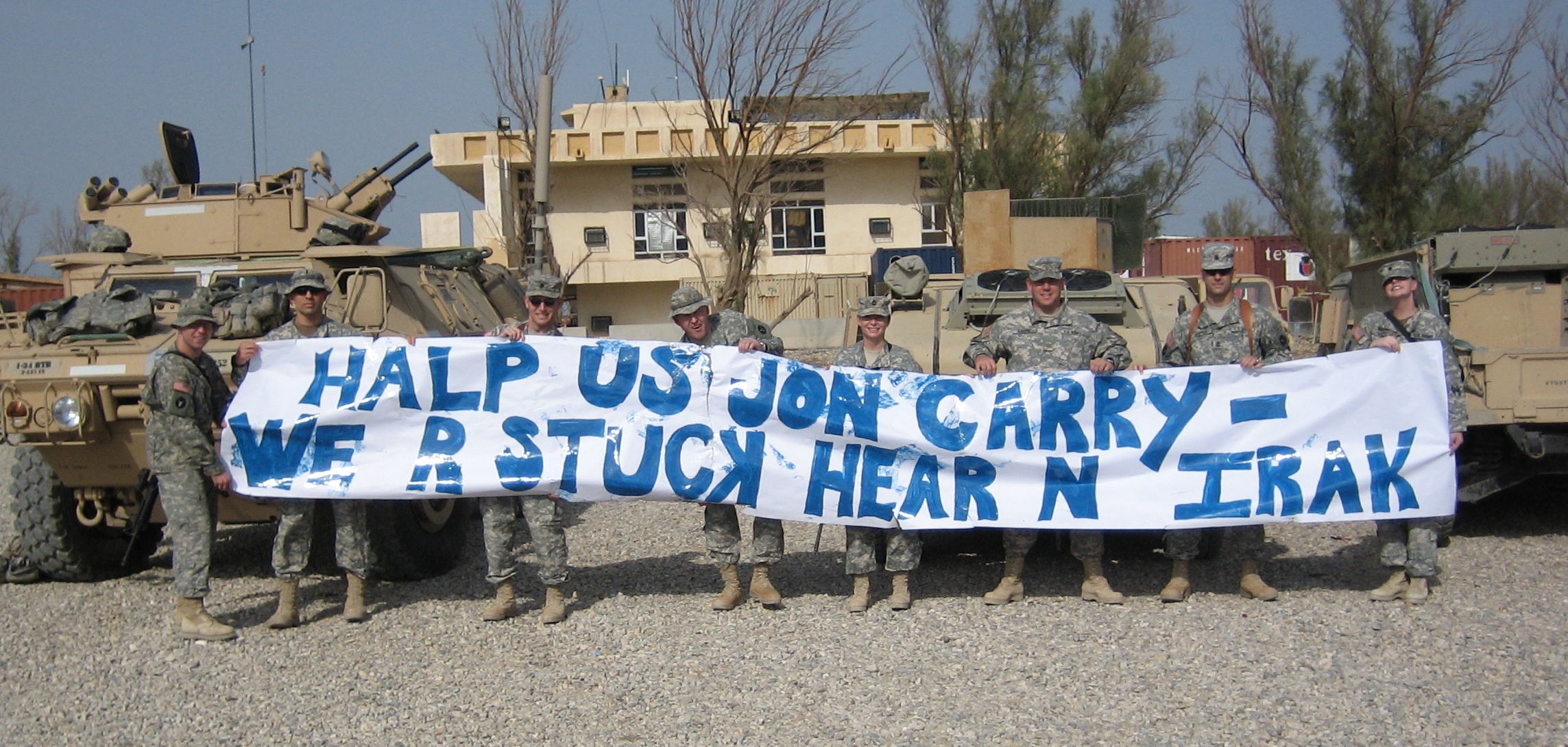
Some Minnesota guardsmen in Iraq had this amusing response to Kerry.

P.S. No blogging recently as Binah has been very busy with personal life. Hope to return to active blogging soon. There's always more to say!

Labels: , , ,

Thursday, August 17, 2006

Because sometimes you feel like a nut

I'm not going to belabor the issue beyond one more posting, so I'll summarize what I think here and move on to other things. My previous postings on "nutroots" are here and here.

What made Lieberman's primary defeat possible? Anger over the Iraq war, Lieberman's ineffectual and clumsy self-defense, and low primary voter turnout (around 15%, about average for an off-year primary). Who is Ned Lamont? A classic "trust-fund baby" -- a patrician airhead, really, not only lacking any political experience, but any political knowledge.

Then there's the unbelievable debacle of our unconstitutional campaign finance laws. Because candidates can't raise enough money from other people, more and more of them in the future will be men who've inherited (Lamont), married (Kerry), or made (Perot) their own personal money. The days of outside challengers (Gene McCarthy in 1968, Reagan in 1976) raising enough money on their own to run history-changing races are over, thanks to the idiocy of campaign finance "reform." Instead, our politics is paralyzed, strangled by an unholy alliance of incumbents, the media, and the Pew Charitable Trust. Under the last three decades worth of campaign finance restrictions, raising enough money to run for national office has become like filling a bathtub with a thimble. Thus have our politicians been reduced to thimble-fillers.

Lieberman's real hope was higher voter turnout, since higher turnout tends to marginalize fringe candidates and their supporters. The left-liberal "netroots" and MoveOn voters are well under ten percent of voters and could hope to affect the outcome only with low turnout. (Perhaps they're more numerous in the liberal Northeast, although the primary results suggest otherwise.) As I alluded to in an earlier posting -- and it's been explained elsewhere in much greater detail then I need to here -- "nutroots" is a strange movement of the information-age declassés, poorly educated, but with outsized pretensions to deep knowledge -- classic material for conspiracist movements, actually. Ignoring the trust-fund babies, the movement mainly consists of on-the-cusp-of-middle-age white folks still living with parents in the inflated-cost Northeast and SF Bay areas, often without steady employment. (In case you're worried, Binah does not fit this profile :)

The negatives here are not immediately apparent, but they will be in the coming months before the general elections in November. As the shock of Lieberman's defeat wears off, the airheadedness of Ned Lamont and the cultish parochialism of "nutroots" will come to the fore in the media as potent turn-offs. Whatever their biases, the media will expose these facts willy-nilly, even in the process of trumpeting "nutroots" as "radical," ending the Lamont bubble.

Also troubling must be the Democratic party, abandoning a vulnerable candidate, appearing as both turncoat and not even good at it (ineffectually disloyal, you might say). It will re-enforce the correct perception that the Democratic leadership is too weak and incompetent to exert coherent discipline over the party and support Democratic politicians. That has to negatively effect how marginally Democratic politicians will behave in the future. They can always become independents or Republicans, after all. The Republicans have famously turned militant partisan loyalty into a signature principle and are much less likely to abandon their own marginal politicians.

Lieberman will run as an independent and already has a real and growing lead over Lamont. If the Republicans decide not to run a candidate for the Connecticut Senate seat, Lieberman will almost certainly win. (He'll probably win regardless.) All of these factors -- the airhead factor, the nuttiness factor, and Lieberman's likely win as an independent -- will add up to another humiliation for the Democrats, who will also be deprived of another Senate seat. The key point here is that "nutroots" is not strong enough to defeat Republicans, only strong enough to pick off vulnerable Democrats in primaries. Only in a primary, with low turnout, can a small group have such a great effect. And if they can't pull off a decisive win in November in the liberal Northeast, they certainly cannot do it elsewhere.

"nutroots" is an attempt by a fringe group to impose an enraged "punish-and-purify" regime on the Democrats. How any of this is supposed to help them is a mystery to me -- maybe someone smarter can explain. This episode is shaping up to be a Democratic disaster and perhaps the start of their post-Bush free fall. Karl Rove couldn't have planned it better. The "nutroots"-Deaniac-MoveOn attempt to take over the party will likely only end in 2010, after a few more electoral debacles and after Dean is sacked as party chairman.

POSTSCRIPT: While the Northeast-based and heavily liberal conventional media is obsessed with Lieberman's defeat, arguably more important primary results elsewhere in the country were largely ignored. The execrable Cynthia McKinney was finally knocked out in the Georgia primaries by Hank Johnson, a new African-American politician who is worlds apart from her politically -- not a conspiracist and with no record of assaulting Capitol police officers.

A number of conservative Republicans won primaries running on anti-spending themes and expressing frustration with Bush's signal failures in the "war on terror" -- the failure to do anything about the main engines of Islamic jihadism, Saudi Arabia and Iran. If that doesn't have Karl Rove scared, he needs to check his morning coffee. Since the Republican party is the majority party and the Bush-populist chokehold on it is weakening, these events are probably more important than what happened in Connecticut.

Labels: , , ,

Friday, August 04, 2006

More thoughts on "nutroots"

To follow up on my previous post on the Kossacks, "netroots", and the "progressive" attempt to take over the Democratic party:

What is it with these blogger "nutroots" cranks and their lunatic ranting, with CAPITALS and rude, incoherent insults, etc., not to speak of denial-of-service attacks and personal threats? (See this important article by Lanny Davis here.) Doesn't it say something very disturbing about them that, unable to defeat any Republicans, they turn on a vulnerable Democrat like Lieberman? As Instapundit puts it, it's like seventh grade out there. Any sensible person would run away from them at this point: you're not their friend --- they have no friends. Certain Democratic politicians are now pandering to them, because of their intense activism and willingness to open their checkbooks. But that doesn't change the reality: they're a small fringe (generously, five or eight percent of voters), and handing the party over to them is total folly. The Democrats need to be rebuilding their much larger center and pick up where second-term Clintonism left off. The fringe is moving in, because the center has collapsed. It will probably be 2012 before the party can be put back on its feet.

A future post will discuss the evolution (or devolution) of American politics. But here's a preview.

The "nutroots"-Kossack episode is a harbinger of a dark future for the Democratic Party. For six years, Democrats and liberals have had a free ride attacking Bush, weak candidate and marginally competent president. (For all the talk of Bush as "cowboy," this weakness is the real reason for the impeachment talk.) After 2006, Bush will effectively be out of the picture, and Republican losses will be probably be minimal in any case. The Dems are poised to turn on each other again, this time from a much shakier position than a generation ago. OTOH, the Republicans, free of the Bush albatross, will be in a much stronger position in the presidential race and closer than ever to stable majority dominance of all branches and levels of government. The 2010 census and congressional/electoral college reapportionment loom even worse for the Dems: Texas, Florida, and other Rep-dominated states will gain share; while New York and, for the first time ever, California will lose.

The big question for Republicans is whether they can form a successful electoral and governing coalition from a party fractured into three major pieces: populists, conservatives, and liberals -- and fight off a potential Perot-style third party. Recall that Perot denied Bush Sr. reelection and made Clinton president. Of this, more anon.

Labels: , , ,

Wednesday, July 05, 2006

Thundering Kossacks

As probably every politico-cybersavvy person has heard by now, a mini-scandal has erupted from the revelations of "webola" received by the leftist blog DailyKos from fellow leftist bloggers and important Democratic operatives. Accusations of corruption are flying, important Democratic moderates (associated with the Democratic Leadership Council, the Clintons, and the New Republic) are trying to wrest their party back from the semi-literate fringe, and DailyKos meister Moulitsas-Zuniga has reacted angrily to the sudden intrusion of adults into his "Miri"-style romper room (no grups!). Descending from the Higher Sefirot, Kavanna is coming a little late to this fracas, so start with this major posting from Instapundit and the key New Republic and Weekly Standard articles here (requires subscription) and here.

Then read the always-thoughtful Ann Althouse of Madison. Check out the quotes from Newt and the "Invasion of the Body Snatchers" guy, then go down to comments. There's a poignant one from a leftie (Theo Boehm). It's incredible that the Democratic dog is being wagged by the Kossack tail and their fellow playpen-mates from MoveOn. They already control a lopsided share of Democratic fundraising and activism, in spite of their 0-for-N (you fill in for N) electoral score. (They're also evidently about to put Lieberman through the wringer -- just what the party doesn't need.) The Deaniac phenomenon was an earlier version of this -- a bizarre cult of angry juveniles, although that wasn't as clear three years ago. (What that struck Binah then about Dean was that he was promoting himself as a populist, but in fact he was largely a media phenomenon -- they built him up, then destroyed him -- and he was too arrogant and clueless to realize what was happening. And like DailyKos, the Deaniacs grossly exaggerated their following.) It's like your local house of worship being taken over by Scientologists. That's the real problem here, not "corruption."

Something similar happened 50 years ago to the Republican party. From the late 1930s until the mid-1960s, before the coalescence of the modern conservative movement, the Republican right-fringe was inhabited by anti-intellectual weirdos and conspiracy theorists. Because the Party lacked a widely-accepted ideology and leadership during that period, it was in considerable danger of being dominated by crackpots. The 1936 and 1940 elections featured impassioned and incoherent Republican reactions to the New Deal and impending intervention in World War II. They did have decent presidential candidates (Landon and Wilkie), and an important part of the party -- East Coast, Anglophile, pro-intervention liberal Republicans -- nearly split off. After 1945, further angry anti-New Deal and anti-interventionist reaction (combined with the nasty and unexpected Korean War) culminated in Congressional revolt against Truman and the McCarthy episode. Not until Eisenhower did the Republican party stabilize, and not until the arrival of Buckley and his National Review were the crazies (isolationists, conspiracists, Birchers, and antisemites) ejected from the respectable Right. Unfortunately, the Democrats have never undergone such a purging -- instead, they seem doomed to continually repeat their post-1968 cave-in to the overgrown adolescents of the Left. They too are now dominated by "... irritable mental gestures seeking to become ideas."

One predictable result is that there's an attempt by the mainstream media right now to portray the blogosphere as generally nutty and not "professional" (unlike them -- ha!). But there's no symmetry between the left-blogosphere and everyone else. The non-left-blogosphere is mostly sane, fairly large, diverse in views, tolerant, and above all grassroots -- made up of people with real lives and lots of common sense. The left-blogosphere is considerably smaller, much nuttier, much angrier, more puerile, and sectarian-cultish. Its social profile has "loser" written all over it. It fits that they're trying to take over the Dems and turn them into a cult front. Can you imagine an academic like Reynolds or even conservative warriors like Hugh Hewitt or Ann Coulter trying to take over the Republican party in this fashion? Just to pose the question is to answer it -- these are normal people, and those are not. (OK, maybe Ann isn't normal.)

Spelling out the negative consequences of DailyKos and the "netroots" movement for the Democratic party and American politics deserves another posting or two. But to start, digest this perceptive article by Matthew Continetti. Keep in mind that the "hit" and pageview numbers claimed by the leftie bloggers are almost certainly a serious exaggeration, which makes Continetti's point even stronger.

Finally, this is just funny: Martin Peretz, publisher and owner of the New Republic, speaks out! But hey, he's tight with that Joe-neocon guy from Connecticut -- right? Aren't "they" all? Or am I just missing something? I guess we here at Kavanna are part of the problem, and we'll never get it :D

Labels: , , ,