Friday, August 15, 2008

Thank god for evolution

As a proponent of the "new" atheism, Richard Dawkins is, like Christopher Hitchens and others, sometimes annoying. But when it comes to explaining the nuts and bolts of evolution, few do it better.

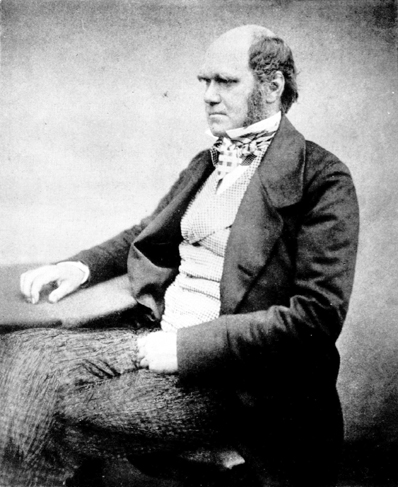
Next year is the 200th anniversary of the birth of Charles Darwin and the 150th anniversary of the publication of On the Origin of Species: By Means of Natural Selection. To mark those dates, the BBC has started an evolution series on Channel 4 with Dawkins, also available from Dawkins' Web site.

For another look at the exciting and controversial world of biblical archeology, television viewers will be able to take in the two-hour Nova special on PBS this coming November (trailer here). From the previews, it seems the content should be taken with a grain of salt: it's unlikely the Bible was written by hundreds of authors, and archeological remains and linguistics tell us that the ancient Israelites were definitely not Canaanites. But this is journalism, after all -- it's not supposed to be accurate, just ... umm ... "provocative" :)

(Hat tip to Adam.)

Labels: , , , ,

Wednesday, June 18, 2008

Thoughts on the environment

Tout commence en mystique et finit en politique.
- Charles Peguy

Thinking about pollution as a public health problem and selective conservation of the natural world, for the sake of present and future generations, are in no way new endeavors. They arose toward the end of the 19th century, led by a variety of people who never dreamed of reading humanity out of nature or expressing hostility toward scientific understanding of nature, then emerging from its infancy. One of the best-known representatives of this movement - which predates the modern environmentalist movement by almost a century - was Teddy Roosevelt, who experienced raw nature first-hand, exploited it by hunting, wrote about it - and then created parks so others could taste the same experience. He was our first, and so far only, "environmental" president. There was nothing coffee-table-ish or armchair about his views, and he made his forays in the wilderness before cell phones, waterproof matches and tents, and other hi-tech paraphernalia were available. Today's environmentalist movement has moved far that orientation, representing a very different and basically mistaken view of nature and of humanity's relation to it. Environmentalism is a movement, not a science. The science is ecology, as practiced by ecologists. That hasn't prevented a long-standing and pervasive confusion between the two.

Born during the period that saw the breakdown of liberalism and its turn towards punitive and backward-looking guilt, the environmentalist movement started as a piece of counterculture and absorbed the older conservation and public health movements, usurping popular acceptance of the latter for its own ends. These ends are motivated by a hatred of technology, science, and modern civilization and bring in train all the classical fallacies of Romanticism: pre-existent "natural harmony," "noble savages," and the evil corruption of civilized humanity. Only once American civilization had reached a certain level of material development could such thinking take hold among more than a tiny number of the unbalanced. It's had a longer run in Europe, where it arose in the late 18th century in reaction to the rise of modern science, industry, and commercial society. The Germans gave a special twist to this thinking, one that merged nature-mysticism with reverence for the Volk and pre-industrial life.

The environmentalist movement has raided non-Western cultures and creatively invented bogus quotes about their attitudes toward the natural world. As shown by Dan Botkin and others, almost all of the supposed wisdom the movement peddles about natural "harmony" and "balance" comes from pre-modern and pre-scientific thinking within Western history, precisely the thinking that has been abandoned by modern science. (It wouldn't be modern or scientific otherwise.) The "pre-existent harmony" or "balance of nature" metaphor is the most common of these fallacies. Such discoveries as organic evolution and chaos (in the technical sense of the word) have forced ecologists to give up "equilibrium" pictures of ecosystems and face the reality of their ceaseless and usually messy change. Ecosystems come and go, start from a little, grow into a lot, mature into a period of glory - then fall apart and are replaced by something else. For example, it's precisely because the chaotic atmosphere and oceans have only a limited "invariant" structure that pinning down what "climate" means is so hard. So it has been throughout the 3.5 billion-year history of life on Earth; human activity just adds some more twists to the mix of permanent chaos.

But the "harmony," "balance," and "equilibrium" metaphors have, since the scientific revolution of the 17th and 18th centuries, taken on a life of their own, now divorced from scientific thought and philosophical criticism. They continued to be sustained by religious feeling and the rise of counter-Enlightenment Romanticism. It helps that the core of Western religious thought since the rise of Christianity has been the template of Paradise-Fall-Redemption, with perhaps an apocalypse in there somewhere. The relationship of environmentalism to this paradigm and the related concept of Original Sin is too obvious to require comment. So is the environmentalist hope that humanity's supposed trashing of the planet demonstrates that humans are still at the center of things, if only in a negative way. High German Romantic thought of the 19th century (with echoes and variations from the American Transcendentalists) recommended withdrawal from both human society and the five senses as a preliminary to communing inwardly with Nature - not the thing you can perceive, but a "telephone from the beyond," as Nietzsche wittily
once put it.*

This is the paradigm of Thoreau's time living alone at Walden Pond, a Romantic exercise if there ever was one. He wasn't scientifically studying the ecosystem at Walden, getting his hands dirty. Not to put too fine a point on it, he was staring at his navel.** The root of environmentalism lies in a restless search for a new religion to replace older faiths no longer believable or relevant.

After the fallacy of pre-existent balance, the most powerful bad metaphor reigning over environmentalist thinking is its misplaced and often childish anthropomorphism and zoomorphism. Wild animals are not pets or farm animals, which are selectively plucked out of "wild" nature and bred by us to heighten characteristics that fit into human domestic and food needs. (After all, the wild ancestors of dogs could have been selectively bred to heighten other characteristics and turned into mean predators with no socially redeeming features.) Ecosystems and, indeed, the whole planet lack the integrated purposive and functional unity of individual animals and humans. It's a gross mistake to take metaphors like "Gaia" as more than fanciful poetic usages; the Earth doesn't think, feel, remember, or command anything.

But environmentalist literature and discourse are thoroughly polluted with such language and the concepts behind it. "Charismatic megafauna" (such as polar bears and baby seals) are projected as quasi-pets (instead of, respectively, hungry predators and their tasty, blubbery lunch). Gorgeous nature photography (itself a selective and superposed human art) is twisted into a "picture-window" or "don't-spoil-my-view" environmentalism that is really little more than middle- and upper-class kitsch. Debate about the human and non-human environments is mired in superstition and dishonesty if it assumes that nature would remain frozen were it not for our interference. It becomes enlightened and honest when the question shifts to, "Well, what do we want it to look like?" Not that we always get our wishes - but they're our wishes, not nature's. Nature has none.


If we're interested in a scientifically-informed view of nature and our relationship to it, we must abandon any notion of pre-existent "harmony" or "balance" that we are violating, restoring, or revering as an authoritative command. Nature commands nothing and speaks nothing. Or - better - it speaks many contradictory things: it's prodigious, wasteful, and hidden; beneficent and poisonous; abundant and barren; peaceful, aggressive, and indifferent - all at once. It is relentless change, on all scales of space and time, with incessant destruction, creation, and overturning. Any harmony or balance we bring to our relationship with nature is a balance or harmony strictly of our own devising. We're not even "managing" nature, except in a limited way. In limiting and modifying how we use nature, we really managing nothing but ourselves.

That is why environmentalism is not science, but a political and religious movement. It is why this movement so frequently turns tyrannical: there's nothing so satisfying to a fanatic than "managing" other people as a vehicle of righteousness.† Perhaps this is the unwittingly ironic sense in which Job urges his friends to "speak with the Earth, and she will teach you." She will teach you all right: she'll teach you that she has no trite moral lessons to offer. Equilibrium, balance, and harmony are not the norm, but temporary and local. Indeed, at the center of Job's encounter with the divine is, not a garden or a zoo, but a whirlwind.

In absorbing and condescending to the older public health and conservation movements, the nearly forty years of modern environmentalism have done our society a large disservice. It is the most potent social force today in attracting the general public away from science. Scientists involved in ecology themselves often lead mentally conflicted lives, caught between knowing and believing. People now routinely use meaningless or wrongheaded concepts to misunderstand the world around them and how human activity affects it. Recycling is often more harmful than just throwing things out. No one has a "carbon footprint," unless they've rubbed graphite on the bottom of their shoes. The Earth's climate is not a greenhouse. Nuclear power plants are not bombs, any more than a coal-fired power plant is a firearm. Runaway metaphors and bad policies motivated by them are the fallacies of the Boomers - history's first mass over- and miseducated generation - and now constitute the brainwashing of the next generation. Led by their delusional gurus, currently starting with Al Gore, they have injected a potent revulsion against modern technological and progressive civilization into our politics.†† But that passion proves nothing about the rightness of their cause, which is essentially romantic, pessimistic, and reactionary.‡

POSTSCRIPT: For an example of what I'm talking about, consider M. Night Shyamalan's embarrassing new movie, The Happening, "the most morally abhorrent film ever made" - but still, important for laying bare the logic, which pervades conventional environmental politics in a watered-down form. Or just read this New Republic blog posting and skip the film itself :)

POST-POSTSCRIPT: Everyone interested in this problem, whatever their opinions, should read Wallace Kaufman's No Turning Back: Dismantling the Fantasies of Environmental Thinking. Published 14 years ago, it is more relevant than ever, and a blog posting cannot do it justice. In related vein, consider as well the two books by Alston Chase, In a Dark Wood and Playing God in Yellowstone.
---
* While not able to speak English, Nietzsche could read it and counted an edition of Emerson's works as one of his prized possessions; he annotated it, heavily in places. His famous Übermensch, or Overman, probably owes something to Emerson's Oversoul. I don't know if Nietzsche read any Thoreau.

** That said, I like Walden Pond as it is now and try to swim it at least once every summer. There's been no attempt to "freeze" it in some mythical past, and it is accessible by car. It was pretty accessible in Thoreau's day, and he was never more than an hour walk from the center of Concord and medical and food supplies. Thoreau even took his laundry home to his mother for washing periodically. The old railroad line, already in existence when Thoreau spent his two years there, still runs right past the pond, behind some trees. Even more than in Thoreau's day, the setting now is as much a product of human artifice as it is of nature and a perfect example of the older conservation movement - but not of modern environmentalism.

† Thoreau himself said it: a man feels a disturbance in his bowels - and he sets off on a crusade to save humanity.

†† Using "progressive" again in the right sense.

‡ The absolute weirdness of our political vocabulary strikes me more and more. Opponents of environmentalism are usually called "conservative" - are they, really? And is environmentalism really "liberal" and "progressive"?

Labels: , , , , , , , , , ,

Wednesday, March 19, 2008

Chaos and the problem of long periods

And so, back to the strangely soothing subject of chaos. If it's happened before, it might happen again.

Nonlinear systems exhibit subharmonics of low frequency, so low that the associated behavior happens only occasionally. If we don't know the fundamental dynamics of a system and can't work out its deterministic logic from first principles, then we are left with staring its empirical behavior, over a necessarily finite time. If we see something happen, how do we know it's a unique event or if it will repeat? After all, its period might just be really long. Is the system not just nonlinear, but chaotic as well?

Stated in a more technical way, empirical study of chaotic systems in always limited by the longest observed time scale. The reciprocal of that time scale gives the lowest frequency we can know about. Without being able to observe the system for an infinitely long time means we can never know for sure what's a unique event and what just takes a long time to repeat.

There's no general solution to this problem, given the restrictions on our knowledge just stated. We might try to ascertain the system's fundamental dynamics and so try to answer the question through mathematical deduction. We might try to extend our observing period through paleo-knowledge, indirect use of old proxy evidence that allows us to infer something about the system over time scales longer than human history. Evolutionary biology and paleoclimate are reconstructed through such techniques. All of these play a large role in the study of chaos in real life.

Labels: , , , ,

Friday, February 01, 2008

The end of Europe? III

"I grieved to think how brief the dream of human intellect had been. It had committed suicide. It had set itself steadfastly towards comfort and ease, a balanced society with security and permanency as its watchword, it had attained its hopes - to come to this at last. Once, life and property must have reached almost absolutely safety. The rich had been assured of his wealth and comfort, the toiler assured of his life and work. No doubt in that perfect world there had no unemployed problem, no social question left unsolved. And a great quiet had followed.

"It is a law of nature we overlook, that intellectual versatility is the compensation for change, danger, and trouble. An animal in perfect harmony with its environment is a perfect mechanism. Nature never appeals to the intelligence until habit and instinct are useless. There is no intelligence where there is no change and no need of change. Only those animals partake of intelligence that have to meet a huge variety of needs and dangers.

"So, as I see it, the Upper-world man had drifted towards his feeble prettiness, and the Under-world to mere mechanical industry. But that perfect state had lacked one thing even for mechanical perfection - absolute permanency."
- H. G. Wells, The Time Machine (1895)

For most of his adult life, Wells was a socialist by conviction, believing that progress could continue only if controlled and directed by a central authority, the kind that traditionally has not ruled free societies except in times of war. Only in his last years, during and after the Second World War, did Wells finally come to accept the obvious: socialism could be achieved - but only by reorganizing society on a permanent war footing. War had already led to socialism in the Europe and the rest of the world; continued socialism would just mean a permanent prospect of war. And even then, society could not be made to stand still in the way the vision-bewitched, power-hungry socialist planners wanted. Socialism could not be a permanent stasis, only a stopping point on the way to decline or self-destruction. In other words, Wells late in life grasped what his and the preceding generation of European intellectuals had led their civilization to: disaster. This same despairing realization lies at the bottom of Orwell's 1984, published in 1949, three years after Wells' death. Thus far Wells the prose stylist and popular social thinker.

But in his science fiction, Wells knew better: his artistic intuition was stronger and better than his political beliefs. In his bones, regardless of whatever socialist opium he deluded himself with, he understood the real situation, probably because in his youth, he had absorbed the new, dazzling, and penetrating ideas of Darwin and other evolutionary thinkers: your biography doesn't stop until your dead, and history doesn't stop until and unless humanity becomes extinct.* There's no PAUSE button. The evolutionary idea had a fatal implication for the socialist utopia: the world of stasis - the heaven-on-earth of the socialists - is a religious fantasy.

Europe might come to that sad end, within our lifetimes. But it's also imperative, before arriving at such a conclusion, to take the longest view possible of European and Western history and see its unusual features in the light of centuries and millennia. Compared with other societies and civilizations, Europe's demography has always been unusual: delayed marriage, exceptional accumulation of capital and knowledge, escape from the Malthusian trap of food supplies saturated by population growth. With these came other unusual traits: starting with feudalism, contractual government in place of autocracy; individualism, romantic love, feminism. These distinctive features originated in the much-misunderstood Middle Ages and Renaissance (which, contrary to a common confusion, should be considered a unit). This era marked the formative age of the modern West. The Western habit of extending adolescence allowed for rapid and sustained social change, so much so that the West now takes innovation and progress for granted. The American branch of the modern West goes a step further in "lightweight," low-overhead civilization. Not so for typical pre-industrial civilizations, where a static ideal always reigned in theory, if not in practice. In place of closed systems of thought (religious and philosophical dogmas), we have learned to live with partial and incomplete truths and take for granted the never-ending possibilities thus opened up.

This is all radically different from any human society that existed before about 300 years ago. Europe's overseas descendants and the societies of east and south Asia have absorbed this dynamic and made it their own, germinating new civilizations along the way. And all of this because Europe failed in a crucial way: it failed to be a successful pre-industrial society - unlike, say, China, by any measure, the world's most successful. (That's before the shock of its encounter with the modern West). Fruitful failure is often much more interesting and charged with possibility than simple success. Simple success tends to halt progress. Progress - real progress, not the fake "progress" of the left - requires repeated failure. One failure, once, won't do much; but repeated trying and failing changes everything. Repeated failure at one thing can lead to other and new things that no one had thought of before. That is one of the main lessons of the 1200 or so years of the history of the modern West.**

We should keep such facts in mind as we survey Europe's recent past and possible futures. These are especially important to keep in mind when we consider the triple roots of modern Western culture: the barbarian peoples (Germans, Celts, Slavs, etc.), the classical Greeks and Romans, and the Hellenistic-Hebraic hybrid of Christianity. It keeps a reasonable perspective on the views of such Catholic or conservative writers as George Weigel, a view that, for all its value, tends to overemphasize the ancient classical and biblical sources of the modern West, to the detriment of the distinctive contribution of the Dark Age barbarians. Their individualistic restlessness kept Europe from becoming too civilized, too successful and complacent at any one thing. That is why the legend of Faust is so dead-on about the modern West. It is perhaps the supreme story that modern Western literati have played with about their own civilization.†
---
* And what is history, but biography writ large?

** This is a larger point to grasp about human evolution. Humans are not better chimps or apes - they're good at something else entirely. Presumably, the ancestors of humanity were at some point primate failures and in danger of extinction. But they evaded an otherwise inevitable doom as failed primates by becoming a successful something-else. It is the unusually long adolescence of humans makes this possible. It also makes culture - as opposed to pure instinct - a human necessity. Culture is (part of) human nature.

† Worth reading in Goethe's version, at least Part One and bits of Part Two - see such modern translations as Kaufmann's.

Labels: , , , , , , ,

Thursday, June 28, 2007

Meet the mother

... or speak with the Earth, and she will teach you. - Job 12

By now, it must be clear that something special is happening on the Earth that keeps its climate within certain bounds. This "something special" clearly involves more than weather per se; it also involves plant life as well as oceans, soil, and other geophysical processes, plus certain basic gross features of the Earth. Certainly compared with its terrestrial planet siblings in the inner Solar System - we looked at Venus and Mars, but didn't bother with Mercury or the Moon, because neither has an atmosphere - the Earth's configuration of geo- and biophysics seems unusual, if not unique.

In the 1980s, when scientists first began to think about other planets and life in a systematic way based on comparisons with other planets in our system (later, with planets orbiting other stars as well), this striking fact became so obvious that it cried out for a name. So biologists James Lovelock and Lynn Margulis coined one: they called it Gaia, an archaic form of the Greek goddess of the Earth, spelled that way, I suppose, to get people to pronounce it correctly - not Gea or even the Latinized Gaea. Perhaps they were being humorous, although they must have known that using such terminology would bring the New Age weirdos out the woodwork. Maybe they were looking to cash in, living as we do in a media- and celebrity-saturated society with many spiritual seekers dissatisfied by traditional religions.

Gaia is sometimes and misleadingly called a hypothesis, which it certainly is not: everything you know about the biogeosphere tells you it's real now. But it's when you consider the Earth's history that Gaia really hits you over the head. Consider the striking fact that the Earth is a little over 4 billion years (4 Gyr) old, and life appeared on it at least as far back as 3.5 Gyr and liquid water at least as far back as 3.8 Gyr. Now consider that the Sun was much fainter earlier in its 5-Gyr history back then, growing steadily brighter with time. Life on Earth required liquid water, which must have kept from freezing by a temperature-enhancing mechanism like those we know today - or perhaps a different one no longer operative, such as large amounts of other infrared-active gases like methane (CH4) and ammonia (NH3).

We've exhaustively examined the "Goldilocks" climate regime (which is really a range of possible climates), which runs from Ice Ages to mildly tropical. (And don't be deluded by the "global warming" hysteria into thinking that the Ice Ages have ended - they haven't.) Two other, quite different possible Earth climate regimes (ranges) are known. One was touched on briefly months ago: the humid but almost cloud-free supertropical Earth of about 304 oK = 31 oC = 89 oF. The other, so far unmentioned, is the "snowball Earth": mostly covered in ice, which reflects incoming solar radiation as effectively as do clouds, an Earth of less than about 245 oK = -28 oC = -18 oF. Earth has avoided both fates.*

A lot of what goes under the name of Gaia has already been covered - in some sense, we're just slapping a label on a collection of mechanisms and features of the Earth. Where the real Gaian controversy comes is when the role of life and consciousness comes in. I should make it emphatically clear right away that the "life" that mainly matters for Gaia is simple but ubiquitous plant life - nothing so sophisticated as an insect, not to speak of mammals or humans. "Ubiquitous" beats "sophisticated" on most days. So don't get any ideas :-)

Clearly, a complex web of feedbacks are operating on the Earth. We've seen some of them, but by no means all. When you hear "feedback," you sometimes think "alive" or even "conscious" - but Gaia doesn't mean that the Earth as a whole is conscious or even living. That's really getting off into the mystical and well beyond what the science justifies. Some people have tried to do that, including scientists who should know better. The feedbacks here are not all-powerful or mystical and don't by themselves imply consciousness or life. "Feedback" is a more primitive and general concept. But that doesn't stop some people from trying to turn the Gaia thing into a religion - which it isn't.

There are also some gross physical factors involved in Earth's unique biogeosphere that don't involve feedbacks. Its orbital position (close to the Sun, but not too close), its surface gravity, and the continuation of plate tectonics through its whole history are also essential. Additional factors that enhance stable long-term evolution of life include the presence of a large moon and a nearby giant (Jupiter) that sweeps up dangerous comets and asteroids.**

Gaia also has a long but finite life. In a few billion years, the Sun, continuing to brighten, will become so strong that the liquid surface oceans unique to Earth will boil away. That's probably what happened to any liquid water on Venus. We can only hope that our descendants will have terraformed Mars - which will be quite balmy by that point - or left the Solar System altogether for a better spot.

Is the Earth unusual? Almost certainly. Is it unique in the Galaxy or in the Universe? No one has the faintest idea for sure, but probably not. Is such a collection of stabilizing feedbacks a sign of purposive causality, or teleology? Maybe. But if it is, it's like Aristotle's teleology: completely naturalistic - there's nothing supernatural about it, in the literal meaning of that word: something intruding from another reality that suspends natural laws. It's about how those natural laws and the peculiar conditions on Earth fit together to produce a wonderful and unexpected result.
---
Crescent Earth from unmanned Apollo 4 (1967)* Or maybe not. There's strong evidence that about 600 Myr ago, the Earth did go through a "snowball" phase. But even then, the magical properties of water saved the day (or saved the epoch). Solid water (ice) is less dense than liquid, an unusual material property. So ice floats on top of liquid water, and the surface of an ocean or lake can freeze while life continues in the liquid below - amazing. That's enough for me to believe in a just and benevolent G-d on alternate Tuesdays and Thursdays.

** Our moon is the largest relative to its primary parent planet in the Solar System. There other moons that are larger in absolute size, like Titan - but their parent primaries are much, much larger (Saturn in Titan's case).

Labels: , , , , ,

Wednesday, June 27, 2007

Goldilocks and the three planets

The Earth has two neighboring "terrestrial" planets, compact and rocky, with significant atmospheres. They're places you can stand on, with climates, of a sort. What about them?

Venus in visible light from Galileo (1990)
The first planet inward from the Sun is Venus, with a mass, size, and surface gravity similar to Earth's. But its atmosphere is wildly different - a CO2-dominated nightmare of extreme pressure and temperatures: at the surface, 92 Earth atmospheres and 735 oK = 462 oC = 864 oF. The middle and upper atmosphere is thick with CO2 and sulfur compounds that reflect over 3/4 of the incoming sunlight. The atmosphere also has significant levels of nitrogen and sulfur dioxide, as well as tiny amounts of water vapor and argon. The most natural assumption is that the CO2 outgassed from the solid planet early in Venus' history and never returned into the planet's interior - a very different story from the Earth's, in spite of the presence of other gases familiar from our atmosphere (nitrogen, argon, water vapor). The absence of oxygen, on the other hand, is exactly what we should expect: there's no plant life on Venus to exhale it.

Venus was once a science fiction favorite for a quasi-Earth setting. But remote measurements of Venus' atmosphere started in the 1950s, greatly augmented by visiting spacecraft operating in situ, and dashed the hopes of astronomers, biologists, and science fiction writers alike for an Earth twin. Trying to understand why a planet so similar to Earth ended up with such a radically different fate then became a cottage industry. Based on a few plausible assumptions, reasonable explanations have been worked out.

Venus is about 28% closer to the Sun than the Earth, and so it receives more solar radiation. But by itself, that cannot explain its extreme surface temperature. The atmosphere-free baseline surface temperature is 327 oK - corresponding to the 279 oK figure for the Earth. But with an albedo of 76%, Venus' surface temperature - absent any CO2 opacity or downward cloud reflectivity - would be a mere 229 oK, lower than Earth's reflective-clouds-only temperature of 250 oK.

Most of the extreme temperature is simply due to the sheer thickness of Venus' atmosphere. There's so much CO2 that the effective opacity of a vertical column of Venusian atmosphere is about 110 times that of the Earth's.* The opacity of a single CO2 molecule itself is increased because of the extreme pressure it experiences from surrounding CO2 molecules.** Additional enhancement of the surface temperature comes from sulfur compound cloud reflectivity bouncing infrared (IR) radiation back towards the surface (instead of absorbing and re-radiating it upwards).

Plate tectonics on the Earth are driven by interior heat released by radioactive decay. Venus' plate tectonics - if it ever had any - stopped a long time ago. That, plus the absence of water oceans and plants, meant the CO2 kept building up in the atmosphere.

Runaway greenhouses and more runaway metaphors. For historical reasons, major confusion once surrounded the theory of Venus' extreme temperatures. Going under the name of "runaway greenhouse," this theory is often misinterpreted as explaining Venus' extreme temperatures today as a function of its hypothetical past. But the vertical temperature profile of Venus' atmosphere requires knowing nothing about its past; it only requires knowing its present composition, heat flow, and surface gravity - just like Earth. The lower third of Venus' vertical temperature profile is dominated by radiative opacity, like the interior of a star - so much so, that even the gravity-work effect that is basic to the Earth's temperature profile is negligible by comparison. In the middle and upper Venusian atmosphere, the air is thinner, and gravity is the main factor controlling the temperature lapse rate.

There was a point to the "runaway greenhouse," however. If you make the plausible assumption that Venus started as a proto-planet with as about much water as the Earth, the striking fact that there's almost no water in Venus' atmosphere today demands explanation, and the "runaway greenhouse" met that demand. Liquid surface water evaporated and floated up (just as it does here), but because Venus' temperatures were always higher to start with, it had hard time condensing into clouds. Instead, the water vapor kept going, into Venus' upper atmosphere, where the deadly solar ultraviolet (UV) radiation dissociated the H2O into H and O2. Being very light atoms, the H's diffused away into space, while the O2's floated back down and reacted quickly with surface rocks. After a while, virtually all the water in Venus' atmosphere vanished in this way.

This mechanism should never have been called a "runaway greenhouse," because that makes it sound as if it has something to do with Venus' present extreme temperatures. It should have been called "runaway evaporation," followed by "catastrophic water loss." Some have even tried to rhetorically connect Venus' present extreme temperatures with climate change on Earth, which is absurd. The conditions on the two planets are so radically different, it's hard to see what direct application Venus' atmosphere has to ours. If it had the same thickness as ours, its surface temperatures would be only slightly larger than ours - instead of 2-1/2 times ours. That would be the hypertropical near-Earth twin envisioned in science fiction before circa 1950.

There is one important and relevant fact, though, that Venus does demonstrate. The temperature distribution of Venus' atmosphere shows far less relative variation than the Earth's. It is true that Venus barely rotates on its axis, but even so, there's little difference between say, poles and equator. This fact illustrates the "more uniformly hotter" principle mentioned in a previous posting. It's ultimately just the Second Law at work. Apart from an occasional sulfur compound shower, you would find "weather" on Venus very dull.

The Earth's tropics are like this, only Venus is far more so.

Mars composite from Mars Global Surveyor (1997)Our other neighbor, one planet outward from the Sun, is Mars. Like Venus it has a CO2 atmosphere and very little water. But the similarities stop there: the Martian atmosphere is much thinner than Venus' and thinner even than ours. Mars is about 52% farther from the Sun than we are. The surface pressure and temperatures are a thin, frigid 0.008 atm and 227 oK = -46 oC = -51 oF (seasonal mean). If our tropics are a faint image of Venusian hell, then our Antarctica is a faint image of Mars' parched, cold desert. And our stratosphere matches Mars' surface in terms of very thin air.

Mars is Venus' opposite in other ways too. If Venus has little "weather," Mars suffers from too much - violent springtime sandstorms with winds exceeding 300 km/hr, and violent episodes of upward convection. At the same time, Mars has no liquid or evaporated water, so its climate suffers from larger extremes over the course of its day (similar to ours) and seasons (also similar, although about twice as long). The thinness of the atmosphere has something to do with that as well - very much the opposite of the climate boredom of Venus. But Mars has only a limited climate repertory, unlike Earth, mainly because of the lack of water vapor.

Mars is a smaller version of Earth in some ways, but small enough and with low enough surface gravity, that it had trouble over its history in holding on to much atmosphere. Because Mars' atmosphere is so thin, taking pictures of its surface from orbit is not hard. The latest and greatest are these results from NASA's Mars Reconnaissance Orbiter.

And finally, we circle back to the Earth we now know so well. Our atmosphere is thinner than Venus', but thicker than Mars'. We're close to the Sun, but not too close.
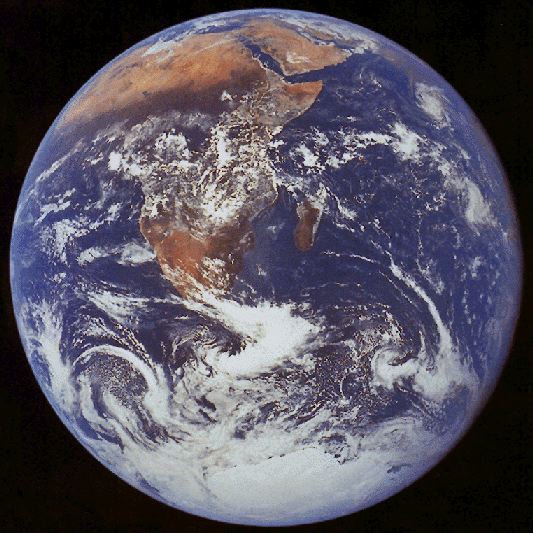
Earth (eastern Africa) from Apollo 17 (1972) And then there is the extraordinary role of water, doing all the things we've learned about in the last few months: moderating temperature swings and variations, dumping some extra heat into the atmosphere, raising lower atmosphere temperatures by its mild infrared opacity effect, but never leaving the Earth because it condenses and precipitates out below the stratosphere. The absence of significant liquid or evaporated water is the most obvious difference between our atmosphere and those of our neighbors - apart from the even more extraordinary, although thermodynamically less significant - persistence of oxygen, thanks to plants.

And the Earth differs in less obvious but no less critical ways from Mars and Venus. It has the largest surface gravity of the three, making it easier for it to retain an atmosphere. And the continued functioning of plate tectonics, combined with persistent oceans, gets many gases out of the air (like CO2) and, chemically transformed, down to the ocean floors, where they're subducted back into the Earth's core from whence they came. The plate tectonics also wipe away the remains of meteor impacts so evident on Mars and our Moon. Finally, they drive the continents around, making geological and biological evolution on Earth much more complex.

The Earth's atmosphere has enough variety in its composition - plus the striking variety of behavior exhibited by just one compound - to keep its climate "interesting" - never dull like Venus', but not a limited, violent mood-swinger like Mars either.
Goldilocks and the three bears
---
* Actually, total IR optical depth. No one uses the correct "venerean" or "venereal" as the adjectival form of Venus, for obvious reasons.

** The IR absorption lines of the CO2 spectrum are broadened by the ambient pressure and "cover" more of the IR radiation in wavelength than a CO2 molecule in Earth's atmosphere.

Labels: , ,

Tuesday, February 27, 2007

Everything under the Sun: Climate dynamics II

NOTE ON TEMPERATURES: Mostly, I'm using the Kelvin scale. Absolute zero (no thermal disorder) means T(Kelvin) = 0. Room temperature is 68 oF = 20 oC = 293 oK. The Earth's average temperature year-round is about 59 oF = 15 oC = 288 oK. Recall what our teachers tried to drum into us: T(C) = (5/9)*[T(F) - 32 oF] = T(K) - 273 oC.
---
The earlier posting about climate dynamics left out the most important source of "difference" in the climate system: the difference between the Sun and empty space (empty of matter, at least). Almost all the heat flow in the Earth's climate comes from the Sun across the vacuum between them. The Earth captures only a tiny amount of the Sun's radiance, but that's enough to make us warmer than the almost-absolute zero of interstellar space.

The Sun's energy is transported as (electromagnetic) radiation, or photons (from the Greek, phos, light). Most of it is emitted from the Sun's surface in the visible part of the electromagnetic spectrum, with a little in the ultraviolet. The radiation that doesn't get reflected back into space by the cloudtops is absorbed and re-emitted by the ground, but in a different part of the spectrum, the mid-infrared or heat radiation band. The electromagnetic energy flows in by radiative transport, flows back up by a mixture of convection and radiation, then leaves again by radiation. Radiation is dominant in the lower atmosphere but is supplemented significantly by convection and water evaporation-condensation, which make what we know as "weather." In the upper atmosphere, the transport is all radiative. The photons there travel almost unstopped into space. The other heat transport mechanism, conduction or heat diffusion in matter, is unimportant in the atmosphere, although it is important in the oceans and solid earth.

Visible and ultraviolet radiation travel mostly in straight lines in the atmosphere, which is largely transparent to them. Radiation can also travel by radiative diffusion, where photons are repeatedly absorbed and re-emitted by matter particles. Infrared radiation in the Earth's atmosphere suffers this process at the hands of water molecules. In stars, which are made of plasma, a hot gas of free nuclei and electrons, rather than neutral atoms or molecules, even visible and ultraviolet light can't make it by straight lines - they too have to diffuse, taking a drunken walk out of the star. In any sort of radiative diffusion, photons get absorbed and re-emitted from the electrons on a microscopic scale. In regular matter, the electrons are bound to atoms (but can still "vibrate"); in plasma, they're free. Radiative diffusion is a lot like conduction, where molecules transfer heat by bouncing off one another. The matter in and around stars is the common plasma in the Universe today. The early Universe - the "Big Bang" - was a hot, dense plasma too.

"Radiation" sounds dangerous, but the kind from the Sun is mostly visible and not dangerous to us. (The ultraviolet part is, and the atmosphere filters much of it.) Our eyes are adapted by evolution to that radiation band. Creatures living on a planet of another sun with a different dominant radiation emission band would have a different set of eyes - or some other functional equivalent.

Electromagnetic radiation (photons) is a physical entity in its own right, carrying energy and momentum. Its energy can be organized or disorganized; that is, the energy can be partially or entirely in the form of heat. That implies that photons also carry entropy. The second law of thermodynamics controls the basic mechanism of the Sun-to-Earth "heat pump": the Sun's surface is much hotter than the Earth's (5800 deg K vs 300 deg K), so the heat flows from the Sun to the Earth. The Earth absorbs the radiation, then re-emits it at 300 deg K into space, which has a temperature of essentially zero. Each step increases the total entropy of the system, if we are sure to include the radiation, as well as the matter of the Sun, the ground, the ocean, and the air, as part of the "system." In fact, essentially all of the increase in entropy in heating the Earth's climate is carried away into the vacuum of space by radiation, the Earth's "waste heat."

The whole process can be thought of as a "disorder waterfall:" as it flows from Sun to Earth to atmosphere to space, no energy is gained or lost; but each step "degrades" the energy by disorganizing into higher-entropy forms. It's like changing money into smaller and smaller denominations - except you can only change from bigger bills to smaller.

This has important implications for the Earth's history. It means that matter on the Earth can retain declining entropy (increasing order), even while the total entropy of the Universe is going up - with all that waste heat being dumped into space. That's why organic evolution, with living things of increasing complexity, is possible. So long as the total entropy is going up, the local entropy in the biosphere can be declining. In the nineteenth century, scientists and others worried that the Second Law meant that the Earth would "wind down" to a "heat death," and that organic evolution contradicted physics. They didn't know about radiation and its entropy. Now we do - there's no contradiction between thermodynamics and evolution.

Labels: , , ,

Sunday, January 07, 2007

Afterthoughts: Teleology and the anthropic principle

First, an apology: I've written before on the anthropic principle (AP), but the AP is used in widely varying senses, and my earlier postings didn't meet this issue directly. Nowadays, you see the AP popping up in two very different ways in two very different contexts - in the evolution/intelligent design controversy and in string theory. I've mainly posted about the latter case, but the former is better-known and more interesting.

There is a sense of the AP (the strong form) which implies teleology or final (purposive) causation. Stated in modern language, teleology or purposive causality is a generalization of the intentionality inherent in living and especially consciousness entities. It need not involve human-like consciousness. The key difference between final causation and reductionism is that reductionism posits a fundamental causality that is purely past-conditioned and purely forward-looking; it contains no feedback. Purposive causality requires "feedback loops" and implies some kind of circularity in the causal sequence. That living and conscious entities exhibit such circular feedback in their purposive behavior is not in dispute; the question is whether such causality is secondary, or if non-living entities and possibly the universe as a whole exhibit such feedback. If the latter, then teleology is fundamental to the universe; if not, it is a secondary phenomenon piggy-backing on a fundamentally causal but "blind" non-purposive universe.

A popular example of teleological reasoning is the "argument from design" or Intelligent Design (ID). But the AP is simpler and more general than that, and it doesn't have to be supernatural or theistic. The classic example in Western philosophy is Aristotle's four-fold causality (first, material or efficient, formal, and final); his system is neither theistic nor supernatural. Modern science started in the 17th century, attended by a philosophical revolution brought off by Descartes, Spinoza, and Locke. The agnostic or negative position of these early modern thinkers on final causality was crucial in the birth of modern scientific thinking. Spinoza's position was the most radical and consistent: he believed in a universe with design but without purpose. His militant monism (one Substance with many Modes) and unqualified belief in blind determinism have the appeal of consistency, but beg the question: purposive causality is inescapable for understanding living entities, and even more so, conscious ones. Descartes' solution was an extreme dualism: human consciousness (res cogitans = thinking stuff) is a supernatural soul; everything else (including our bodies and other animals) is a blind machine (res extensa = matter-energy in spacetime). Unfortunately, this solution, still very much with us as a pratical rule of thumb, has gradually been knocked down by modern biology, psychology, and medicine. Aristotle's unified treatment of all forms of biological teleology is theoretically superior. At the end of the 17th century, Locke had what, for modern science, has amounted to the final word on this question, which has seen no real improvement since. Agnostic on the role of teleology in the universe at large, Locke admitted that final causes are inescapable for understanding any kind of life. However, Locke also believed that "G-d could make matter think" and held out the hope that Descartes' dualism could ultimately be overcome. Hume in the 18th century attacked intelligent design and purposive causality, but from a quite different direction, casting doubt on causality and objective knowledge altogether. Such skepticism leads, not to modern science, but in a nihilistic direction first explored by Nietzsche in the late 19th century; it needn't detain us here.

What's the bottom line? The rejection or suspicious treatment of final causes is not a result of modern science, but an assumption. Modern science has made far more progress on "what" and "how" questions than on "why?". That fact alone justifies this approach, but it leaves unanswered the "why" questions that everyone ever born has thought of. The status of final causality remains elusive: is it a fundamental metaphysical category or a secondary of non-purposive causality?

This type of AP makes no sense in a Newtonian world, which is just such a world of blind determinism, driven by causal laws and conditioned only by past events. In modern physics, with quantum mechanics, non-equilibrium thermodynamics, and modern cosmology, such questions can be asked again, but we still lack definitive answers. Obviously, a teleology acceptable today would be very different from Aristotle's, since our knowledge of physical and biological mechanisms is broader and deeper than his was. It would be more abstract and simpler, and would hinge essentially on information or entropy, treated as a co-equal to spacetime and matter-energy. Information is inherently selective; it selects some of the world as "signal" and rejects the rest as "noise." Such selectivity is visible everywhere in the living world, from nutrition and waste elimination (eat this, flush that), to consciousness (attention to this, ignoring of that), to evolution by selectional mechanisms (this fits, that doesn't).

Philosopher Thomas Nagel recently penned a penetrating treatment of final causation in the form of a review of Richard Dawkins' new book, The God Delusion (requires subscription). By way of talking about Darwinist-selectional theories of biological evolution, Nagel takes Dawkins and others to task for overstating their case: Darwin's theory explains the origin of species, but not the origin of life - it doesn't and can't answer such a question. (Amusingly, Dawkins has to fall back on the hand-waving of the weak AP, invoking billions and billions of planets, instead of billions and billions of universes - explaining nothing - see below.) And Darwin's theory is a non-teleological (although not deterministic) theory - all modern scientific theories are: by assumption, not because they prove final causes invalid.

Since the 17th century, purposive causality has lived in a limbo of "parascience"; if it involves super- or "extra"-naturalism, it falls outside science altogether. The best-known case in recent years is the ID movement, which is attempting to re-introduce strong teleology into biology, a purposive causality set up by a human-like designer. In practice, many invocations of final causes are scientifically redundant, unfalsifiable, or empty. That fact is the (generally sound) basis for attacking the ID movement as pseudo-science. And many attempts to import ID theory into biology teaching are much cruder than that, just thinly veiled forms of creation "science," an obvious anti-science, as it rejects not just Darwinian selectional theories, but the whole framework of modern cosmology, geology, biochemistry, and genetics.

But in a final irony, the "other" AP controversy raging right now - about the weak form of anthropic reasoning invoked by string theorists - shows the AP in a much worse and far more objectionable light than the ID controversy. This non-teleological form of the AP proposes an infinity of unobservable universes, with no method to enumerate them, and offers no explanatory power whatever. It gives up on the project of modern science, seeking unity among observable phenomena: matter and energy, space and time, living species as descended from a common ancestor and sharing the same biochemistry, etc. The weak AP is a flight from scientific reason, driven by blind clinging to string theory. That theory isn't a real theory anyway, only an unlikely conjecture, and its solutions are more conjecture. As astrophysicists devise thought-universes with slightly different physical laws that can also support life as we know it, the reasoning behind this form of the AP falls apart. Its sole appeal is to people who believe in string theory for other reasons anyway (and bad reasons at that). This weak, multiverse AP is truly "millennial madness." It widens the already large chasm between string theorists and the rest of science and pushes string theory even further down the road of becoming a self-validating cult. And it makes creationism and ID look good by comparison - almost like real science.

Labels: , ,