
The end of Europe? I
But it would seem that if despotism were to be established amongst the democratic nations of our days ... it would be more extensive and more mild; it would degrade men without tormenting them .... [T]his same principle of equality which facilitates despotism, tempers its rigor .... I think then that the species of oppression by which democratic nations are menaced is unlike anything which ever before existed in the world: our contemporaries will find no prototype of which will accurately convey ... the idea I have formed of it, but in vain; the old words "despotism" and "tyranny" are inappropriate: the thing itself is new; and since I cannot name it, I must attempt to define it ....
.... Above this race of men [would stand] an immense and tutelary power, which takes upon itself alone to secure their gratifications, and to watch over their fate. That power is absolute, minute, regular, provident, and mild. It would be like the authority of a parent, if, like that authority, its object was to prepare men for manhood; but it seeks on the contrary to keep them in perpetual childhood: it is well content that the people should rejoice, provided they think of nothing but rejoicing. For their happiness such a government willingly labors, but it chooses to be the sole agent and the only arbiter of that happiness: it provides for their security, foresees and supplies their necessities, facilitates their pleasures, manages their principal concerns, directs their industry, regulates the descent of property, and subdivides their inheritances - what remains, but to spare them all the care of thinking and all the trouble of living? Thus it every day renders the exercise of the free agency of man less useful and less frequent; it circumscribes the will within a narrower range, and gradually robs a man of all the uses of himself. The principle of equality has prepared men for these things: it has predisposed men to endure them, and oftentimes to look on them as benefits. ... [T]he supreme power then ... covers the surface of society with a net-work of small complicated rules, minute and uniform, through which the most original minds and the most energetic characters cannot penetrate, to rise above the crowd. The will of man is not shattered, but softened, bent, and guided: men are seldom forced by it to act, but they are constantly restrained from acting: such a power does not destroy, but it prevents existence; it does not tyrannize, but it compresses, enervates, extinguishes, and stupefies a people, till each nation is reduced to be nothing better than a flock of timid and industrious animals, of which the government is the shepherd.
I have always thought that servitude of the regular, quiet, and gentle kind ... might be combined more easily than is commonly believed with some of the outward forms of freedom; and that it might even establish itself under the wing of the sovereignty of the people. Our contemporaries are constantly excited by two conflicting passions; they want to be led, and they wish to remain free: ... they strive to satisfy them both at once. They devise a sole, tutelary, and all-powerful form of government, but elected by the people. They combine the principle of centralization and that of popular sovereignty; this gives them a respite; they console themselves for being in tutelage by the reflection that they have chosen their own guardians. Every man allows himself to be put in leading-strings [harness], because he sees that it is not a person or a class of persons, but the people at large that holds the end of his chain. By this system the people shake off their state of dependence just long enough to select their master, and then relapse into it again .... [T]hey think they have done enough for the protection of individual freedom when they have surrendered it to the power of the nation at large. This does not satisfy me: the nature of him I am to obey signifies less to me than the fact of extorted obedience.
- Tocqueville, Democracy in America (1838)
More than a year ago and several times since then (see here and here), Kavanna took a look at the situation in Europe and came to rather negative conclusions. But there's only so much a few blog postings can convey about this profound and many-sided topic. More comprehensive are the armful of excellent books on Europe that have appeared in the last few years: Bruce Bawer's While Europe Slept (2006), Mark Steyn's America Alone: The End of the World As We Know It (2006), and Walter Laqueur's The End of Europe: Epitaph for the Old Continent (2007). Laquer's book is a shocker, a sign that the trend is serious and no mere epiphenomenon. The author of the earlier Europe in Our Time: A History (1992) - a laudatory account of Europe's post-1945 reconstruction - Laqueur's view of Europe has obviously changed in recent years.
While all these books are important, Claire Berlinski has the distinction of kicking off serious discussion in the US with a stream of articles and her book, Menace in Europe: Why the Continent's Crisis is America's Too. Berlinski writes regularly for the Washington Post, National Review, etc., and now lives in Istanbul. She's even written a couple of well-received novels. Menace in Europe was published in late 2005. Nothing has happened since to lessen its validity and much that re-validates it.
Before starting with Berlinski's book, we need to clear away some myths that get in the way of informed discussion of contemporary Europe. There are three major misconceptions. One is that what's happening in Europe doesn't matter to America. This myth has some currency on the center and right of American politics. Two other myths are still widespread among American liberals and leftists. These are the "Europe is more sophisticated than America" myth and that stubborn urban legend, "It's all W.'s fault, and the problem will vanish when he leaves office." None of these myths is true.
What's happening in Europe does matter - Europe is the West's "other half," and if Europe fails, the United States will need a Plan B for many things. And what happens there is paralleled, in certain ways, by what happens here. Nor is it all, or even mainly, W.'s fault. European anti-Americanism has a history stretching back to the 1920s, to the immediate aftermath of part one of Europe's civilizational suicide. It surged in the 1970s and early 80s, died down afterwards, then reappeared in the late 90s, with globalization and Europe's glaring failure in Yugoslavia. While Bush's actions and political style have aggravated the problem, anti-Americanism has also dissipated somewhat compared to a few years ago - but it will not disappear when he leaves office. Fresh events and new personalities will keep the kettle boiling. As for European sophistication, read on and judge for yourself.
Part of the problem is that older Americans have a distorted picture of Europe picked up in the immediate postwar period, when much of Europe's traditional culture was still alive; and that all Americans have misleading experiences as tourists spending time admiring an older European civilization that isn't where and how most Europeans live today.
The most painful chapter of Menace in Europe is the one on Britain. It is, in part, an excursus on Britain's Muslims, largely of south Asian origin, and the heritage of British imperialism. But it also, by comparison, makes telling observations on Britain's non-Muslim former imperial subjects and why, upon immigration to Britain, they have so few of the problems that Muslims do.
The causes are partly socioeconomic: many, although not all, of Britain's Muslims come from villages; the other immigrant groups are overwhelmingly educated, urban, and middle class. The causes are also partly connected to the history of the Indian subcontinent, spanning the whole of British-ruled India before 1947 (encompassing modern India, Pakistan, and Bangladesh). Britain's empire in India was at first strictly economic-exploitative, run by the private East India Company, the same whose tea was dumped in Boston Harbor in a well-known incident. Later it became a political entity - an empire within an empire - created at the expense of India's minority Muslim rulers, the Mughals. The British Raj, first unwittingly, later wittingly, became a powerful force on behalf of India's Hindu majority, its non-Muslim minorities, and (after 1920 or so) its women.
This mixed Anglo-Indian heritage is visible today in India, but especially in Britain, where the south Asian Hindus, Christians, Parsees, and Sikhs do well, but the Muslims often do not. The baleful heritage of the Deobandi school of Islam, south Asia's verion of Wahhabi or Salafi Islam, sticks out clearly in this generation of anti-assimilated south Asian British Muslims and their attraction to Islamic militancy.
Berlinksi's most fun chapter is that on the French port city of Marseille. Although it might surprise some of her readers (it shouldn't), her evaluation of France, the French, and France's secular republican ideal is very positive, even as she acknowledges that that ideal has probably outlived itself and met an insuperable barrier in the form of Islam.
Affectionate yet disapproving is her other chapter on France, an extended and satirical take on antiglobalization activist José Bové, exposing the layers of Europe's mystical and apocalyptic movements that stretch back 1500 years, to the origins of modern Europe. Here we are treated to the successive reincarnations of the charismatic romantic mystic, with his striking eccentricities and strong sex appeal. Until the 18th century, they were religious revolutionaries, proclaiming the coming of heaven on earth, the abolition of wealth, rank, and distinction, and (before the Reformation) demonizing the Jews as the people of Satan. The first modern (secular) revolutionary of this type was Rousseau, the founder of leftism and creator of the "noble savage" myth - the origin of all politics of adolescent rage against modern civilization. Modern Europe's angry, mystical political movements are secularized re-creations of these older religious movements, with virtually the same themes.* The chapter is a mixed-mood piece because Berlinski herself feels disturbed by the anonymous nature of globalization and questionable nature of modern factory farming and food production, harmful to animals and sometimes to humans. The spectacular British case of "mad cow disease" just underscores the point.**
The mosht dishtuurbing chapter is that covering Germany and its famous heavy metal band, Rammstein. (They're all over the Web - see here.) Berlinski uses Rammstein as a foil to explore the return of nihilistic late Romanticism - Expressionism - as a feature of German kultur. This is a crucial theme in modern German history, Germans as the people of nihilism and the people of Faust. Important German thinkers (Goethe, Nietzsche, Thomas Mann) were themselves acutely aware of this aspect of "national personality." You can't imagine Rammstein's songs sung by anyone, say, French or Italian. British and American heavy metal bands are about personal rebellion and angst. But in Germany, where music exposes the national soul, juvenile angst is automatically political, with an unmistakable esthetic familiar from the 1930s and 40s.
While French, British, and American Romantic tendencies have usually taken the form of personal rebellion, and its political form consists of delusional searching for the noble savage somewhere else - among workers, brown and black people, or among animals - in Germany, Romanticism was xenophobic from the start: the German Romantics decided that they didn't need to look elsewhere for noble savages. Rather, they felt that the Germans themselves were the noble savages, possessing deep Germanic "culture" in opposition to the superficial and materialistic Anglo-Franco-American "civilization" or the "mere barbarism" of the Slavs. This view, increasingly important in the 19th century, became, after 1918, the sickness of much of German-speaking Europe. In exploring this history, Berlinski's personal venom is evident here, understandable given her family's history in Germany. This disapproving chapter is not at all affectionate.
Germany sadly remains a crime scene still cordoned off after all these years, with people continuing to stand around and wondering what the hell happened. Germany's civilized and semi-civilized neighbors have all peered into the gloom of the dark Teutonic forest. They squint and scratch their heads.
Berlinski's final chapter, "To Hell with Europe," seems flippant at first sight. But she doesn't mean, to hell with France, or Britain, or Germany, etc. Her point is the "persistence of national personality." When she writes "to hell with Europe," she means just that: to hell with the false unity of the EU, the pretense that Europe's real nations have been made to go away, and that Frenchmen, Britons, Germans, etc., are now all just Europeans.
The modern West has its origins in the Dark Ages that immediately followed the collapse of the western Roman empire, which was replaced with a variety of what historians once called "petty kingdoms, dukedoms, and principalities." Europe in some ways has never left that state. The barbarian peoples - the Celts, the Germans, and later, the Slavs and others - rebuilt civilization from what was left in the Roman wreckage, including the Church. Modern Europe has rejected these sources of its civilization, leaving an immense spiritual, cultural, and political void. Into the void step what Berlinski calls "black-market religion" (Bové) and "black-market nationalist hate/nihilism" (Rammstein). No pan-European unification project since the end of the Roman Empire has succeeded - not the Catholic Church, the Holy Roman Empire, the Hapsburgs, the Bourbons, Napoleon, Hitler, or the Communists - in spite of the attractive appeal of new religions and utopias. In reminding her readers of these facts, Berlinski is passing on an essential perception of modern Europe's history, its arc from origins to finish.
Berlinski recommends some sensible changes as a necessary start to saving Europe - none of them is original, as she acknowledges: reforming its deadly economic mix of overregulation and unsustainable entitlements; dealing with Islamic extremists - both as individuals and institutions - in a more consistent and punitive way; applying Western legal and social standards equally to Muslim men and women without apology. (This is one of a number of her points of admiration for the French, whose policy towards Islamic radicalism is one of zero tolerance.) Major changes will happen soon: Europe's social democratic systems will either be reformed or collapse; its demography will change dramatically in the next generation; the political unification project will fail. Some of these changes are already starting. Other possibilities are more speculative.
Menace in Europe has a fragmentary form, which might at first make it seem like a jumble. But its thematic and stylistic unity is powerful; Berlinski grabs her readers and shakes them, saying "See?" and "See?" She has a Web site of her own, and you can listen to a podcast interview with her here.
---
* I mean identical in some cases. For example, the program of the anonymous German Revolutionary of the Upper Rhine, circulating in manuscript just before the Reformation, called for the expulsion or extermination of the Rhine Valley Jews, the end of Germany's economic relations with the outside world, the independence of a unified Germany from the Papacy, and the creation of a new religion mixing Christianity and a restored pantheon of old German gods. Reading it, you get confused: is it from 1500 - or 1933?
Then there's Joachim from the Italian town of Flora: his speculative tripartite theory of history, published in manuscript around 1300, postulated a three-stage historical evolution leading to an Age of Pure Spirit, where everyone would be living equally in a barracks or a monastery. The tripartite stuff sounds a little like Hegel and a lot like Marx; the equality of the barracks and the monastery, like the pre-Marxian socialists whom Marx himself ridiculed as "utopian."
In laying bare the religious and utopian origins of the modern West's extremist political movements, Berlinski and the rest of us are profoundly indebted to the works of Norman Cohn, especially his classic In Pursuit of the Millenium (1957). Cohn's work explodes the claim that these modern movements made about themselves, that they were "scientific," "progressive," or "enlightened." There's nothing scientific or enlightened about Marxism or race theories; these movements repackaged tribal, mystical, and apocalyptic ideas in a superficially modern garb of pseudoscience. Environmentalism bears strong traces of the same.
** Consider too America's industrialized food production, with its heavy use of subsidized corn, bestowing upon us the dubious blessings of corn syrup, corn feed, and ethanol.
Labels: Berlinksi, books, Britain, Christianity, food, foreign policy, France, Germany, immigration, India, Islam, music, Muslims, Pakistan, popular culture
posted by Binah @ 7:06 AM
0 comments

 This southwest-facing coast is not as famous as the Greek-influenced southeast corner and lacks its own Mount Etna. But you've heard of some of this part of Sicily, although perhaps not with that association. It's a part of the island first colonized by the Carthaginians around 800 BCE, itself a North African colony founded in 814 BCE by the Phoenician city of Tyre back in what is today Lebanon. Sicily is three-cornered, with coasts facing north, southwest, and southeast. The northern coast was originally the least developed part, the home of a mysterious people the Romans called the Siculi, for whom the island was named. Over the millennia, Sicily has been ruled by Carthaginians, Greeks, Romans, Greeks again, Arabs from North Africa, the Normans, the Spanish, and finally by the modern Italian republic.
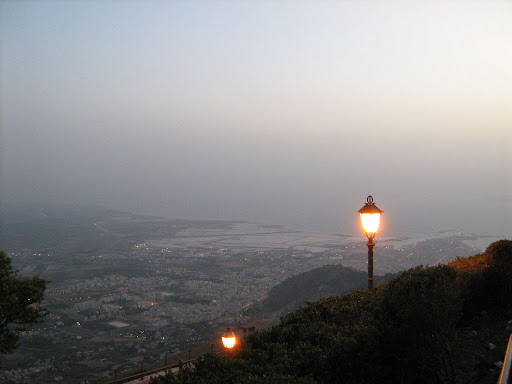 August in Sicily is hot, tending toward the humid, with strong sea breezes. But Sicily is also subject to the powerful north African
  In spite of the heat, I walked all around our mountain town of Erice every day, enjoying the amazing Sicilian food, and took a part of day to hike down to
