Wednesday, October 15, 2008

"Right-wing extremists"

The recent Austrian elections saw gains by far-right parties. The death of one of their leaders, Jörg Haider (at four times the legal alcohol limit, author of the carnage on the right), brings to mind an important debate in the blogosphere and elsewhere about the nature of Europe's anti-immigration and anti-Islamization parties.

Europe is facing some tough choices, too long put off, about its immigration policies and how they will impact Europe's political future. Will Europe's cities become Islamicized and start sprouting "countries within countries" -- a return to the medieval practice of fragmented sovereignty and theocratic legal systems? Consider that Britain has now endorsed shari'a courts for civil and personal status cases, with the full force of of the state behind them, and you'll see that it's no hypothetical question.

Liberal journalist and historian Ian Buruma has recently written about how important it is to listen to voters' concerns about such issues. Such questions and concerns are generally ignored by Europe's elites, leaving voters frustrated and prone to vote for fringe parties as a protest.
... to see the rise of the Austrian right as a revival of Nazism would be a mistake. For one thing, neither [far-right] party is advocating violence, even if some of their rhetoric might inspire it. For another, it seems to me that voters backing these ... parties may be motivated less by ideology than by anxieties and resentments that are felt in many European countries, including ones with no Nazi tradition, such as the Netherlands and Denmark.

In Denmark, the hard-right Danish People's Party is the third-largest party in the country, with 25 parliamentary seats. Dutch populists such as Rita Verdonk, or Geert Wilders, who is driven by a paranoid fear of "Islamization," are putting the traditional political elites -- a combination of liberals, social democrats and Christian democrats -- under severe pressure.

And this is precisely the point. The biggest resentment among supporters of the right-wing parties in Europe these days is reserved not so much for immigrants as for political elites that, in the opinion of many, have been governing for too long in cozy coalitions, which appear to exist chiefly to protect vested interests. In Austria, even liberals admit that an endless succession of social democrat and Christian democrat governments has clogged the arteries of the political system. It has been difficult for smaller parties to penetrate what is seen as a bastion of political privilege. The same is true in the Netherlands, which has been governed for decades by the same middle-of-the-road parties, led by benevolent but ... paternalistic figures whose views about multiculturalism, tolerance and Europe were, until recently, rarely challenged.
And opposition to such developments hardly makes one a "fascist." The European Left has worked tirelessly to vilify anyone who questions or objects to its project of civilizational suicide. For the most part, the media slavishly parrots this line.

Actually, European parties of the democratic Right are easy to identify and distinguish from fascist parties. The distinctive historical characteristics of fascism -- a closed society and economic system; extreme forms of chauvinism, bordering on racism; contempt for democratic politics and worship of violence and violent leaders -- are less relevant today than certain other hot-button issues.

The most obvious are antisemitism and attitudes toward Israel. Even more important is the question, how do the local Jewish community and Israeli embassy feel about the party in question? Answers to such questions are strongly correlated with deeper attitudes: What is the party's attitude toward political democracy? How does it feel about Islamification, as a social phenomenon? As a political-legal phenomenon? Specific questions better illuminate the issue: for example, are they hostile to the Bosnian Muslims persecuted by the Serbs? If so, what is the nature of their hostility?

An even easier way to make the distinction is to ask, which European figures of the recent past do they admire and mimic? Does the list include conservative, democratically-oriented figures like Churchill, De Gaulle, Adenauer, Thatcher, or the last Pope? Or is the list populated with names like Mussolini, Hitler, Antonescu, Milosevic, or Le Pen?

On a very relevant, hot-button issue, the far-right, quasi-Nazi parties of Europe have been quietly shifting toward support of radical Islam, in spite of their anti-immigrant rhetoric. Austria's Freedom Party, for example, is strongly opposed to the combined American-European attempt to stop Iran from getting nuclear weapons.

Asking the right questions and not fudging the answers are all that is needed to sort this issue out.

(Read this post from earlier this year about the Islamicization debate. See here and here for related posts from last year.)

Labels: , , , , , ,

Tuesday, September 09, 2008

Rediscovering Hezekiah's tunnel

I once had a date, sort of, in Hezekiah's tunnel in Jerusalem. My friends started calling it "Hezekiah's Tunnel of Love" in honor of that event. Seems like a long time ago :)

This month's Biblical Archaeology Review has an excellent article on the expanding discoveries at the tunnel. It's an underground water way, over 1700 feet long, dug by the Judahite king Hezekiah (II Kings 18-20) in the late eighth century BCE. The tunnel traverses a winding course from the Gihon Spring (Jeruslem's only natural water source) to the Pool of Siloam (Shiloach). Hezekiah's engineers dug it in anticipation of a siege by the Assyrian king Sennacherib, because the spring was outside biblical Jerusalem's walls. The article discusses some recent finds and conclusions that illuminate how such engineering was done in the early Iron Age. From Assyrian records, the siege is most likely to be dated to 701 BCE.

In 1880, an inscription in paleo-Hebrew (not the post-Babylonian script used today) was discovered in the tunnel. It commemorates the completion of the tunnel and describes in vivid terms how the water started to flow when the two teams of workmen, converging from the two ends, met up. The inscription was taken to the Istanbul Archaeological Museum, where it still sits today.

In the late 1990s, a particularly foolish group of "biblical minimalists" asserted that the Tunnel inscription dated from Hellenistic times (third century BCE, after Alexander the Great). The hard scientists struck back, and the minimalists had to beat an embarrassing retreat. The most recent work on Hezekiah's Tunnel demonstrated the antiquity of the tunnel anew, with radiocarbon dating of twigs and leaves left in the tunnel by the engineers. The date: eighth century BCE.

Although they rarely say it, the minimalists frequently insinuate that their claims are modern, skeptical, and "scientific." Their frequent target is an invented straw man ("biblical maximalists"). This dispute is sometimes echoed in the popular media, with the same insinuation intact. The minimalists have even, on occasion, attempted to attack Jewish presence in Palestine as late as the Dead Sea Scrolls era (second and first centuries BCE).

The truth is very different. While scarcely fundamentalists, the "hard" scientists know that the northern Israelite and southern Judahite kingdoms were real and were destroyed by the Assyrians in 721 and the Babylonians in the 586 BCE, respectively. Post-exilic Jewish presence in the land in the Persian (539-332 BCE), Hellenistic (332-37 BCE), and Roman eras (after 37 BCE) is massively attested and beyond question. The minimalists are made up of historians and literary critics, coming into frequent conflict with the "hard" sciences of archeology, epigraphy, and linguistics. It's the minimalists who are anti-science, not their opponents.

POSTSCRIPT: The complete body of Dead Sea Scrolls texts is about to be published online by the Israel Antiquities Authority.

Labels: , ,

Saturday, May 10, 2008

Gun control and Jewish values

We've said it before here: one of the strangest features of American Jewish politics is its embarrassment about self-interest. I don't exactly mean its liberalism. Any religious minority in a liberal democracy finds itself exceptionally in tune with the need for safeguarding religious and other civil freedoms.

What I do mean is the frequent inability to say the obvious, steer clear of political correctness, and think about the things Kavanna wrote about a few days ago here about the right of self-defense. Although there are nuances in how far people can go and avoid taking the law into their hands, it's not a hard-to-understand principle. But ever since the breakdown of liberalism in the 1960s, gun control (banning guns, actually) has become another one of those quixotic causes that liberals have taken up as a vehicle for self-flagellation. It's not as if there's strong evidence that it works: law-abiding people obey gun control laws, and criminals don't. Countries with gun control laws do not have consistently lower rates of violent crime. But such rational considerations obstruct our view of the motives of gun control advocates: it's about guilt and becoming helpless in order to assuage that guilt. It sometimes results in pretty astounding rationalizing, such as quoting the Ten Commandments (which forbid murder, not self-defense) in debates over the issue. Judaism is not about turning the other check, BTW: that's a different religion.

There are many self-identified liberal causes (like gay marriage) that stand or fall on their own merits. The problem with American Jewish politics is taking over those causes and trying to make "Jewish values" out of them. What results is sometimes misguided and often distorted. Although it's based on obligations, not rights, Jewish law has always recognized a right of self-defense. (See this lucid discussion, which uses the classical exegesis of the 11th century commentator Rashi. He carefully distinguishes self-defense from both murder and judicial punishment and limits the use of deadly force to deadly situations.) Although I don't own a firearm myself, it's perfectly understandable to me why people without reliable police protection would want to be able to protect themselves. In the US, that includes people living in rural areas, but also residents of inner cities. It doesn't mean everyone has to own a gun or even know how to use one. The days of a citizen militia are long past.

The real source of the distorted thinking is the hundreds of years of diaspora Jewish vulnerability and belief in the "good czar." Actually, a lot of modern Jewish politics can be understood this way. Only under oppressive and discriminatory rule by Christians and Muslims were Jews gradually disarmed and reduced to helplessness. We all know how that ended.

It's best to look at the situation in Israel, where personal firearms are not unusual. The Israeli approach - gun ownership common, but highly regulated - is probably the closest thing to real "Jewish values" on this question. Of course, there's a larger context: guns don't kill people; people kill people. And that is why there is so much in Jewish tradition about keeping the negative side of human nature in check. Someone might decide to use force against someone else, and that someone else might need to defend himself. But violence foreseen and prevented is better than violence acted out - the "Jewish way" in the fullest sense.

Labels: , , ,

Wednesday, May 07, 2008

Israel: Sixty years!

Tonight/tomorrow is Israel Independence Day. Yom holedet sameach :: Happy birthday!

Labels:

Sunday, April 13, 2008

At the movies

In thrall to ideology, formula, and powerful special effects, Hollywood has had a difficult time producing really memorable movies recently, although the situation is slowly improving. The independent and semi-independent scenes are livelier than ever. Movies made in and about the Middle East are especially rich these days, with Iran and Israel leading the pack.

The Band's Visit (Bikur Ha-Tizmoret, 2007) is the first feature of Israeli director Eran Kolirin, with some Hebrew and Arabic, but mostly in English (which is why it didn't qualify for the Oscars as a foreign film). The story is a bit of a fairy tale, the plot set in motion by one of those subtle Middle Eastern misunderstandings. In striking sky-blue uniforms, the Ceremonial Police Band of Alexandria, Egypt, is sent on a cross-cultural visit to the Arab cultural center of the Israeli city of Petah Tikvah (Door of Hope, founded in 1878 and the oldest modern Jewish settlement in Israel). But in Arabic, there's no "p," only "b," so the visiting musicians accidentally take a much longer bus ride to Beit Tikvah, the House of Hope, an ironic name for one of those dreary Israeli development towns in the Negev desert (or so it seemed to me).* And the movie sets off from there, in a probing story both realistic and surrealistic. See it if you have a chance.

Another must-see recent foreign film is The Lives of Others (Das Leben der Anderen, 2006), a powerful first work from German director Florian Henckel von Donnersmarck and an Oscar winner (German, with English subtitles). Set in the mid-80s, a few years before the end of Cold War, the story centers around an agent of the East German secret police (Stasi) assigned to spy on a couple, becoming absorbed into their lives beyond even the obvious potential for voyeurism. Over East Germany's 45-year history, the Stasi became the most efficient and cunning secret police ever known. Many millions of people, often themselves blackmailed by information from existing informants, became in turn informants themselves, turning the whole country into a giant snitching exercise twisting all institutions and relationships. Precisely the social and cooperative virtues supposedly prized in a communist utopia were relentlessly undermined by the destruction of trust and the isolation of individuals from one another by an all-powerful state.

The legacy was and still is painful, since the full truth about this system became known after the Berlin Wall came down and shocked the disintegrating country, accelerating its fall. The Lives of Others is a powerful piece of Cold War history and joins the ranks of other anti-collectivist classics such as 1984 and Darkness at Noon. Hollywood's ideological bent and historical ignorance make such movies difficult to produce here. Don't miss it.

POSTSCRIPT: Another recent offering from the former Soviet bloc, set in late Cold War Romania, is 4 Months, 3 Weeks and 2 Days (4 luni, 3 saptamini si 2 zile, Romanian with English subtitles). I have not seen it, but have heard nothing but very positive things about it.
---
* That's how the ancient Neapolis ("New City") in northern Palestine became the modern Arabic Nablus. Thus Arabic-speakers argue about "bolitics," not about politics.

Labels: , , , ,

Thursday, April 10, 2008

The wages of sin

A Sumerian clay tablet describing an asteroid impact, inferred by constellation positions to June 29, 3123 BC, has been deciphered and somehow connected to the destruction of Sodom and Gomorrah, which I had always thought was something from about a millennium later. I'm not sure how this connection was made, but you can read the London Times article here. The tablet was discovered in the 19th century in the ruins of the royal Assyrian library at Nineveh, itself dating from much later, to around 700 BC.

Amusingly, the clay tablet itself is misidentified in the headline as the asteroid: "Clay tablet identified as asteroid that destroyed Sodom and Gomorrah"! :) But the story's first paragraph sets it straight:
A clay tablet that has baffled scientists for 150 years has been identified as a witness’s account of the asteroid suspected of being behind the destruction of Sodom and Gomorrah.
In good newspaper style, the unnamed asteroid is identified only as "suspected." The asteroid has actually been held for questioning and could not be reached for comment.

Labels: , , ,

Sunday, March 30, 2008

William F. Buckley, Jr.: An appreciation

Where to start? A giant of the postwar world, one of the founders of modern conservatism, and a leading light who remade American politics, died just over a month ago. Many tributes have appeared, and his positive influence is everywhere you look.

When World War Two ended, American conservatism seemed to be finished. Although opposition to the increasingly statist bent of liberalism came from many and often conflicting points of view (individualism, religion, nativism, etc.), the two large forms of opposition were isolationism (opposition to American entry into the war - although that was not in any way purely a cause of the Right) and hostility to the dramatic expansion and pretensions of the federal government. Both oppositions appeared discredited, although disillusionment with the New Deal and federal intervention in general was widespread by the time of the 1940 election. And a significant part of the Republican party - its East Coast, Anglophile wing, led by Wendell Wilkie - did support intervention, in fact preventing foreign policy from becoming a major partisan issue in the 1940 and 1944 elections and marginalizing isolationism to a great degree. Nonetheless, while much of the New Deal had been repudiated after the 1938 midterm elections, everyone in 1940 knew what the great question was: to intervene or not, how fast and how deep. Of course, the Germans' undeclared submarine war of 1940-41 and the attack on Pearl Harbor at the end of 1941 rendered that debate moot. The US did intervene in World War Two, on the Allied side, and few regretted it afterwards, in spite of the immense cost and the dubiousness of having the Soviet Union as an ally.

Other factors were at work in the fragmented state of the American right in 1945. It had some of the same components familiar today. There were conservatives, people who deferred to tradition because it was tradition. The fact that the American political tradition was largely a liberal one (with one major exception) created something of a paradox.* That tradition was one of limited government, one overturned by the socialist-tinged "new" or "reform" liberalism of the Progressive and New Deal eras. (The change was large enough that it is questionable whether the adjective "liberal" should be used at all.) Classical liberals (later called libertarians) never bought into tradition-for-tradition's-sake and based their views on straightforward, historically informed ideas (abundantly confirmed by recent experience in the world wars and totalitarian dictatorships) about the negative effect on human liberty and prosperity by too-large and too-powerful a government. Some went further and re-developed the familiar 18th-century theories of natural rights and consensual government in terms understandable to a 20th century audience. To that they added a more modern and deeper appreciation of the limits of social knowledge and the impossibility of social planning.

A striking fact astute readers might notice is that I make no mention of the "religious right" in this potted history. That's because, after the liberal-fundamentalist battles of the late 19th and early 20s centuries, the fundamentalists retreated to their own, anti-political, subculture. To the extend that they were political, they largely voted Democratic, because they were largely southern or urban-ethnic Catholic - and in those days, virtually all white southern and Catholic voters voted Democratic. The "religious right" as we now know it, an alliance between conservative Catholics and conservative Protestants, was 30+ years in the future at the end of the war. In 1945, a few feeble attempts at ecumenism apart, the relation between Protestants and Catholics was one of mutual suspicion, laced with ignorance and prejudice - although the war itself had had a strong positive impact on this state of affairs. The full scope of this impact is in large part the complete transformation of religious and ethnic identity in America in the postwar era. This transformation made black civil rights easier to swallow (for whites), gave rise to a new level of interreligious understanding, and made Buckley's type of "big tent" conservatism possible. All of these were out of reach and almost unthinkable before 1945. In his relationship with American Jews, Buckley's approach was even more radical, given the level of anti-Jewish prejudice still prevalent in 1945. By the late 1950s, his nascent movement and its allies counted a significant number of Jewish thinkers, many of them refugees from Europe and carrying first-hand experience of life under the totalitarian dictatorships. Well before the Republican party, under Nixon, fully embraced support of Israel, Buckley adopted such support as a matter of course, because he understood the basic issues at stake. When the Soviet Jewry movement started in the mid-1960s, Buckley and his followers were among its early non-Jewish allies and supporters.

Buckley was a wealthy liberal Catholic, a man from a social background (including a father who was an American ambassador) that, on the surface, seemed conventionally WASP. It was his quirky Catholicism that initially made the difference. It made him have to think - really think - about political issues in a deeper way than most people have to, people who take their political views without much thought from their parents, teachers, and peers. This led him initially to oppose modern American liberalism from a traditionalist point of view, but also made him open to libertarian approaches. From these experiences, he formed a clear conception of how to rebuild the American right around a few simple and broadly appealing stands that any rational person could assent to, without regard to ethnic or religious background: opposition to the growth of government at home and opposition to the dominant form of collectivist tyranny abroad, communism. Buckley and his allies founded National Review, still the flagship of American conservatism, and began a campaign that stretched from the early 1950s to the late 70s to absorb all opposition to modern liberalism in this way. By doing this, Buckley sidestepped the leftover isolationist-interventionist debate and ended the American right's parochialism. By the late 1950s, all sorts of people, many Protestant, but a large minority of Catholics, and a surprising number of Jewish thinkers had been pulled into Buckley's movement, so much so that by the 1960s, the movement had become a broad political tendency in its own right and no longer a "movement." Buckley concentrated on the crucial common ground, dispensed with the provinciality and ethnocentrism of the prewar right, and even proved ecumenical enough to accept individualist and libertarian followers. (They often rejected him anyway, but that was their doing, not Buckley's.) Buckley even flirted with libertarianism himself, in his 1965 run for Mayor of New York and his famous, offshore 1960s pot parties on his yacht.

The era of Buckley's and conservatism's success was the late 70s and 1980s. In the 1960s, American liberals had obtained a blank check, under Kennedy and Johnson, and led themselves and the country, both domestically and internationally, into a gratuitous mess: instead of triumphing, liberalism went haywire and, after 1965, began a free-fall from which it has never recovered. The fact that the president who brought the Kennedy-Johnson tendencies to their logical conclusion - Richard Nixon - was a Republican seemed at first to set back the conservative cause. But Nixon was not a conservative. He was nominated in 1968 in part because he wasn't Goldwater and couldn't be tarred as a "crazy radical." The Watergate crisis (and the war that led to that crisis) were largely, and correctly, perceived as failures of the new, expensive, obtrusive, and frequently dysfunctional expanded government introduced by liberals. Nixon went along with it ("we are all Keynesians now," he famous said in 1972) and did big government a few times better - wage and price controls, entitlements and affirmative action as we now know them, and so on. His fall opened up a singular opportunity for conservatives, one taken by Reagan. The rest is history: a halt in the growth of domestic spending in the 1980s and 1990s, the successful and peaceful end of the Cold War, the end of "stagflation" and a generation-long success of low-inflation economic expansion and moderating the growth of the federal government. It was a stunning achievement, especially for a political movement - conservatism - that never gained majority acceptance. Buckley's approach saw to it that what we now call "identity politics" would not wreck his coalition and that, even when not having a strong influence over the Presidency, conservative ideas and policies shaped by those ideas would have their continued impact. Certainly, the rise of Clinton in 1992 was a direct response - "neoliberalism" - to the prior failure of liberalism and the success of conservatism. Clinton went on, chastened by the 1994 mid-term elections, to become the most conservative Democrat since - well, Grover Cleveland.

Buckley, like his movement, spent more recent years in ill-health. Certainly, the decline of conservatism after 1994 troubled him. Even more troubling was the return of "Nixonism," in the form of Bush Jr. and Karl Rove. This tendency started at the end of the 90s with a grand throwing-up-of-the-hands by conservatives, a giving-up on ever implementing a conservative program. Being the majority party in Congress put them into the position of actually having to decide whether to go ahead with serious reform, and they couldn't do it. (Many thought conservative reform politically impossible.) Another disturbing trend was the return of authoritarian, big-government populism, as signaled by Perot in 1992 and 1996, with its powerful tendency to split the right-leaning vote. (Indeed, Perot made Clinton's election and re-election possible.) To capture these voters for the Republican party meant dropping much, if not all, of conservatism as Buckley and others had defined it. The prize was permanently incorporating white southern and Catholic voters into the Republican coalition. The price: alienating everyone else - and proving multiple times over that big government fails for an inherent reason, not just when it's done by liberals. It also led, on an intellectual level, to nasty disputes between conservatives and libertarians on one side and neoconservatives on the other, those disaffected liberals who dropped out of the Democratic party in the 1970s and 80s. The opposition of many conservatives and libertarians to the Iraq war sharpened the nastiness.

Buckely's synthesis of traditionalism and "classical" liberalism (to use the L-word in its original and best sense) seemed unstable and incoherent to many. But it has proved enduring, like his very Catholic mix of faith and philosophical reason. It is both seriously intellectual, answering to that part of us that is consciously rational, and attractive because it recognizes the limits of individual reason. It combines with a classical liberal understanding of government a solid understanding of the limits of politics. Conservatives view society as more important than government, culture as more important than politics, and custom as more important than law. Buckley made his own contribution to culture as a prolific author and as host of public television's Firing Line for more than 30 years.**

He will be missed.
---
* That exception was the semi-medieval views that had taken hold in the antebellum South regarding slavery, which then influenced the dominant American thinking about race from the end of Reconstruction, in the 1870s, until the 1950s.

** When Binah was a youngster, he was confused by Buckley's sometimes notoriously Latin-inflected discussions on Firing Line, reflecting Buckley's high-level Catholic education. Latin came later to Binah and, with it, some understanding of what Buckley was talking about. Buckley himself adopted a less erudite and more straightforward style in later years.

Labels: , , , , , , , , , , , , ,

Friday, March 21, 2008

"When oy! meets girl"

Come on, admit it: you rushed out to get your copy of this year's Sports Illustrated special swimsuit issue. It features Israel's top super model, Bar Refaeli. So don't miss it :)

Labels: , , ,

Saturday, February 02, 2008

Reading and digging

Occasionally serious investigation of the Bible, archeology, and the ancient world get some serious attention from the world of journalism. Who knew? :)

David Plotz of Slate has spent much of the last two years reading, digging, and blogging the Bible. Check out his blogging, both the reading and the digging (archeology in Israel and Jordan), over at Slate. The archeology postings feature some nice picture shows too.

He bills himself as an ignoramus, which is a little misleading - Plotz seems to know his way around. But he's friendly and wears his learning lightly, which is the only way to dress.

And happy Groundhog Day!

Labels: , , , ,

Wednesday, December 12, 2007

Power and powerlessness in Jewish history

Chanukah is a holiday that can get one to thinking, about the Jews of antiquity, about Jewish survival - and about Jewish power or, for much of history, lack of it.

We haven't - still - gone far enough in analyzing the malignant mental disorder of antisemitism - how some Jews pick it up from antisemites; how it's not a mental illness in the strict sense, but a willful, obsessive irrationality; why Jews need political power, and why Jews have been so bad at it, to the point of often not being able to protect themselves.

The operational source of political antisemitism in the Western world today is the far left, which acts in part from its own destructive fantasies and in part as a conduit for radical Islamic ideas (repackaging them somewhat along the way). Mainstream liberals and the traditional Jewish organizations have been, first asleep, then confused, and finally, late in grasping the nature of these developments and responding to them. Some are still in a hypnotic semi-sleep. OTOH, things today are not as bad as in the 1930s: we have a state, allies, and a number of legitimate avenues of influence in democratic countries. It's also better understood, at least to an extent, how much of a danger political antisemitism poses to everyone else; so everyone else pays more attention.

Worship of powerlessness, the result of centuries of exile, is the key to understanding Jewish political weakness. Self-hatred is not the problem with most Jews; the problem is the embarrassment over having power, some power, any power. Many Jews consciously or unconsciously rationalize powerlessness as a higher morality, sharing with the ultraorthodox the belief that power is bad, at least for Jews. Among the religious, this tendency is wrapped up with messianic hope; among liberals and leftists, with utopianism and the belief that power is bad for everyone.

And all wrongly look within for the solution to the riddle of antisemitism, not realizing that antisemitism is really a gentile problem and not a Jewish problem at all. Antisemitism is a classic warning sign that something is wrong in the larger non-Jewish society, not the Jews. It is this hatred that is absorbed and transformed into self-hatred. In reluctantly and unwillingly modernizing societies, Jews are often targeted as symbols of modernity and forced into being the ultimate voodoo doll.

An essential antidote to this condition is Ruth Wisse's new Jews and Power. In it, she concisely puts down on paper the pathology and its solution. Her book is remarkable in its perspective, and short enough to read in one long sitting. Without so much as a by-your-leave, she turns Jewish history around - right-side up, so to speak - and takes having power as normal and powerlessness as abnormal. In Wisse's view, it was the Jews-as-tolerated-separated minority, the classical Old World Diaspora, that was the great experiment, not Zionism. It worked for a long time, but eventually failed: in one sense, with the rise of modern liberal political systems, liquidated peacefully; in another sense, destroyed, or murdered, really. Its success and eventual failure were closely bound up with the flourishing and ultimate fall of the great aristocratic-theocratic empires that controlled much of the Old World between antiquity and modern times.

Power is an expression of self-interest, which sometimes seems like a taboo concept in the Jewish world. Why is self-interest bad? Isn't it "right-wing," and doesn't it lead to war? Isn't it better if the Jews are always ready to sacrifice themselves? Not at all. Peace is certainly in one's interests - if it's real peace, not fake diplomatic-media nonsense. Even Israel's peace with Egypt and Jordan, limited as it is, is a good thing. Announcing to the world that one is always on call to sacrifice oneself makes war and conflict more, not less, likely.*

Once we get disentangled from the contortions of self-hatred and unearned guilt, we can keep clarity on the Israel issue by just remembering to keep it out of the colonialism box and keep it in the box marked, national self-determination, where it belongs. Power is essential for human and social life within civilization. But at the same time, power is limited and able to accomplish only certain things. In this vein, we should also stay clear of the neoconservative fallacy as well: having lacked power for so long, it was inevitable that some Jews, instead of viewing power as evil, would come to view it as magic.

POSTSCRIPT: If you don't think Jews need power any more, think again.
---
* The novelist Ayn Rand used to say, in connection with this, that "it's earlier than you think." When someone asked her, isn't everyone selfish, she replied, in effect, if only. Obviously, Rand's conception of self and selfishness differs greatly from the common use of these terms.

Labels: , , , , ,

Friday, December 07, 2007

Armenians, Turks, Israelis, and Jews: A final word

Someone left a lengthy comment on my first posting on Ottoman Turkey and the Armenian genocide, and I responded in the comments section. The larger issues raised by this history are worth returning to, briefly. I've reposed my response below, slightly edited. Apparently, this reader didn't read my second posting, which would have clarified some things he missed.

My response explains the wrongness of the such views and alludes to the reasons why people hold them. Denial of the bare facts is rare today; instead, there's a lot of dancing around the facts and refusal to label them honestly. Rationalizations based on the Ottoman-Russian war are equally flimsy and irrelevant; they fall into the same scapegoating that the Young Turks themselves engaged in at the time. Their "Armenian problem" preceded the outbreak of war in 1914 by decades. But my response also gets deeper into historical detail than most readers will want; and even greater detail is available in the works of Fromkin, Power, and Florence, among other places. Up here, let me just cut to the chase and answer the question of why this sad history is important today.

There are some broad issues of critical importance that the Armenian genocide and the collapse of the Ottoman empire touch on and illuminate: the incompatibility of empire and modernity; the crisis that every modernizing empire has faced with the rise of chauvinistic and racist movements (like pan-Turkism), often confused with nationalism. Countries with strong Christian-liberal-enlightenment traditions were able to keep these forces at bay or marginalize them - plus they had the alternative of liberal and democratic nationalism, a powerful basis for rejecting racist and class-warfare ideologies. Eurasia's great empires could not; while they all went through liberalizing and reformist phases in the 18th and 19th centuries, these forces were shallow and short-lived, expressed as brief episodes of "enlightened despotism." Both czarist Russia and Ottoman Turkey entered their final, post-liberal phases in the late 19th century, while Germany and Austria-Hungary didn't feel the full impact of such trends until after 1918. The whole subject - empire, nations, modernity, self-rule versus autocracy, aristocracy, monarchy, and theocracy - deserves and will get a posting of its own. I'll just say again: Ataturk, the founder of the modern republic of Turkey, understood these points very well, better than rationalizers of the Young Turks and Ottomans do today. All of the Ottoman minorities - even those, like the Jews, who did well for much of the empire's history - came around to this view by 1918. The Armenian genocide of 1915-17 played a large role in their change of view.

For us today, there is a weirder irony. Contrary to what Libby says, few Armenians (at least none that I know) "wallow" in this history. (There's no business here like Shoah business :) This is a far more crucial issue precisely for modern Turkey itself, a basic question that touches on just how modern it is, and how ready it is to join Europe. It's an unavoidable bridge the Turks will have to cross if they are to join. Imagine if Germany were still having fundamental difficulties facing the Nazi period. Obviously, Jews would be outraged. But forget about that for the moment: What would Germany's neighbors think? Would NATO or the EU have ever have been possible, or the Cold War come to an end, with such a fundamental and ominous question mark hanging in the air? This issue is not about Armenians, Jews, or Israel: it's about Turkey.


This is my response to the commenter at the first posting.

[snip]

What you're doing is what a lot of Ottoman-Young Turk apologists do, which is to essentially admit the Armenian massacre of World War One, then rationalize by playing with words, teasing readers with a seductive historical amnesia, or tell Jews in particular that they did well under the Ottomans or that modern Turkey is a good ally of Israel. I didn't compare the Armenian genocide directly to the Holocaust. In certain respects - its Teutonic thoroughness, the irrational paranoia of antisemitism - the Holocaust was unique. But by that standard, the Holocaust would be the only genocide in the book, and that's certainly not right either. I also don't want to stoop to genocide card-trading: you know, I'll swap your Holocaust for two genocides and 20 pogroms, hold the mustard.

As I wrote, the most damning evidence on the genocide was precisely the reaction of the German, Austrian, and American ambassadors, allied to Turkey or neutral. All three diplomatic missions quickly concluded in 1915 that the Young Turks (Enver and Talaat) were trying to exterminate the Armenians within the Ottoman Empire. Enver and Djemal admitted as much to the Germans. That's genocide, period.

Nor was there any military reason for extermination. While apologists try to claim the Ottoman Armenians were rebelling, there's no evidence of such rebellion. The real reason was that Turkey's offensive against Russia in the winter of 1915 was a disastrous failure, and the Young Turks needed someone to blame. The Armenians had already been such targets in the past, and they were near the Russo-Turkish border. So they were convenient scapegoats for [terrible bungling]. Outside the universe of rationalizers and apologists (like Toynbee), historians and observers at the time understood that the Young Turks' program in 1915-17 was continuous with past Ottoman behavior toward their Christian minority subjects - it was NOT about winning the war with Russia. If wiping out the Armenians was so critical to the Turkish war effort, why did the German and Austrian ambassadors protest it? After all, they had a large stake in Turkish success against Russia.

Nor is it true that the Christian minorities "flourished" under the Ottomans, at least not in the Empire's last century. Much of it was in steep long-term decline in any case. But the Ottomans' contradictory efforts to liberalize and modernize their empire, while still keeping the dhimmis in some kind of subordinate status, created an impossible situation, one that could only be resolved in one of three ways: convert all Ottoman subjects into equal citizens (which ran against Islamic law and Turkish dominance), relinquish Turkish rule over the dhimmis (which is what ended up happening), or genocide. This problem was not unique to the Ottomans. Next door, the Russian empire went through a similar cycle, during the same period, and for similar reasons: liberalization and reform earlier in the 19th century, followed by violent reaction (pogroms etc.) aimed at preserving the older imperial-feudal-theocratic structure before it disintegrated. These governments in part created this dilemma by their earlier efforts at reform. The Ottoman Christian subjects suffered in the last couple generations before the war because either granting them full rights or accepting their growing demands for independence would mean the end of the Ottoman empire as traditionally constituted. Once the Ottoman authorities accepted this, they began (in the 1890s, a decade after the pogroms started in Russia) a series of anti-Christian massacres. Something similar happened in German-speaking lands, but not until after 1918. Until then, Germany and Austro-Hungary retained many liberal features.

The reason Jews did so well for so long under the Ottomans was that, being small in number and having no state or political power, they were not a threat. While Enver and Talaat were anti-Christian, they were not anti-Jewish. But the Jews just came late to nationalism, and the Ottomans didn't get the chance before 1918 to persecute them on a large scale. BTW, Djemal did understand this; while not anti-Christian, he did start persecution of Jews during the war. By 1918, almost all the Jews in the empire wanted an Allied victory - among other things, they had seen what happened to the Armenians. [The Jews of Palestine also suffered greatly under wartime Young Turk rule.]

Finally, I don't want to sound as if I'm being mindlessly anti-Turkish. I've been to Turkey and find a lot to admire about it. Ataturk was a great man, for his military brilliance and his political acumen. Everyone chatters about his master stroke of making Turkey a secular republic, abolishing the caliphate/sultanate. (The Sultan was already a prisoner of his own government in any case, before the war.) What people should admire at least as much is that Kemal also understood that Turkey could not become a modern republic unless it abandoned its rule over non-Turkish and non-Muslim subjects. Unlike the Young Turk triumvirate, Ataturk was a great military commander, one with real victories under his belt - and no need to commit genocide to achieve them.

It's more clear in my second posting, but I'll spell it out: why does the modern Turkish republic feel the need to rationalize for what the collapsing Ottoman Empire did? After all, modern Germany is constituted by a very different political regime from the Nazis or even the Kaisers (not that I want to equate the two). This is what baffles a lot of foreign observers otherwise sympathetic toward, and admiring of, modern Turkey.

Labels: , , , , , , , ,

Monday, November 19, 2007

Life at the tip

When I visited Jerusalem this summer, like previous times in the last 20 years and like many tourists before me, I had the usual encounter (you always have at least one) with a Palestinian offering his services as a tour guide in the Old City. His name was Hamid. He showed me around the Zion Gate area, including the grave of Oskar Schindler, who is buried nondescriptly in the Old City's main Roman Catholic cemetery. Hamid then offered to drive me to see Bethlehem, which I hadn't seen since the late 80s, when I was younger and it was safer. I declined. He said he was from Ramallah and a man without a country, which is true. The Israeli security "fence" and checkpoints have made it hard for Palestinians living in the West Bank to work in Israel, and the flow of workers from Gaza has stopped altogether. The only thing worse than being exploited by the Capitalist Man is, I guess, not being exploited by the Capitalist Man.

This got me to wondering about the whole issue and why the Palestinians, of all the large number of refugees the last century has produced, still live in political limbo. After all, next year will be 60 years since Israel's war of independence, which produced the first and larger wave of these refugees; while this year is 40 years since the Six Day War, which produced a smaller but still significant wave. The 1990s Oslo "peace process" was supposed to lead to a semi-state, run by Arafat and his Fatah organization (the core of the PLO), and then to real political independence. But the events of the last 15 years has produced nothing of the sort. Instead, whatever there were of state-like functions in the West Bank and Gaza were weak and rotten with corruption. With the triumph of Hamas in Gaza and its impending victory in the West Bank, even the pretense of a state has disappeared. These places are now satellites of Iran, if they have any political orientation at all. Recent proposals by its mayor to redivide Jerusalem provoked bitter complaints from the Arabs of East Jerusalem, who simply don't want to live in a Hamas- or Fatah-ruled statelet. They saw the future, and it didn't work.

Palestinianism: What it is, and isn't. The Arabs of Palestine are not a people by the usual criteria (language, religion, geography) and "Palestinianism" is not a form of nationalism. Palestinian terror against Israelis and Jews is not resistance in the service of nationalism - it's pseudo-nationalism in the service of terror. The Palestinian Arabs have been used as a proxy army, in classic Middle Eastern fashion, for much of the last century. The goal of this proxy army has always been destroying Israel, not making a state for the Palestinians to rule themselves. Individual Palestinians occasionally wake up and understand this, especially if they're Christian or better educated.*
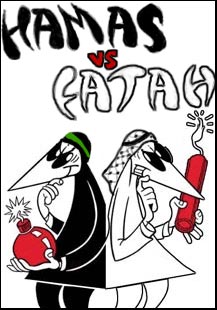
Almost everything about this conflict and Palestinian political behavior, otherwise a mystery, becomes understandable once you see this. Palestinians are in the conflict, but it's not about them. The rise of non-Palestinian proxies for use against Israel - the Lebanese Hizbollah especially - demonstrates this fact in a different way. The Palestinians "never pass up an opportunity to pass up an opportunity" because opportunities of that type are not what they're looking for. Neither are they looking for a constructive politics of the nation-building type. Arafat was not a Washington, a Garibaldi, a De Valera, or a Ben Gurion - that is, "father of his country." It would be best to think of him as a glorified bandit who managed to extort many billions of dollars for himself and his organization (the PLO, or Fatah) from Arab governments and later Israeli and Western governments. Of course, the PLO's replacements, Hamas and Islamic Jihad, are openly theocratic and oriented to pan-Islam. The PLO was indifferent to nationalism; the theocrats are actively hostile.

The scandal of the refugee camps. On top of this is the six-decade disgrace of the Palestinian refugee camps, which continue to exist only because Arab governments and the UN want them to. Even in cases where Palestinian Arab refugees could or could have returned to the villages they fled from during 1948-49 and 1967 Arab-Israeli fighting, Arab governments won't let them. They're not supposed to; that would spoil their role. Instead, in the 1950s, the Arab League extorted from the UN a special refugee agency (UNRWA) just for the Palestinian Arabs, separate from the regular UN refugee organization (UNHCR). No Arab government (with one exception) allows Palestinians to become citizens. These governments typically allow only Muslims as citizens in any case. (The Gulf kingdoms further restrict citizenship to members of the majority tribe.)

The anomaly of Jordan. The one exception to the inability of Palestinians to become citizens in Arab countries is Jordan, Israel's next-door neighbor, ruler of the West Bank from 1949 until 1967 and still claiming it until 1988. When the Arab governments rejected the UN partition of western (cisjordanian) Palestine in 1947, they rejected a potential Arab state in western Palestine - the same entity under discussion today as a "Palestinian state." Lost in the confusion was the fact that "Palestine" is a geographic, not an ethnic or national, term and that it covered areas both east and west of the Jordan River. Carved out of eastern (transjordanian) Palestine, the kingdom of Jordan was created by Britain in 1922 as a consolation prize for the Hashemite dynasty after it was kicked out of Mecca and Medina by the ibn Sa'ud family. The ruling Hashemite family are Arabian Beduin, and the kingdom today remains about half Bedu. The other half are "Palestinian" - that is, Arabs (some Christian, most Muslim) living in towns and villages. Rather than converting the new Jordanian kingdom into "the" Palestinian Arab state (which it manifestly was already), British colonial and foreign affairs officials repeatedly and stupidly encouraged the growth of extremist, rejectionist leaders and groups in Arab Palestine - above all, Haj Amin al-Husseini, the Grand Mufti of Jerusalem, collaborator with Hitler, and reputedly Arafat's maternal uncle - and then reacted with bafflement when such groups and leaders instigated riots and pogroms against Jews, even in places like Jerusalem and Hebron, where they had been living since antiquity.** When the Arab-Jewish conflict over Palestine sharpened into its current form in the 1930s, the British Peel Commission recommended partition of western Palestine into Jewish and Arab parts, with the Arab part awarded to these rejectionist leaders - who didn't want it anyway. These "divide-and-rule" policies of encouraging the wrong people were a central part of what was wrong with colonialism.

While the Peel Commission's 1937 partition lived on in the UN's 1947 partition and the more recent "Palestinian state" idea and seems reasonable on the surface, it evades the big question of the Arab world's lack of democracy. Awarding political sovereignty means "awarding to whom?" and in the Arab world, that means authoritarian monarchy, brutish usurper dictatorship (think Saddam), or no one (think semi-anarchy, like Iraq and Gaza). In the case of western Palestine, it's always meant "radical, rejectionist groups and people" - like al-Husseini, Arafat, the PLO, and now Hamas and Iran. At the heart of their radicalism is a blend of rejection of outside rule (anticolonialism), rejection of outside influences (once anti-Western, now again anti-infidel), and oppression of national and religious minorities (such as the Egyptian Copts, the Kurds, Jews, black Sudanese Christians and Muslims, etc.). Since the latter sometimes had European powers and later the United States as protectors and champions, resentment of these minorities and of infidel outsiders became intertwined, both viewed as threats to Islamic supremacy.

Defeating the rejectionists. Progress toward conflict resolution in the Middle East has historically been possible only when rejectionist forces are weakened, discredited, knocked out, or "turned." Modern Middle East history demonstrates this principle without exception: local progress toward peace in Palestine is enabled when radical forces in the larger region are defeated: 1974-79 (Sadat) and 1988-1994 (end of the Cold War, Iraqi defeat in the Gulf War, followed by Oslo and the Israel-Jordan peace). These regional rejectionist forces are the ones who use the Palestinians (and now the Lebanese Shi'ites) as proxies, and they are the "root cause" of the conflict. The Palestinian conflict is the tail, not the dog; the ultimate effect, not the cause. The Palestinians are important in the Middle East to the extent they're useful as tools to these forces. Torrents of fallacies, big lies, and clichés to the contrary can't change this fact. The end of this month (November 29th) is the 60th anniversary of the UN resolution partitioning western Palestine into Jewish and Arab states, which the Arab states then rejected. Clearing away some of the charter myths of the modern Middle East is an important step toward regional peace.

The main rejectionist force today is Iran and its proxies Hamas and Hizbollah. Defeating Iran, isolating it, "turning" it, or some combination of the three is now the key. Anyone serious about peace in the region needs to recognize this. Thinking otherwise is to reverse cause and effect and misidentify the prime movers of the Middle East's regional conflicts. There is no ground-up politics in the Middle East; it's all "sponsored proxyship" inspired, funded, and armed by bigger players. It's essential again to get over the idea that radical groups in the Middle East represent the mythical "Arab street" or any bottom-up politics. All Middle Eastern politics is top-down; factions become powerful when they're someone's proxy, organized, funded, and armed as such.†

The next steps can include abolishing UNRWA and merging its functions back into the main UN refugee agency, together with pressuring Arab governments to drop discriminatory measures against Palestinian Arabs (although that still leaves the problem of Palestinian Christians).

This is not a question of Palestinians as individuals or families. Political identity is a collective question, with a collective answer. It's not clear what could serve as a political identity for the Palestinians, or even if one is possible. Confusion here is due to misuse of "national" language: the PLO as the "sole legitimate representative of the Palestinian people" - but is there such a people, and is the PLO "representative" in any meaningful sense? It was created as a proxy instrument by Egypt and Syria in 1964. Egypt has since abandoned the cause, and Syria has moved on to Hizbollah. Fatah is certainly incapable of functioning as a government - it was never set up or intended to be such.

The Arabs of Palestine have been used for eight decades as the tip of someone else's spear, held by successive rejectionist states and groups in the Middle East. They're organized as a proxy army and a form of "human shield" politics. These conditions are the root of the sick nihilism that has been normalized among Palestinians. No one is born that way; they have to be brainwashed into it. And they have been, as a part of being used as someone else's tools of violence.

POSTSCRIPT: In the last 30+ years, the Western media has turned away from its once forthright pro-Israel stance toward the fake "noble savage" claptrap of the New Left, with disastrous effect on journalistic standards. Occasionally, the "open secrets" of postmodern journalism in the Middle East come into sharp focus. One such recent case was the al-Dura trial in France, an example of the pervasive irrationality of contemporary journalism and the ease with which it can turn into a postmodern blood libel, a deadly mix of propaganda and ignorance. PajamasMedia covered it extensively; plus don't miss this essay by Melanie Phillips.

ANOTHER POSTSCRIPT: This posting was inspired, in part, by Haim Harari's wonderful book, a fine analysis, on this and other topics, done by someone who still believes in progress and truth - liberal in the correct, older, and almost forgotten meaning. Thinking like this is often called "conservative" nowadays, but only because the right word has been usurped by the wrong people.

Earlier I mentioned Amos Oz's novel-like autobiography of growing up in Jerusalem in the 1930s and 1940s. Many regard it as his best book. People have asked me, if Edward Said was a fraud, are there real Palestinian authors worth reading? Indeed there are, for example: Sari Nusseibeh and Anton Shammas, one Muslim, the other Christian. Agree with them or not, they are actual Palestinians.

All four books are enhanced by another, Orhan Pamuk's Istanbul, a memoir of the novelist's youth in the former capital of a once-great empire.
---
* Until recently, there was a large overlap between the two groups, and Palestinian Christians have always had strong incentives, both "push" and "pull," to just get up and leave. (OTOH, Arab Christians played a disproportionate role in secular Arab nationalism, having the most to gain from it - and having the most to lose from the Islamic revival.) As the conflict has moved back toward a Muslim-Jewish religious struggle and Arab Christians have felt increasing pressure from Muslims to subordinate themselves or convert, the "push" reasons have gotten stronger. The main "pull" is the fact that Palestinian Christians have always had an easier time integrating into Western societies.

And apologies to Antonio Prohías! :)

** Thereby demonstrating that the crux of the conflict is one of political sovereignty, not just Jewish presence. After spending the war in Berlin and trying to recruit Bosnian Muslims for the SS, al-Husseini was tried, convicted, and sentenced to death in absentia by the Nuremburg War Crimes Tribunal. After the war, he fled to Syria and later died in Lebanon. He was also a probable participant in the successful 1951 assassination plot against King Adbullah of Jordan.

Because they share common enemies, the ruling Jordanian Hashemites and the Israeli government secretly cooperated for many decades (long before the formal peace between the two countries) to defeat what I have called here "rejectionist" forces threatening both of them. The most famous instance was the Israeli offer to help the late King Hussein stop the attempted PLO coup in 1970 ("Black September"), which set off a brief civil war in Jordan and led to the PLO's forced removal to southern Lebanon.

† A different example, with more direct impact on Americans, is the multifaceted al-Qa'eda network, germinated by Saudi Arabia and Pakistan. It might seem strange that governments technically friendly to the United States and other Western countries would sponsor such dangerous organizations, but they're useful to countries - like Saudi Arabia and Pakistan - that lack political legitimacy and promote religious radicalism as a substitute for nationalism. Not that they fit traditional Islamic criteria of legitimacy either: they're not successors of Muhammad. The simplest way to satisfy that is to be one of Muhammad's descendants - which the monarchs of Jordan, Morocco, and the smaller Gulf states are, but not the rulers of Saudi Arabia or Pakistan. They're usurpers by traditional Islamic standards and, at the same time, fail to meet modern criteria for democratic legitimacy.

Labels: , , , , ,

Tuesday, November 06, 2007

Armenians, Turks, Israelis, and Jews II

It would better if Turkey had continued its pre-1990s attitude of ambiguity towards the Ottoman empire and its final decades as "the sick man of Europe." That would at least make a good starting point towards recognition of what the wartime Ottoman government attempted and partly succeeded in doing, and why.

But that was not to be. In the last 15 years, Kemalism has suffered not only attacks from the outside (from the Islamic forces that deny nationalism, secularism, and republicanism), but also from an internal identity crisis. Instead of reaffirming Ataturk's basic commitment of Turkey toward a European future, Turkey's secular elites have fallen into a powerful Ottoman nostalgia, lamenting the empire's final days as a vanished golden era of Turkish power. It is not Kemalism that is the problem, but the abandonment of it. Turkey's elites are now in the grips of a romantic swoon - like Gone with the Wind - with the usual highly selective historical memory.


What about the Kurds? The Kurds are a Muslim, but Indo-European, people who speak a language closely related to Farsi (Persian). They live mainly in the mountainous areas of northern Iraq, a tip of Syria, part of Iran, and a large chunk of mountainous eastern Anatolia. They have never had a unified state, although they have produced famous Muslim leaders such as Saladin, who defeated the Crusaders in Jerusalem in 1187.

The Kurds were vaguely promised a homeland of some sort after 1918. But the facts on ground defeated them. Iran remained independent and neutral. The largest group of Kurds, in eastern Anatolia, came under the rule of the new Turkish republic, and in a strange status, as Muslims but not Turks. The second-largest group of Kurds, centered around Mosul and Kirkuk, were reluctantly herded by Britain, the new Mandatory power under the League of Nations, into what became Iraq. The Kurds of Turkey have suffered from second-class status ever since. The Kurds of Iraq, in recent decades, suffered not just from second-class status, but savage persecution under Saddam, including chemical gassing toward the end of the Iran-Iraq war in the late 1980s.*

The more radical Kurds in Turkey formed a Marxist-oriented guerilla movement (the Kurdish Workers Party, or PKK) that started to revolt against the Turkish state in the 1970s. After the Cold War ended, the PKK lost its old sponsor (the Soviets) and needed a new one. There is circumstantial, but strong, evidence that this new sponsor is - no surprise - Iran. The recent PKK incursions into Turkey (clearly modeled on Hizbollah's attack on northern Israel in June 2006) are designed to provoke Turkey into invading northern Iraq the same way that Israel invaded Lebanon in 2006. In this view, which is probably right, Tehran has an opportunity to create a new international crisis, not only for the US, but to divert attention from its nuclear weapons program - not that different from the Cartoon Jihad of early 2006.

The Turkish Kurds still have grievances, although the post-Cold War period did see a large improvement for them. They were allowed some degree of linguistic and cultural autonomy, although not self-government. That liberalization has petered out, because it ran into more and more resistance from Turkish elites and ordinary Turks in the street.

One final twist: the Kurds and the Armenians hate each other.


What to do? Look at the Israeli attitude. At a human level, free of official obligations, everyone in Israel knows what happened to the Armenians: you merely have to walk around the Armenian quarter of Jerusalem and talk to descendants of survivors. It's a ritual Israelis know well in another context. The newspapers certainly have no difficulty talking about it. But the Israeli ambassadors have a tougher job. Turkey is a key ally of Israel, while the present country of Armenia has formed a strange alliance with Syria and Iran. So on a official level, Israeli governments maintain a careful ambiguity whenever this issue comes up.

Successive American governments have to do the same: Turkey is a key ally in the Middle East and a member of NATO. The US officially backs Turkey's membership in the European Union. Hence the manifesto from the Secretaries of State and Defense. This in spite of the fact that, over the last 15 years, Turkey has developed some nasty new strains of anti-Americanism and antisemitism and is facing apparently insuperable obstacles to its full membership in the EU.

But that doesn't mean people can't know what they know on an everyday level, even if they oppose something as in-your-face as the recent Congressional resolution. There are other ways to work on this problem without turning it into diplomatic high explosive. David Harris, the American Jewish Committee's executive director, explains:
From my experience in tackling difficult relationships, I believe that engagement, not avoidance, is the best strategy. In a perfect world, Armenian and Turkish historians would sit together and review the archival material, debate differences, and seek a common understanding of the past. To date, that hasn’t happened in any meaningful way. I continue to hope that it will. It should. We at AJC have offered our services, if needed, to help facilitate such an encounter. Ninety years of distance ought to allow for the creation of a “safe” space to consider contested issues.
Two important Turkish writers, the novelist Orhan Pamuk and the historian Taner Akcam, have written and spoken at length about the Ottoman empire's final agony and what happened to its Armenians; both now face official prosecution and freelance death-threats for their pains. And it's important to recognize that the problem, while exacerbated by the Iraq war, is not American: Turkey's strange drift and regression result from an internal crisis. The Armenian genocide of 1915-17 is a fact; acknowledgment by Turkey of that fact won't happen unless the more basic crisis of Turkish national identity is constructively resolved. Otherwise, Congressional resolutions will mean nothing. The ruling Justice and Development Party, suspected by many of being crypto-Islamist, is a better bet here than the bankrupt Kemalist elite. Although supporting the JDP involves some risks, better a moderate religious party committed to democracy than decayed imperial stench and a heavy whiff of fascism.

Hrant Dink, an Armenian-Turkish journalist, one of the few Armenians left in Turkey, was assassinated earlier this year by a pan-Turkish fanatic. His funeral was attended by tens of thousands, mostly Turks. He once said he'd rather live in a democratic Turkey that had a hard time admitting the truth about the Armenian genocide, than in an autocratic Turkey that pushed some kind of "official line" on the subject, even if it happened to be the truth.

What Dink was saying was that "official history," like "official science," is a dangerous business. History, like science, works from the bottom up, not from the top down. To acknowledge facts on an individual level is one thing; to manufacture history like a political platform is a dead-end. It serves neither historical truth, nor the dead, nor the living.**

POSTSCRIPT: The national ADL's position has always been to avoid the word "genocide" in discussing the Ottoman Armenians and try to avoid the subject altogether. The New England ADL, facing criticism from local Jewish, Armenian, and human-rights groups, rejected the view of the national ADL, which then fired its New England regional director. (The Boston area has a significant Armenian diaspora, partly from those who fled the Ottomans during and after the Great War.) Eventually, the national ADL changed its view somewhat, but only under intense pressure.

The ADL's national director, Abe Foxman, later complained bitterly about what he viewed as the mistaken "idealism" of other Jewish groups, their refusal to play realpolitik. Undoubtedly, Foxman has a point, and he seems to view himself as the only adult in the room, so to speak. Some have tried to portray this as a conflict between promoting "interests" versus promoting "values." And really, given that choice, who wants to be on the side of "values" - politics is about interests, not values, right?

But the deeper issue here does involve Jewish interests. A world in which genocide is practiced, then ignored and denied - and the ignoring and the denial are essential to the practice - is a dangerous world for Jews, any ethnic or religious minority, and anyone who cares about freedom and human life. As the AJC's David Harris put it,
... as the issue once again heats up in the United States, it’s important to be clear. In a book entitled Holocaust Denial, published by the American Jewish Committee in 1993, the author, Kenneth Stern, an AJC staff expert on the subject, noted: “That the Armenian genocide is now considered a topic for debate, or as something to be discounted as old history, does not bode well for those who would oppose Holocaust denial.”

He was right. Picture a day when a muscle-flexing Iran or Saudi Arabia seeks to make denial of the Holocaust a condition of doing business with other countries. Sound far-fetched? It shouldn’t.

We have many interests as a Jewish people. Protecting historical truth ought to be right up there near the top of the list.

Final thoughts from Victor Davis Hanson.


References

Some standard references in English in print today on the Ottoman Empire, the Armenians, and World War One. Fromkin and Power make extensive use of contemporary and pre-war documents, both published and unpublished, which are not lacking on these topics.

~ Winston S. Churchill, The Aftermath (1929; supplementary volume to The World Crisis: 1911-1918), covers the period 1918-24 in connection to British policy and the Anglo-Greek war against the Turks in great detail. He includes the unforgettable story of how a monkey's bite killed the King of Greece and many more besides. Churchill was both a participant in and an important historian of these events. It covers much else as well, such as the Russian Civil War and the Anglo-Irish and Irish Civil Wars of the same post-1918 period.

~ Rebecca West, Black Lamb and Grey Falcon: A Journey through Yugoslavia (1941). Published the week Italy and Germany invaded Yugoslavia in April 1941, this monumental treatment of the Balkans and modern Yugoslavia is the greatest English-language work of contemporary history of the last century. Along the way, West is detailed and damning about the Ottoman and Hapsburg empires, their final decades of rapacity and oppression, and the huge mess they left behind when they imploded. Her book has had no equal since, but Robert Kaplan's Balkan Ghosts is a fitting sequel, paying repeated tribute to its model, and, like West's book, informs its readers of far-off places of which they knew nothing.

~ David Fromkin, A Peace to End All Peace: The Fall of the Ottoman Empire and the Creation of the Modern Middle East (1989), covers the period 1912-1924, with the greater Middle East (including Turkey and Central Asia) as the geographic frame. Best recent one-volume treatment; indispensable.

~ Samantha Power, "A Problem from Hell": America and the Age of Genocide (2002), covers the major genocides of the last century, from the Armenians in the First World War to Kosovo in the late 1990s; also indispensable.

~ Accounts devoted to the Armenian genocide itself include the books of Graber, Melson, and Balakian. There is also the once-famous novel of Franz Werfel, The Forty Days of Musa Dagh (1934), still worth reading and still shocking.

---
* This episode is also covered in Power's book.

Even the Arabs, Muslim but not Turkish, got a nationalist movement in World War One, although ironically, they were the last Ottoman group to do so - undoubtedly because they were Muslim and the majority and thus had the least incentive to revolt.

** Bush complained recently, in connection with the Congressional resolution, that he can't be put into the position of sorting through the Ottoman empire's history. It's hard not to sympathize - that's too much homework for anyone. Clinton had Yugoslavia, and Bush lept half-blindfolded into Iraq. One leftover Ottoman mess per presidency is enough.

Labels: , , , , , , , , , , ,

Monday, November 05, 2007

Armenians, Turks, Israelis, and Jews I

Maybe I should have blogged this earlier ... and added the Kurds as a fifth to the list. Suddenly, it's blown up in our faces.

The recent uproar over the ADL's flip-flop on the Armenian genocide was a hot topic in the Israeli newspapers when I was in Israel at the end of the summer. All of them - left, right, religious, secular - found the flip-flop bizarre. What happened to the Ottoman Armenians during World War One is common knowledge, and genocide-denial is not a business Israelis or Jews should want to get into. But that was just the beginning.

More recently, the US Congress considered a non-binding resolution endorsing the facts of what happened and labeling it genocide. The resolution has triggered an internal political and external diplomatic crisis for Turkey. Congress had passed earlier resolutions about this, going back to the 1980s, but they were not as emphatic and didn't use the word "genocide."

But it's not just a change in Congressional resolutions. A lot has changed since then in Turkey, and the resolution could not have come at a worse time for Turkish politics or US-Turkish relations. That's why the resolution was opposed by President Bush, former Presidents Clinton and Bush Sr., and by all currently living Secretaries of State.

Since the end of the Cold War, Turkey has drifted farther and farther away from its secular-republican ideology of Kemalism, formulated by the founder of the modern Turkish republic, Mustafa Kemal. Also known as Ataturk ("Father of the Turks"), he organized both critical Great War victories for Turkey: the defeat of the 1915 Anglo-French landings at Gallipoli and of the Anglo-Greek offensive of 1920-22.* While the Ottoman empire's fragments became the pieces later assembled into the modern Middle East, Ataturk retrenched in Anatolia and regenerated Turkey as a national republic, free of its old imperial superstructure. When the Greek-Turkish war ended in 1922, over a million Greeks were expelled from Anatolia, where they had lived since the days of Homer; almost a million Turks were counterexpelled from mainland Greece into Turkey. Alas, no one ever said nation-building would be pretty - but it's not half as ugly as empire collapse.

Ever since, Turkey has been a secular-nationalist republic protected its military. Everyone's heard of the Islamist Refah (or Welfare) Party that arose in the early 1990s and how it was prevented from taking power by the Turkey military. While radical and pan-Islamic thought has gained a foothold in Turkey in the last generation, and Turkey's ruling secular elites have been in a state of corruption and decline for decades, many Turks (not just the army) are devoted to Ataturk's ideal and now view it as their passport to EU membership and becoming a truly Western country.

The Refah party re-established itself as the Justice and Development Party, without an overt Islamic component, and went on to win successive later victories in Turkish elections. They currently run Turkey's elected civilian government. But something else has happened that is less known in the West, something directly related to the present crisis.

The attitude of Kemal and his followers toward the Armenians and the events of 1915-17 was ambiguous. The Turks consistently distanced themselves from Ottoman persecution of Christian minorities (which went on repeatedly all through the empire's final century: Serbs, Greeks, Romanians, Bulgarians, as well as Armenians), while simultaneously denying that the massacre of Armenians in 1915-17 was a deliberate attempt at extermination. Ataturk's military government even prosecuted a few of the final Ottoman government's high offficials for war crimes in 1919-20. The general attitude was that what the Ottoman government did in its final death throes had nothing to do with the modern Turkish republic that arose from the ruins.


Why did the massacre happen? Did it happen? For the bare facts of the case, consult Samantha Power's classic history of 20th century genocide, "A Problem From Hell:" America in the Age of Genocide. The first chapter of her book covers this, the first of the 20th century's great "race-murders," as US ambassador to Turkey Henry Morgenthau, Sr., labeled it while it was happening: about 800,000 to a million Armenians dead. The word "genocide" was coined in the 1940s, by Raphael Lemkin, a Polish-Jewish lawyer struggling to capture the intent and the act in a single word that could be written into laws and treaties that would ban it. Power accepts Lemkin's narrow but unconditional definition: a deliberate attempt, successful or not, to exterminate a national, ethnic, or religious group. It doesn't include fuzzier notions of "imperialism," "cultural genocide," and so on: it's nothing but plain physical extermination. Lemkin struggled with this concept before Hitler's planned and largely completed genocide of European and Middle Eastern Jews; Lemkin was thinking of the Armenians when he did so, not the future fate of his own people.**

To understand why the massacre happened, it's better to turn to David Fromkin's comprehensive The Peace to End All Peace, the most useful modern book covering the end of the Ottoman empire and the rise of the modern Middle East. Fromkin treats the "greater Middle East," which includes Turkey and Central Asia. This larger perspective is essential to understanding the Ottoman empire, why it collapsed, and what happened when it collapsed.

The modern Middle East is often traced, not back to 1918, but to 1798, when Napoleon invaded Egypt, which at that time was loosely attached to the Ottoman empire. His intent was to make Egypt modern, by force, in the same way that the French revolutionary armies were marching all over Europe under the banner of Liberty, Fraternity, and Equality. Napoleon was defeated by the British, and Egypt passed into the control of reforming local rulers such as Muhammad Ali. The Ottomans themselves later adopted such reformist approaches, much like the "enlightened despots" of Germany, Austria-Hungary, and Russia in the same period. To some extent, they were forced to do so by the system of capitulations that European powers had forced on the Turks, by which European powers became protectors of Ottoman minorities and which was widely resented in the empire. The Ottoman realm included Turkish Muslims, but also non-Turkish Arabs, as well as a confusing array of Christian minorities and Jews. These latter were the dhimmis, the subordinated and second-class groups that were tolerated under Islamic law with large legal and political disabilities. The Ottoman empire did not have citizens in any case, but subjects - an important distinction.

The Ottoman reformers attempted to remake their empire into a modern, secular, and liberal polity, but collided with basic realities that eventually defeated them. The largely illiterate rural population, along with urban religious leaders, was firmly attached the institution of dhimma, with women, slaves, and infidels viewed as subordinate groups, while all Muslim males were theoretically equal. Furthermore, the secular-national concept itself was explosive in the Ottoman context, because, setting religious status aside, the empire contained numerous conquered non-Turkish peoples whose interpretation of Enlightenment ideas naturally led toward national independence and self-rule. It did not naturally lead toward equal citizenship under Ottoman rule, which turned out to be an oxymoron anyway: subjects and dhimmis in the end could not become citizens. Thus, starting with the Serbs and the Greeks, later extending to the Bulgarians, the Romanians, the Armenians, and finally the Jews (who came late to the nationalism party), the Ottoman ethno-religious minorities demanded and in most cases, with the backing of various European powers and later the United States, got their independence - but not without a price.†

That price was strong suspicion and eventual persecution by Ottoman authorities. While the Serbs and Greeks, with British backing, won their independence during the Napoleonic era, groups attempting to assert their rights later were savagely massacred by the last generation of Ottoman governments, when they lurched from reform toward violent reaction. The final ruling faction in Istanbul, the "Young Turks" of the 1908 revolution (Committee for Union and Progress), failed in their last reform attempts. Turkish elites were then led to a new solution to their minorities problem - extermination. Under the sway of a super-national, racial idea (pan-Turkism), the government that led Turkey into alliance with Germany in 1914 looked forward to a new, wholly Turkish empire that would encompass the Turkic peoples of central Asia (the "stans" familiar to us today). What would happen to the non-Turkish minorities was up for debate. Some thought they should be killed; others, that they should be kicked out; still others, that Turks should relinquish rule over them. The similarity to the super-national racial idea of pan-Germanism is not accidental: that idea was the seed of the Nazi movement, which, contrary to myth, was not a nationalist movement, but a pan-European racial movement dedicated to the destruction of the European nation-state system and its replacement by a purified racial empire. In this Aryan-surpemacist empire, "inferior races" would be expelled, enslaved, or eliminated. What's critical to understand is that, before Nazism, this "pan" racial idea had an earlier instance in the final days of the Ottoman empire.

While the entire apparatus of Ottoman rule was not redirected toward exterminating the Armenians, it was the policy of part of the wartime Ottoman government, as Ottoman leaders admitted to their German allies once the massacres were underway. The Ottoman Armenians had cousins across the border in Russia, Turkey's historic enemy. (There was no independent Armenia then; Russian Armenia was ruled by the Czar.) Those Armenians were fervently pro-Russian, and the Ottoman government had reason to suspect the loyalty of its Armenians. The Russians and the Russian Armenians tried to set up an independent Armenian government when they conquered part of Turkey. But the Ottoman Armenians remained resolutely non-political and did not rise to the bait. Contemporary accounts - from then-neutral Americans and from Austrian and German observers stationed in Turkey to help their ally - show rare unanimity on the situation in Ottoman Armenia in 1915: it was quiet.

Some (including many in Turkey) try to use the Russian attempts to get the Ottoman Armenians to rebel as a rationale for the massacre. And if the Turks had merely interred or expelled the Armenians, it would be easier to rationalize. But to see that motive as the basis for the forced deportation and starvation that ensued in 1915-17 is to miss the point. The Ottoman government wasn't just trying to prevent an Armenian "fifth column." It was left by 19th century Ottoman reformers with an impossible dilemma and found a dazzling modern solution - genocide. The war just accelerated the genocidal tendency of Ottoman minorities policy already latent in the preceding generation; the genocide was not a strategy for Turkey to defeat Russia, anymore than the Holocaust was a strategy for Germany to defeat its enemies 30 years later. In both cases, genocide was a goal in its own right.

It also marked a large break in the nature of governmental persecution of minorities - one that shifted from the millennial focus on religion to the apparently "scientific" basis of race. The technological and organizational powers available to the modern state had opened up new vistas of mass murder unavailable and unimaginable to previous eras. The lesson was not lost, especially on Hitler.
---
* This is a reminder that, while World War One ended on November 11, 1918 in the West, in the East, with regards to Russia and Turkey, it didn't really end until 1922, after the Russian Civil War, and after Ataturk drove the Greeks out of Anatolia and established the Turkish Republic. Along the way, he abolished the Ottoman caliphate and renounced Ottoman claims over the defunct empire. The 1922 settlement was formalized by the Treaty of Lausanne, which replaced the Treaty of Sèvres, signed in 1919, that had been far more favorable to both the Christian minorities and the European victors.

Among other things, the earlier, harsher Treaty of Sèvres required the Ataturk government to try the Young Turks responsible for the Armenian atrocity - which it did. Several were even executed. The Armenian massacre left a strong impression among the Allied governments that Turkey could not be trusted with rule of non-Muslim minorities or even non-Turkish Muslim Arabs.

** Power's own book is, in part, a contemporary continuation the original human rights movement in the 19th century. Its main early manifestation was abolitionism, and Americans tend not to be familiar with its later development - under the influence of Christian missionaries in the Middle East and Africa - into the immediate ancestor of the "human rights lobby." It is the fruit of a characteristic liberal-Protestant and Anglo-American ethos of the 19th and early 20th centuries, exemplified by such figures as Lincoln, Gladstone, Lloyd-George, and Wilson. More recent examples - such as Jimmy Carter and George W. Bush - mark the later decay of this tradition.

† The entire relevant chapter from Churchill's memoir, The Aftermath, is worth reading (chapter 18, "The Greek Tragedy"), as Churchill was a contemporary observer, helped to instigate the failed Dardanelles campaign of 1915-16, and tried to correct the pro-Ottoman apologetics already then spreading in the 1920s that attempted to rationalize the Armenian massacre. Enemies in the Great War, Britain and Ottoman Turkey had been allies in the nineteenth century, and, in 1914, a significant residue of support for Turkey remained in Britain, especially in the Conservative Party. OTOH, the Liberals, led earlier by Gladstone, had been a thorn in the side of the Ottomans as they launched a final wave of massacres against their Christian subjects in the 1890s.

The first major English-language apologist for the Ottomans was British historian Arnold Toynbee, who was also an antisemite. Toynbee claimed that the Armenian massacre was merely wartime Allied propaganda. While it is true that the Allies made effective use of the Armenian massacre in their propaganda, the distrust and horror of Ottoman minorities policy was real and deeply-rooted, and for good reasons. The most damning evidence on the massacre is precisely the records of the German and Austrian missions in Istanbul, not publicly available until after 1918. The ambassadors were convinced by mid-1915 that the Young Turk government meant to exterminate the Ottoman-ruled Armenians. Without guidance from Berlin or Vienna on the issue, they protested verbally but made only feeble attempts to stop it and publicly rationalize for their ally. Individual Germans and Austrians did undertake some attempts to save the surviving Armenians.

Churchill's First World War memoirs are not read much here in the US. They're far more relevant to what we're seeing now - in Turkey, Iraq, Afghanistan, and Pakistan - than his better-known Second World War memoirs.

Labels: , , , , , , , , ,