Monday, April 28, 2008

Culture and conflict in the Middle East
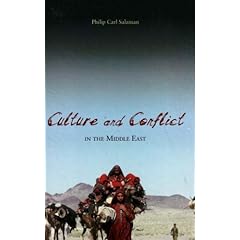
Many in our post-modern, "post-liberal" society, intimidated by the pseudointellectualism of the half-educated, stumble when they encounter the unfamiliar world of human societies very different from our own. It is here that the politically correct often find the most profitable point to ram home their confused but potent messages of cultural relativism and nihilism. The spread of higher education in the last 60 years hasn't helped: as an unexpected side effect, it's created an entire class of such people. They know less than they think, and what little they do is garbled and half-baked.

It's refreshing when an anthropologist, used to working in a specialized research in remote parts of the world, addresses the general educated reader with his decades of experience in studying pre-state and tribal societies and simultaneously illuminates an issue of pressing importance. Such are Philip Carl Salzman and his new book, Culture and Conflict in the Middle East. Salzman has taught anthropology at McGill University in Montreal for many years and was a founder of the Commission on Nomadic Peoples of the International Union of Anthropological and Ethnological Sciences. His main research has been the study of the tribal peoples of Iran and Pakistan, in the anthropological mode and thus mainly on the "structure" of their culture. (However, his book does have a fair amount of recent history and some memorable personalities as well.) Anyone familiar with so-called "primitive" peoples will recognize the general point: they're materially primitive and have no government or state; but at the same time, they have an elaborate culture of tribal custom and lore that takes an outsider many years to fully understand. That aspect of anthropology is anything but primitive.

Readers of this blog will recognize the general thrust of Salzman's argument about the nature of tribal society, especially its Middle Eastern version: the unique intertwining of Islam and tribalism, very different from the other great universalistic religions (Christianity, Buddhism, later Judaism) and even from most other, non-universalistic religions (Hinduism, earlier Judaism, classical Greco-Roman paganism); the pattern of conflict along the lines of "balanced opposition," familiar in somewhat different language as the "power challenging" of Pryce-Jones, in his classic, The Closed Circle.** In fact, the similarities to Pryce-Jones are striking, but Salzman's book is shorter, less dense, and focuses on just one large anthropological point. Like Pryce-Jones, Salzman has a precursor, the brilliant scholar and historian Ibn Khaldun, the 14th-century North African author of a universal history with a famous, lengthy philosophical-anthropological preface, the Muqaddimah. Salzman makes liberal use of Ibn Khaldun's ideas about the cycle of Islamic history, the circling from tribal invasion and conquest of decadent, sedentary cities; to the tribal conquerors themselves becoming sedentary and decadent; to their being overthrown by another tribal invasion. The prototype was the original Islamic conquest itself, in the seventh century.
Tribal societies worldwide, Muslim or not, are based on "balanced opposition," with the power to use legitimate violence spread equally among all adult males, regulated only by charisma and luck. This system is incompatible with civilized life and the state, which monopolizes legitimate violence. It is perfectly adapted to nomadic life, but fails when transplanted to sedentary ways. "Balanced opposition" creates endless, unresolvable conflict by its very nature, because it contains no larger peacemaking power: no state, no social contract, no force of public opinion outside small tribal groups. It survives only because (and if) each segment of society is balanced in size against other segments. Oppressive and exploitative states emerge when one group acquires overwhelming power against other groups - then winner takes all. That is how most states emerged historically, in fact. They didn't come into existence to serve the public good. Anthropologists are typically sympathetic to non-state tribes if and when they are crushed by these classical tyrannies - it would be hard not to be. But don't romanticize: the freedom of tribal life is collective. It's not individual freedom, which is a late product of advanced civilization, with civil government and the rule of law.

It's not as if Middle Eastern peoples themselves are blind to the nature of this system. There is a famous Arabic saying: I against my brother, my brother and myself against my cousin, my cousin and I against the world. Islam might have overcome this problem to create a state or states founded on rule of law, but it failed to do that. Instead, the tribal way re-emerged, mixed with Islam (I and my cousin against the non-believer), within Islamic civilization itself. This system, incompatible with the traditional state, is obviously even more incompatible with the modern liberal-democratic state, with its essentials of rights, citizenship, and the public good. The tribal world has exact replacements for each of these, making it self-sufficient and self-contained. The autobiography of Ayaan Hirsi Ali, reviewed here earlier this year, is one large demonstration of these truths by specific example.

It shouldn't need to be said, but I'll say it anyway: modern anthropology is not about social Darwinism or feeling superior to "savages." It's about the power of culture, because humans are cultural animals. They certainly do not function by instinct. Most humans through most of history (including the ancestors of everyone reading this blog) lived in something like this system. The same raw material of human nature is at work among civilized peoples as among as "primitive" peoples, but the collective shape of culture is different. Primitive peoples have many of the same values we do: individualism (at least among adult males), self-interest, notions of fairness and justice. But, in contrast to modern civilizations, nomadic peoples are dominated by group loyalty, with honor and shame typically the overriding motives. It's all there for a reason, because amongst us, we have a substitute that functions in their place: the rule of law, constitutionalism, and an openness to crossing group boundaries. It's just what makes peaceful cooperation and progress possible. At once a source of durability and backwardness, their lack is what makes progress in tribal society impossible.

Most of Salzman's message would have been unexceptional up until about 25 years ago. Since then, liberal academic and intellectual culture has been been subject to the obfuscatory fog of "post-colonialism" (Said). Many in the Arab-Islamic world itself are aware of these conflicting values and critical of the tribal system. The imposition of tribal ways on the Near East's civilized peoples by the Arab-Islamic conquest was the seed of their later decline and these societies' present difficulties in coping with the modern world.* But Said-ian doctrines are so many clubs with which to beat these critics. It's one of the most noxious contributions of the post-modern and post-liberal West to the rest of world and has crippled political debate and clear thinking in Western societies themselves.

POSTSCRIPT: Jared Diamond discusses conflict and revenge in tribal New Guinea here.

As he says, people living in state societies (societies with civil government) and, even more so, living as citizens in modern liberal democracies, have a hard time coping with the conflict between organized killing implicit in war, "civilized" warfare between armies or not, and peacetime life. In tribal societies, the conflict is not felt: there is no sharp boundary between peace and war, or between impersonal justice and simple vengeance. Men aren't ashamed of their killings, but boast of them. It's not exactly the way Hobbes conceived it - tribal life is far from solitary - but he came pretty close to depicting the "state of nature." What's particularly astonishing is that in many tribal societies, most adult males are involved in some way in the killing of other adult males. The obvious advantages of having governments were not strong enough, until recent human history, to overcome the ingrained taste of tribal peoples for their traditional collective freedom.

An interesting corollary of Diamond's analysis is that it explains why so many such tribal societies accepted colonial rule by outsiders so quickly: it reduced or eliminated internal conflict.

Diamond concludes with a relative's harrowing story of the Holocaust and the dilemma those of us who refrain from executing justice on our own face when the state doesn't keep up its end of the bargain.
---
* Ironically, the Arab group that Israel has the fewest conflicts with is the Beduin of the Negev and Sinai deserts. Being nomadic, with no economic need for land to grow food or political claims to sovereignty, they view modern states and borders as little more than nuisances and just slide past them.

** Judaism is a bit of an odd duck here, no doubt because its origins lie in the late Bronze Age (second millennium BCE), before the rise of universalist religious and philosophical thinking in the first millennium. This epoch, the so-called Axial Age, saw the pre-exilic and post-exilic Hebrew prophets, Zoroaster, Siddhartha Gautama (Buddha), Confucius, Lao Tzu, and the philosophical movement among the Greeks. Developments in later antiquity, such as Hellenistic science and philosophy (Stoics, Epicureans, Aristotelians, Platonists), Christianity, rabbinic Judaism, Islam, and Confucianism were secondary outgrowths of the Axial Age. Judaism straddles the earlier tribal/national and later universalist/philosophical eras, with its universal truths implicit and esoteric in biblical times, and open and explicit in later eras. No other religion has seen so much creativity generated by such a tension between the particular and universal.

Labels: , , , , , , ,

Sunday, February 24, 2008

A culture is a terrible thing to waste

Here's a lesson in cultural decline. Consider one of the greatest natural scientists ("natural philosophers") of the Arabic-Persian golden age, Alhacen of Basra, who lived in the later 900s (see here and here). Then contrast with this flat-earth theorist of present-day Iraq (video clip requires WMP).

What a difference a millennium makes.


This may seem like just shooting fish in a barrel. But here's a serious point: in the West, we're used to progress - the future is better than the past. In our conceited arrogance, we even think progress is automatic, like getting on an UP escalator.

In fact, progress is anything but automatic. It needs the right conditions. We've had those in the West since the late Middle Ages, with some occasional, if terrible, interruptions. The right conditions are always under threat from ideologues, fanatics, and people with obsessive fixed ideas.

Now imagine you live in a land of regress: the past is better than the future. The regress may have been going on for so long - say, seven or eight centuries - that it seems automatic. Of course, that's not right either. But in your land of regress, there are people - including some important and powerful people - with a vested interest in decline. Turning things around seems threatening to them. To make their point, they even get violent.

Labels: , , , , ,

Friday, January 25, 2008

Empires and nations

The earlier postings on Armenians, Jews, Turks, and Israelis (and Kurds!) cut a small way into the Big Issue of empires versus nations. A century ago, much of the world's population lived in multiethnic, multireligious empires, ones rules by a dominant group defined by ethnicity and often religion, with other ethnic and religious groups subordinated in political power and civil rights. Some countries (like the United States and France) were already republics, while others, like Great Britain, had mixed republican-imperial features, a combination of aristocracy and popular representation. But the imposing, centuries-old structures of the pre-1914 era were empires like the Austro-Hungarian (dominated by Austrian Germans and Hungarians and which ruled over Christians, Jews, and even some Muslims), the Russian (which ruled over many non-Russian Christians, as well as Jews and Muslims), the Ottoman (which ruled over non-Turks and non-Muslims), and the Chinese (ethnically mostly Han Chinese, but with a mix of languages). Once empire and theocracy were the way of the world. But they have had their day.

The last century has seen a dramatic growth in the number of nation-states and the dismantling of empires, in three major waves: after World War One, after World War Two, and after the Cold War. Clearly, if we want to understand the modern world, we need to, not just note the fact, but understand the why. Let's step back and take in the basic forces at work here.

The most fundamental is the incompatibility of empire and modernity - they're as incompatible as tribalism and modernity, or modernity and theocracy. National self-rule is essential in the modern world and, indeed, one of the pre-conditions of "being modern." The political unit of a nation-state, republic, or representative democracy is a citizen, who has equal, or nearly equal, rights with other citizens. Citizens participate in society (in political life, but not just political life), a sine qua non of constituting a modern society. Political and social units are integrated to an historically unprecedented degree. Empires, with their aristocracies and monarchies, were a whole world apart. Their political basis was narrow. Their political units were radically heterogeneous and unequal: ruling castes, and conquered ruled with varying levels of granted toleration. Outside their narrow political bases, empires often had ignorant and backwards - and in all cases, helpless - populations. These were subjects, not citizens. This type of political structure is compatible with theocracy as well, although it isn't a requirement.

From the fall of the western Roman empire in the late 400s, it took 1200 years for nations-states to be accepted in principle as the organized basis of political life and, even then, only in western Europe. It took another 300 years to sort out which nations would have states, a not-entirely settled issue even now. This question lies at the root of the great partition wars of the last century, the largest being India, but also encompassing Palestine, Cyprus, and Ireland, for example.

At the highest level, this is the evolution at work in the Middle East and Africa, which the nation-state principle and practice are still not fully accepted or even understood. Outside the West, the rise of radical Islam is the main force today in conflict with nationalism. Within the West, there is increasing confusion - especially in Europe, and especially among European elites - about the necessity of nationalism, instead of empire. (The EU is, in some ways, an empire-by-stealth, what happens when nations given up their sovereignty to non-representative supernational institutions lacking democratic legitimacy.) And Europe might very well be faced with theocratic demands in another generation. Already, parts of certain European cities have seen the abandonment of state sovereignty to Islamic-tribal custom, the first such development since the end of the Middle Ages.

Europeans and some Americans might be surprised to hear this. A central postmodern myth, upon which the EU is built, is that World War Two discredited nationalism. The problem is that for the countries responsible for World War Two (primarily Germany, as well as the Soviet Union to a smaller extent) were not fighting for nationalism, but for supernational ideals, like racism. (Nothing will destroy a nation-state faster than racial ideologies - the two are incompatible.) In any case, Europe's great nationalist moment was not 1939, but 1914. Even then, the First World War was a result of the implosion of the empires of central-eastern Europe, not something about the nation-states of western Europe. These empires had started economic and social modernization before they were politically modern, which in turn created impossible contradictions that then did them in. Their final manifestations were the supernational or "pan" ideologies, like pan-Turkism, Aryanism, and other racist movements.

To be part of the modern world means, among other things, living in a nation-state. That excludes much of the social and political practice that dominated human existence for most of recorded history and all of prehistory. For those of us living on the other side of this divide, the historical reality is often forgotten. When we encounter conflicts across this divide, we look around at how we live, but don't see; hear, but don't listen.

Labels: , , , ,

Saturday, January 12, 2008

Rock the casbah

This posting isn't really about that venerable song by the Clash ... but it sounded cool :)

This weekend's Wall Street Journal had a very interesting article on the possibility of an independent and critical scholarship of the Qu'ran, similar to the sort of thing that Christian and, later, Jewish scholars achieved in the last 300 years with regards to the Hebrew and Greek scriptures that make up the Bible. German scholars at the forefront of "Oriental" research made a start from the end of the nineteenth century, until the rise of the Nazi regime. The project was suspended and much of its materials (photos of old Quranic texts taken in the 1920s and 30s) apparently lost during the war. The subject is also, of course, one of extreme sensitivity in the Muslim world. Nine years ago, the Atlantic Monthly published a prescient article on the subject, and the politico-religious minefield around it, available if you can find a print or online database copy of their January 1999 issue. (It's available on the Atlantic site only to their subscribers.)

The Journal article announces a stunning discovery: the photo archive was not actually lost. It survives and has been made publicly available. See here and here for more.

POSTSCRIPT: Here we go again with the mindcrime of publishing the Danish-Muhammad cartoons, accompanied by the same weird mixture of the medieval and the postmodern (charges of blasphemy mixed with bogus charges of victimhood). See the brilliant videos from the ludicrously misnamed Ontario "Human Rights" Commission here.

No Danes or Canadians have committed violence against Muslims because of the cartoons.

Labels: , , , , , ,

Friday, January 04, 2008

Meet the thinkers: Ayaan Hirsi Ali

I just finished reading Ayaan Hirsi Ali's autobiography, Infidel. You can read here about her opinions and thoughts on politics, the West, and Islam. But in this book, she wisely chose to tell her story personally. Abstractions often wash over and through our minds - easy come, easy go - but facts and events like those of Ali's life will not wash over and through anything - they will stick in readers' minds for a long time. Infidel is a powerful book and must reading for anyone in the West who wants to understand the unfolding confrontation of Islam and modernity, and avoid diversionary rationalizing. Women, particularly young women, should especially read it. Muslims should read it as well, for a whole set of different, if overlapping, reasons.

Ali's books (Infidel, as well as the earlier The Caged Virgin) and film Submission Part I (the later parts remain unmade after her partner Theo Van Gogh's murder) don't force her own answers on her viewers and readers. But they do push unavoidable questions to the fore and provoke everyone to consider their own answers. Her attitude is a refreshing and positive contrast to the proselytizers of the "new" atheism popular of late.

Her encounters with Christianity and its concept of a covenantal or "partnership" relation between man and the divine forced her to see something contrasting about Islam, a word that means "submission" in Arabic. (Muslim means "one who submits.") Lurking around here is an old argument about whether a "social contract" style of civil government is even possible in the Muslim world. The "social contract" of Western governments has its ultimate roots in the the biblical notion of covenant. It's different from autocratic government (rooted in conquest and overlordship) or the clan-aristocratic political culture of the ancient and medieval worlds. Theocentric in its original form, the humanized covenant becomes a contract among people, reflected in constitutions and consensual and representative forms of government.

What is a consistent approach to this war for the world, this contest between Islam and modernity?* This is not a conflict we can decide; Muslims have to. But we can consistently follow the rule that sticking to our rights is the best policy: defend ourselves and maintain the firm view that peaceful interaction between Muslims and the outside world is possible - if Muslims are willing to treat non-Muslims and "deviant," liberal, and secularized Muslims as equals. That's a big "if." The decision is theirs to accept or reject, not ours. But our response to the Muslim decision, either way, should be unapologetic.

Ali's larger and unmistakable point is that the West must abandon the claptrap of multiculturalism and its attendant subcults of victimhood and noble savagery. Ayaan, daughter of Hirsi, great-granddaughter of Ali, has been there and done that, and it's no fun. People are equal; cultures are not.

POSTSCRIPT: Read Ali's brief self-explanation here at Cato (PDF), and listen to a 2007 NPR interview with her here.
---
* And, by the way, these days, the world's only real war on women. Read Anne Applebaum's review of Infidel at the Amazon page.

Labels: , , , , , , , ,

Monday, October 29, 2007

Mahmoud, we hardly knew ye

He stayed too long, but not long enough really ....

SNL does it again, this time with Andy Samberg's love-note music video to Ahmadinejad. Unfortunately, the video was yanked from the Web because of a copyright clearance snafu.

Ahmadinejad spoke in September at the United Nations and at Columbia University in New York in person and at the National Press Club in Washington DC by teleconference. See these summaries here and here.

Columbia, like so many universities these days, disgraced itself. Or maybe, it was a superb opportunity to let the students and New Yorkers off campus to show up the ridiculous administrators and faculty. The students and New Yorkers acquitted themselves well.

Not enough Said, I guess. For a wackily surreal sidebar on Ahmadinejad's visit and more evidence of the decline of American universities under the reign of political correctness, check this out. Anti-colonialism apparently now includes beating up gay men. I guess none of these bozos have ever read any medieval Arabic or Persian love poetry.

Is it just me, or is something completely off the rails here?

Which leads to the final comment, from funny man Andy Borowitz.

POSTSCRIPT: It's not all bad news from the Middle East. Some Israeli doctors are examining Iraqi children in Jordan for heart conditions that can be treated at the Wolfson Medical Center in Israel. See here.

Labels: , , , , , ,

Monday, March 05, 2007

The falling star of Edward Said

One of the most influential and damaging intellectual trends of the last quarter century - one that still echoes in academic and media culture - was set off in the late 1970s by the publication of Edward Said's Orientalism, a superficially serious attack on an entire academic discipline whose history stretches back to late medieval times, with an intellectual pedigree reaching back further to Herodotus. The book simultaneously exhibited shoddy scholarship, execrable writing, and bad faith; while at the same time demonstrating a sharp eye for catching the then-rising academic wave of junk post-humanism: post-structuralism, post-Marxism, post-colonialism - all later to known to most of us through post-modernism and political correctness.

The consequences have been unrelievedly awful - for academia and general intellectual culture - enthroning a sanctimonious ignorance-cum-PC mythology that rules in certain quarters concerning the Middle East. Based on the undeserved deference paid to him, Said's quackery has been institutionalized in certain universities as "Middle East studies," a PC parody of an older, real academic discipline. The writings of real Arabist and other Middle Eastern scholars against Said - such as those of Bernard Lewis and Martin Kramer - were not enough to stop the spread of the virus.

Dangerous Knowledge, an important new book by Robert Irwin, a prominent British historian, literary scholar, and Orientalist himself, marks a turning of the tide against this ascendancy. The book has received almost entirely favorable reviews (see here, here, and here) - a clear sign that the post-modernist lunacy hatched in academia a quarter century ago is abating. Unfortunately, the entrenched legacy remains. Orientalism, Irwin summarizes, "seems to me to be a work of malignant charlatanry in which it is hard to distinguish honest mistakes from willful misrepresentations."

Said's doctored autobiography as a Palestinian refugee contributed to this debacle and helped to delegitimize real scholars and real scholarship. (See here for a free summary and here for discussion.) Said's position at Columbia also contributed strongly to the rise of "Middle East studies" there and elsewhere, a critical component of political correctness. That in turn has led to censorship and intimidation of Jewish and other students, abetted by the usual administrator spinelessness. But as always with the Middle East, "radicalism" also weirdly converges with the "realist" establishment (Baker, Carter), lubricated and backed by oil money.

In reality, Said was from an upper-middle class Egyptian Christian family and educated in Egypt and the US. (Further irony: his family, as Christians, were dispossessed and exiled: from Egypt, by Nasser's revolution in the 1950s.) He later became a successful literary critic who, in the 1970s, re-invented himself as an oppressed Third World peasant and then began shoplifting other people's identities. He created a potent academic cult around himself made up of gullible followers who thought, "He must know what he's talking about - he's one of them." His cult represented an historic failure to tell the truth about Islam and the oppression of non-Muslim and non-Arab minorities in the Islamic world.

Instead, he concocted for the Arab world bogus claims of victimhood as a postmodern layer pasted on a deeper and older layer of theocratic and tribal intolerance. Said's influence validated the suffocating and sometimes violent obscurantism that has engulfed the Middle East in the last 30 years. His ideas have been consistently used as they were intended: clubs to intimidate and strangle free thought. Orientalism caricatures many of the great Western scholars of the Near East of the last few centuries - all of whom probably forgot more than Said ever knew - omits critical facts that undermine Said's argument, and shows a sometimes astonishing ignorance of history and even geography. Instead, the book combines the barely-comprehensible agit-prop of late Marxism with the then-new jargon of post-modernism - and in 1978, failed to anticipate the fall of secular nationalism and Marxism and the rise of Islamic radicalism. Said spent the last decade of his life rationalizing his multiple stories, while spreading a fog of misinformation about the Middle East and pursuing a now-familiar dual career of printing xenophobic nativism in Arabic-language publications, then elegantly repackaging this poison for Western audiences.

That makes Christopher Hitchens' favorable review of Dangerous Knowledge all the more remarkable. Hitchens was a friend of Said and wrongly defended him when Said's embroidered tall tales were exposed. Writing this review not too long after Said's death must have been a painful exercise in honesty and bidding adieu to a documented fraud. Hitchens has emerged as a brilliant critic of the modern Middle East, its intolerance and oil money corruption. (See his earlier 2003 retrospective on Orientalism here.) Said posed as an alternative to this pre-9/11 status quo. In fact, he offered an escapist fantasy that appeals to the historical ignorance and passionate self-hatred of Western leftists. To his very great credit, Hitchens has slowly backed away from the moral squalor of the man and his ideas.


Is there no greater contrast than with Asia? Here was a clash of civilizations that started in the 19th century, when modern Europe encountered then-declining Asian societies and came to influence or control them, then was overlaid with 20th-century ideological conflicts (World War II, Cold War), sometimes mixed in confusing ways, as in Vietnam (confusing to Asians, not just to us). The rebirth of Asian civilizations, under the impact of Western ideas and technology, is complete, after a seventy-year period of wars and violent revolutions. The interaction of the West and Asia since about 1980 has been peaceful, and the exchange between the two is now extensive. While you still hear occasional grinding noises, the "clash" has been converted into a productive symbiosis, with the two maintaining distinct identities even as they borrow from one another. Only a few relics remain from the war-revolution era: North Korea, Burma, and the Chinese Communist Party (in form only, not in content). Even appeals to traditional Chinese concepts of Confucianism play less and less role in Asia.

The Middle East is obviously different, in a politically very incorrect and devastating way. As someone famous once said, Asia solves more problems than it creates, while the Middle East creates more problems than it solves.* The Middle East no longer forms an important civilization. Take away its oil money, and you have a region as backwards as and poorer than Africa. (For example, the Arab world publishes fewer new Arabic books a year than does Israel, its supposed mortal enemy; it has produced fewer translations in four centuries than Western countries publish from Arabic in a year.) Its powerful mix of tribalism and religious intolerance is what makes the place so intractable, unlike Asia. Lewis' classic essay on the "roots of Muslim rage," published in 1990, still hits the mark.

In place of a public culture based on facts and realistic history, the Middle East is dominated by a phantasmagoria of imaginary dream palaces. Not a civilization either, it is rather the collapsed ruin of one, like one of those decayed grands maisons you see at the edge of an old town. It doesn't produce much beyond oil and, technically, doesn't even produce that. In place of the unraveling foreign policy paradigms of realism and liberal internationalism, neoconservatism has had its day in the sun recently and been given the chance to tackle the issue. There are many things wrong with neoconservatism (that's a whole other discussion), but here I want to zero in on one thing: the false idea that the Middle East is "ripe" for constructive and quasi-Western political change. (Even Lewis, as smart as they come and not a neoconservative, has bought into it.) There's no evidence for this; all the evidence is opposite and virtually screams "No!" The Middle East has been moving away from European-inspired paradigms (liberal democracy, nationalism, fascism, communism) for more than a generation and shows few signs of turning in a different direction.

The decline of the Arab nation-state and secular Arab nationalism has created a void that radical pan-Islam is trying to fill. No factor has contributed so powerfully to the strength of radical Islam than the feeling that it has no serious opponents in the Muslim world. It opposes the existing, largely illegitimate state structure of the modern Middle East, but at the same time, derives major support from those states, such Egypt, Saudi Arabia, and Pakistan.

Lacking much introspection or self-examination, hatred in the Islamic world has classically been directed outwards. (The violence directed at apostate, deviant, and lapsed Muslims is a more recent phenomenon.) The broad features of the spread of Islam - conquest, forced conversion, triumphalism combined with a contemptuous rejection of the pre-Islamic past - continue to shape the Islamic world, including its complete unity of the political, military, and spiritual. The contrast with Christianity could not be more complete - its division of spiritual and worldly, its emphasis on inward examination and change, its absorption of the classical and Hebrew past by Christianizing instead of simply rejecting it, its religious violence largely directed inwards, Christian against Christian.

Of course, Mohamed wasn't thinking about these issues in the seventh century. By all evidence, he was seeking to unite disparate Arabian tribes into a super-tribal religious "nation" (the `umma). But he only partially succeeded. The tribal mentality remains - Islam carried it within itself wherever it went by Arab conquest - and conflicts profoundly with the demands and possibilities of civilization. Historically, within a few centuries of their initial conquests, the Arabs demonstrated their inability to rule themselves, and political leadership in the Islamic world passed over to non-Arabs: the Berbers, the Turks, the Persians, the Indians, and others. The intellectual and economic achievements of classical Arabic civilization depended heavily on the presence of the tolerated (dhimmi) Christians and Jews; as they converted under the pressure of economic and legal discrimination, Arabic civilization began its long decline (see Bostom's Legacy of Jihad).

See now why leftists and Islamists hook up with each other? The haters unite with the self-haters - perfect fit! This is a reminder that the real "Other" here is the West itself, in relation to an isolated and incurious Middle East enraged by its own decline and marginalization. For an introduction to this way of looking at things, see Buruma and Margalit's disturbing but insightful Occidentalism.
---
* That would be Paul Wolfowitz, in better days, some time in the 1980s.

Labels: , , , , ,

Sunday, September 10, 2006

Kavanna returns

I've been "off the air" for two weeks of vacation, attending to life, and fixing some technical problems with the blog.

As a follow-on to my posting on the clash of civilizations (Islam versus everyone else), read this perceptive essay by Martin Amis from the Guardian. It is based, in part, on the Paul Berman's fine book, Terror and Liberalism. "The best lack all conviction, while the worst/Are full of passionate intensity" (Yeats).

More soon.

UPDATE: Don't miss these postings on Khatami's appearance at Harvard and the protests it inspired, from PubliusPundit (with help from HamsaWeb), Teresa of Technicalities (who got lost in Cambridge, but who doesn't?), and Miss Kelly.

What IS wrong with Harvard these days? The decline and fall of American academia: that deserves a few postings all by itself ....

Labels: , , , ,

Tuesday, August 08, 2006

Middle East: Deep background

Friends want to know from where I know what I know about the Middle East (ME). My first advice: stop watching television news and treat newspapers with a large grain of salt. The latest faux-tography scandals just reinforce this point.

The Middle East's most basic problems are (1) its tribal/sectarian social structure; and (2) the curse of oil money.

1. The first means that ME countries are not societies in the Western sense, but tribal collectives lacking a "social contract" and making civilization and progress impossible. The only apparent alternative to endless Hobbesian war-of-all-against-all is dictatorship or theocracy.

2. The flow of oil out means a flow of oil money in. That money goes into the hands of elites (governmental and otherwise). It gets squandered on war and terrorism, or socked away in Swiss bank accounts. Governments also use it to buy off their populations, inverting the normal relationship between productive citizens and the tax-dependent state. Without the normal flow of money from society to state, society has no say in how the state operates. Here is one of the main reasons why the Middle East is not democratic.

American policy must be rebuilt from scratch to counter these two problems:

1. Political reform (NOT forced regime change) in promising Arab countries (like Jordan, Morocco, Gulf States) while reducing American relations with Saudi Arabia and Egypt; and

2. An international effort by oil-consuming countries to reduce demand for oil. This is not mainly an American problem (most of that oil goes to Europe and Asia), but American leadership here is nonetheless essential. The international oil market is fully flexible, and oil is a fully fungible commodity, meaning that its pointless to try to achieve "energy independence" -- the oil market in one place is completely coupled to everywhere else.

On the subject of oil money and what it does, look at Roger Stern's concise, arresting analysis of oil market power (a politically managed monopoly with artificially elevated prices) and the ME mischief it makes possible (PDF download). Here's a non-technical summary.

Take a look at JihadWatch and its DhimmiWatch page. You will learn things that the establishment media would rather not discuss about Islam and its attitude towards nonbelievers and their status under traditional Islamic law. If you want to know what a dhimmi is, think of Uncle Tom living under Islamic law, then go read DhimmiWatch. In this vein, consider these books: Andrew Bostom, The Legacy of Jihad (2005) and Ibn Warraq (pseudonym), Why I Am Not a Muslim (2003). In a related vein, check out The David Project, led by the brilliant Charles Jacobs.

The best blog on the Middle East is that of Michael Totten. It is essential reading if you want to keep up and get a flavor of what it's really like. Totten has spent the most time in Lebanon, but also a lot of time in Israel, Kurdistan, and other places. And he has a long list of links to other great blogs and resources, as well as to wonderful essays by himself and others.

Here's my own, far from exhaustive, list of essential books, with comments.

Bernard Lewis: Any book you can get, especially The Muslim Discovery of Europe (1982), The Jews of Islam (1984), Semites and Anti-Semites (1986), Islam and the West (1993), and What Went Wrong? (2001). The last of the polymathic giants, an unrivaled knowledge of languages and literature, one of the last century's greatest historians and Orientalists. Increasingly under attack by PC-ignorant "Middle East studies" hacks not worthy to lick his shoes. Has important blind spots -- too close to the subject in some ways, often blinds him to what Pryce-Jones writes about (see below).

Speaking of PC-ignorant academic hacks, contemplate the corruption of American academia by political correctness and Saudi oil money by following Martin Kramer's devastating study of "Middle East studies," Ivory Towers on Sand (2001).

David Fromkin: International relations faculty at Boston University, author of A Peace to End All Peace (1989), the best single book on the origins of the modern Middle East. Narrows temporal focus to 1910-1924, broadens geographic focus to all of "greater" Middle East, including central Asia (Persia, Afghanistan, Soviet "stans").

Critical insights: the collapse of the Ottoman Empire in 1918 and its caliphate in 1921 started the transition of the ME from an imperial-theocratic to a Western-style secular nation-state system, which transition is resisted by Islamic traditionalists and reactionaries. More than ever, now that the Cold War is over, this is THE major conflict at issue in the ME.

David Pryce-Jones: Journalist and novelist, 60-plus-year veteran of the ME, author of The Closed Circle (1989), the best single book on the culture of the Middle East. Dark, dense, long, with depressingly pessimistic conclusions, worth the long slog to get through it.

Critical points: defines like no other book the keys to the ME's tribal culture: the honor-shame system, power challenging and violent careerism built on sponsored proxyship (think Arafat, Zarqawi, Nasrallah etc.), lack of social contract, resulting in no progress possible -- hence, the "closed circle" or "zero-sum" game. How these tribal patterns interact in a toxic way with Islamic restrictions on women and religious and ethnic minorities. The noxious role played by petrowealth in creating pseudo-modern countries with the material trinkets of modernity (bought from actually modern countries), but lacking real political, social, and economic modernity.

Fouad Ajami: Now teaching at Johns Hopkins, author of two essential books on the post-1967 Middle East, The Arab Predicament (1981 and 1992) and The Dream Palace of the Arabs (1998). The best criticism of the ME is by semi-insider/semi-outsiders -- in Ajami's case, a half-Persian, half-Arab Shiite from Lebanon now living in America.

Conor Cruise O'Brien: Famous Irish diplomat, once Ireland's ambassador to the UN, got to know Israel's ambassador because "Ireland" is next to "Israel" in the alphabet, author of The Siege: The Saga of Israel and Zionism (1986). Somewhat dated and superseded by more recent scholarship, but still the best single-volume introduction.

Fareed Zakaria: I should also mention a book that I'll return to later, his The Future of Freedom (2003), one of the most important foreign policy books published since the end of the Cold War.

This generations' sharpest critics of Islam, not surprisingly, are women. Everyone suffers under the theocracy-based system of honor-shame, but women more so as a rule than men. Many of the best women authors here are Iranian. See these personal odysseys:

- Azar Nafisi's Reading Lolita in Tehran (2003), an astonishing best-seller
- Marjan Satrapi's Persepolis (2003) and Persepolis 2 (2004)
- Roya Hakakian's Journey from the Land of No (2004)

And they're not all Iranian: don't miss Irshad Manji (The Trouble with Islam, 2004) and Ayaan Hirsi Ali (The Caged Virgin, 2006, based on Submission, a 2004 film co-produced with director Theo van Gogh, who was murdered by an Islamic fanatic as a result). See Christopher Hitchens' tribute to Ali here.

Labels: , , , , , , , , ,

Sunday, August 06, 2006

A clash of civilizations?

Are we seeing a clash of civilizations? It seems like a no-brainer -- the conflict between the Islamic and modern worlds has been brewing since the 19th century. It was then that the phenomenon we now call "globalization" first began to penetrate the Middle East. The resulting conflict is a chronic clash of cultures, institutions, and attitudes across a deep, wide chasm of centuries, punctuated by occasional political-military crises. Myopically concentrating on these crises means missing the larger picture.

The question is shibboleth among pundits, and many commentators, including some very smart ones, have repeatedly denied this obvious fact. (When you're that smart, you can rationalize and deny the obvious.) Francis Fukuyama, Thomas P. M. Barnett, and Mr. Clash-of-Civilizations himself, Samuel Huntington, have said so. (Historian and orientalist Bernard Lewis fudges the question, presumably not liking the implications.) But they're wrong. The clash between Islam and everyone else is an old one, just playing out under new conditions. Once it was a conflict of Muslims with Christians, Hindus, pagan Africans, etc. Now it's a conflict between a declining Islamic world and the secular, globalizing world of the 21st century.

A significant portion of Western opinion leaders also fail to see the obvious, even when it's right in front of their eyes. If you feel like you're living in a 1930s newsreel, you're not alone. While the scale and intensity of global conflicts have dropped dramatically since the end of the Cold War (something you'll never learn watching CNN), most of the world's remaining violent conflict occurs between Muslims and Muslims or Muslims and non-Muslims. Democracy has also spread in a striking way since the end of Cold War. But the Middle East remains the striking exception. Trends so consistent cannot be an accident.

What keeps smart people from seeing this is fear and incomprehension. Western culture revolves around rational self-interest and liberal give-and-take strategies. It assumes that, even if a conflict becomes violent, it can still be understood and ultimately resolved in political terms -- conflict can be contained within a box called "politics." The West's most important theorist of war, Clausewitz, famously wrote as much. Academically-trained thinkers, by the nature of their training and careers, are even more inclined to see things this way. They have fundamental blinkers that keep them from understanding the Middle East's culture of honor-shame, power-challenging, and religious dominance based on violence and imperialism.

A clash of civilizations means that political, military, and economic means cannot achieve much beyond holding the jihadists at bay. Everyone from the Bush administration to most of its critics, including the most hysterical, believe that political change is the way forward here. Suppose they're all wrong?

Labels: , ,