Monday, April 28, 2008

Culture and conflict in the Middle East
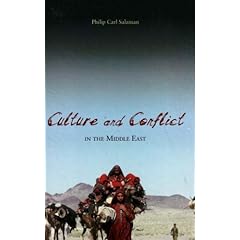
Many in our post-modern, "post-liberal" society, intimidated by the pseudointellectualism of the half-educated, stumble when they encounter the unfamiliar world of human societies very different from our own. It is here that the politically correct often find the most profitable point to ram home their confused but potent messages of cultural relativism and nihilism. The spread of higher education in the last 60 years hasn't helped: as an unexpected side effect, it's created an entire class of such people. They know less than they think, and what little they do is garbled and half-baked.

It's refreshing when an anthropologist, used to working in a specialized research in remote parts of the world, addresses the general educated reader with his decades of experience in studying pre-state and tribal societies and simultaneously illuminates an issue of pressing importance. Such are Philip Carl Salzman and his new book, Culture and Conflict in the Middle East. Salzman has taught anthropology at McGill University in Montreal for many years and was a founder of the Commission on Nomadic Peoples of the International Union of Anthropological and Ethnological Sciences. His main research has been the study of the tribal peoples of Iran and Pakistan, in the anthropological mode and thus mainly on the "structure" of their culture. (However, his book does have a fair amount of recent history and some memorable personalities as well.) Anyone familiar with so-called "primitive" peoples will recognize the general point: they're materially primitive and have no government or state; but at the same time, they have an elaborate culture of tribal custom and lore that takes an outsider many years to fully understand. That aspect of anthropology is anything but primitive.

Readers of this blog will recognize the general thrust of Salzman's argument about the nature of tribal society, especially its Middle Eastern version: the unique intertwining of Islam and tribalism, very different from the other great universalistic religions (Christianity, Buddhism, later Judaism) and even from most other, non-universalistic religions (Hinduism, earlier Judaism, classical Greco-Roman paganism); the pattern of conflict along the lines of "balanced opposition," familiar in somewhat different language as the "power challenging" of Pryce-Jones, in his classic, The Closed Circle.** In fact, the similarities to Pryce-Jones are striking, but Salzman's book is shorter, less dense, and focuses on just one large anthropological point. Like Pryce-Jones, Salzman has a precursor, the brilliant scholar and historian Ibn Khaldun, the 14th-century North African author of a universal history with a famous, lengthy philosophical-anthropological preface, the Muqaddimah. Salzman makes liberal use of Ibn Khaldun's ideas about the cycle of Islamic history, the circling from tribal invasion and conquest of decadent, sedentary cities; to the tribal conquerors themselves becoming sedentary and decadent; to their being overthrown by another tribal invasion. The prototype was the original Islamic conquest itself, in the seventh century.
Tribal societies worldwide, Muslim or not, are based on "balanced opposition," with the power to use legitimate violence spread equally among all adult males, regulated only by charisma and luck. This system is incompatible with civilized life and the state, which monopolizes legitimate violence. It is perfectly adapted to nomadic life, but fails when transplanted to sedentary ways. "Balanced opposition" creates endless, unresolvable conflict by its very nature, because it contains no larger peacemaking power: no state, no social contract, no force of public opinion outside small tribal groups. It survives only because (and if) each segment of society is balanced in size against other segments. Oppressive and exploitative states emerge when one group acquires overwhelming power against other groups - then winner takes all. That is how most states emerged historically, in fact. They didn't come into existence to serve the public good. Anthropologists are typically sympathetic to non-state tribes if and when they are crushed by these classical tyrannies - it would be hard not to be. But don't romanticize: the freedom of tribal life is collective. It's not individual freedom, which is a late product of advanced civilization, with civil government and the rule of law.

It's not as if Middle Eastern peoples themselves are blind to the nature of this system. There is a famous Arabic saying: I against my brother, my brother and myself against my cousin, my cousin and I against the world. Islam might have overcome this problem to create a state or states founded on rule of law, but it failed to do that. Instead, the tribal way re-emerged, mixed with Islam (I and my cousin against the non-believer), within Islamic civilization itself. This system, incompatible with the traditional state, is obviously even more incompatible with the modern liberal-democratic state, with its essentials of rights, citizenship, and the public good. The tribal world has exact replacements for each of these, making it self-sufficient and self-contained. The autobiography of Ayaan Hirsi Ali, reviewed here earlier this year, is one large demonstration of these truths by specific example.

It shouldn't need to be said, but I'll say it anyway: modern anthropology is not about social Darwinism or feeling superior to "savages." It's about the power of culture, because humans are cultural animals. They certainly do not function by instinct. Most humans through most of history (including the ancestors of everyone reading this blog) lived in something like this system. The same raw material of human nature is at work among civilized peoples as among as "primitive" peoples, but the collective shape of culture is different. Primitive peoples have many of the same values we do: individualism (at least among adult males), self-interest, notions of fairness and justice. But, in contrast to modern civilizations, nomadic peoples are dominated by group loyalty, with honor and shame typically the overriding motives. It's all there for a reason, because amongst us, we have a substitute that functions in their place: the rule of law, constitutionalism, and an openness to crossing group boundaries. It's just what makes peaceful cooperation and progress possible. At once a source of durability and backwardness, their lack is what makes progress in tribal society impossible.

Most of Salzman's message would have been unexceptional up until about 25 years ago. Since then, liberal academic and intellectual culture has been been subject to the obfuscatory fog of "post-colonialism" (Said). Many in the Arab-Islamic world itself are aware of these conflicting values and critical of the tribal system. The imposition of tribal ways on the Near East's civilized peoples by the Arab-Islamic conquest was the seed of their later decline and these societies' present difficulties in coping with the modern world.* But Said-ian doctrines are so many clubs with which to beat these critics. It's one of the most noxious contributions of the post-modern and post-liberal West to the rest of world and has crippled political debate and clear thinking in Western societies themselves.

POSTSCRIPT: Jared Diamond discusses conflict and revenge in tribal New Guinea here.

As he says, people living in state societies (societies with civil government) and, even more so, living as citizens in modern liberal democracies, have a hard time coping with the conflict between organized killing implicit in war, "civilized" warfare between armies or not, and peacetime life. In tribal societies, the conflict is not felt: there is no sharp boundary between peace and war, or between impersonal justice and simple vengeance. Men aren't ashamed of their killings, but boast of them. It's not exactly the way Hobbes conceived it - tribal life is far from solitary - but he came pretty close to depicting the "state of nature." What's particularly astonishing is that in many tribal societies, most adult males are involved in some way in the killing of other adult males. The obvious advantages of having governments were not strong enough, until recent human history, to overcome the ingrained taste of tribal peoples for their traditional collective freedom.

An interesting corollary of Diamond's analysis is that it explains why so many such tribal societies accepted colonial rule by outsiders so quickly: it reduced or eliminated internal conflict.

Diamond concludes with a relative's harrowing story of the Holocaust and the dilemma those of us who refrain from executing justice on our own face when the state doesn't keep up its end of the bargain.
---
* Ironically, the Arab group that Israel has the fewest conflicts with is the Beduin of the Negev and Sinai deserts. Being nomadic, with no economic need for land to grow food or political claims to sovereignty, they view modern states and borders as little more than nuisances and just slide past them.

** Judaism is a bit of an odd duck here, no doubt because its origins lie in the late Bronze Age (second millennium BCE), before the rise of universalist religious and philosophical thinking in the first millennium. This epoch, the so-called Axial Age, saw the pre-exilic and post-exilic Hebrew prophets, Zoroaster, Siddhartha Gautama (Buddha), Confucius, Lao Tzu, and the philosophical movement among the Greeks. Developments in later antiquity, such as Hellenistic science and philosophy (Stoics, Epicureans, Aristotelians, Platonists), Christianity, rabbinic Judaism, Islam, and Confucianism were secondary outgrowths of the Axial Age. Judaism straddles the earlier tribal/national and later universalist/philosophical eras, with its universal truths implicit and esoteric in biblical times, and open and explicit in later eras. No other religion has seen so much creativity generated by such a tension between the particular and universal.

Labels: , , , , , , ,

Saturday, January 05, 2008

Ayaan Hirsi Ali: Further thoughts

One of the most interesting features of Ali's thinking is her view of Islam as failed social utopia. She says: I'm from a clan in Somalia; long ago we accepted Islam and following the divine will as the path to an ideal society, and we have failed. This approach marks an arresting starting point and allows her to connect the civil war anarchy she escaped with the "theologico-political problem" of early modern Europe (à la Spinoza, Hobbes, etc.), as well as the great failed secular utopias of our own time. Of course, she is a political scientist by academic training - the University of Leiden in Holland, to be exact. Her drive to understand why the modern West has succeeded and the floundering of the tribal-theocratic world she came from is why she decided on graduate school in the first place. It was academic, but not just academic.

There is a line of thinking - exemplified by Pryce-Jones' The Closed Circle - that postulates the problem of the Islamic world, not as religion, but as a failed overcoming-of-tribalism. There is a serious case to be made for this view. The tribal world is not a "civil society" - there is no voluntary, peaceful cooperation, the kind required for progress. Instead, everything cancels everything else out - the closed circle. The relation of Islam to political power is different from Christianity or Judaism: there is neither a separate state with a monopoly on power, nor a voluntary self-organized community. Religion, politics, family or clan - all are mixed together in primitive society. This gives exceptional urgency to the problem of succession to Muhammad (khalifa). Without a single, agreed-upon successor, there is no legitimacy. Yet such a figure is a necessity in classical Islamic political thought for truly legitimate political authority. In reality, there is a void, filled by plausible or implausible claimants.

A completely different example of the impact of tribal custom is the barbaric practice of female genital mutilation.* Mentioned nowhere in the Qu'ran, female genital mutilation, where it is practiced (in some Muslim countries - not all - as well as some non-Muslim ones), is intended as a kind of female-chastity protector and female-sexual-pleasure-destroyer. It's rationalized as a way to keep girls and young women "pure." This sort of tribal-custom-rationalized-by-Islam is at work in the purist Wahhabi or Salafi Islam of Saudi Arabia and the tribal code (Pashtunwali) of the Pashtuns of Pakistan and Afghanistan.** One of the basic dilemmas posed by Muslim immigration to Europe is the assertion of tribal custom in Europe's cities, in a way not compatible with the rule of law or state sovereignty. In some ways, "Talibanism" is an assertion of extreme tribal reaction against urban, middle-class life. This cycle has a long history in Islam, discussed in the classical sources such as ibn Khaldun's Muqadimah. Such ways of thinking have almost been lost to us here in the West, and so we often have a hard time recognizing them for what they really are when we encounter them elsewhere.

These are among the many not-just-academic questions that arise from Ali's Infidel and The Caged Virgin, as well as the other recent additions to the bookshelf on Islam by Muslim women. Ali's autobiography blends the personal and political in a powerful way that illuminates both, leaving the chatterboxes of post-modern academia far behind in the dust.
---
* Sometimes mislabeled "female circumcision." The actual male equivalent, were it practiced, would be something like cutting off a quarter or more of the male sexual organ - depending on size, of course :)

** The link between the two is the 19th-century Deobandi school of Islam on the Indian subcontinent. Both the Salafi and the Deobandi schools were early reactions to the incipient clash of Islam and modernity, one in the context of the Ottoman empire, the other in the context of a polyreligious India under the British Raj.

Labels: , , , , , , , , ,

Monday, August 28, 2006

Further notes on Middle East madness

In my post on Middle East deep background, I mentioned Pryce-Jones' The Closed Circle as a critical and unique book in explaining to outsiders how the Middle East works. If you've read it, nothing in the Middle East will surprise you -- the incomprehensible becomes frighteningly understandable. Nasrallah and Hizbollah are the latest example of power-challenging, honor-shame, violent careerism based on sponsored proxyship, and the "closed circle" of destructive and self-destructive playacting.

I might have made it sound as if Middle Easterners themselves don't understand this retarded folly. Fortunately, there are some; unfortunately, they're rarely in the driver's seat. Check out IraqPundit's denunciation of Nasrallah here.

Although there are reprehensible individuals and organizations of this type all over the Middle East, I'm far from blaming individual Arabs on the street for this nightmare. It's the result of centuries of decay, once held in check by Ottoman rule and the Arabs' backwardness, now puffed up by oil revenue and modern technology. If there is a way, current elites or new ones will lead the Arabs out of it. It won't happen as the result of democracy, which seems everywhere in the Islamic world to be leading towards "shari'a by the will of the people."

LATER: In case you think the Arab-Israel national conflict hasn't been fully converted by the jihadis into a Muslim-Jewish religious conflict, see here and here.

It will take, oh, say a few years, for the Western "news" media to catch on to this. Its main role in our society is rehashing ideology, the manufacture and baby-sitting of conventional wisdom, clichés, and half-truths.

EVEN LATER: Wrote too soon, sort of. The IHT has a disturbing story on the decline of secularism in Malaysia, which is barely-majority Muslim, as picked up by DhimmiWatch.

Labels: , , , , , , ,

Tuesday, August 08, 2006

Middle East: Deep background

Friends want to know from where I know what I know about the Middle East (ME). My first advice: stop watching television news and treat newspapers with a large grain of salt. The latest faux-tography scandals just reinforce this point.

The Middle East's most basic problems are (1) its tribal/sectarian social structure; and (2) the curse of oil money.

1. The first means that ME countries are not societies in the Western sense, but tribal collectives lacking a "social contract" and making civilization and progress impossible. The only apparent alternative to endless Hobbesian war-of-all-against-all is dictatorship or theocracy.

2. The flow of oil out means a flow of oil money in. That money goes into the hands of elites (governmental and otherwise). It gets squandered on war and terrorism, or socked away in Swiss bank accounts. Governments also use it to buy off their populations, inverting the normal relationship between productive citizens and the tax-dependent state. Without the normal flow of money from society to state, society has no say in how the state operates. Here is one of the main reasons why the Middle East is not democratic.

American policy must be rebuilt from scratch to counter these two problems:

1. Political reform (NOT forced regime change) in promising Arab countries (like Jordan, Morocco, Gulf States) while reducing American relations with Saudi Arabia and Egypt; and

2. An international effort by oil-consuming countries to reduce demand for oil. This is not mainly an American problem (most of that oil goes to Europe and Asia), but American leadership here is nonetheless essential. The international oil market is fully flexible, and oil is a fully fungible commodity, meaning that its pointless to try to achieve "energy independence" -- the oil market in one place is completely coupled to everywhere else.

On the subject of oil money and what it does, look at Roger Stern's concise, arresting analysis of oil market power (a politically managed monopoly with artificially elevated prices) and the ME mischief it makes possible (PDF download). Here's a non-technical summary.

Take a look at JihadWatch and its DhimmiWatch page. You will learn things that the establishment media would rather not discuss about Islam and its attitude towards nonbelievers and their status under traditional Islamic law. If you want to know what a dhimmi is, think of Uncle Tom living under Islamic law, then go read DhimmiWatch. In this vein, consider these books: Andrew Bostom, The Legacy of Jihad (2005) and Ibn Warraq (pseudonym), Why I Am Not a Muslim (2003). In a related vein, check out The David Project, led by the brilliant Charles Jacobs.

The best blog on the Middle East is that of Michael Totten. It is essential reading if you want to keep up and get a flavor of what it's really like. Totten has spent the most time in Lebanon, but also a lot of time in Israel, Kurdistan, and other places. And he has a long list of links to other great blogs and resources, as well as to wonderful essays by himself and others.

Here's my own, far from exhaustive, list of essential books, with comments.

Bernard Lewis: Any book you can get, especially The Muslim Discovery of Europe (1982), The Jews of Islam (1984), Semites and Anti-Semites (1986), Islam and the West (1993), and What Went Wrong? (2001). The last of the polymathic giants, an unrivaled knowledge of languages and literature, one of the last century's greatest historians and Orientalists. Increasingly under attack by PC-ignorant "Middle East studies" hacks not worthy to lick his shoes. Has important blind spots -- too close to the subject in some ways, often blinds him to what Pryce-Jones writes about (see below).

Speaking of PC-ignorant academic hacks, contemplate the corruption of American academia by political correctness and Saudi oil money by following Martin Kramer's devastating study of "Middle East studies," Ivory Towers on Sand (2001).

David Fromkin: International relations faculty at Boston University, author of A Peace to End All Peace (1989), the best single book on the origins of the modern Middle East. Narrows temporal focus to 1910-1924, broadens geographic focus to all of "greater" Middle East, including central Asia (Persia, Afghanistan, Soviet "stans").

Critical insights: the collapse of the Ottoman Empire in 1918 and its caliphate in 1921 started the transition of the ME from an imperial-theocratic to a Western-style secular nation-state system, which transition is resisted by Islamic traditionalists and reactionaries. More than ever, now that the Cold War is over, this is THE major conflict at issue in the ME.

David Pryce-Jones: Journalist and novelist, 60-plus-year veteran of the ME, author of The Closed Circle (1989), the best single book on the culture of the Middle East. Dark, dense, long, with depressingly pessimistic conclusions, worth the long slog to get through it.

Critical points: defines like no other book the keys to the ME's tribal culture: the honor-shame system, power challenging and violent careerism built on sponsored proxyship (think Arafat, Zarqawi, Nasrallah etc.), lack of social contract, resulting in no progress possible -- hence, the "closed circle" or "zero-sum" game. How these tribal patterns interact in a toxic way with Islamic restrictions on women and religious and ethnic minorities. The noxious role played by petrowealth in creating pseudo-modern countries with the material trinkets of modernity (bought from actually modern countries), but lacking real political, social, and economic modernity.

Fouad Ajami: Now teaching at Johns Hopkins, author of two essential books on the post-1967 Middle East, The Arab Predicament (1981 and 1992) and The Dream Palace of the Arabs (1998). The best criticism of the ME is by semi-insider/semi-outsiders -- in Ajami's case, a half-Persian, half-Arab Shiite from Lebanon now living in America.

Conor Cruise O'Brien: Famous Irish diplomat, once Ireland's ambassador to the UN, got to know Israel's ambassador because "Ireland" is next to "Israel" in the alphabet, author of The Siege: The Saga of Israel and Zionism (1986). Somewhat dated and superseded by more recent scholarship, but still the best single-volume introduction.

Fareed Zakaria: I should also mention a book that I'll return to later, his The Future of Freedom (2003), one of the most important foreign policy books published since the end of the Cold War.

This generations' sharpest critics of Islam, not surprisingly, are women. Everyone suffers under the theocracy-based system of honor-shame, but women more so as a rule than men. Many of the best women authors here are Iranian. See these personal odysseys:

- Azar Nafisi's Reading Lolita in Tehran (2003), an astonishing best-seller
- Marjan Satrapi's Persepolis (2003) and Persepolis 2 (2004)
- Roya Hakakian's Journey from the Land of No (2004)

And they're not all Iranian: don't miss Irshad Manji (The Trouble with Islam, 2004) and Ayaan Hirsi Ali (The Caged Virgin, 2006, based on Submission, a 2004 film co-produced with director Theo van Gogh, who was murdered by an Islamic fanatic as a result). See Christopher Hitchens' tribute to Ali here.

Labels: , , , , , , , , ,