Monday, November 19, 2007

Life at the tip

When I visited Jerusalem this summer, like previous times in the last 20 years and like many tourists before me, I had the usual encounter (you always have at least one) with a Palestinian offering his services as a tour guide in the Old City. His name was Hamid. He showed me around the Zion Gate area, including the grave of Oskar Schindler, who is buried nondescriptly in the Old City's main Roman Catholic cemetery. Hamid then offered to drive me to see Bethlehem, which I hadn't seen since the late 80s, when I was younger and it was safer. I declined. He said he was from Ramallah and a man without a country, which is true. The Israeli security "fence" and checkpoints have made it hard for Palestinians living in the West Bank to work in Israel, and the flow of workers from Gaza has stopped altogether. The only thing worse than being exploited by the Capitalist Man is, I guess, not being exploited by the Capitalist Man.

This got me to wondering about the whole issue and why the Palestinians, of all the large number of refugees the last century has produced, still live in political limbo. After all, next year will be 60 years since Israel's war of independence, which produced the first and larger wave of these refugees; while this year is 40 years since the Six Day War, which produced a smaller but still significant wave. The 1990s Oslo "peace process" was supposed to lead to a semi-state, run by Arafat and his Fatah organization (the core of the PLO), and then to real political independence. But the events of the last 15 years has produced nothing of the sort. Instead, whatever there were of state-like functions in the West Bank and Gaza were weak and rotten with corruption. With the triumph of Hamas in Gaza and its impending victory in the West Bank, even the pretense of a state has disappeared. These places are now satellites of Iran, if they have any political orientation at all. Recent proposals by its mayor to redivide Jerusalem provoked bitter complaints from the Arabs of East Jerusalem, who simply don't want to live in a Hamas- or Fatah-ruled statelet. They saw the future, and it didn't work.

Palestinianism: What it is, and isn't. The Arabs of Palestine are not a people by the usual criteria (language, religion, geography) and "Palestinianism" is not a form of nationalism. Palestinian terror against Israelis and Jews is not resistance in the service of nationalism - it's pseudo-nationalism in the service of terror. The Palestinian Arabs have been used as a proxy army, in classic Middle Eastern fashion, for much of the last century. The goal of this proxy army has always been destroying Israel, not making a state for the Palestinians to rule themselves. Individual Palestinians occasionally wake up and understand this, especially if they're Christian or better educated.*

Almost everything about this conflict and Palestinian political behavior, otherwise a mystery, becomes understandable once you see this. Palestinians are in the conflict, but it's not about them. The rise of non-Palestinian proxies for use against Israel - the Lebanese Hizbollah especially - demonstrates this fact in a different way. The Palestinians "never pass up an opportunity to pass up an opportunity" because opportunities of that type are not what they're looking for. Neither are they looking for a constructive politics of the nation-building type. Arafat was not a Washington, a Garibaldi, a De Valera, or a Ben Gurion - that is, "father of his country." It would be best to think of him as a glorified bandit who managed to extort many billions of dollars for himself and his organization (the PLO, or Fatah) from Arab governments and later Israeli and Western governments. Of course, the PLO's replacements, Hamas and Islamic Jihad, are openly theocratic and oriented to pan-Islam. The PLO was indifferent to nationalism; the theocrats are actively hostile.

The scandal of the refugee camps. On top of this is the six-decade disgrace of the Palestinian refugee camps, which continue to exist only because Arab governments and the UN want them to. Even in cases where Palestinian Arab refugees could or could have returned to the villages they fled from during 1948-49 and 1967 Arab-Israeli fighting, Arab governments won't let them. They're not supposed to; that would spoil their role. Instead, in the 1950s, the Arab League extorted from the UN a special refugee agency (UNRWA) just for the Palestinian Arabs, separate from the regular UN refugee organization (UNHCR). No Arab government (with one exception) allows Palestinians to become citizens. These governments typically allow only Muslims as citizens in any case. (The Gulf kingdoms further restrict citizenship to members of the majority tribe.)

The anomaly of Jordan. The one exception to the inability of Palestinians to become citizens in Arab countries is Jordan, Israel's next-door neighbor, ruler of the West Bank from 1949 until 1967 and still claiming it until 1988. When the Arab governments rejected the UN partition of western (cisjordanian) Palestine in 1947, they rejected a potential Arab state in western Palestine - the same entity under discussion today as a "Palestinian state." Lost in the confusion was the fact that "Palestine" is a geographic, not an ethnic or national, term and that it covered areas both east and west of the Jordan River. Carved out of eastern (transjordanian) Palestine, the kingdom of Jordan was created by Britain in 1922 as a consolation prize for the Hashemite dynasty after it was kicked out of Mecca and Medina by the ibn Sa'ud family. The ruling Hashemite family are Arabian Beduin, and the kingdom today remains about half Bedu. The other half are "Palestinian" - that is, Arabs (some Christian, most Muslim) living in towns and villages. Rather than converting the new Jordanian kingdom into "the" Palestinian Arab state (which it manifestly was already), British colonial and foreign affairs officials repeatedly and stupidly encouraged the growth of extremist, rejectionist leaders and groups in Arab Palestine - above all, Haj Amin al-Husseini, the Grand Mufti of Jerusalem, collaborator with Hitler, and reputedly Arafat's maternal uncle - and then reacted with bafflement when such groups and leaders instigated riots and pogroms against Jews, even in places like Jerusalem and Hebron, where they had been living since antiquity.** When the Arab-Jewish conflict over Palestine sharpened into its current form in the 1930s, the British Peel Commission recommended partition of western Palestine into Jewish and Arab parts, with the Arab part awarded to these rejectionist leaders - who didn't want it anyway. These "divide-and-rule" policies of encouraging the wrong people were a central part of what was wrong with colonialism.

While the Peel Commission's 1937 partition lived on in the UN's 1947 partition and the more recent "Palestinian state" idea and seems reasonable on the surface, it evades the big question of the Arab world's lack of democracy. Awarding political sovereignty means "awarding to whom?" and in the Arab world, that means authoritarian monarchy, brutish usurper dictatorship (think Saddam), or no one (think semi-anarchy, like Iraq and Gaza). In the case of western Palestine, it's always meant "radical, rejectionist groups and people" - like al-Husseini, Arafat, the PLO, and now Hamas and Iran. At the heart of their radicalism is a blend of rejection of outside rule (anticolonialism), rejection of outside influences (once anti-Western, now again anti-infidel), and oppression of national and religious minorities (such as the Egyptian Copts, the Kurds, Jews, black Sudanese Christians and Muslims, etc.). Since the latter sometimes had European powers and later the United States as protectors and champions, resentment of these minorities and of infidel outsiders became intertwined, both viewed as threats to Islamic supremacy.

Defeating the rejectionists. Progress toward conflict resolution in the Middle East has historically been possible only when rejectionist forces are weakened, discredited, knocked out, or "turned." Modern Middle East history demonstrates this principle without exception: local progress toward peace in Palestine is enabled when radical forces in the larger region are defeated: 1974-79 (Sadat) and 1988-1994 (end of the Cold War, Iraqi defeat in the Gulf War, followed by Oslo and the Israel-Jordan peace). These regional rejectionist forces are the ones who use the Palestinians (and now the Lebanese Shi'ites) as proxies, and they are the "root cause" of the conflict. The Palestinian conflict is the tail, not the dog; the ultimate effect, not the cause. The Palestinians are important in the Middle East to the extent they're useful as tools to these forces. Torrents of fallacies, big lies, and clichés to the contrary can't change this fact. The end of this month (November 29th) is the 60th anniversary of the UN resolution partitioning western Palestine into Jewish and Arab states, which the Arab states then rejected. Clearing away some of the charter myths of the modern Middle East is an important step toward regional peace.

The main rejectionist force today is Iran and its proxies Hamas and Hizbollah. Defeating Iran, isolating it, "turning" it, or some combination of the three is now the key. Anyone serious about peace in the region needs to recognize this. Thinking otherwise is to reverse cause and effect and misidentify the prime movers of the Middle East's regional conflicts. There is no ground-up politics in the Middle East; it's all "sponsored proxyship" inspired, funded, and armed by bigger players. It's essential again to get over the idea that radical groups in the Middle East represent the mythical "Arab street" or any bottom-up politics. All Middle Eastern politics is top-down; factions become powerful when they're someone's proxy, organized, funded, and armed as such.†

The next steps can include abolishing UNRWA and merging its functions back into the main UN refugee agency, together with pressuring Arab governments to drop discriminatory measures against Palestinian Arabs (although that still leaves the problem of Palestinian Christians).

This is not a question of Palestinians as individuals or families. Political identity is a collective question, with a collective answer. It's not clear what could serve as a political identity for the Palestinians, or even if one is possible. Confusion here is due to misuse of "national" language: the PLO as the "sole legitimate representative of the Palestinian people" - but is there such a people, and is the PLO "representative" in any meaningful sense? It was created as a proxy instrument by Egypt and Syria in 1964. Egypt has since abandoned the cause, and Syria has moved on to Hizbollah. Fatah is certainly incapable of functioning as a government - it was never set up or intended to be such.

The Arabs of Palestine have been used for eight decades as the tip of someone else's spear, held by successive rejectionist states and groups in the Middle East. They're organized as a proxy army and a form of "human shield" politics. These conditions are the root of the sick nihilism that has been normalized among Palestinians. No one is born that way; they have to be brainwashed into it. And they have been, as a part of being used as someone else's tools of violence.

POSTSCRIPT: In the last 30+ years, the Western media has turned away from its once forthright pro-Israel stance toward the fake "noble savage" claptrap of the New Left, with disastrous effect on journalistic standards. Occasionally, the "open secrets" of postmodern journalism in the Middle East come into sharp focus. One such recent case was the al-Dura trial in France, an example of the pervasive irrationality of contemporary journalism and the ease with which it can turn into a postmodern blood libel, a deadly mix of propaganda and ignorance. PajamasMedia covered it extensively; plus don't miss this essay by Melanie Phillips.

ANOTHER POSTSCRIPT: This posting was inspired, in part, by Haim Harari's wonderful book, a fine analysis, on this and other topics, done by someone who still believes in progress and truth - liberal in the correct, older, and almost forgotten meaning. Thinking like this is often called "conservative" nowadays, but only because the right word has been usurped by the wrong people.

Earlier I mentioned Amos Oz's novel-like autobiography of growing up in Jerusalem in the 1930s and 1940s. Many regard it as his best book. People have asked me, if Edward Said was a fraud, are there real Palestinian authors worth reading? Indeed there are, for example: Sari Nusseibeh and Anton Shammas, one Muslim, the other Christian. Agree with them or not, they are actual Palestinians.

All four books are enhanced by another, Orhan Pamuk's Istanbul, a memoir of the novelist's youth in the former capital of a once-great empire.
---
* Until recently, there was a large overlap between the two groups, and Palestinian Christians have always had strong incentives, both "push" and "pull," to just get up and leave. (OTOH, Arab Christians played a disproportionate role in secular Arab nationalism, having the most to gain from it - and having the most to lose from the Islamic revival.) As the conflict has moved back toward a Muslim-Jewish religious struggle and Arab Christians have felt increasing pressure from Muslims to subordinate themselves or convert, the "push" reasons have gotten stronger. The main "pull" is the fact that Palestinian Christians have always had an easier time integrating into Western societies.

And apologies to Antonio Prohías! :)

** Thereby demonstrating that the crux of the conflict is one of political sovereignty, not just Jewish presence. After spending the war in Berlin and trying to recruit Bosnian Muslims for the SS, al-Husseini was tried, convicted, and sentenced to death in absentia by the Nuremburg War Crimes Tribunal. After the war, he fled to Syria and later died in Lebanon. He was also a probable participant in the successful 1951 assassination plot against King Adbullah of Jordan.

Because they share common enemies, the ruling Jordanian Hashemites and the Israeli government secretly cooperated for many decades (long before the formal peace between the two countries) to defeat what I have called here "rejectionist" forces threatening both of them. The most famous instance was the Israeli offer to help the late King Hussein stop the attempted PLO coup in 1970 ("Black September"), which set off a brief civil war in Jordan and led to the PLO's forced removal to southern Lebanon.

† A different example, with more direct impact on Americans, is the multifaceted al-Qa'eda network, germinated by Saudi Arabia and Pakistan. It might seem strange that governments technically friendly to the United States and other Western countries would sponsor such dangerous organizations, but they're useful to countries - like Saudi Arabia and Pakistan - that lack political legitimacy and promote religious radicalism as a substitute for nationalism. Not that they fit traditional Islamic criteria of legitimacy either: they're not successors of Muhammad. The simplest way to satisfy that is to be one of Muhammad's descendants - which the monarchs of Jordan, Morocco, and the smaller Gulf states are, but not the rulers of Saudi Arabia or Pakistan. They're usurpers by traditional Islamic standards and, at the same time, fail to meet modern criteria for democratic legitimacy.

Labels: , , , , ,

Thursday, October 11, 2007

Hangin' in the Holy City

All truly great thoughts are conceived by walking.

- Nietzsche

And there's no city more built for walking than Jerusalem.

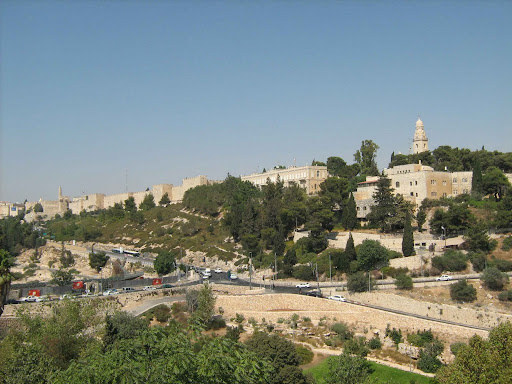
I was experiencing less tension than I expected. Walking around Jerusalem proved easier than I had thought. The scene of the worst suicide-bombing campaign ever a few years ago (imagine a 9/11 attack every month) was remarkably calm. The tourists haven't returned to Jerusalem in quite the numbers you see elsewhere in Israel. And there's more self-segregation by neighborhood now than 20 years ago - religious Jews of different tendencies keep to their own neighborhoods, more liberal or secular Jews in theirs - all Jews on the western or "new" city side (or in the western suburbs) - and all Arabs on the eastern side ("east" Jerusalem), as well as the Old City in the middle. Jerusalem is an avocado with a Jewish half to the west, northwest, and north; an Arab half to the east, northeast, and southeast; with the Old City as the "pit" at the center. The Old City was the only part that survived for many centuries, until just before World War One. Its present walls were built in the sixteenth century by an Ottoman emperor.

It's also one of the most hauntingly beautiful places you'll ever see. It's a fragile sort of beauty, and elusive. Much of it has to do with the quality of its light. Americans living in northern California or northern New England (in the summer and fall) are a little familiar with this light. But in those places, it's connected with being on the water. Except for the Dead Sea off in the distance, there's no body of water here.*

I walked all over, mostly the Jewish western part, with part of one day in the narrow streets and alleys of the Old City. It was all familiar, since I lived for one summer in Jerusalem and visited twice again later. At the same time, much has changed. The arrival of the Russian Jews in the 1990s meant that English was no longer the unchallenged second language it had once been. You also don't have to listen for long to hear another second language, French, the product of a more recent wave of French Jews - some neighborhoods of Jewish west Jerusalem are now heavily French. The amount of construction was startling - new buildings, new and improved roads, new hotels, etc. The western suburbs have expanded, and the more modern parts of Jerusalem even have traffic jams now.

I didn't walk as much in east Jerusalem, but I did pass through it on my way out and around the Old City. It too has grown and modernized - new shops, new hotels, modern taxis and buses - very different from 20 years ago when I first visited. It makes you wonder about the radically misleading stuff you get on television. Free of context or accurate explanation, such experiences bring home how much television news is junk food. In the case of the 2001-2004 terror war (second intifada), you never see the ordinariness of life at all.

But there are reminders of the terror war here. Security is far more in-your-face than in Tel Aviv or Eilat. Restaurants, banks, and stores all have guards. The public buses spot check people as they board. The impressive new bus station also has very obvious security, although nothing onerous. Near the Old City, if you look out northeast or southeast, you can see the security "fence" or "wall" that divides Israel proper (more or less) from the Palestinian areas of the West Bank. The combination of this fence and the active security measures have prevented anyone from pulling off a suicide bombing here since 2004.

The combination of self-segregation, security, and residual fear has put a damper on the economy in and around Jerusalem. While the western edges and suburbs of the city are thriving, the Old City even now lacks the level of tourism it had before 2001. The security restrictions also dampen the Palestinian Arab economy in east Jerusalem and the West Bank. When I walked into the Old City, past the narrow market (shuq or suq), shopkeepers descended all with they claimed were great deals. The Armenian quarter (the smallest of the four) was quieter, with fewer shops and, I suspect, less economic desperation. The Armenian community here is small but old and has strong connections with both Armenia and the Armenian diaspora. Fundraising among Armenian-Americans had made possible a beautiful renovation of the Quarter's Gulbenkian library.

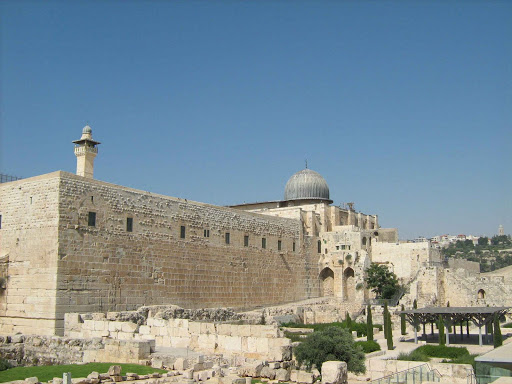
Around the "corner," past the Zion Gate along the southern wall, and you reach the Jewish Quarter. After the Jordanians captured the Old City in 1949, this quarter was demolished, only to be rebuilt after Jerusalem was reunified in 1967. It didn't look that different from the 1980s - until I reached the Temple Mount plaza. The plaza in front of the Western or "Wailing" Wall, the prime focus of Jewish worship as the last remains of the Second Temple, had been rebuilt, as well as guarded by an elaborate security gate. Up on the ramparts of the Temple Mount compound itself was the controversial new construction by the Muslim Waqf (religious endowment) that controls the compound itself and its buildings. This area (the Haram es-Sharif, or Noble Sanctuary) is the site of the Dome of the Rock, once a mosque, now a museum (that's the gold-domed building) and the Al-Aqsa Mosque, the silver-domed building on the southern end of the compound overlooking the new archeological park.

The Jewish western city is much more modern and secular. Although few countries recognize Jerusalem as Israel's capital, virtually all governmental functions have moved here from Tel Aviv in the last 40 years. It boasts the Israel Museum and countless other world-class institutions, including the two-campus Hebrew University. It even boasts real nightlife now - real nightclubs, as well as the famous Ben Yehuda pedestrian mall that comes alive after the sabbath ends Saturday evening.** Nonetheless, Jerusalem is a definitely more conservative, family-oriented place than Tel Aviv, which by default, is Israel's capital of commerce and secular culture. (Unlike Tel Aviv, Jerusalem has no nude beaches :) Given that Jerusalem's secular population is declining as a fraction of the whole and the city's evident self-segregation - religious versus secular, Jewish versus Arabic, "official" Jerusalem versus "ordinary" Jerusalem - it's a wonder that the city has flourished. But it has.

POSTSCRIPT: A Sunday afternoon trip (a work day for Israelis) took me to Abu Ghosh, a charming Arab town a little west of Jerusalem. Israelis are no longer comfortable walking around the Old City, so they flock to Abu Ghosh instead. Today it's all Muslim, but there remain two beautiful churches, both once Greek (Byzantine) sites, now controlled by the French Catholic order of the Lazarist Brothers. Although it was officially closed, the abbot of the lower one (Church of the Resurrection) let me in to walk around, both inside and out. He spoke no English, so we conversed in limited doses of French and Hebrew. Here is the sanctuary, an interesting mix of Byzantine architecture and Roman Catholic (western) art and furnishings. The acoustics are fantastic, and the sanctuary is home to frequent concerts.
---
* The Dead Sea is an odd duck even among salt water lakes. Part of the Great Rift that runs up from east Africa, it's the lowest land point on the Earth's surface. The sea is so laden with salts that you can easily float on its surface; its name in Hebrew is Salt Sea. It's fed by the Jordan River, but there so much water being diverted now from this system, that the Jordan in places is more brook than river, and the Dead Sea has now shrunk to three separate puddles. See here.

** The most fun new nightclub in Jerusalem is The Lab, on the grounds of the old railroad station. It's complete with mosh pit and greeters at the door, in white lab coats, who hand out drinks served in beakers and testtubes. There are sex, drugs, and rock-n-roll in the Holy City; they're just more discreet. And getting wasted in Jerusalem is - well - different from getting wasted anywhere else.

Labels: , , ,

Friday, July 27, 2007

Never passing up an opportunity

Ever notice how the Palestinians are the "caboose" of the Arab world? Meaning, they always adopt something that's old hat elsewhere and about to go out of style. For example, the PLO adopted radical nationalism in its 1964 charter, just when radical Arab nationalism was about to be discredited by the 1967 war. In the 1970s, it adopted radical Marxism, when that was about to be replaced by radical Islam. In the 1980s, the PLO clung to this orientation long after it was discredited. Then it reverted briefly to radical nationalism, supporting Saddam's invasion of Kuwait in 1990. Only slowly did radical Islamic ideas and movements penetrate among the Palestinians, really only since the late 90s. By that point, they were old hat in the Shi'ite world of their Iranian sponsors, and they're presently becoming old hat among Sunnis as well. Indeed, now that Iraqis are the victims of suicide bombings and other radical-Islamic barbarities, splattered all over al Jazeera and al Arabiya, radicalism of that sort seems to be acquiring a bad rap in the Middle East. Not a moment too soon.

People speculate on why this should be so, but I think it's obvious: the Palestinians have no real developed politics of their own, only what various sponsors feed them for their own purposes. Far from being the "root cause" of the Middle East's problems generally, they are in fact the "outermost branch effect," a function of everything else - very much the tail, not the dog.

The Palestinian problem persists in part because the rest of the world, the West especially, has accepted without much question a set of wrong or misleading assumptions about the conflict's origin and nature. These assumptions were first promulgated by radical Arab leaders in the 1930s; became accepted in the West at first only in reactionary, anti-semitic, and oil-connected circles, in the 1940s and 50s; then adopted by the New Left in the 1970s as part of its ideology of "noble savagery"; and today are repeated by implication, with little awareness, in the media. The purest form of this poison can be found in the academic "Middle Eastern studies" cult. The media-diplomatic version is a watered-down version of same.

The Arab-Jewish conflict over Palestine (which is what it really is) is not "the" Middle Eastern conflict or problem - it's one of many, and not even the most important. It has produced four major wars, plus a number of less intense, but more dragged out, episodes. The first and third of those wars (in 1948-49 and 1967) produced somewhat less than a million refugees on both sides, all told. A number of conflicts in the modern Middle East have generated each significantly more refugees. The largest was the Soviet war in Afghanistan in the 1980s, which produced between one and two million deaths and about five million refugees. The Armenian genocide of 1915-17 produced a couple million refugees and over a million deaths. The Iran-Iraq war of the 1980s produced over a million deaths and a couple million refugees. The present civil war in Iraq has produced about a million outgoing refugees (so far), although that should be balanced against returnees.

Nor can it be claimed that the wars are somehow a product of the refugees - the truth is the opposite, of course: it's the wars that produced the refugees - wars started by Arab governments. The Palestinians are the deliberately orphaned tools of these wars - orphaned by those same Arab governments who bear the main responsibility for creating and perpetuating the problem. But spare a little pity for the tools - Newton's third law does apply here. Being used that way - as a tool to beat someone else, or "waving the bloody shirt" - has to hurt. That's where the radical ideologies come in - they're "opiates of the masses," in effect - both painkillers and hallucinogens.

Only the Jordanian government has taken up a smidgen of this responsibility, in that it's the only Arab government that allows Palestinians to become citizens. Palestinians are often looked upon with suspicion by Arab governments and sometimes kicked out when they wear out their welcome. (See Lebanon in the 1970s or Kuwait in 1991.) These governments obtained over 50 years ago a special UN agency (UNRWA) to administer Palestinian Arab refugees, separate from every other refugee problem, which is handled by different agency.

A British diplomat said in the late 40s, right after Israel's independence, that future Western attitudes towards it would be shaped by two factors, oil and anti-semitism. This situation hasn't changed much, at least as far as elites go. The oil factor plays a large role in the anti-Israel attitudes of elites both here and in Europe and, in fact, forms a central force in what might be called the "anti-Israel" lobby. It has limited presence in the more democratic and open parts of our political culture, but it lurks in the background in the more secretive and less public parts - anything connected with oil and oil regimes, and anything funded by oil money - Saudi-financed mosques and imams, "Middle East studies," and key parts of the "realist" foreign policy establishment.

But anti-semitism plays a large role as well. In Europe, it's often just - well - anti-semitism. But both there and here, there is another side: not anti-semitism, but a false perspective of "noble savagery" and victimhood that's imposed on the problem by liberals and the left. This isn't anti-semitism - but it is a consequence of it. These same liberals and leftists are quick to oppose religious intolerance and supremacism in the West on the part of Christians, something the Christian world has taken centuries to outgrow. When faced with something similar in the Muslim world, with similar origins, these same liberals and leftists often become confused, shuffle their feet, and change the subject - when they don't swallow the hatred whole, transform it into self-hatred, and demand that Jews share this self-hatred as a cheap higher virtue.

Labels: , , , ,

Wednesday, June 06, 2007

Forty years on

Here's a measure of how much American journalism has changed in 40 years: read Time magazine's account of the Six-Day War, whose 40th anniversary is this week, published shortly after the war.

As Charles Johnson puts it,
Reading TIME magazine’s account of the Six Day War, written in June 1967 shortly after it finished, is an amazing experience. The absence of cynicism and bias in this piece is a very marked contrast to the TIME magazine of today, and is a stark illustration of how deeply this magazine has gone wrong .... And notice: not once are the Arabs who lived in the area referred to as “Palestinians.”
Or you might say: how deeply an entire generation and whole intellectual establishment have gone wrong. One more measure of their bankruptcy.

Labels: , , ,

Tuesday, June 05, 2007

And an example ...

One example of thousands - and a frightening one - of clueless and braindead administrators in charge of American universities is the case of Walid Shoebat and the University of California at Irvine. This school is now the first ever to be investigated by the US Civil Rights Commission for anti-semitism. You can watch an interview with Shoebat at Pajamas Media.

This case is also an example of something else clueless and braindead: many of the major American Jewish organizations have been completely asleep about the real threats to Jews here and elsewhere in the post-Cold War era and instead are obsessed with the declining, fringe threats of distant other times and places.* Some, to their credit - like the American Jewish Committee - are now partly awake. But not one is fully awake. The leadership in some cases - and the followers as well - live in a bizarre time warp - a self-imposed politico-cultural ghetto, really.

If the issues of political legitimacy and political Islam can be successfully resolved in a more liberal and pluralistic direction - a prerequisite for democracy and not a result of it - then secondary issues - refugees, borders, Jerusalem, and so on - become solvable in principle. That's the optimistic way of looking at it. You know the pessimistic way already.
---
* I mean the once-real, although never major, threat of Nazi-like movements in the US. These are still a significant problem in Europe. I also mean the pseudo-threat of the Christian right.

Labels: , , , ,

Tuesday, March 20, 2007

The coming war with Iran

It's usually bad a idea to stick one's neck out like this, but the coming crisis with Iran requires it. There will be war involving Iran by the end of 2008. The next president's first crisis will be this, not Iraq. See here for the skinny (requires subscription). An immediate consequence will be the end of the nuclear non-proliferation regime in place since the late 1960s, with Saudi Arabia, Egypt, Turkey, and others crowding in to get their nuclear weapons too. This is a certainty if the US can no longer demonstrate an ability to shield its "allies" (read: dependencies).

The latest idiocy on this issue emanates from the usual places and postulates a détente with Iran. Apparently, the chattering classes don't yet realize that détente with Iran has already come and gone - the faux-reformers of a few years ago are without influence in the era of Ahmadinejad. The original détente, with the Soviets in the 1970s, made a limited sense then; although in the long run, it was no more than an interlude. With the present Iran, it's loopy. The real problem is that by getting ourselves into Iraq with little preparation for the cost and consequences, we're now hobbled in dealing with a much more serious threat from Iran. The Iranian problem would have happened anyway, but the Iraq war has accelerated it. Bush has not used the Iraq war in any advantageous way against Iran. He clearly needs to be replaced by someone - of either party - who knows what he's doing.

What were the neocons thinking in the 90s? Some of them did correctly emphasize Iran, but that's not what got transmitted into policy. What got into policy instead was an undeserved obsession with a country - Iraq - effectively neutralized in 1991 and a lot of dubious, fuzzy ideas about how the Middle East was "ripe" for constructive, Western-style political change. Nothing could show more clearly how little connection neocon theorizing has with Israeli views than this. The Israeli political, military, and intelligence establishment shows rare unanimity when it comes to Iran: since the early 90s, they have viewed Iran's quest for nuclear weapons as their biggest threat. OTOH, they regarded Iraq as defanged, a spent force. And Israelis would have laughed themselves to death at the neocon fantasy of "democratic transformation" of the Arab world.

OTOH, the fantasy of "realism," as it's played itself out in the last year, largely consists of conventional wisdom recycled from 10, 20, or 30 years ago. They include myopic denunciations of American policy as being "too tough" on Iran - when in fact, it's more likely too little, too late. Here's a really real principle of realpolitik the chatterboxes in the news media might consider - if they're not distracted by Britney Spears' latest underwear malfunction: peacemaking negotiations are possible when there isn't a powerful player able to block peace. E.g., Sadat kicked the Soviets out of Egypt in 1974, moved towards the US, and was able to make peace with Israel. The end of the Soviet Union and the defeat of Iraq in 1991 made the Oslo process and the Israel-Jordan peace deal possible. When a hardline rejectionist state like Iran is on the ascent (helped by a large, sustained jump in crude oil prices), peacemaking becomes much harder. When Iran gets nuclear weapons, peacemaking will become history.

Iran's insistence on butting into the Israeli-Palestinian conflict and using it as an inflammatory rallying cry for Islamic radicalism means that a new "warrant for genocide" is being assembled before our eyes - that was the real meaning of the Holocaust-denial conference in Tehran. While the academic liberals and leftists bellow on and on about "never again" - meaning, never again the Nazi Holocaust in 1940s Europe - the next one is being prepared. The left in particular has played a disgraceful role in paving the way for the next crisis - as apologists, rationalizers, and liars - just as the isolationists and Nazi fellow-travellers did in the 1930s. Along with Jim Baker and Lee Hamilton, they will be remembered - if they are remembered - as the Chamberlins and Halifaxes of this generation. The media will be remembered - if they're remembered either - as having helped the crisis happen - just as the media of the 1930s did.

And it's not just Iran that keeps dragging Israel into the region's problems - for some never-clear reason, so do a lot of other people. What the Shi'ite revival, the Iranian missile threat to the region or to Europe, or the near-destruction of Lebanon by Hizbollah, Syria, and Iran have to do with the Israel-Palestinian conflict is a mystery. Really, they have little to do with each other, except perhaps indirectly. In any case, how Israel is supposed to negotiate seriously with a Palestianian quasi-state now at war with itself is a further mystery. The fatal obstacles to the formation of a Palestinian state come from Arab governments and the Palestinians, not from Israel.

The Bush administration's expensive fiasco in Iraq also has nothing to do with Israel, except in the fervid imaginations of certain people. The driving impulse, as far as we know from the people who did it, came from the desire to finish the Persian Gulf war in a different and more decisive way. It would have been a good idea then, and you can thank Baker & company for that not happening. But, after the 9/11 attacks, this predominantly neoconservative view failed to see that the rising threat in the Middle East comes from radical Islam. After the Persian Gulf war and the end of the Cold War, secular nationalist tyrants like Saddam have become yesteryear's failed idols. Such men - starting with Nasser and proceeding to the late Assad père and Qaddafi - have clearly had their day. The new, rising, cutting-edge radicals who replaced them are the bin Ladens, the Ahmadinejads, the Nasrallahs, and so on, with a new ideology and a new base.

There is a grand irony in the fantasies of Israeli control of American foreign policy, and it is this: if the United States had been channeling Israeli thinking under either Clinton or Bush, it would have been paying attention to Iran, its radicalism, its terrorism, and its quest for nuclear weapons much sooner. Israeli judgment, even in regards their own self-interest, is not flawless: witness the Oslo process. But the Israelis grasped soon after 1991 that the future major threat to them would come from Tehran, a point that has taken 15 years to sink in over here. They rightly discounted the post-1991 threat from a contained and nearly-vanquished Iraq. We would be in a very different place today had this history played differently: we could be consistently rallying Americans and other countries against radical Islam, undiverted and unburdened by having to straighten out the remains of Saddam's mini-gulag. Of course, we'd still have the Sunni branch of radicalism (al Qaeda) to deal with - a largely Saudi-Egyptian-Pakistani creature. Not accidentally, all three countries are major US allies - we're their protector and sugar daddy and hence a target of those governments' radical malcontents. Some people say the Iraq war has diverted American attention from al Qaeda, and that may be. Nonetheless, the real negative legacy that Bush leaves will probably be, not Iraq, but the failure to do something about Iran.

And naturally, if the Bush and two preceding adminstrations had been on this wavelength, the 2003 Iraq war would not have happened.

Labels: , , , , ,

Tuesday, January 16, 2007

Another thought on Jimmy

In the mail today, I received another solicitation from the Carter Center - guess they're in big trouble now with their donor base.

Looking over Carter's book, I still can't decide if he's an anti-semite or not. But the charges against the book are true: there's serious misrepresentation of his own 1979 Camp David negotiations; a fantasy of "what must have happened" at Clinton's negotiations in 2000 - in conflict with the exhaustive account of Dennis Ross, who actually was there; obvious plagiarism and distortion of Ross' tables and maps (just lay the books side by side, and you'll see); and willful amnesia when it comes to Arab terrorism and rejectionism.

There's something else about the book, too, that struck me: it's profoundly cynical - and by implication, so is Carter, in spite of his carefully groomed image as holier-than-thou. On the surface, there is moral outrage at the supposed "apartheid" of Israel and constantly repeated attempts at lining up the reader's sense of underdog-David-ness with the Palestinians and top dog-Goliath-ness with Israel. Towards the end of the book, however, Carter acknowledges the obvious truth that there is no apartheid, only conflict over religion, nationality, and sovereignty - not so different from other such conflicts: Kashmir, Lebanon, Iraq, Ireland, etc.

The David-and-Goliath comparison is far from obvious and actually cuts both ways. Until recently, it was Islam (in the form of the Ottoman empire) that was top dog in the Middle East, and in most respects, Islam still is. Oriental Jews were, until almost yesterday, among Islam's oppressed minorities. The sudden rise in their status in the last 50 years has far more to do with this conflict than any imaginary "apartheid." The sudden rise in status of Iraq's Shi'ites and Kurds has a lot to do with what's going on there. The top dogs of the Middle East (Muslims, Arabs, Sunnis, males) have had a lot of adjusting to do - sort of like white Southerners in the civil rights era. Such changes are not simple winner-take-all propositions either. Few would argue today that the South isn't better off after the civil rights revolution - better for everyone, including whites.

Why does Carter engage in such offensive bait-and-switch tactics? One answer is that he very publicly oozes his Christianity and wants to stick it to Jews. But there's another explanation. He's also, like other ex-presidents, a frequent visitor in the Persian Gulf states, where he gets hefty speaker fees. It can't be a simple quid-pro-quo; Clinton and Bush Sr. also speak in the same countries and don't pander to Muslim prejudice like this. But in Carter's case, I believe there is a half-hidden fear of the once-powerful Islamic world and an awed feeling in the presence of its fabulous petro-wealth.

The feeling that Christians have to put on kid gloves when dealing with Muslims was also at work in the attitude of the last Pope, who was otherwise very willing to take on oppression. Partly it was a post-Crusades hangover, an historical fear that a tougher stand towards the Islamic world might endanger declining Christian minorities there. You might call it a kind of civilizational appeasement. The current Pope is clearly not in the same camp, which is a good thing. We need less appeasement and more clarity. Making unilateral concessions just leaves the Islamic world hungry for more, because it reinforces a bogus sense of victimhood as the master explanation for why the House of Islam is in such trouble.

This is Carter's real failure: he's muddled about who the historical oppressors are and can't disentangle himself from white/Christian guilt. He expects Jews to share in this self-hatred; when they don't, he's puzzled, then mad.
---
POSTSCRIPT: Speaking of civil right eras, a belated happy MLK birthday holiday to all!

Labels: , , , , , ,

Friday, December 29, 2006

Jimmy you will have with you always

Rabbi Shmuel Boteach has written an interesting essay on why Jimmy Carter isn't an anti-semite, but a disturbing something else, a clueless moralist:

Jimmy Carter is not so much anti-Semite as anti-intellectual, not so much a Jew-hater as a boor. The real explanation behind his limitless hostility to Israel is a total lack of any moral understanding .... Carter wants to do what's just. His heart's in the right place. He just can't figure out what the right is. He is, and always has been, a man of good intentions bereft of good judgment. He invariably finds himself defending tyrants and dictators at the expense of their oppressed peoples. Not because he is a bad man, but because he is a confused man.

Carter's confusion is rooted in the unreliable "underdog" theory of morality, mixed with a heavy dose of white guilt. Carter's book title is not only an insult to Israel, but, as Boteach points out, an insult to black South Africans as well. The Palestinians cannot be placed in such company - they don't deserve to be.

(BTW, what Boteach says about the 70s really is true: it sucked big time. The leisure suits were made with polyester. What a horror :)
---
POSTSCRIPT: Here's further comment on Jimmy Carter's book, from another disillusioned Emory University professor.

One sub-lie, constantly repeated by Carter, of the Big Lie of the Middle East, is that the decline of Christians in Israel/West Bank is due to ... Israel! In reality, Christians have been in decline over the whole region for most of the last century, for obvious reasons having nothing to do with Israel: see this from the Boston Globe - not the most Israel-friendly newspaper in America either.

Labels: , , , , ,